
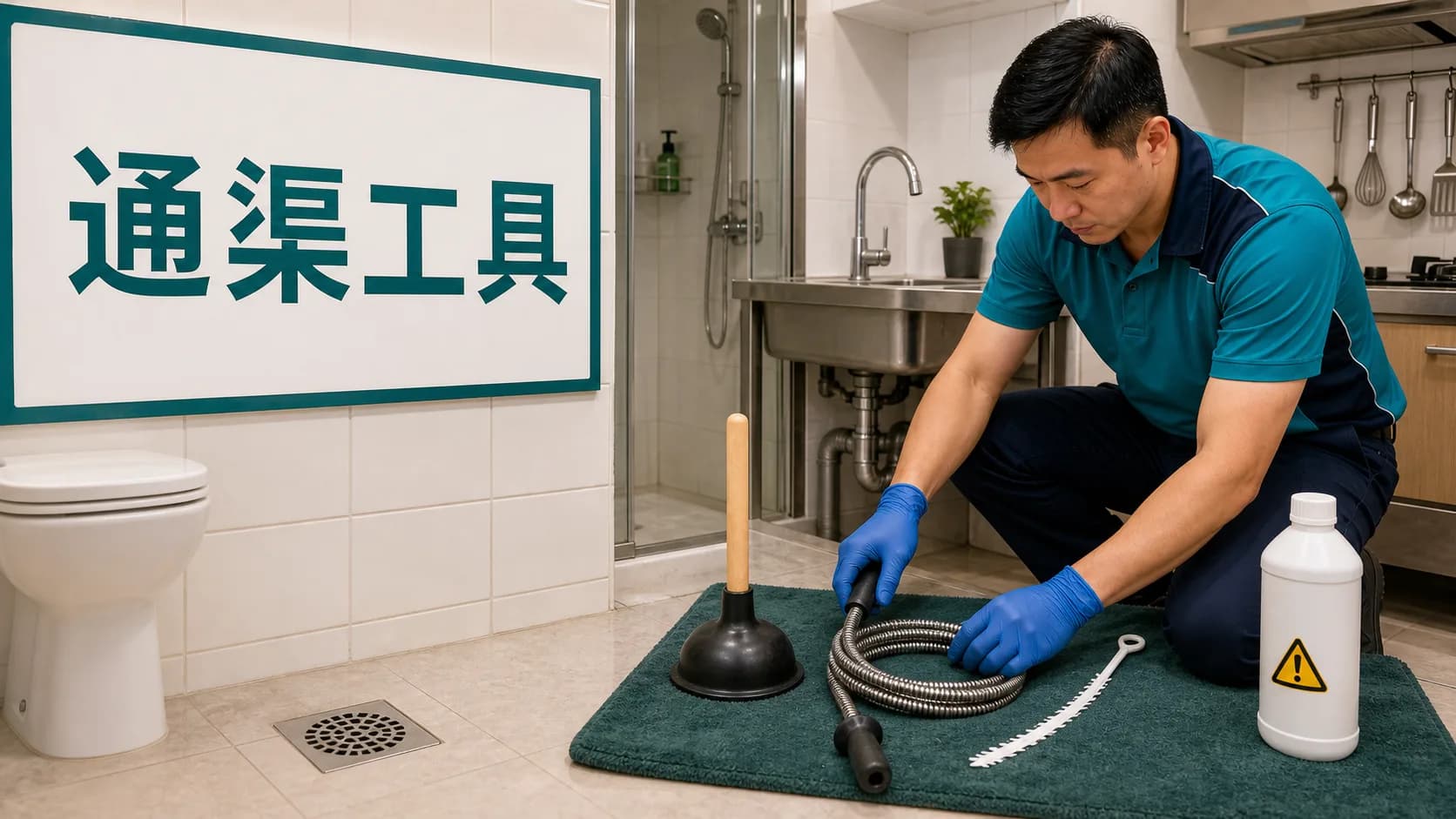
People searching for a drain-unblocking gadget often want a tool from Japan Home Centre, a hardware shop or an online store to try at home. Plungers, augers, flexible hair-removal strips and chemical cleaners address different problems. The wrong tool may scratch pipework, push an obstruction deeper or splash chemicals without clearing the drain.
Stop water use to prevent overflow, wear gloves and establish that no drain cleaner has been added before selecting a tool. Stop DIY if chemicals are present, several outlets are blocked, sewage or dark water backs up, an auger becomes stuck or the problem returns within days. Assess professional clearance or pipe cleaning.
This guide compares common tools. Also see chemical cleaner risks, rising toilet water, blocked floor outlets and shower and bath blockages.
Four tool types and their limits
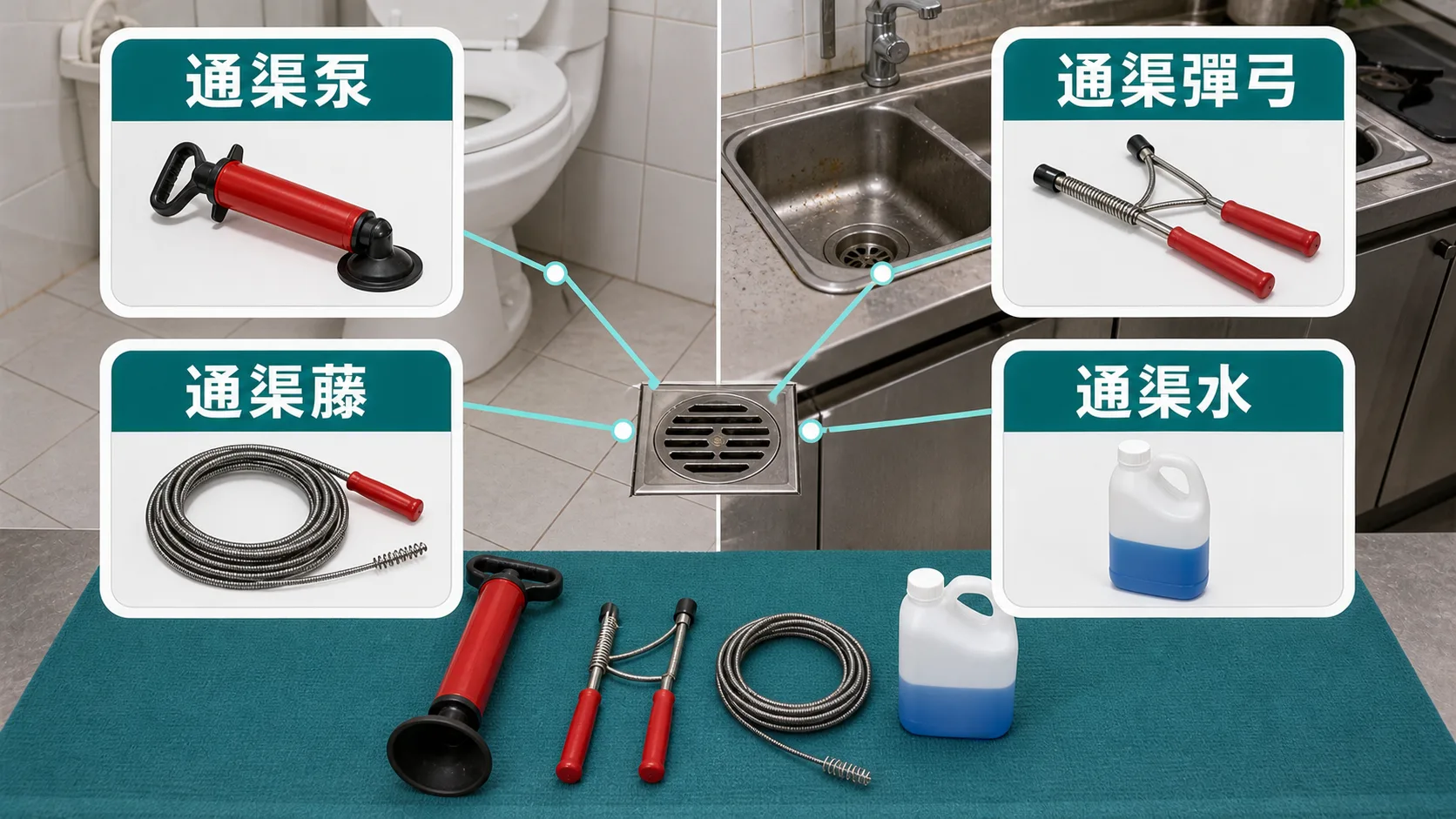
1. Plunger: an outlet that can be sealed and covered with water
A plunger uses pressure and suction to loosen some obstructions in toilets, baths and suitable basins. Its cup must cover the opening completely and have enough water around it. Use controlled vertical strokes rather than repeatedly flushing. Stop flushing a toilet already close to overflowing.
2. Drain auger: deeper access without forcing it
An auger can reach into some basins, sinks and floor drains to retrieve or break up deposits. Concealed domestic pipes often contain several bends. If it cannot turn, becomes stuck or scrapes abnormally, do not push hard: it may jam further or damage fittings.
3. Hair-removal strip: shallow hair, not hard objects or mains
A flexible toothed strip can retrieve some hair and soap near basin, shower or floor outlets. It has limited value against grease, hard objects, grit, cement, bundles of wipes or building-main faults. Rapid recurrence suggests deposits remain farther inside.
4. Liquid or powder cleaner: not universal, especially with standing water
Corrosive products may act on certain organic deposits, but may not address hard objects, grit, cement, plastic, wipes, deep grease or main-drain restrictions. In standing water they can remain at the opening; subsequent plunging or augering can splash skin or eyes.
Four checks before DIY
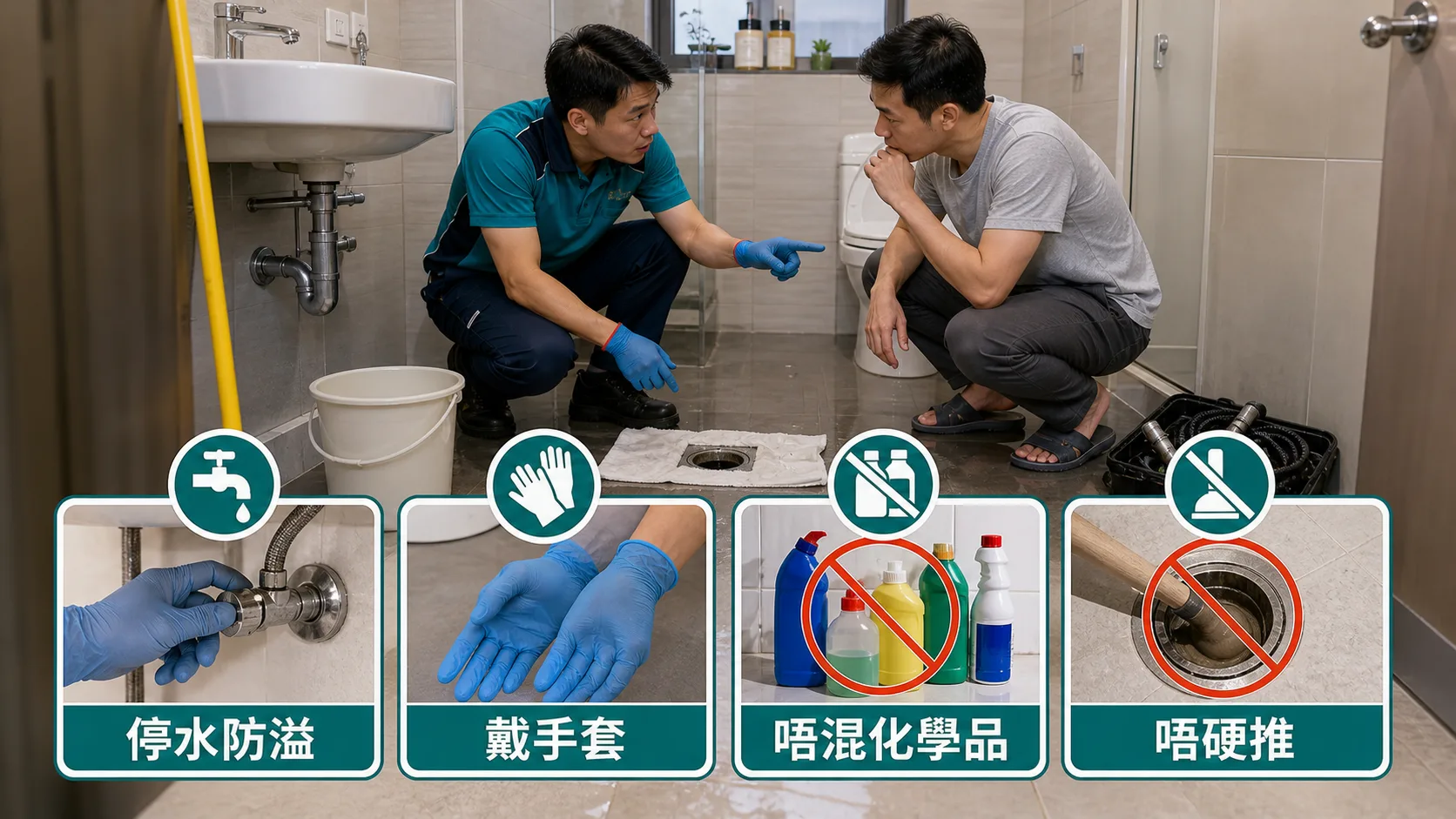
Stop water use
Do not repeatedly flush or run water into a slow toilet, sink or floor drain. Stop the supply or use, move floor-level belongings, protect nearby areas with suitable absorbent or waterproof material and record water levels and drainage speed.
Wear gloves
Outlets can contain sewage, grease, sharp fragments and chemical residue. Wear waterproof gloves at minimum and do not reach inside barehanded. Where dark water, backflow, smells or sewage contamination occur, affected surfaces need appropriate cleaning and disinfection afterwards.
Never mix chemicals
Do not mix drain products, bleach, detergents or powders, or plunge forcefully after adding chemicals. Tell the technician the product, amount and time of use.
Never force a tool
Stop if an auger or strip meets clear resistance, jams, loosens a fitting, scrapes unusually or moves outlet components. Force may push the obstruction somewhere less accessible.
Matching tools to outlets
- Toilet: consider an appropriately sized plunger for a suitable minor obstruction, without chemicals. Stop flushing if the level rises towards overflow.
- Basin: clear the strainer and accessible hair first. A strip suits shallow hair; an auger requires care around traps and bends.
- Bathroom floor outlet: clear accessible hair and soap. For smells or seal faults see water-seal maintenance.
- Kitchen sink: forcing an auger is not necessarily appropriate for grease. See recurring grease and food deposits.
- Several outlets: treat them as a possible connected-system problem, not isolated openings; see multiple blocked drains.
When should DIY stop?
Stop after a few unsuccessful gentle attempts, recurrence within days, a jammed tool, chemicals, sewage backflow, strong smells, several affected outlets or suspected cement, hard objects, wipes or main-drain faults. These conditions may need professional assessment, suitable equipment, jetting or CCTV.
For recurrence, a temporary return of flow is not the only goal. Pipe-wall grease, incorrect fall, deposits at bends, concealed cracks or shared-drain resistance may remain. Read why drains repeatedly block before choosing another clearance, cleaning or inspection.
If a plunger, auger or strip has not helped, or chemicals have already been used, WhatsApp PipeButler on 5340 0748 with outlet photographs, video, tools or products used, locations and other affected outlets. We can assess suitable clearance, cleaning, odour investigation or disinfection. Use the contact page to arrange assessment.
Frequently asked questions
Do household drain tools work?
In suitable cases: plungers can help certain minor obstructions, strips retrieve shallow hair and augers reach some deeper deposits. Hard objects, grit, cement, wipes, heavy sludge and building-main problems often exceed their capability.
Can a plunger be used with drain cleaner?
No. Chemical residue increases splash risk. Stop DIY, ventilate, avoid contact and tell the technician which product was used.
What if an auger is stuck?
Do not pull or rotate forcefully. Release pressure and, only if it moves freely, gently reverse the feed. If it remains stuck, seek help: force can break the tool inside or damage traps and fittings.
Why is flow still slow after pulling out hair?
More hair and soap may remain deeper inside, or the issue may be grease, trap deposits or downstream flow. Early recurrence warrants clearance or pipe-cleaning assessment.
What photographs help before buying a tool?
Show the outlet, level, drainage speed, odours or dark water, other affected outlets and previously used tools or products. This helps determine whether DIY remains appropriate.