
Loading page…
Loading page…
CCTV helps investigate recurring blockages, concealed pipes and suspected defects. Learn when it is useful, what it cannot show and what a report should contain.
WhatsApp with the problem and district, and we will confirm available timing.
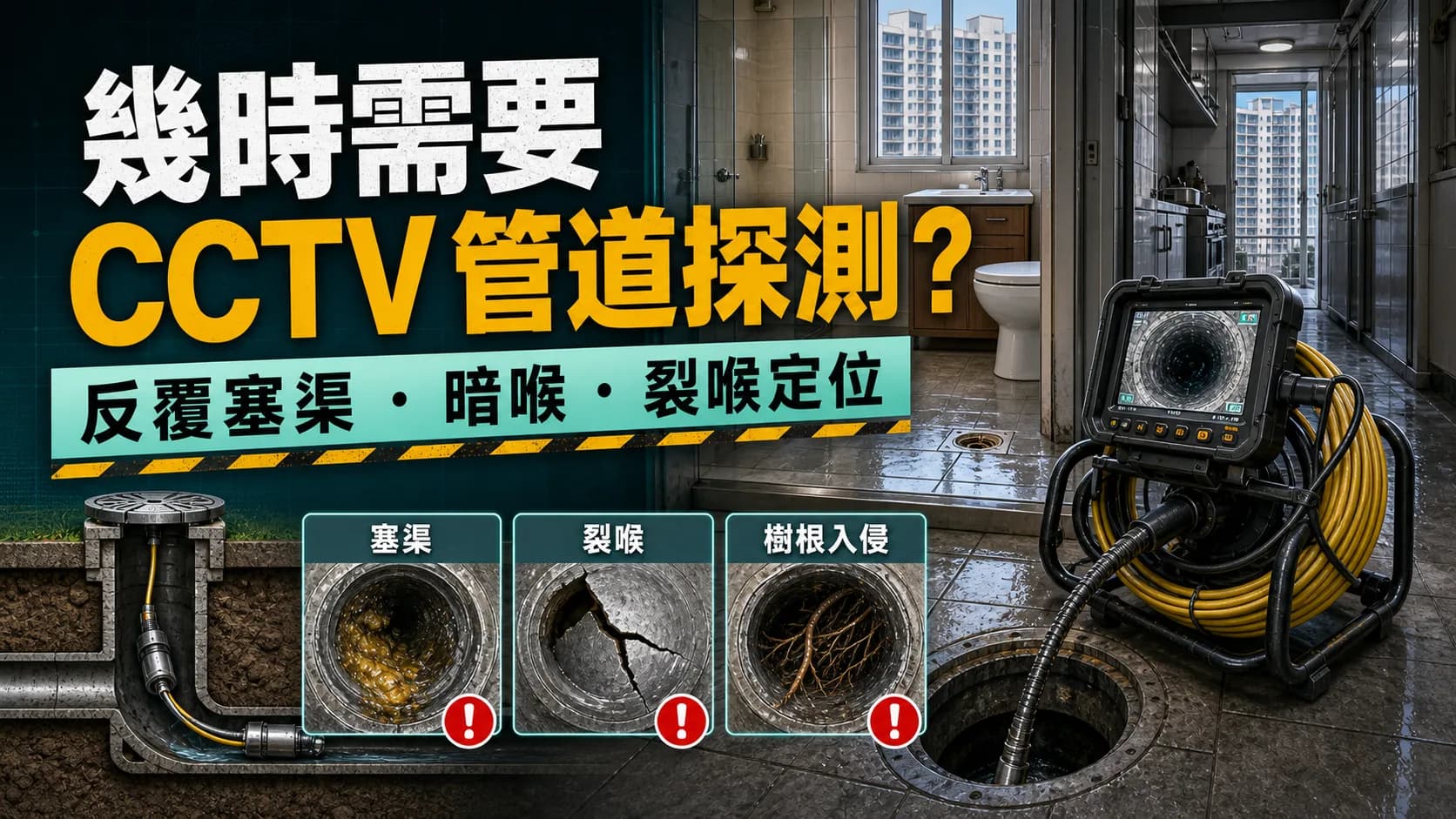
CCTV drain inspection places a waterproof camera inside a pipe to look for grease, objects, concrete, cracks, displaced joints, collapse, roots and other hidden conditions. It is not needed for every blockage and does not itself clear a drain: it is a diagnostic tool.
Visible hair or a soft blockage near an outlet usually calls first for ordinary unblocking. CCTV becomes more useful when a blockage returns quickly, concealed or damaged pipework is suspected, problems begin after renovation, lower floors experience backflow or management needs evidence of the location.
This guide explains when inspection is worthwhile, when it may be unnecessary, the process and the information a useful report should contain for Hong Kong homes, shops and buildings.
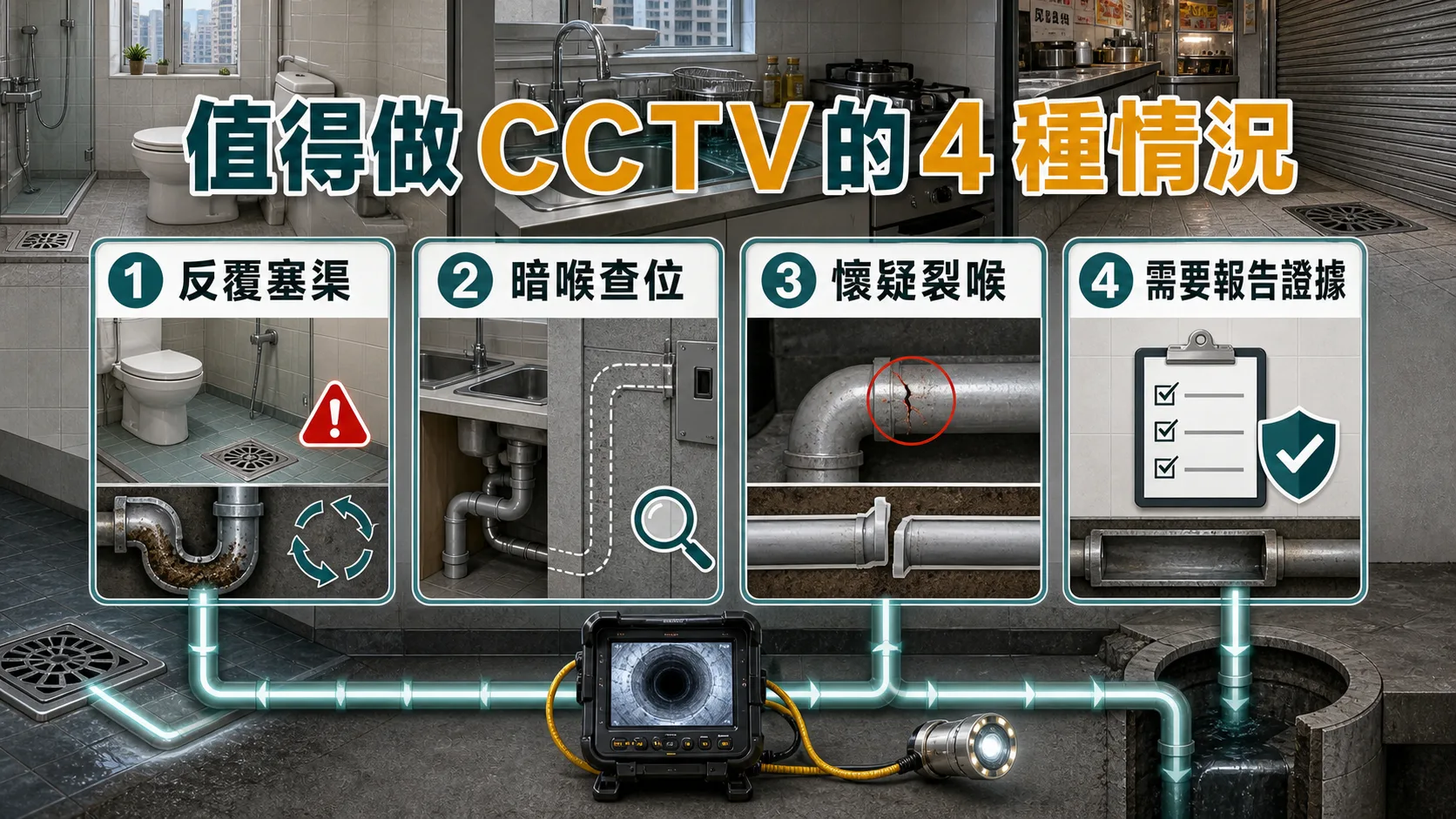
A basin, floor drain, toilet, sink or commercial channel that slows days or weeks after clearance may have thick wall deposits, trapped objects, sand, deformation or gradient problems. CCTV can help distinguish them. See recurring blockage patterns.
Many pipes run beneath cupboards and floors or behind walls and false ceilings. Inspection can help locate a restriction or defect before unnecessary dismantling, subject to camera access and reach.
Blockage after renovation, sand or cement at an outlet, seepage, recurring odour or rapid recurrence after jetting can involve structural defects or hard objects. Chemicals and repeated clearing cannot correct all such causes.
Multiple affected units, low-floor backflow, chamber or main-drain faults and tenancy or renovation disputes often need images and written findings. Video, stills, location descriptions and recommendations make the issue clearer than saying only that a drain is blocked.
Review symptoms, images, recurrence, affected area and safe access first. If ordinary clearing is sufficient, additional investigation may not be necessary.
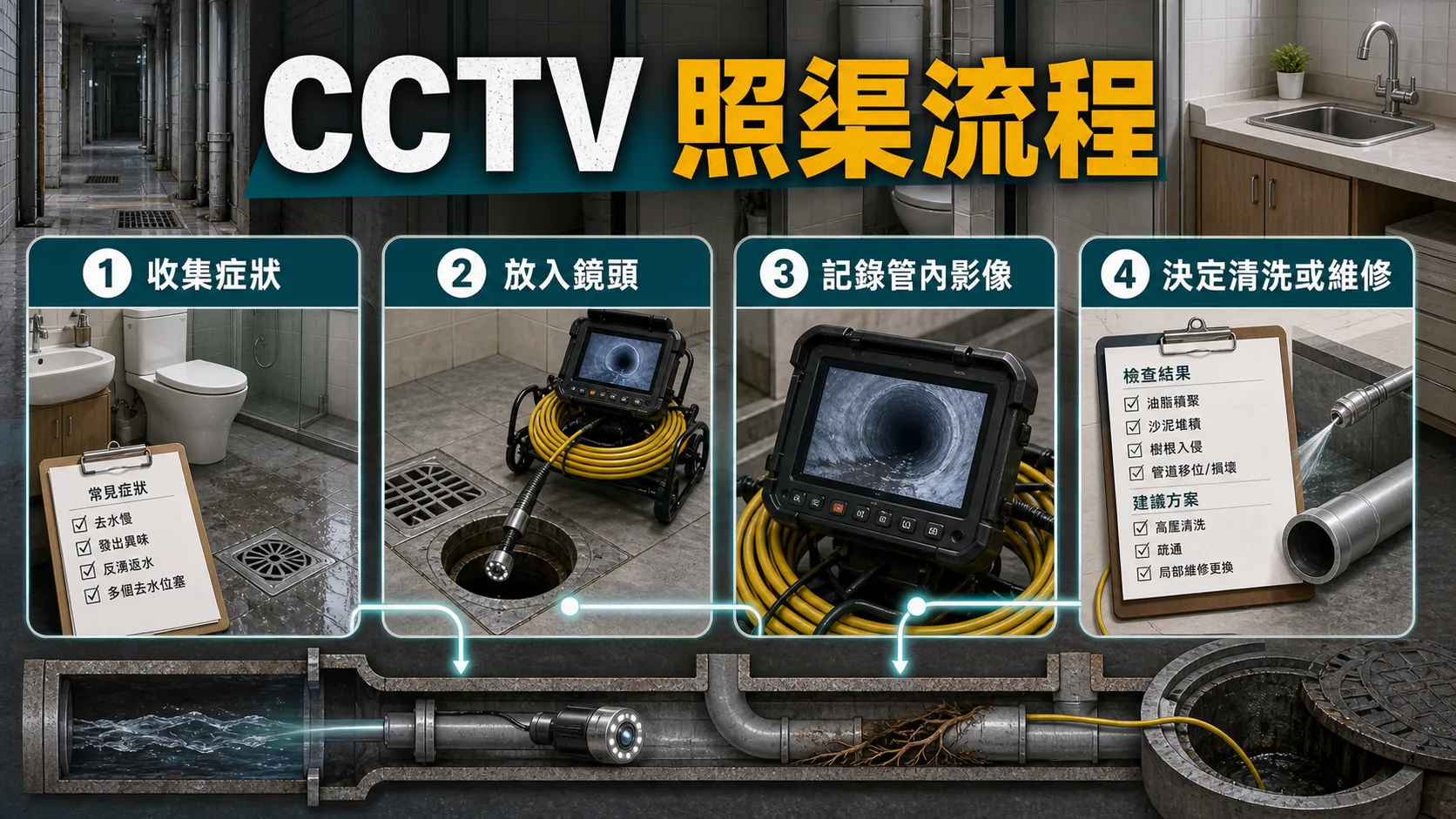
Visible conditions can include grease, sand, concrete, cloths, wipes, objects, lost items, cracks, corrosion, displaced joints, sagging, possible leakage signs, roots and chamber connections. Deep water, heavy grease, tight bends, small diameter, an impassable blockage or no suitable entry point can restrict the view.
A completely blocked pipe may need initial clearing to let the camera advance. Thick grease may require cleaning as the practical first action. See high-pressure drain jetting for the difference.
If the findings are for management, an owner, renovation contractor or insurer, agree beforehand whether video, stills, a written report, location descriptions and recommendations are included. Images without an understandable explanation may be less useful.
Restores flow through a local restriction such as hair, paper, small food deposits or a soft blockage near the outlet. It addresses the immediate inability to drain.
Investigates why and where a problem occurs, particularly with repeat faults, concealed pipes, cracks, objects and evidence requirements before repairs.
Uses water to clean pipe walls and longer runs affected by grease, sand and repeated slow drainage in kitchens, channels or building branches.
Physically removes deposits from chambers, floor channels, external drains, grease traps and low points. Filming sediment does not restore the capacity it occupies.
Consider pipe diameter, inspection length, access difficulty, chambers or underground sections, reporting requirements, out-of-hours access and any preliminary unblocking or pumping. A short domestic inspection and a long building or commercial drain require different arrangements. Cleaning or desilting may need to be coordinated.
Send a video, layout information, outlet or chamber photos, the duration and frequency of blockage, previous clearing details and the report's purpose. See planning a drainage visit or contact PipeButler to discuss the appropriate scope.
No. It views and records conditions. Clearing may happen first to restore flow and access, or inspection may identify the obstruction before selecting a tool.
No, but rapid recurrence, repeated concealed-pipe problems, several affected outlets or suspected objects, cracks and chamber faults make it more useful than repeating the same clearing attempt.
It depends. Ordinary grease or sand may be cleaned first; old pipes, suspected cracks, trapped objects, post-renovation faults, leaks and shared drainage concerns require condition assessment, with CCTV where appropriate.
Normal camera inspection is non-destructive. Unsuitable access, excessive force, fragile old pipes and unsafe working conditions create risks, so an experienced operator should select equipment and methods for the pipe.
Blockage videos, affected locations, floor level, whether several outlets are involved, the last clearing date, renovation history and any report required by management or owners.
WhatsApp PipeButler on 5340 0748 with flow videos, outlet or chamber photos, recurrence timing and site details. These help determine whether ordinary unblocking, CCTV, pipe cleaning or desilting is appropriate.
For shared washrooms, ceilings or other units, coordinate accessible points and authorisation with management. The need for inspection, sections covered, documents and fees depend on the issue and site rather than being automatic with every call-out.