
Loading page…
Loading page…
Before moving a toilet, sink or drain, check water seals, ventilation, gradients, shared pipes and maintenance access. Keep evidence and confirm the applicable work procedures.
WhatsApp with the problem and district, and we will confirm available timing.
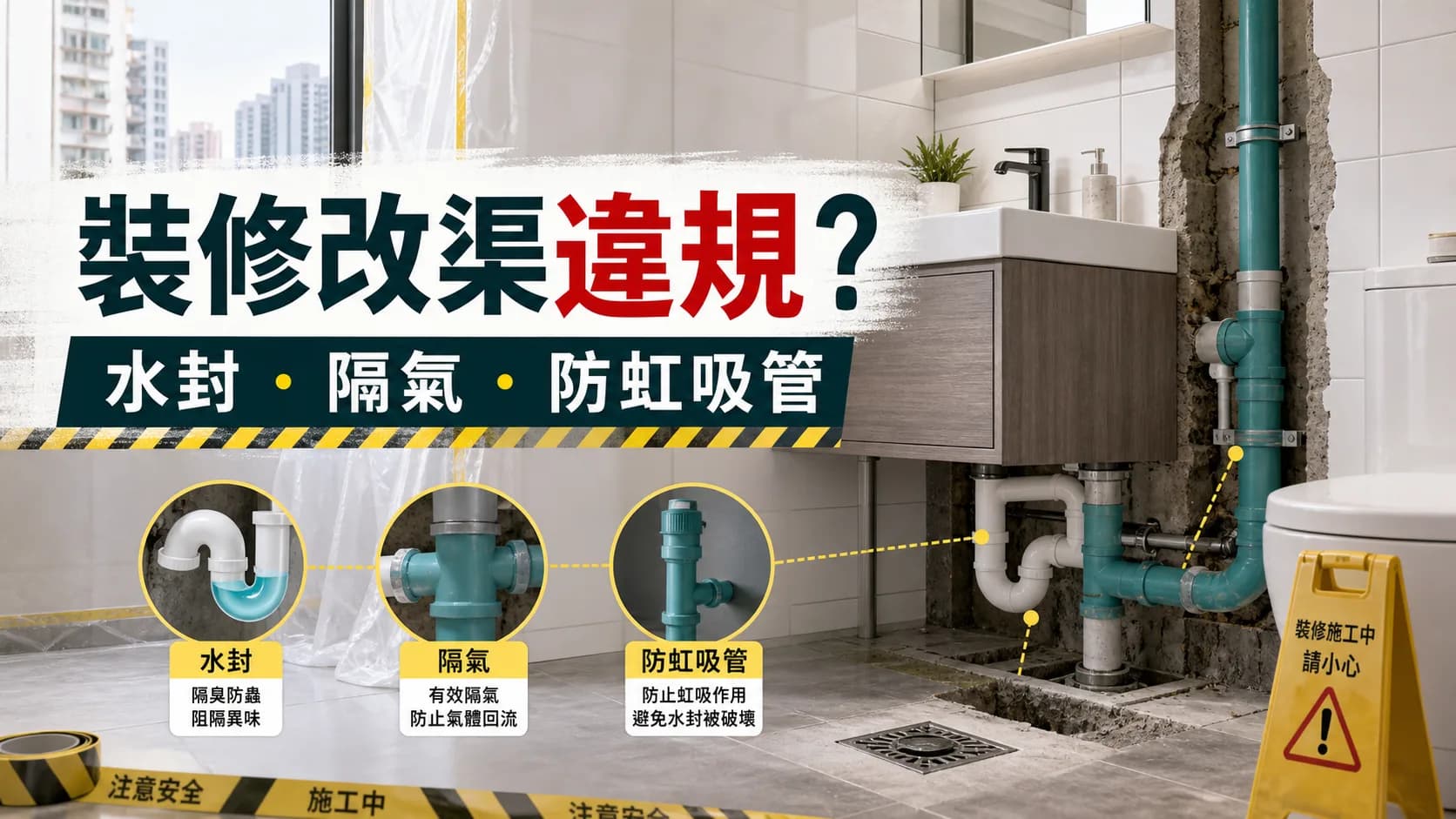
Renovation often involves moving a toilet or basin, adding a floor drain, relocating a kitchen sink or hiding exposed pipes behind a false wall. But drainage work is not complete simply because water flows away. It must also retain effective water seals, ventilation, suitable gradients and maintenance access. Incorrect changes to traps, anti-syphonage pipes, shared drains or concealed pipes may cause odour, slow drainage, leakage or backflow and may involve unauthorised work.
This is a practical renovation-risk and inspection guide, not legal advice. The Buildings Department distinguishes repair or replacement of internal branch pipes (other than embedded pipes) and sanitary fitments in accordance with the original design, which may be exempted building works, from repair of external drains or internal main drains under the Minor Works Control System. Erection, alteration or removal of a unit's drainage system, including anti-syphonage pipes, requires the applicable procedures to be confirmed with a building professional or appropriately registered contractor. Management approval does not replace statutory requirements. After an alteration, record symptoms before arranging odour investigation, installation assessment or CCTV inspection.
The following checks cover common situations in Hong Kong homes, older buildings, new developments and shops. If renovation is already complete and odour has appeared, also see drain smells after renovation.
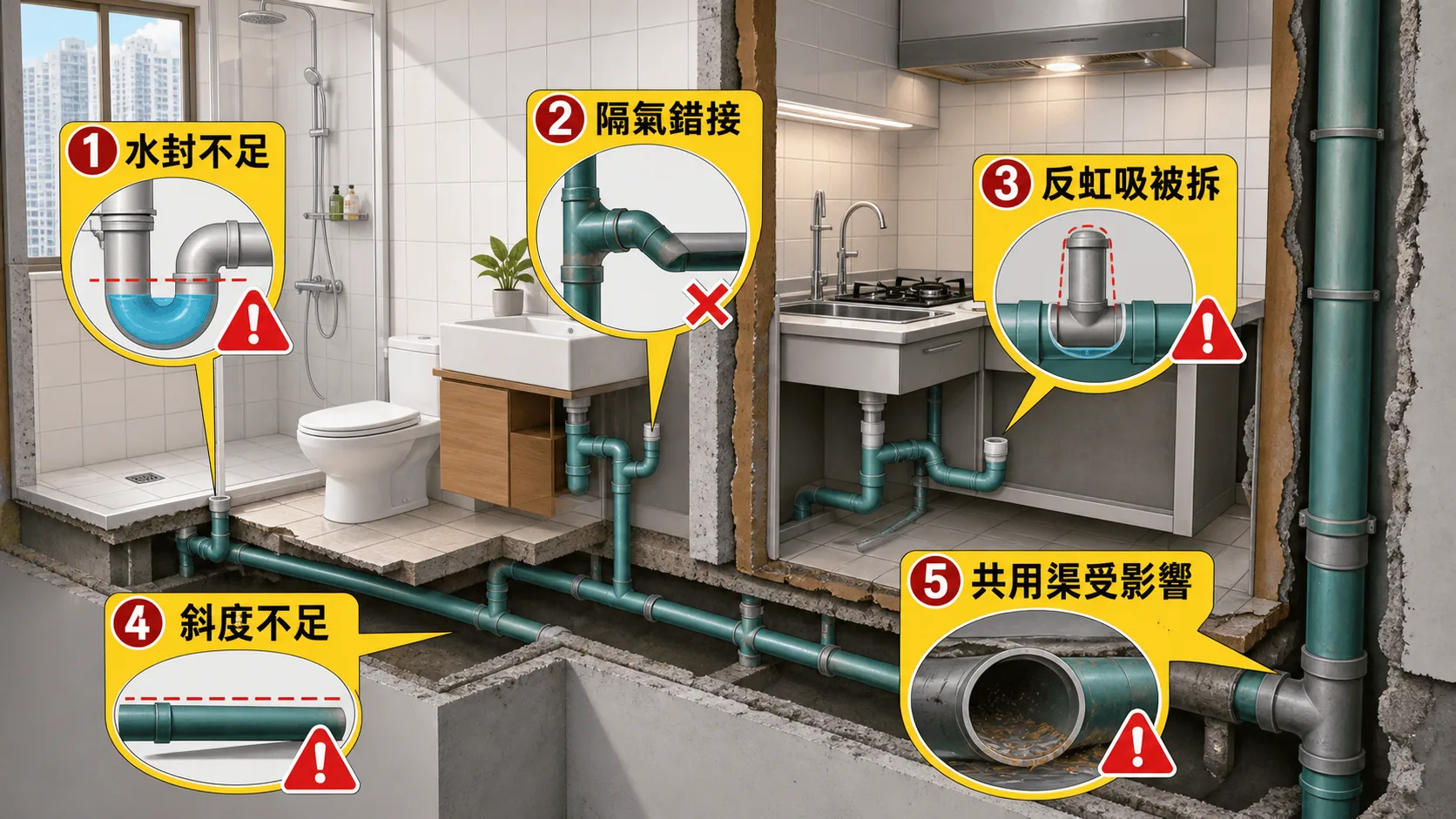
Replacing a basin, toilet or drain cover in the same position differs from relocation, adding or removing pipework, changing connections or modifying main drains or anti-syphonage pipes. The Buildings Department's drainage guidance treats repair or replacement of internal branch pipes (other than embedded pipes) and sanitary fitments in accordance with the original design as exempted building works, while external-drain and internal-main-drain repairs are handled under the Minor Works Control System. Erection, alteration or removal of drainage systems may also fall under that system. Confirm the actual classification and current requirements for the proposed scope.
Floor drains, basins, kitchen sinks, baths, showers and toilets rely on traps or water seals to separate rooms from drain gases. Removing a trap to save space, fitting an unsuitable bottle trap or shallow seal, or connecting a floor drain incorrectly may let water escape while allowing odour indoors. See U-traps and water seals for the principle.
Anti-syphonage pipes help balance drainage pressure so trap water is not drawn away. Removing, sealing, shortening or misconnecting them may lead to gurgling after flushing, floor-drain odour or several smelly outlets. Read how anti-syphonage pipes work; an unfamiliar small pipe or external pipe is not necessarily redundant.
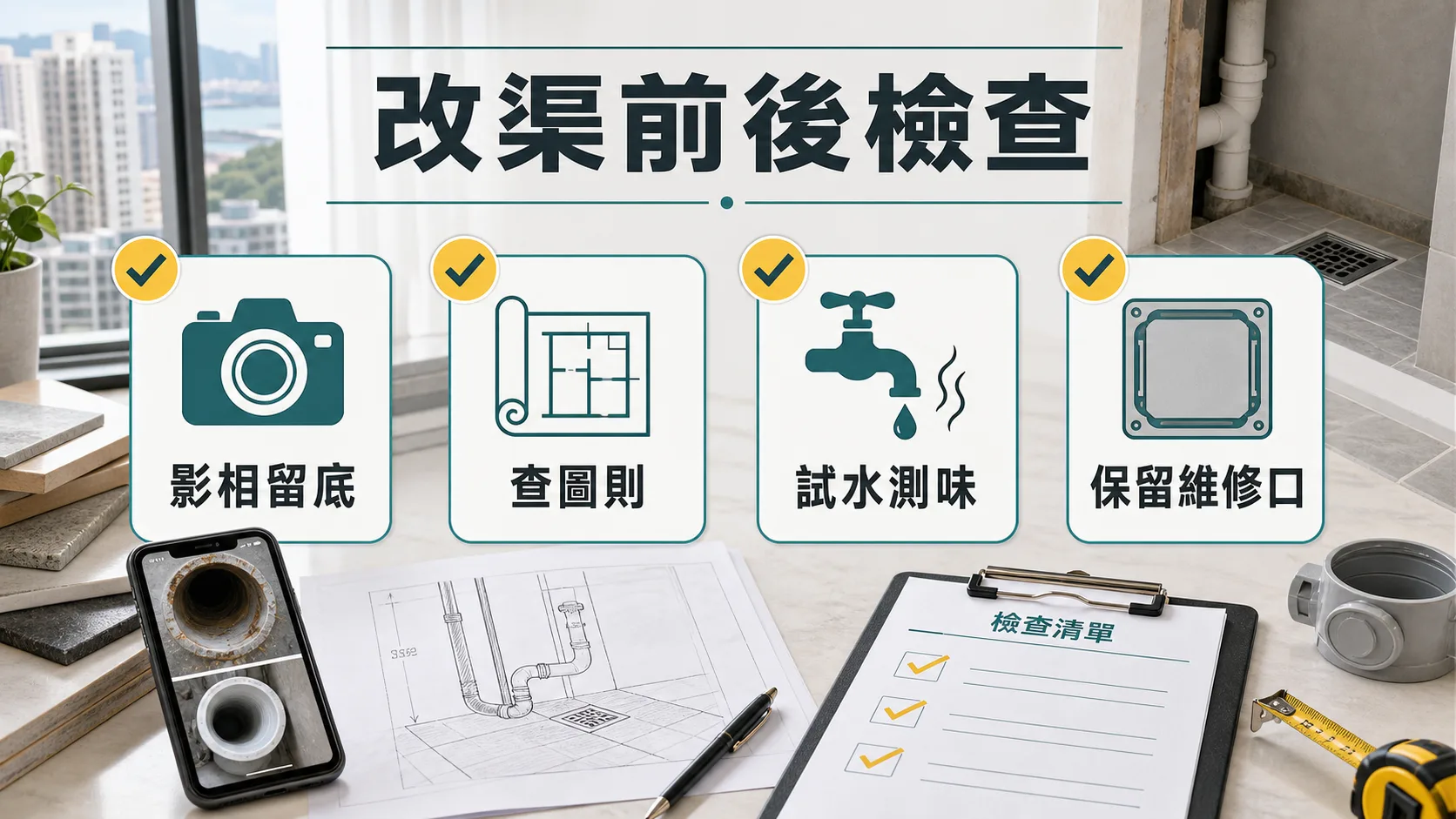
Record the toilet, basin, floor drains, washing-machine outlet, kitchen sink and visible ceiling or external pipes. Retain management drawings, renovation plans and old repair records. Before dismantling is the best opportunity to establish diameter, gradient, connections and shared sections.
Do not wait until tiling and cabinetry are complete to test the work. Have the contractor test new connections under suitable controlled conditions, watching drainage speed, gurgling, backflow, leaks, damp cabinet surfaces and odour. Test individual fixtures and, where appropriate, their combined operation. Stop if leakage or backflow appears.
Completely enclosing traps, joints, valves or concealed pipes can make future smells and leaks difficult to investigate. Retain photographs, videos, materials information, work locations, access-point positions and warranty responsibilities. See the new-development drainage handover checklist.
After renovation, start with three low-risk observations. Replenish water in infrequently used trapped outlets where appropriate and note whether odour improves temporarily. Record whether flushing, extractor-fan use, upstairs water use, rain or several days of disuse makes it worse. Check visible cabinet undersides and floor edges for dampness, musty smells or loose joints.
Repeated drain cleaner, bleach or strong acid or alkali is not a suitable first response. Chemicals do not repair incorrect connections, missing water seals, failed ventilation or cracked pipes and can increase risks during dismantling. See drain-cleaner safety.
Consider CCTV inspection for repeated post-renovation blockages, a recurring restriction at one location, concealed odour sources, uncertain pipe routes, suspected cracks, displacement or construction debris, or evidence needed for discussions with the contractor, management, owner or insurer. Not every odour problem needs CCTV, but it may help with concealed pipes and recurring faults.
Damp walls, ceiling leaks, musty smells, darkened skirting or neighbouring complaints also warrant considering drainage leaks and cracks. See warning signs of cracked drain pipes.
The renovation contractor: if symptoms began immediately after relocation, wall closure, cabinet installation or fixture replacement, retain test videos and work photographs and request inspection under the applicable warranty arrangements.
Building management: notify management where several units, adjacent floors, corridor drains, external pipes or common drains are affected.
Appropriately qualified contractors or professionals: establish the qualifications and procedures required for erection, alteration or removal of drainage systems, main drains, external pipes or anti-syphonage facilities.
PipeButler: photographs and videos can help establish whether to investigate obstruction, odour sources, traps, water seals, ventilation, concealed pipes or deposits. Depending on the findings, discuss unblocking, odour investigation, pipe cleaning, CCTV or installation and alteration work. Confirm scope and limitations before work begins.
No. Replacement and repair are not automatically unauthorised. The Buildings Department distinguishes repair or replacement of non-embedded internal branch pipes and sanitary fitments in accordance with the original design from other drainage work. Do not rely only on a contractor's assurance or management approval; check the actual scope, applicable minor-work classification and required registration.
Do not remove it merely for appearance, space or easier wall closure. Incorrect removal or sealing may destabilise water seals and cause gurgling or odour at multiple outlets.
No. The system must also control odour and leakage, remain maintainable and avoid affecting common drains. Traps, seals, ventilation, joints or cracks may still cause problems.
Not necessarily. Start with appropriate water-seal checks, controlled test records, symptom timing and visible-area inspection. Evidence can then guide CCTV, an inspection opening or dismantling.
The Chinese source recorded these references as reviewed on 18 August 2026. Requirements and classifications may change; confirm current official requirements for the actual work.
Before alterations, or if renovation has led to smells, slow drainage, gurgling, leakage or repeated blockages, send PipeButler photographs from before and after work, affected outlets, test videos, the renovation timeline and management's response via WhatsApp 5340 0748. Agree the appropriate investigation and work scope before proceeding.