
Loading page…
Loading page…
Tin Shui Wai · Private estate
Occupied 1992–1998 in six phases · 58 towers · tall stacks & combined flats
Kingswood Villas in Tin Shui Wai was developed by Tin Shui Wai Development Ltd, a Cheung Kong subsidiary.
Last reviewed ·
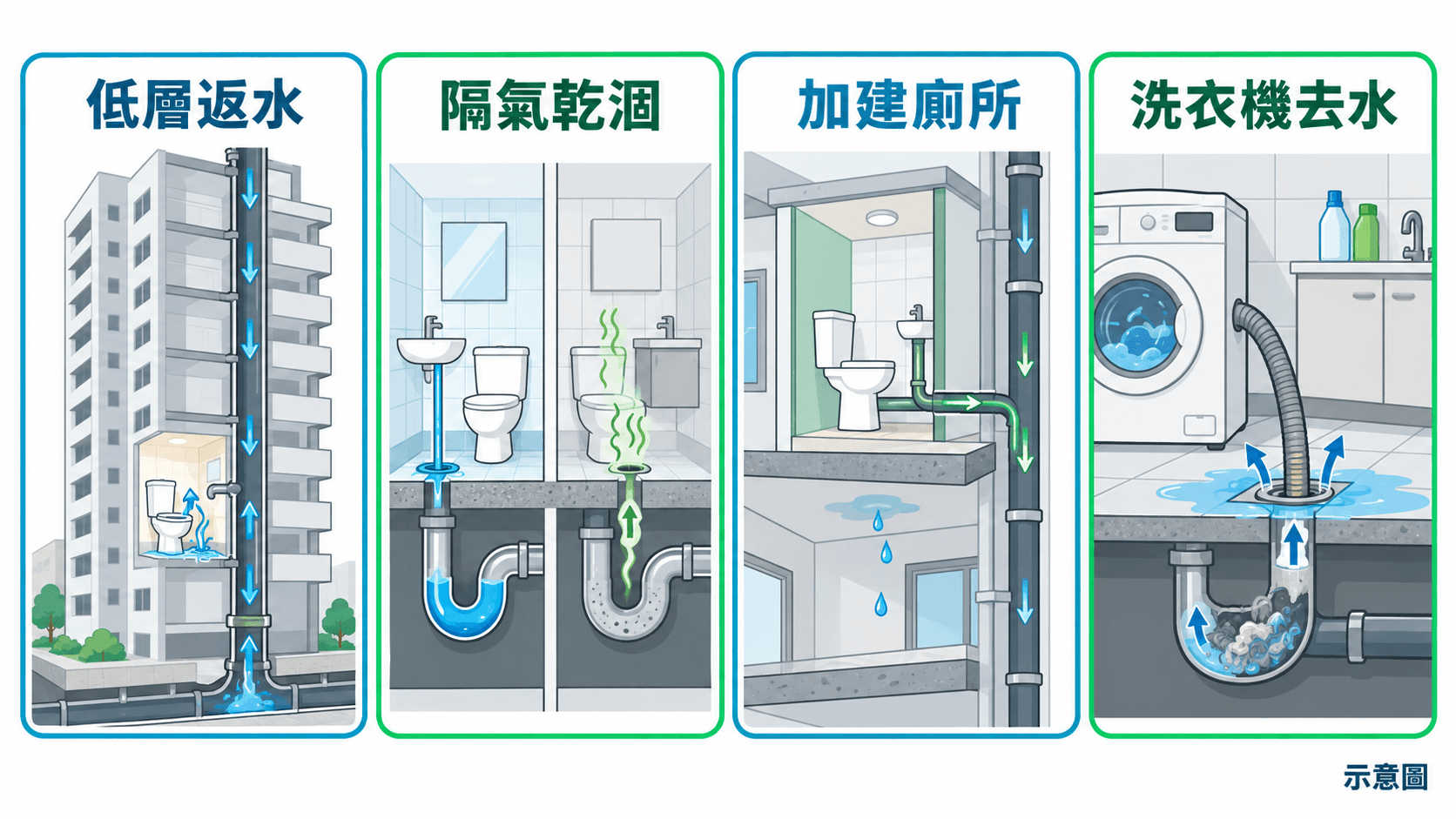
Choose the problem you are seeing to read the likely cause and next step.
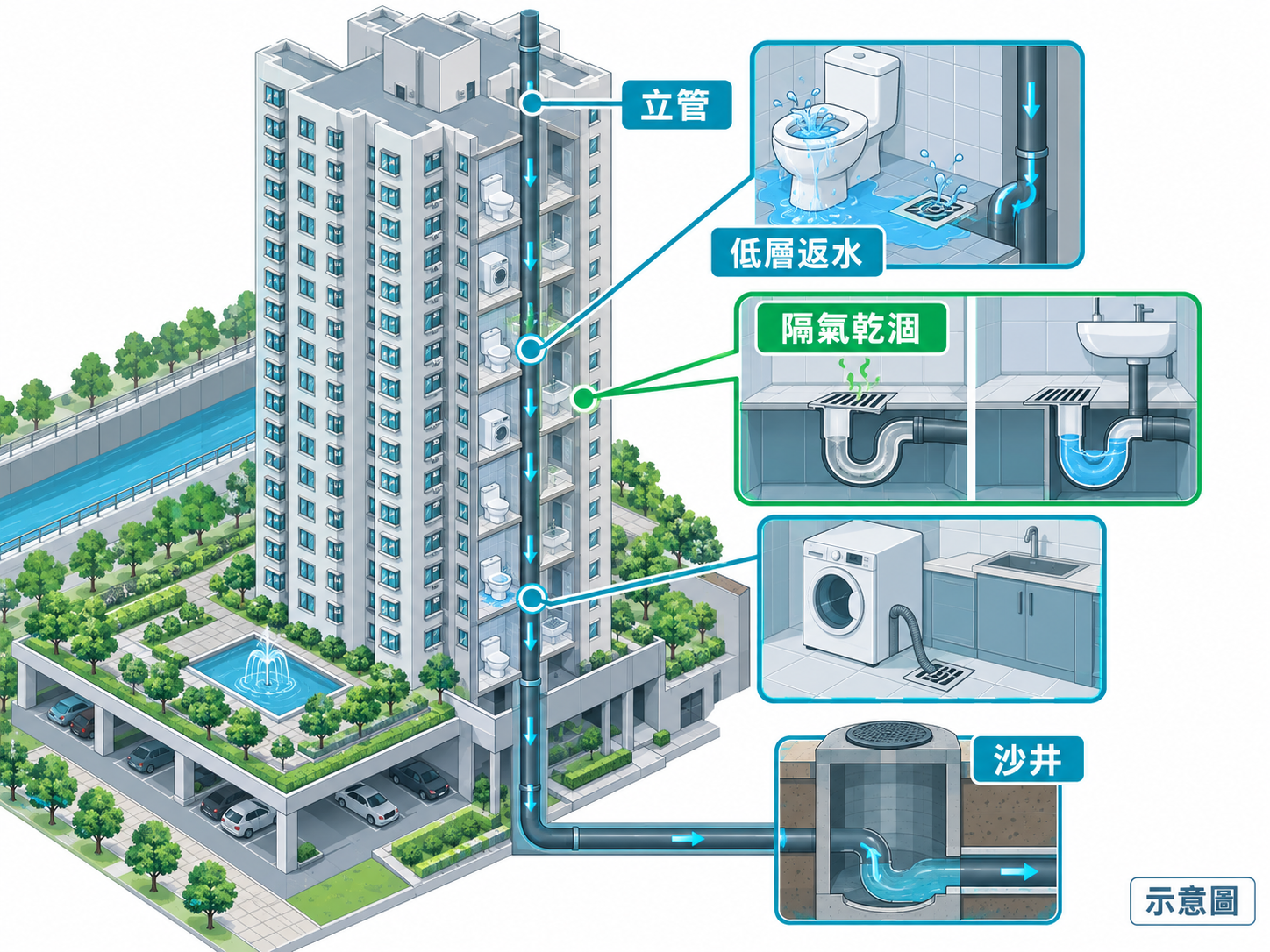
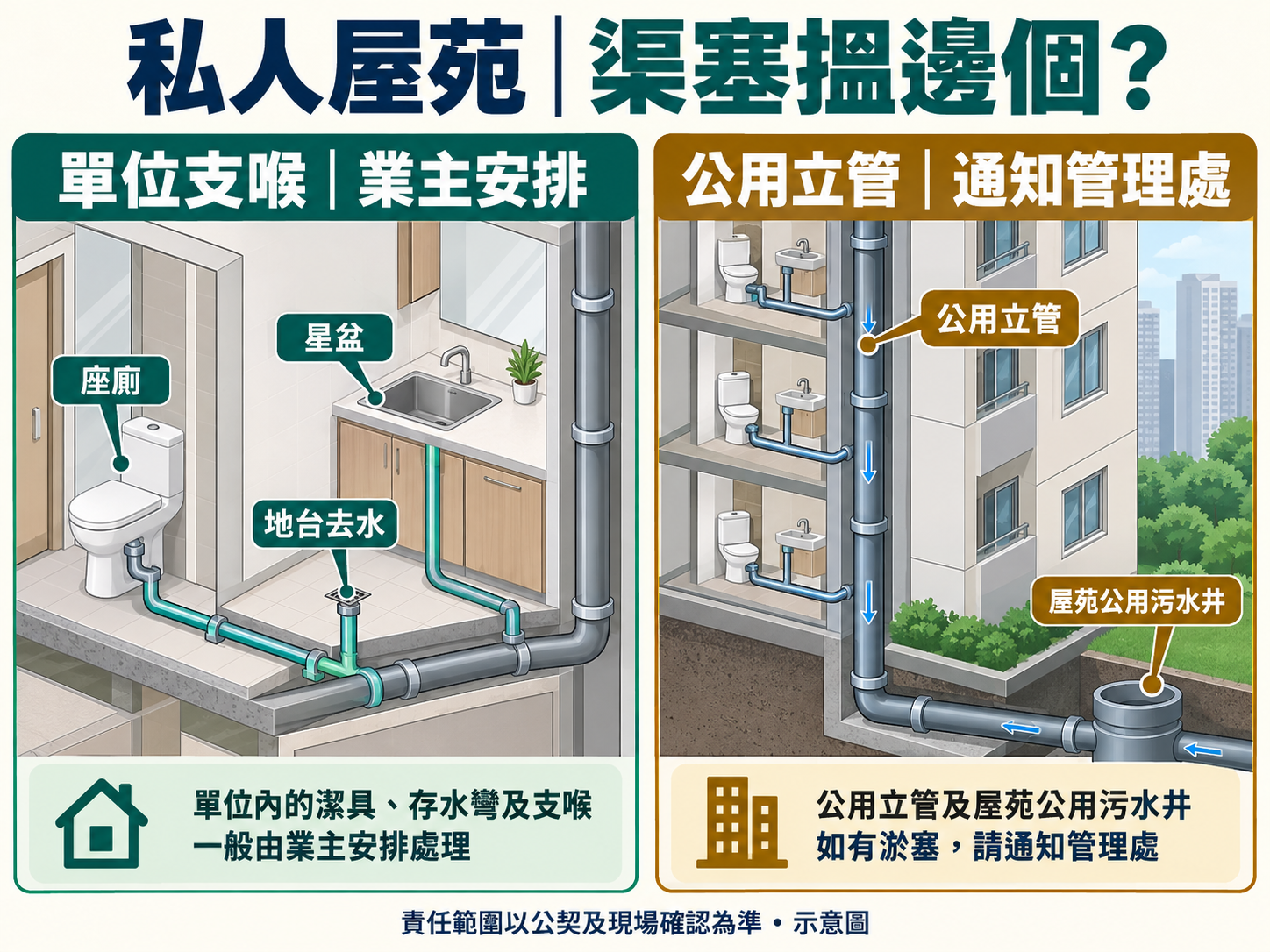
The towers are 27 to 39 storeys high, so by design one stack probably collects water from twenty or thirty floors, and low-floor flats sit closest to its foot. When grease, wet wipes and similar debris collect at the stack foot, in the underground drain or in a manhole, and the floors above use a lot of water at once (in the morning or after dinner, say), the toilet and floor drain on a low floor are the first to bubble and rise, and in bad cases sewage comes back up. One slow outlet usually means the flat's branch pipe; if several outlets play up together, or flats above and below are affected, tell the management office straight away.
According to Chinese Wikipedia, the living-room wall between neighbouring flats at Kingswood Villas is not load-bearing, and every phase, old and new, has many flats that owners have combined themselves. A combined flat can have two kitchens and three or four bathrooms, one set of which is rarely used or is simply covered over when the space becomes a room. It follows that the trap seals at those outlets slowly evaporate and let sewer air in. Pour about half a litre of water into each floor drain every week, and have a registered contractor properly cap or remove outlets that are no longer used.
HK01 reported in July 2022 that it had found at least four suspected subdivided flats advertised for rent at Kingswood Villas, across Kenswood, Sherwood and Locwood Courts, one of which appeared to have a toilet and shower partitioned out of the kitchen; The Collective reported in September 2026 that five flats registered under the Basic Housing Units Ordinance are all in Locwood Court. Certification requires each subdivided unit to have its own toilet and a sink outside it, which means new drainage points, and BD says drainage alterations in subdivided flats must also be done by a registered contractor. If your ceiling leaks or your bathroom starts to smell after works upstairs, take photos and tell the management office.
Standard flats have no balcony or utility platform, so, inferring from the design, many households keep the washing machine in the kitchen with its hose pushed into the floor drain or connected under the sink. A washing machine discharges a large volume of water full of detergent residue and fibres at once; this builds up in the trap and branch pipe, so the sink drains slowly and the floor drain backs up, and a hose simply pushed into an open outlet rather than connected to a trapped point also lets sewer smells in. The fix is to clear the build-up and give the hose a secure connection to a trapped outlet.
The Tin Shui Wai Nullah runs past Locwood Court. DotDotNews reported in May 2026 that Jeff Yiu Ming, a Legislative Council member for New Territories North, noticed rubbish and silt still collecting along parts of the channel when he visited the nullah, some of it giving off a smell. If the smell mainly appears with the windows open and does not improve after you pour water into every drain in the flat, the source may be outside, and you can report it to the government through 1823. If the bathroom or kitchen still smells of drains with the windows shut, the traps, branch pipes and vent pipes need checking.
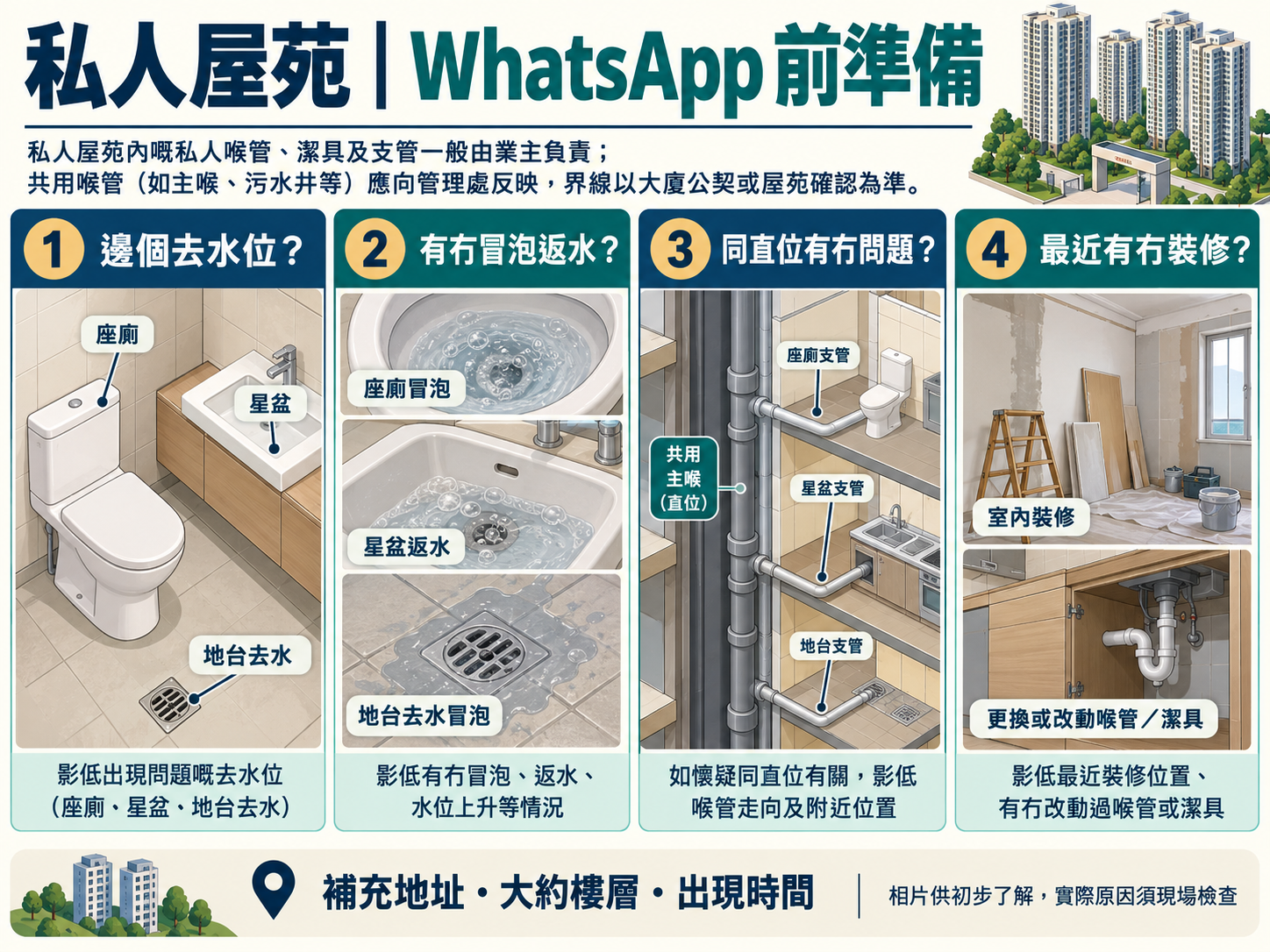
Photos or a short video on WhatsApp help us tell a single-fixture blockage from a shared-stack problem.
Kingswood Villas in Tin Shui Wai was developed by Tin Shui Wai Development Ltd, a Cheung Kong subsidiary. Its 58 residential towers hold 15,880 flats, occupied in six phases between 1992 and 1998, in blocks of 27 to 39 storeys with eight flats per floor. At that height a single stack may serve twenty or thirty floors, and the estate also has many combined flats and flats with altered layouts. When a drain blocks, backs up or smells, the first thing to work out is whether the trouble sits in your own flat — the traps and branch pipes — or further out in the stack and the estate's manholes: the first you can book a plumber for yourself, the second goes to the management office.
Planning for Kingswood Villas began in 1988, and it was built in seven phases between 1991 and 1998: six residential phases, plus Phase 4, a shopping centre and hotel (the mall is now called +WOO). According to Chinese Wikipedia, every phase has three lifts and eight flats per floor, and standard flats come in three types: a two-bedroom of about 580 sq ft gross, a three-bedroom of about 710 sq ft, and a three-bedroom of about 820 sq ft with an en-suite bathroom. No standard flat has a balcony, utility platform or maid's room. Inferring from these plans, a standard flat has at most two bathrooms, and the washing machine usually ends up in the kitchen or the bathroom.
The whole development stands on a large area of filled fishponds. Gardens, pools and courts take about 90% of the site, every residential phase has a residents' car park underground, and the Tin Shui Wai Nullah runs past Locwood Court. By design, large podium gardens and basement car parks mean the common areas contain many open channels, gullies, manholes and sumps. These are maintained by the management office and should be treated separately from the drains inside a flat.
Locwood Court, the first phase, is now about 34 years old and even Maywood Court, the newest, is 28. The five phases occupied from 1992 to 1996 have passed 30 years, the age at which BD's Mandatory Building Inspection Scheme applies, and common drainage falls within its scope. As a general inference from building age, most flats' branch pipes and traps have been replaced during renovation, so two flats in the same tower can be in very different condition and each needs checking on its own.
Note: statements based on building age and type are general inferences, not findings for any particular flat.
A clear process from enquiry and assessment to an agreed scope of work
Tell us the drain problem and district and ask about available timing.
Confirm timing based on the district and schedule, then inspect the blockage or odour issue.
Explain the proposed approach, scope and price before agreed work begins.
Use suitable tools for the site conditions and agreed scope of work.
After the agreed work, test drainage and explain the observed result and any next steps.
PipeButler is an independent drain-service provider with no affiliation to the developer, owners' corporation, management company or Housing Department of the places above. Facts come from public sources checked on the dates shown; work on common drains or common parts follows the management office's and deed of mutual covenant's arrangements.
WhatsApp with the problem and district, and we will confirm available timing.