
Loading page…
Loading page…
Tin Shui Wai · HOS / PSPS
Occupied 1997–2000 · about 18,500 flats in four courts · external & light-well stacks
Tin Shing, Tin Chung, Tin Fu and Tin Lai Court are four of the Home Ownership Scheme courts the Housing Authority built in Tin Shui Wai, occupied between 1997 and 2000 with about 18,500 flats in total; the older and much smaller Tin Yau Court (1992) and Tin Oi Court (1993) are separate estates.
Last reviewed ·
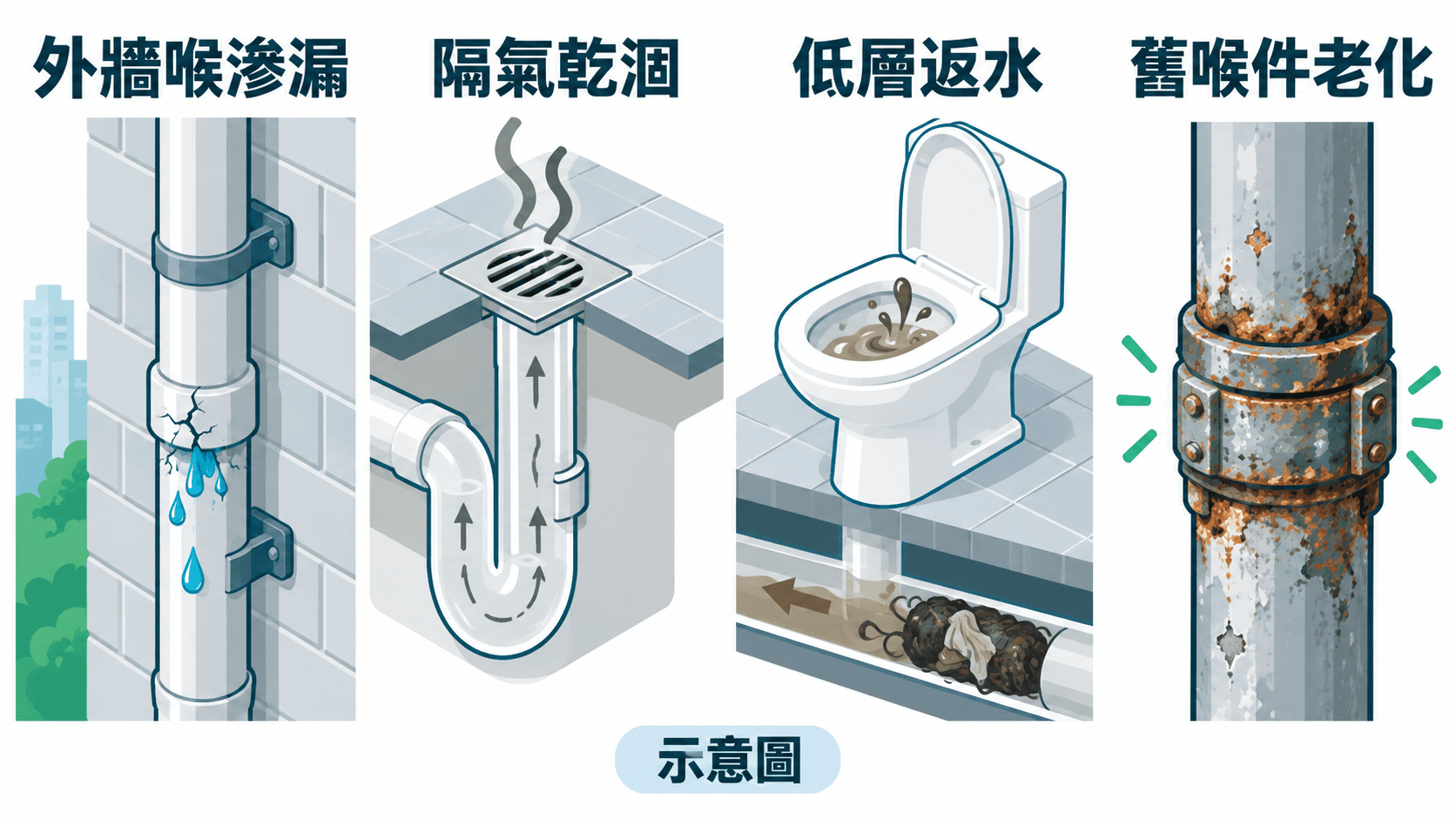
Choose the problem you are seeing to read the likely cause and next step.
Concord blocks have their drainage points at the light well, and third-generation Harmony blocks carry their soil and vent pipes on the external wall. If the smell is strongest by a window, the light well or the clothes-drying rack, or you can see stains, cracks, rust or loose brackets on the external pipes through the window, the fault is more likely in a shared pipe than in your drain outlet. These pipes are common parts: photograph the spot and report it to the management office. Repairs usually need scaffolding or a gondola, so never lean out of the window to deal with it yourself.
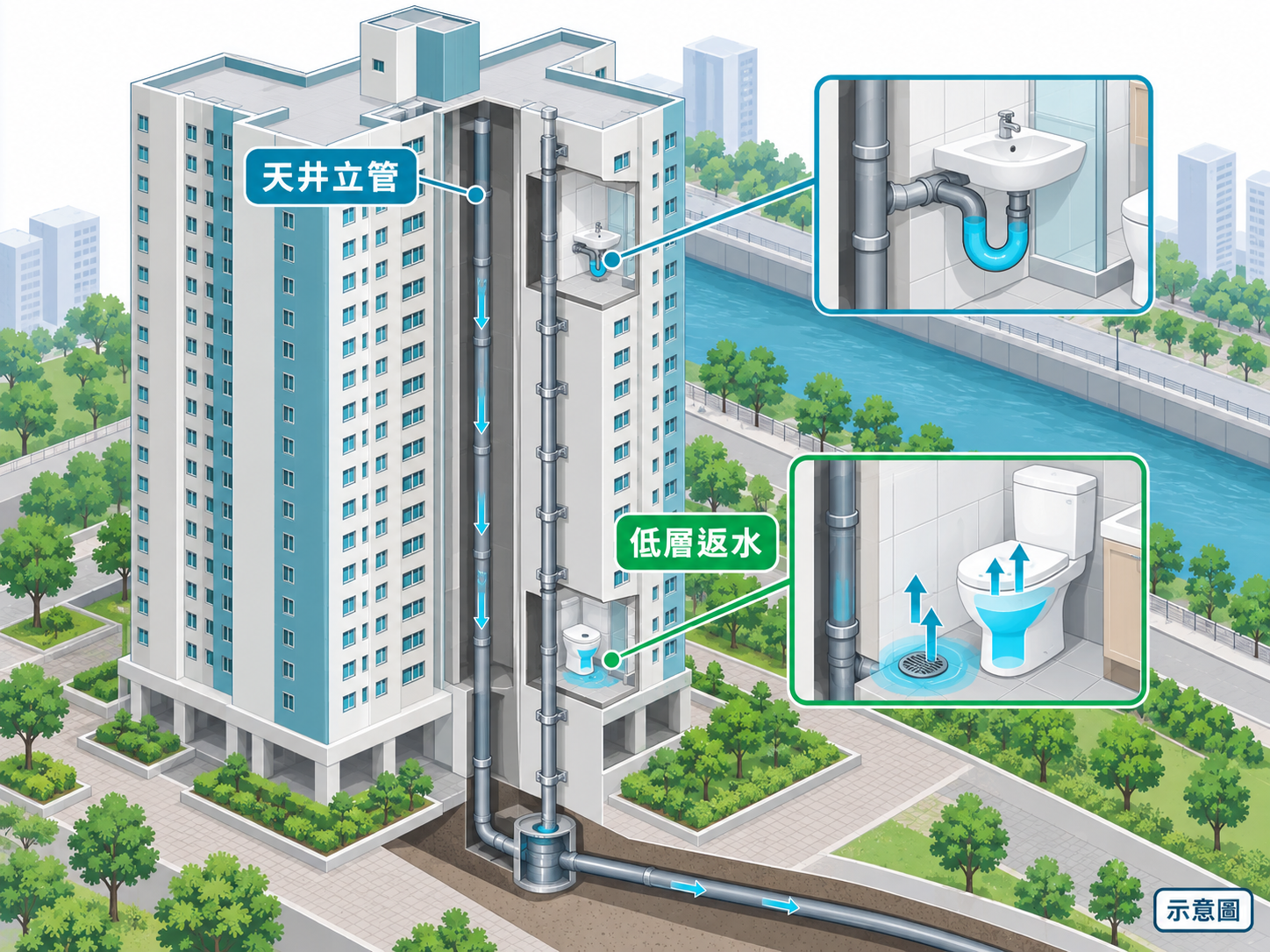
Most Concord 1 blocks are 40 storeys high, so one stack takes the waste from dozens of floors. By design, if the bottom of the stack, an offset bend or the outlet to the manhole is narrowed by grease, tissue or renovation debris, the toilet and floor drain of a low-floor flat are the first to see rising water or even overflow when floors above use a lot of water. If only one fixture is slow, the flat's branch pipe or trap is the more likely cause. If the toilet and floor drain back up together, or low-floor neighbours have the same problem, tell the management office at once; the branch pipes inside your flat can be checked separately by appointment.
According to Wikipedia, three-bedroom flats in third-generation Harmony blocks have one toilet with a bathtub plus a second toilet with no shower. If the second toilet is mostly used for storage, water rarely flows through its floor drain, the trap's water seal evaporates and sewer air comes back from the stack into the flat. The Buildings Department reminds residents to pour about half a litre of clean water into every floor drain at least once a week, and the same goes for a bathtub that is never used or an empty flat. If the smell remains after topping up, check whether the trap is damaged or was altered during renovation, or whether a branch-pipe joint is leaking.
After the foundation strengthening, Tin Fu Court Block J and Tin Chung Court Blocks K and L were not sold until 2007 and 2013 respectively. Sky Post reported in March 2013 that when the media were shown round flats in Tin Chung Block K, the pipes and windows had not been replaced, and a building surveyor who inspected one of the flats said the drain pipes were rusty; the Housing Department said at the time that badly corroded taps and poorly performing water heaters had been replaced, while undamaged items were kept for environmental reasons. It is reasonable to infer that the trap seals dried out long ago while the flats stood empty. If a flat has not been renovated since handover, or odour or slow draining began after moving in, check the traps, floor drains and branch-pipe joints one by one.
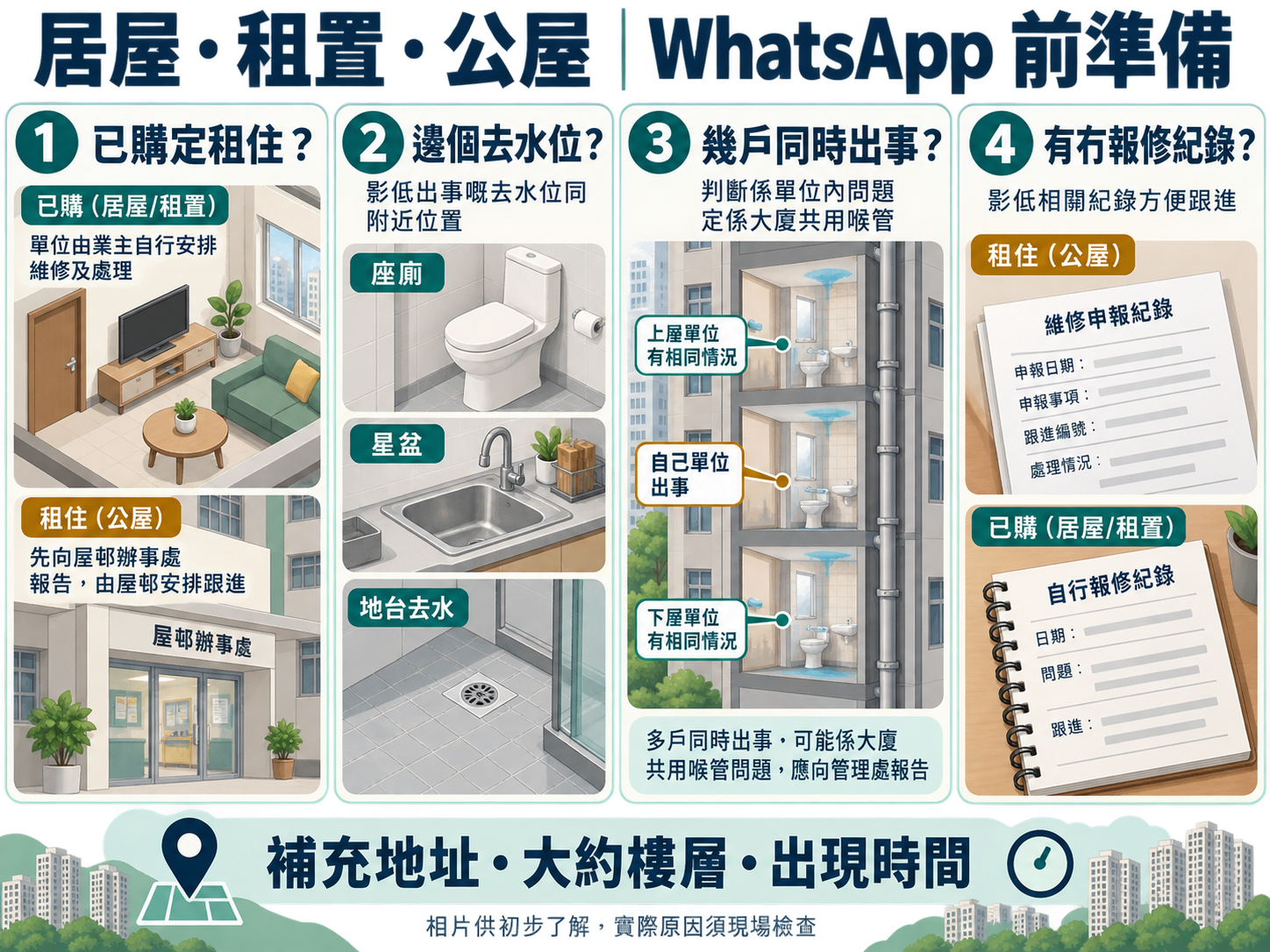
Photos or a short video on WhatsApp help us tell a single-fixture blockage from a shared-stack problem.
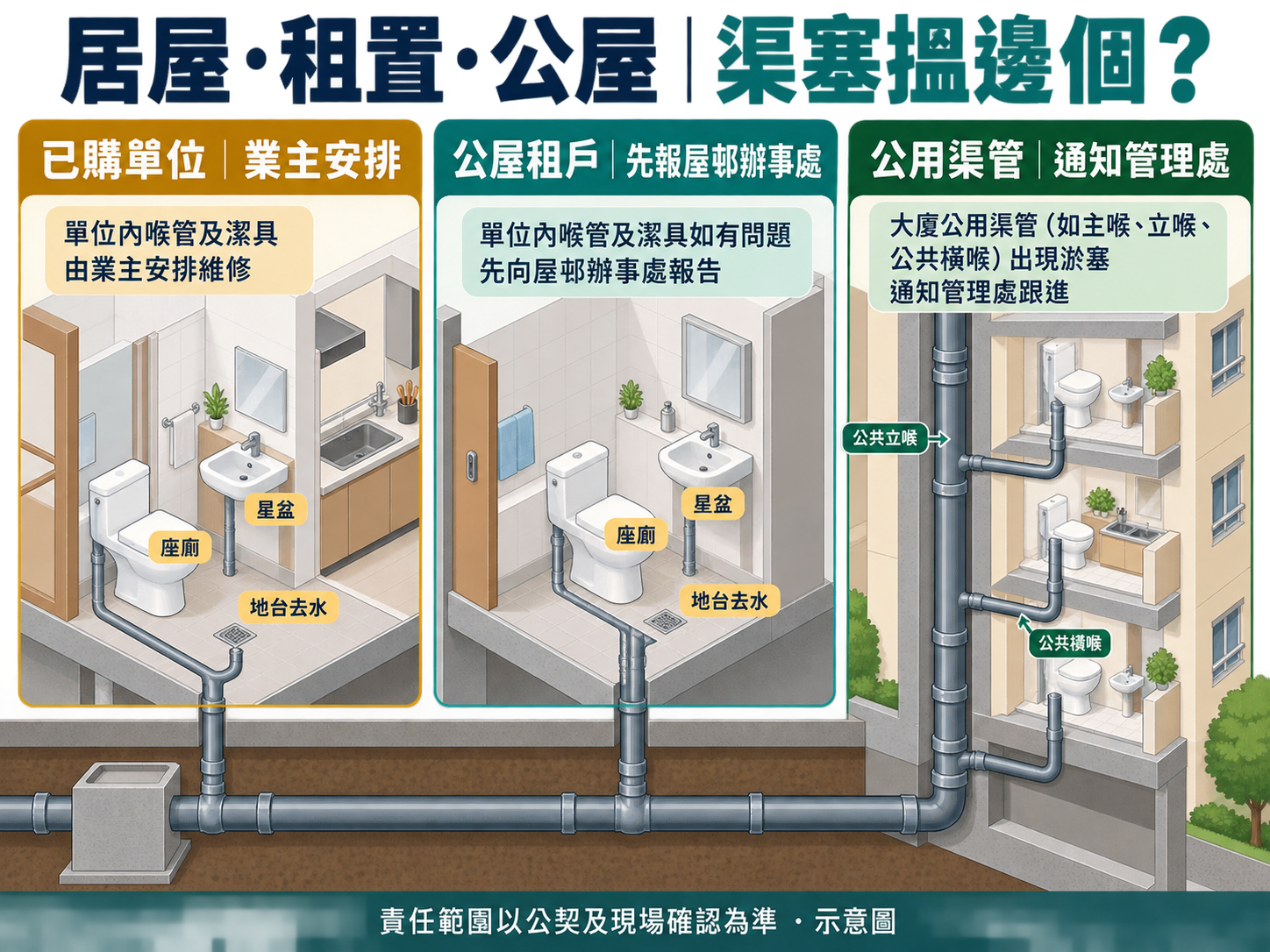
Tin Shing, Tin Chung, Tin Fu and Tin Lai Court are four of the Home Ownership Scheme courts the Housing Authority built in Tin Shui Wai, occupied between 1997 and 2000 with about 18,500 flats in total; the older and much smaller Tin Yau Court (1992) and Tin Oi Court (1993) are separate estates. Once sold, HOS flats are private property: the toilet, basin, kitchen sink, floor drains and branch pipes inside a flat are the owner's to repair, and owners cannot call the Housing Department to clear a blockage the way public-rental tenants can. The stacks, external pipes and the estate's underground drains are handled by the management office appointed by the owners' corporation. When a drain blocks, backs up or smells, first work out whether the fault is inside the flat or in a common part, then decide between unblocking, odour work or reporting it to management.
The four courts differ greatly in size. Tin Shing Court, occupied in 1999, has 17 blocks and 6,580 flats, the largest of the four. Tin Chung Court began occupation the same year with 15 blocks and 6,080 flats. Tin Fu Court, in Tin Shui Wai North, has been occupied since 2000 and has 16 blocks and 5,120 flats. Tin Lai Court is a single Harmony block completed in 1997 with 756 flats, next to the Tin Tsz public rental estate. Housing Authority records show that all four courts have formed owners' corporations, which appoint the management companies.
Tin Fu Court is entirely Concord-type blocks, while Tin Shing and Tin Chung mix Concord and Harmony blocks. According to Wikipedia, the Concord 1 block is cruciform, mostly 40 storeys high with 8 flats per floor, and has its drainage points at the light well. Third-generation Harmony blocks, completed from 1997 to 2002, moved the water supply, soil and WC vent pipes from the balcony to the external wall, and Tin Lai Court is one of these. By design, the soil stacks in both types mostly run vertically down a light well or an external wall. The pipes are exposed to sun and rain for years, and when joints and brackets age, residents often cannot tell from indoors; the first signs are usually water stains or a smell by the window.
Tin Fu Court Block J (Chui Fu House) and Tin Chung Court Blocks K and L (Chung Po House and Chung Ho House) needed foundation strengthening because of short piling. The Housing Authority's warranty records show that Block J was first offered for sale in 2007, and Blocks K and L not until 2013. The other blocks are about 26 to 29 years old in 2026. As a general inference from age, original traps, branch-pipe joints and external pipe fittings have reached the stage where they need watching, and many flats are likely to have been renovated once or twice, so pipe positions and trap types can vary from flat to flat within one block and each flat has to be checked on its own.
Note: statements based on building age and type are general inferences, not findings for any particular flat.
A clear process from enquiry and assessment to an agreed scope of work
Tell us the drain problem and district and ask about available timing.
Confirm timing based on the district and schedule, then inspect the blockage or odour issue.
Explain the proposed approach, scope and price before agreed work begins.
Use suitable tools for the site conditions and agreed scope of work.
After the agreed work, test drainage and explain the observed result and any next steps.
PipeButler is an independent drain-service provider with no affiliation to the developer, owners' corporation, management company or Housing Department of the places above. Facts come from public sources checked on the dates shown; work on common drains or common parts follows the management office's and deed of mutual covenant's arrangements.
WhatsApp with the problem and district, and we will confirm available timing.