
Loading page…
Loading page…
Lam Tin · Private estate
Completed 1990–1994 · 4 phases, 38 blocks, 8,072 flats · partly on reclaimed land
Laguna City, at 99 Cha Kwo Ling Road in Sai Tso Wan, Lam Tin, has 38 blocks and 8,072 flats in four phases, completed in batches between December 1990 and December 1994, so even the newest blocks are now more than 30 years old.
Last reviewed ·
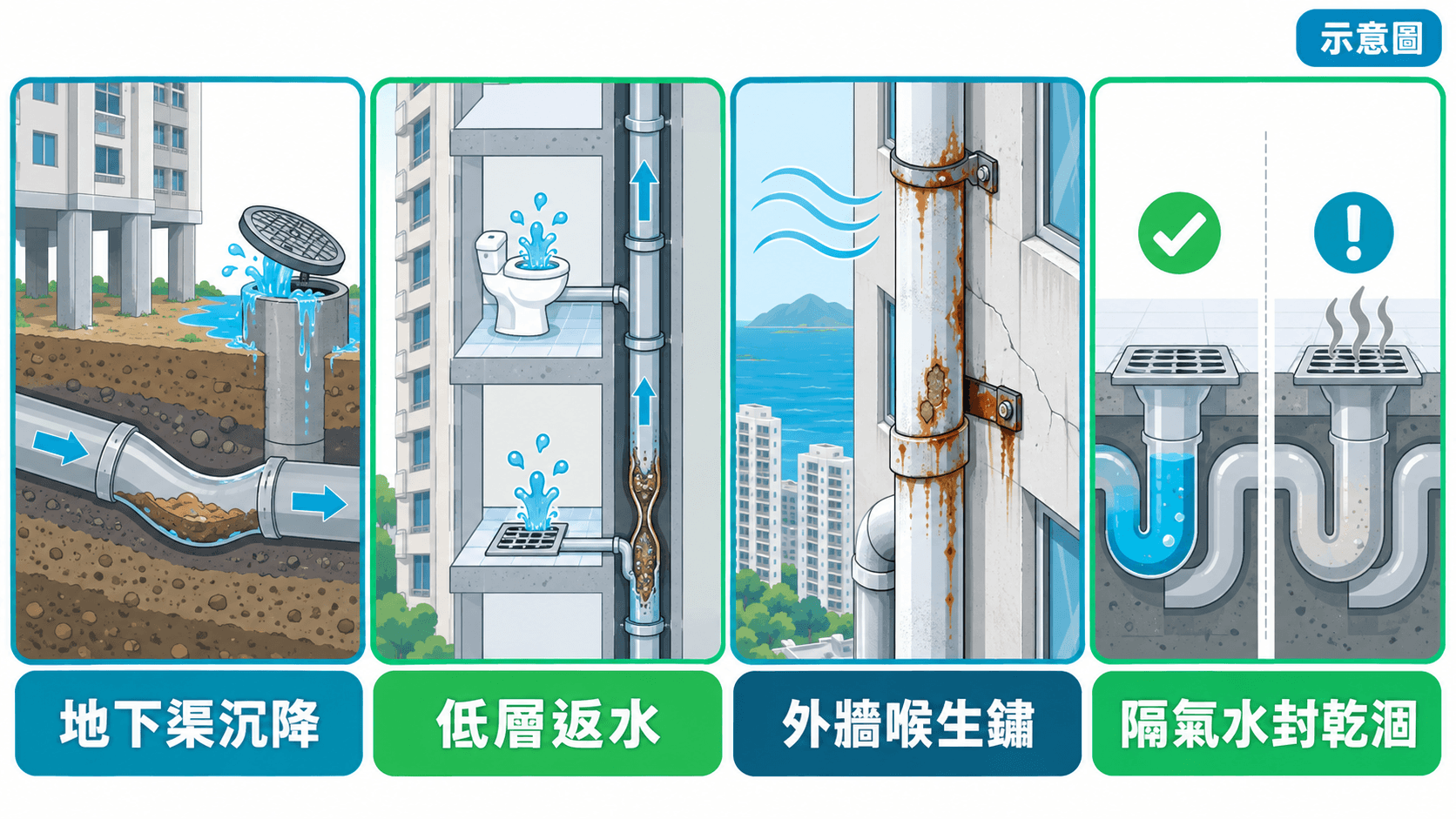
Choose the problem you are seeing to read the likely cause and next step.
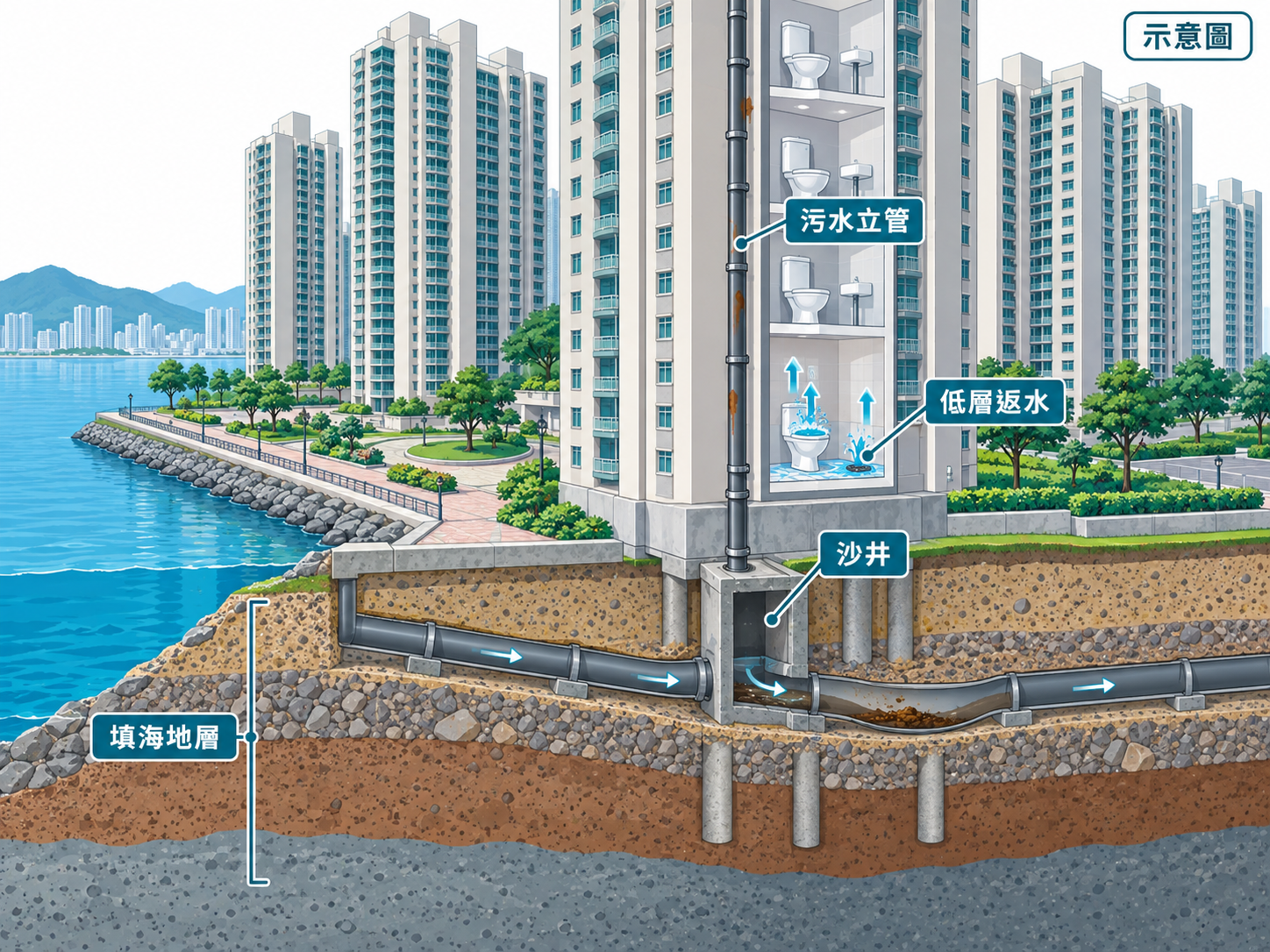
Part of the Laguna City site is land reclaimed and levelled in 1947 for the oil depot; separately, Wikipedia's Cha Kwo Ling article records that Blocks 36–38 and Laguna Street South were only built after the Cha Kwo Ling hill was removed. As an inference from the site history, high-rise towers usually stand on piles, but the estate's paving and buried drains do not necessarily move with the buildings. If the ground around a block settles slightly, underground drains can lose their fall and joints can be strained, so silt builds up more easily; signs include manholes overflowing at ground level, slow podium or car-park drains, and ground-level odour after rain. We found no public record of settlement at Laguna City. If you see these signs, note the location and time and tell the management office, which can arrange desilting or a CCTV survey.
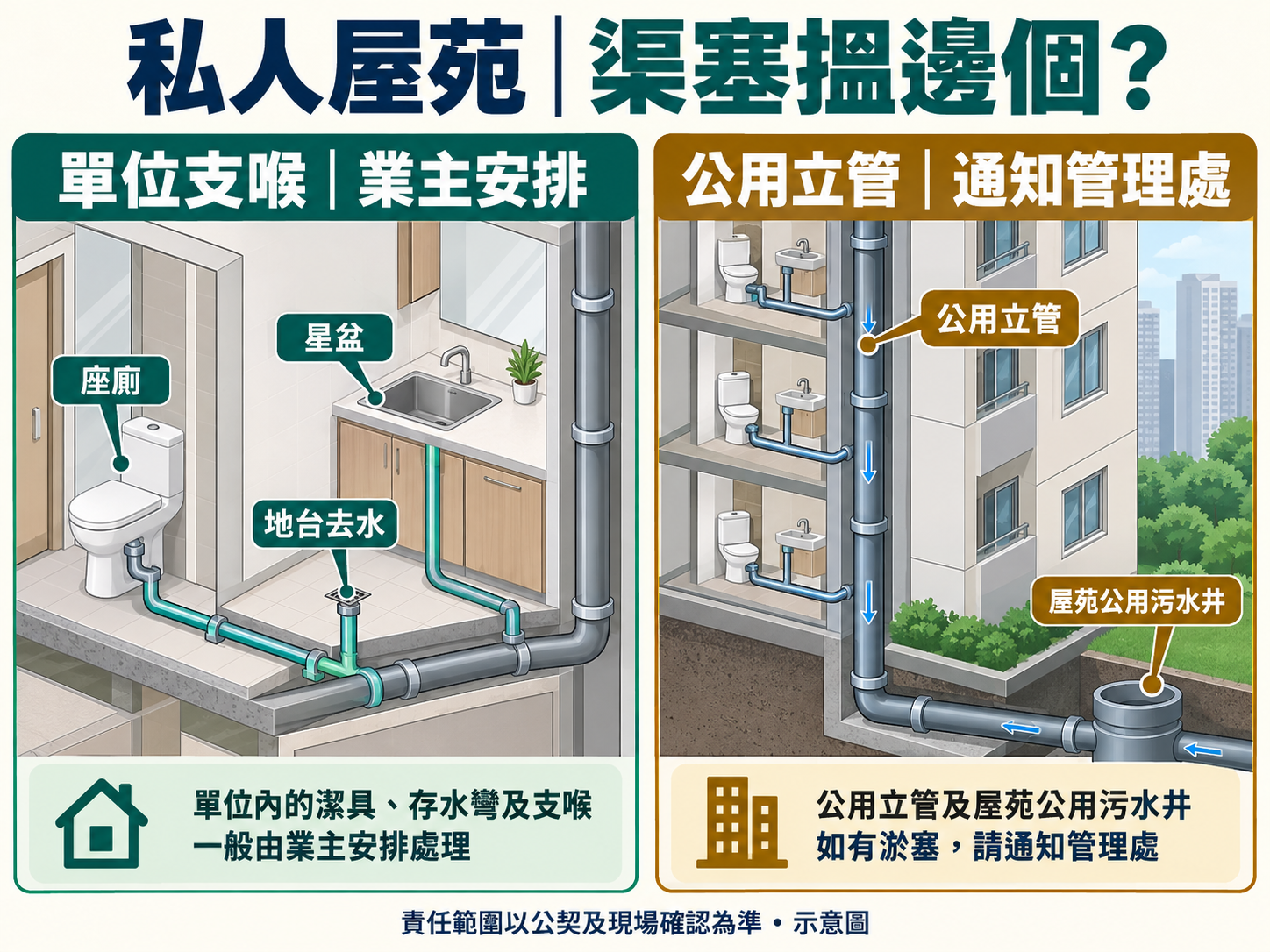
Each Laguna City block is 25 to 28 storeys. As an inference from high-rise design of this era, flats in the same vertical line normally share one soil stack. The Buildings Department's APP-164 of 2021 requires that in buildings over 20 storeys, fitments on the floor where the stack discharges to a manhole, and on the floor above, drain to the manhole through separate pipes instead of the stack. Laguna City was completed between 1990 and 1994, before requirements of this kind. Again as an inference from that design, once the stack base, a bend or the outlet manhole is narrowed by grease, wet wipes or renovation debris, water released from the upper floors of the same line has to find a way out on the lowest few floors: first a gurgle from the toilet, then a water level that creeps up, then a floor drain welling over. To tell the two apart, if a single fixture is slow, check your own branch pipe and trap first; if several fixtures in the flat, or the flats above and below, act up together, ask your phase's management office to look at the stack and the manhole.
Every Laguna City block is now over 30 years old, which meets the age threshold of the Buildings Department's Mandatory Building Inspection Scheme (an inspection is only required once a statutory notice is served), and the scheme's inspection covers drainage on external walls and in common parts. As an inference from the setting, salty sea air on the waterfront speeds up rusting of exposed iron pipes and metal brackets. If pipes outside your kitchen or bathroom window show rust stains, leaks or cracks, or the drain smell is strongest by the window, the fault may not be in your flat's outlets; take photos and report it to the management office so qualified people can assess the common pipes.
The estate is mostly two- and three-bedroom flats and, as an inference from building age, most will have been renovated over three decades. Fitting a shallower trap, removing an anti-syphonage pipe, or replacing a bathtub with a shower tray without a compliant trap can all break the water seal and let sewer air back in through the outlets. The Buildings Department says toilets, bathtubs or shower trays and floor drains must all have an effective water seal, that altering anti-syphonage pipes is minor works for a registered contractor, and that residents should pour about half a litre of water into every floor drain at least once a week. If your flat has a second bathroom that is rarely used, odour usually starts at its dried-out floor drain.
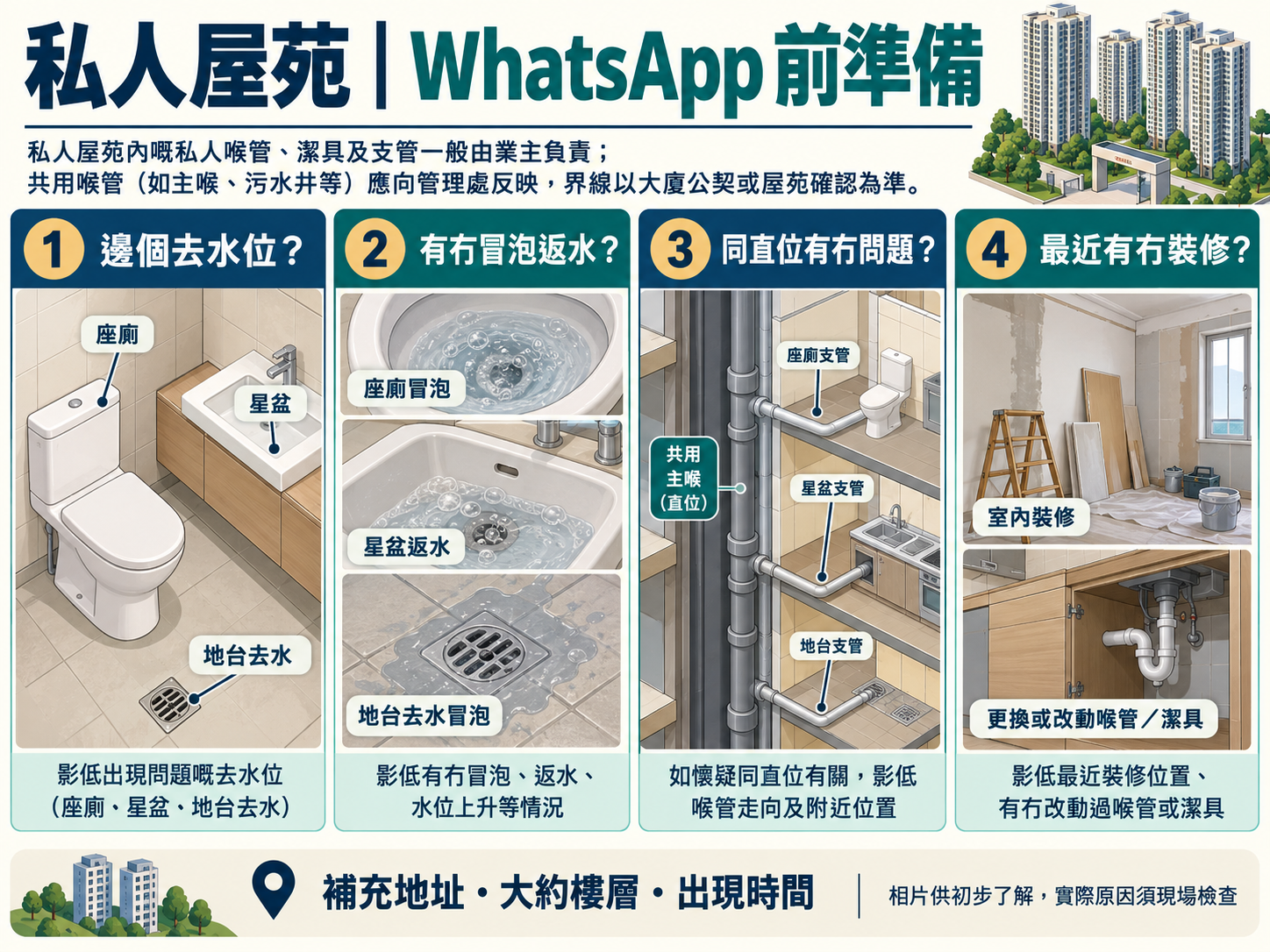
Photos or a short video on WhatsApp help us tell a single-fixture blockage from a shared-stack problem.
Laguna City, at 99 Cha Kwo Ling Road in Sai Tso Wan, Lam Tin, has 38 blocks and 8,072 flats in four phases, completed in batches between December 1990 and December 1994, so even the newest blocks are now more than 30 years old. The site was an oil depot built on land reclaimed and levelled in 1947, and the drainage design predates APP-93, the Buildings Department's drainage design requirements first issued in 1997. We found no public record of a specific drainage incident at Laguna City, so the issues on this page are inferred from building age, site history and design. If your flat smells of drains, drains slowly or backs up, first work out whether the cause is a trap or branch pipe inside the flat, or a shared pipe that your phase's management office is responsible for.
Laguna City has four phases. Phase 1 (Blocks 1–8 and 13–17) is next to Laguna Plaza; Phase 2 (Blocks 24–31) is closest to Lam Tin station; Phase 3 (Blocks 32–38) has its own clubhouse and two podium shopping arcades; Phase 4 (Blocks 9–12 and 18–23) is the newest. Flats are mainly two-bedroom (about 517 and 521 sq ft saleable) and three-bedroom (about 681 and 748 sq ft). The estate also has four car parks and three private streets, and the adjoining Laguna Park is managed by the Leisure and Cultural Services Department.
The site history is unusual for an urban estate. In 1947 the Asiatic Petroleum Company levelled slopes and reclaimed land between Sai Tso Wan and Cha Kwo Ling for an oil depot, covering what is now Laguna City and Laguna Park. The Sai Tso Wan resettlement area set up in 1974 stood on what is now Phase 2, and the Cha Kwo Ling temporary housing area set up in 1982 on what is now Phase 1, while Blocks 36–38 and Laguna Street South were only built after the Cha Kwo Ling hill was removed. In other words, the estate sits on a mix of reclaimed, levelled and cut ground, so conditions below ground are not uniform.
As an inference from building age, homes completed in the early 1990s were usually fitted with cast-iron or early plastic drain pipes, and over three decades most flats have been renovated, so branch pipes and traps vary from flat to flat. The Buildings Department first issued Practice Note APP-93 in August 1997, noting that older designs sometimes ran drains through private flats, so repairs meant entering homes and opening floor slabs; it therefore required common soil stacks in new buildings to sit in common parts. Laguna City's design predates that requirement, so how a particular pipe runs can only be confirmed on site.
The January 2021 events at Blocks 5 and 7 were a public-health investigation and compulsory testing, not a record of damaged drains (see the FAQ below). The issues below are all inferences, and the real situation has to be confirmed by an on-site check.
Note: statements based on building age and type are general inferences, not findings for any particular flat.
A clear process from enquiry and assessment to an agreed scope of work
Tell us the drain problem and district and ask about available timing.
Confirm timing based on the district and schedule, then inspect the blockage or odour issue.
Explain the proposed approach, scope and price before agreed work begins.
Use suitable tools for the site conditions and agreed scope of work.
After the agreed work, test drainage and explain the observed result and any next steps.
PipeButler is an independent drain-service provider with no affiliation to the developer, owners' corporation, management company or Housing Department of the places above. Facts come from public sources checked on the dates shown; work on common drains or common parts follows the management office's and deed of mutual covenant's arrangements.
WhatsApp with the problem and district, and we will confirm available timing.