Loading page…
Loading page…
Tin Shui Wai · Private estate · HOS / PSPS · Public rental housing
Developed from 1987 · about 94,850 households · nearly 60% public rental
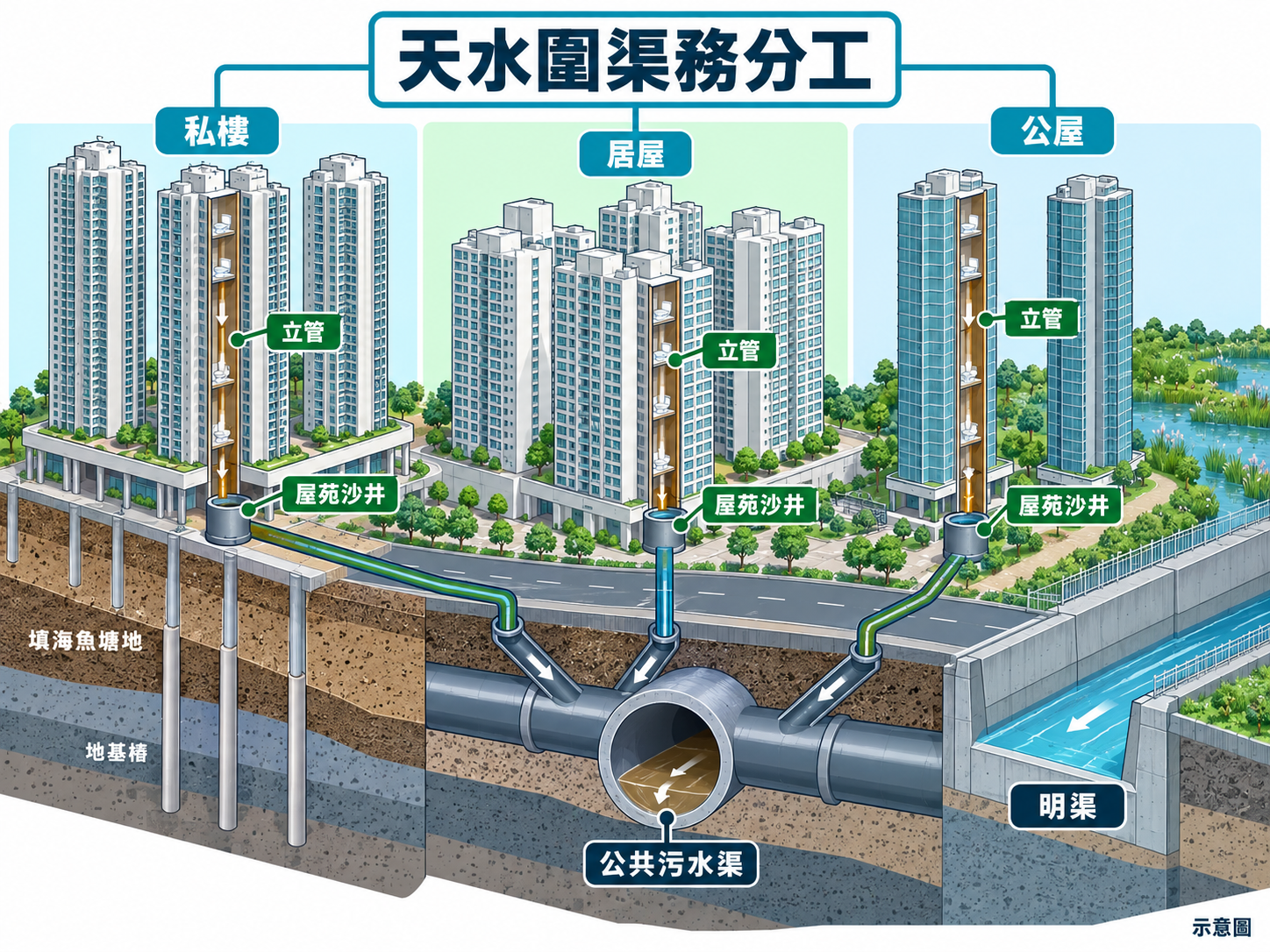
Most of Tin Shui Wai New Town stands on filled fishponds and low-lying land.
Last reviewed ·
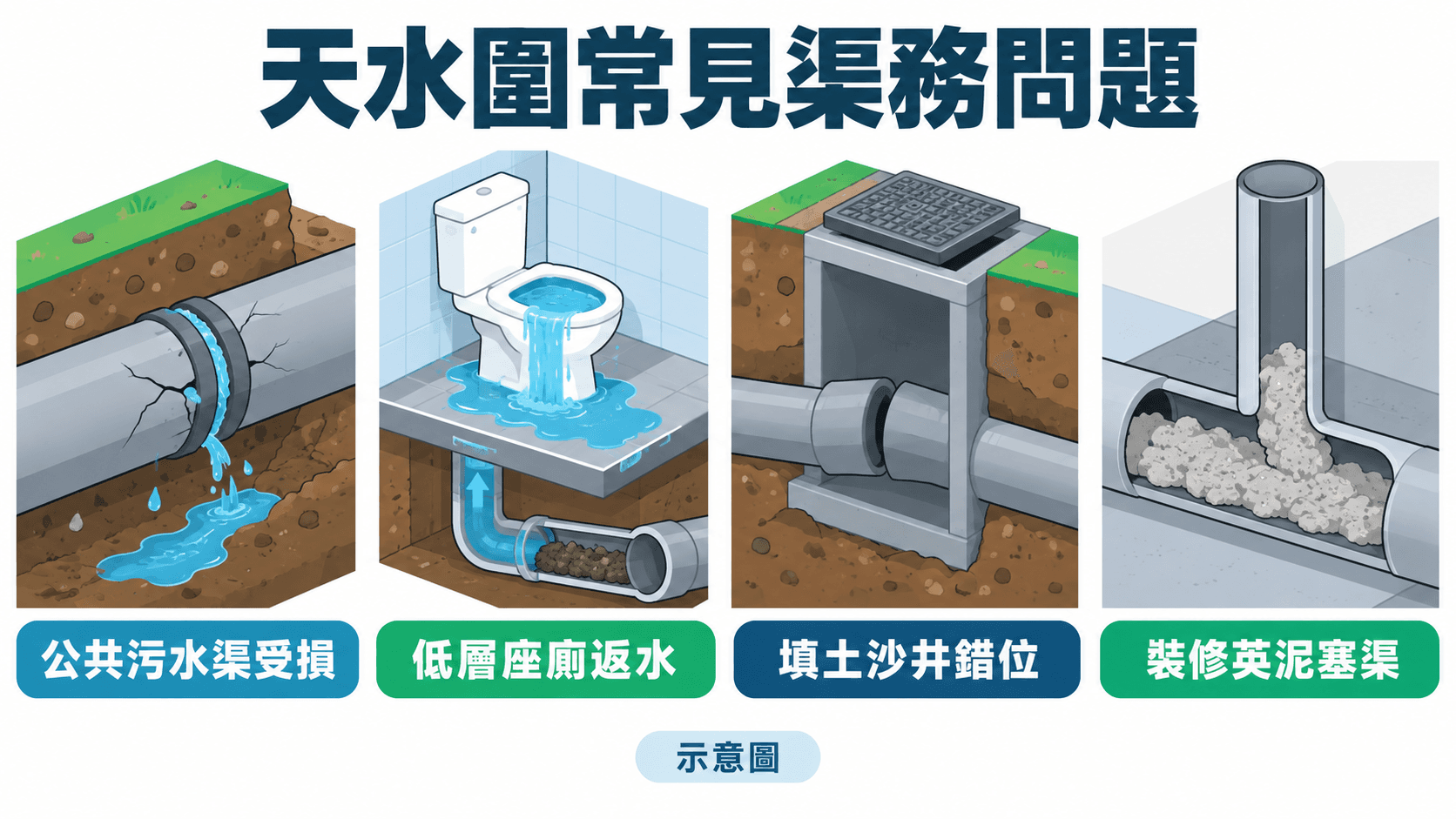
Choose the problem you are seeing to read the likely cause and next step.
On 20 October 2021 the Drainage Services Department announced that a sewer about 9 metres below ground and 2.1 metres in diameter under Tin Ying Road near Ping Ha Road had been damaged, causing the road to subside, and DSD had to divert sewage temporarily to the Yuen Long Sewage Treatment Works and the Tin Shui Wai Main Nullah. HK01 reported the same day that from the evening of the road collapse, residents of several estates had complained online of a foul smell, including people as far away as Tin Heng Estate and Grandeur Terrace, although the source had not been identified at the time. So when your neighbours notice the same smell, ask the management office or DSD first rather than rushing to clear the drains in your flat.
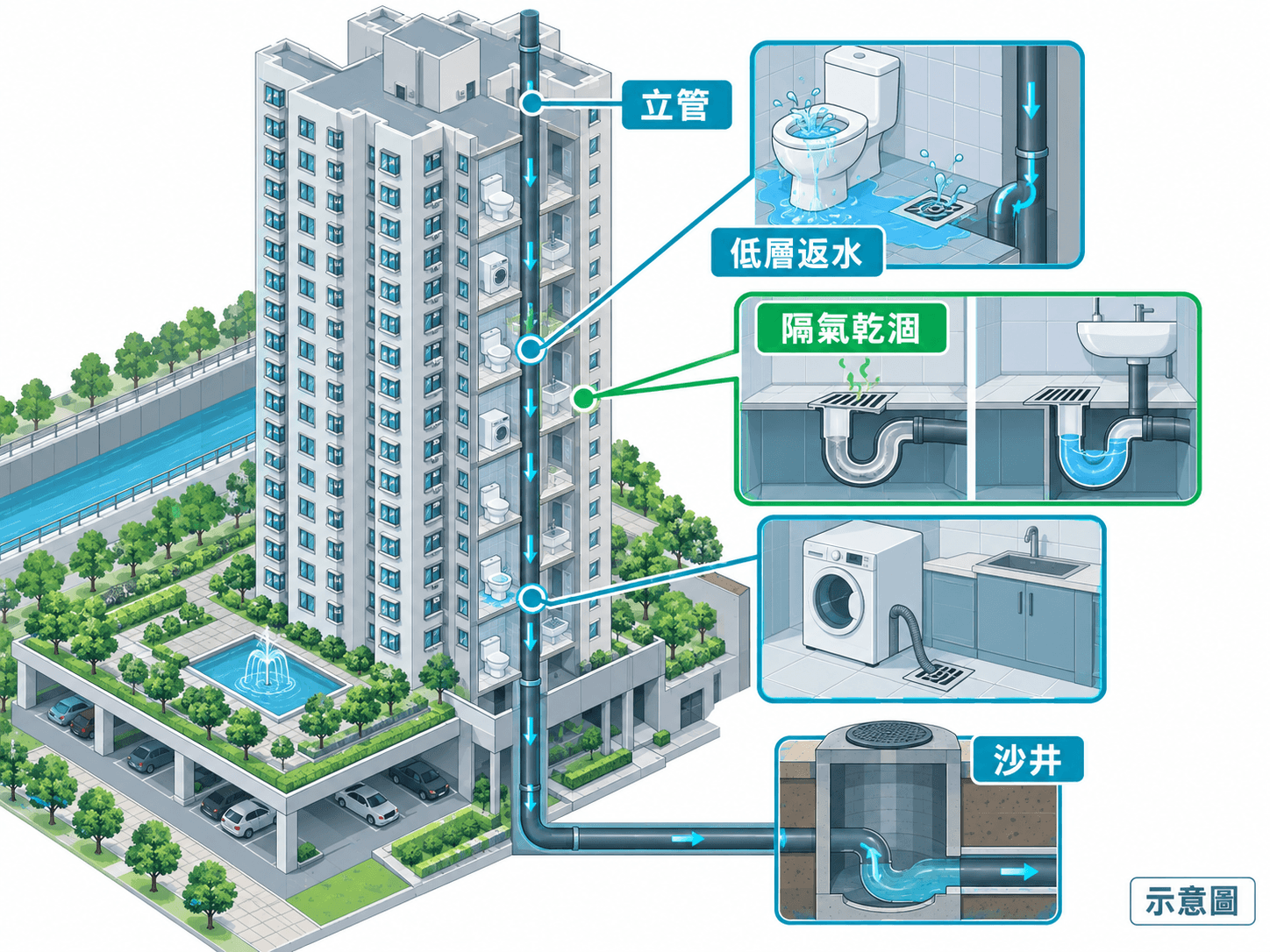
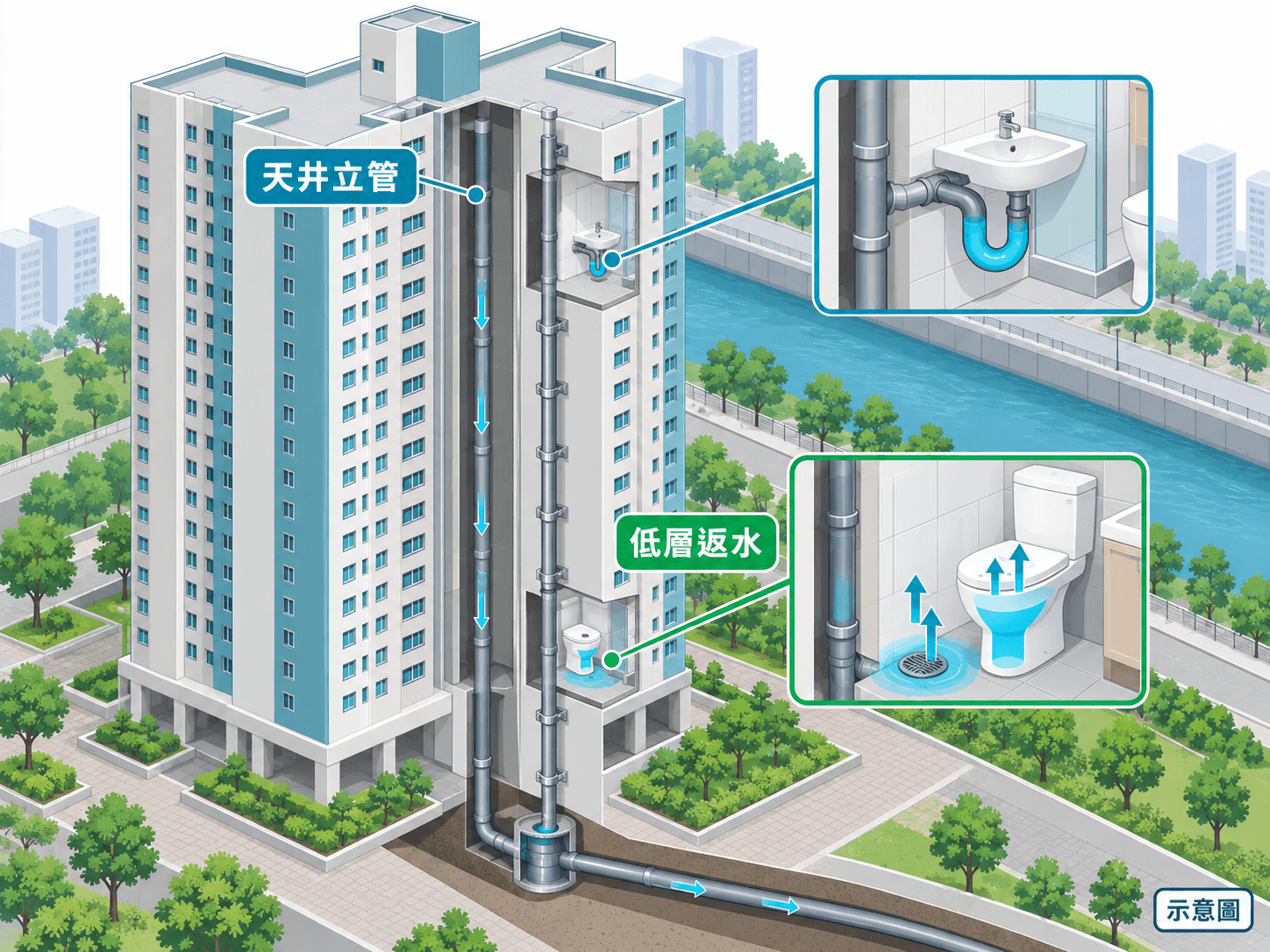
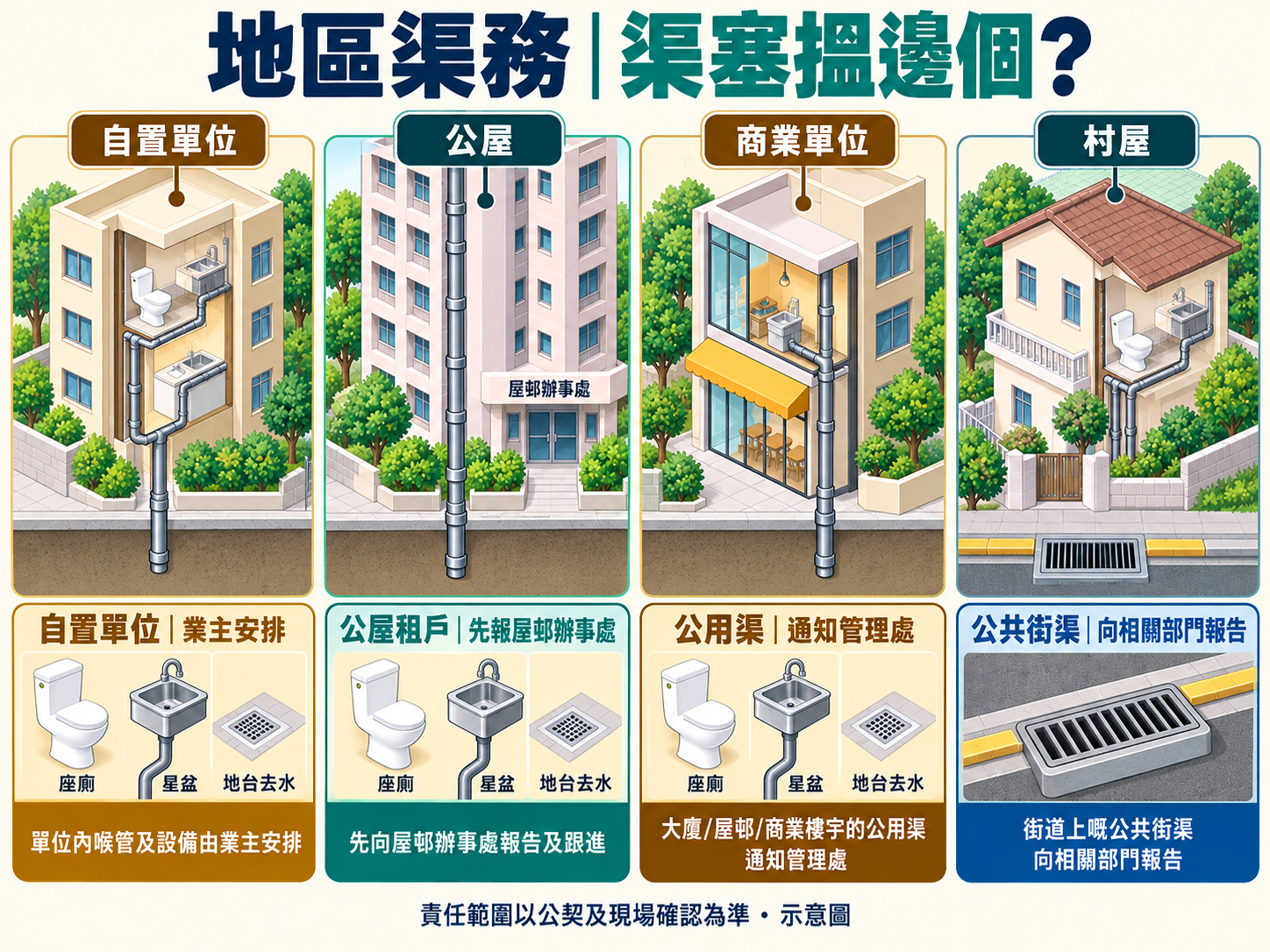
Oriental Daily reported in January 2010 that the Housing Department had selected 39 'high-risk' estates where sewage backflow had occurred in the previous two years, including Tin Wah Estate in Tin Shui Wai. Over three years it would check the drainage serving low-floor flats and study larger sewer diameters, steeper pipe falls and better venting; the department said blockages were often caused by residents throwing bulky items into the drains. Inferring from design, most blocks here are high-rise, so when the lower part of a stack is narrowed by grease, tissue or wet wipes, low-floor toilets and floor drains are the first to rise or back up as soon as the floors above use water. Public housing tenants should report backflow to the estate office as soon as it happens, noting when it is worst and whether the floors above are using water, so the department can tell a branch-pipe problem from a stack problem.
Inferring from the ground conditions, the towers in Tin Shui Wai stand on piles, but estate ground drains, podium drains and underground pipes are mostly laid on filled fishpond land, so after twenty or thirty years differential settlement between the pipes and the buildings can misalign manhole joints and flatten pipe falls, letting silt collect. In heavy rain, ground-level gullies and podium drains are then more likely to drain slowly or even overflow. These drains are common parts of the estate, so desilting and CCTV surveys are for the management office or owners' corporation to arrange; if only a floor drain inside your flat is slow, the cause is usually the flat's own branch pipe or trap.
New flats are still being occupied here — Wetland Seasons Park and Wetland Seasons Bay were handed over in phases from 2020 to 2022, and YOHO WEST was completed in 2024 — and renovating resale flats is common. Once cement, mortar or tile adhesive gets into an outlet and sets inside the pipe, drain-clearing tools may not shift it, and in bad cases the pipe has to be replaced. In an empty flat or during long renovation works, floor-drain traps also dry out through evaporation. The Buildings Department advises pouring about half a litre of water into every floor drain at least once a week; at handover or when works finish, run water into each outlet to check how fast it drains and whether it smells. Any alteration to the drainage system, anti-syphonage pipes included, must be carried out by a registered contractor under the Minor Works Control System.
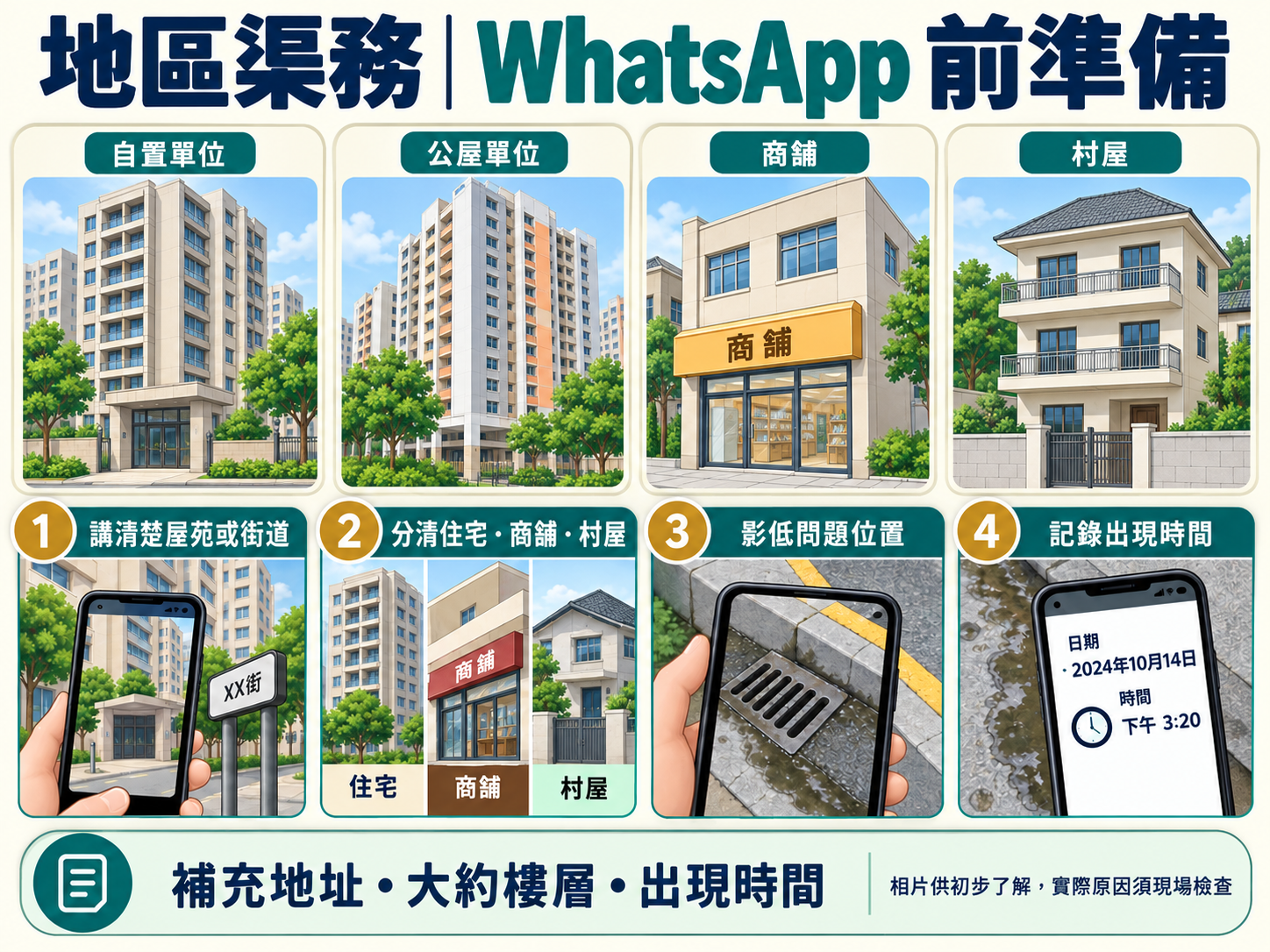
Photos or a short video on WhatsApp help us tell a single-fixture blockage from a shared-stack problem.
Most of Tin Shui Wai New Town stands on filled fishponds and low-lying land. Residents began moving in during the early 1990s, and Tin Wah Road divides the town into a southern and a northern part. The 2021 Population Census counted about 94,850 domestic households: nearly 60% in public rental housing, and roughly 20% each in subsidised ownership flats such as HOS and in private housing. Whether a blocked drain goes to the Housing Department, the management office or a contractor you hire depends on which of these you live in, and if several estates smell at the same time, the public sewers or the nullah need to be ruled out first.
Tin Shui Wai was once a large expanse of fishponds and wetland on the southern shore of Deep Bay. According to the Civil Engineering and Development Department, development of the new town began in 1987, and its roughly 406 hectares were formed mainly by filling low-lying land. The south (below Tin Wah Road) was developed first: Tin Yiu Estate was completed in 1992 and Kingswood Villas was occupied in phases through the 1990s. Main infrastructure for the northern Reserve Zone began only in July 1998 and was completed in stages from 2000 to 2004. Wikipedia records Tin Chung Court and Tin Wah Estate as occupied in 1999, with the following few years the peak for new estates in the north, which was planned as mainly high-density public housing.
Today three kinds of housing sit side by side. On the private side Kingswood Villas is much the largest; there is also Vianni Cove in the north, occupied in 2004, and Central Park Towers, whose 2,960 flats were taken up in two phases in early 2008 and in 2010. The newer additions are Wetland Seasons Park and Wetland Seasons Bay near the Wetland Park, occupied in phases from 2020 to 2022, and YOHO WEST above Tin Wing Light Rail stop, completed in 2024 with about 1,800 flats. HOS courts include Tin Shing, Tin Chung and Tin Fu; Kingswood Villas and the Tin Shui Wai HOS courts each have their own page, listed below. Public rental housing accounts for nearly 60% of households. Grandeur Terrace, Tin Yat and Tin Heng were planned as HOS and later let as public rental flats; inferring from that original HOS planning, the blocks were designed much like HOS courts, but repairs inside the flat follow public housing arrangements.
As a general inference from building age, the southern estates completed in the 1990s are now about 30 years old, and grease, soap scale and debris build up in their stacks year after year. Inferring from design, almost everything here is high-rise, flats in the same vertical line share a stack, and when the lower part of a stack narrows, low-floor flats feel it first. Paragraph 2(e) of the Buildings Department's practice note APP-164 provides that in a block over 20 storeys the sanitary fitments on the floor where the stack discharges to a manhole, and on the floor above it, must not be connected to the stack but taken to the manhole by separate pipework. Paragraph 3 limits that to drainage plans submitted for approval after 31 August 2021, a date later than almost every block in Tin Shui Wai, which therefore generally lacks that protection. Inferring from the ground conditions, estate ground drains laid in fill may also shift as the ground settles, as explained below.
Note: statements based on building age and type are general inferences, not findings for any particular flat.
A clear process from enquiry and assessment to an agreed scope of work
Tell us the drain problem and district and ask about available timing.
Confirm timing based on the district and schedule, then inspect the blockage or odour issue.
Explain the proposed approach, scope and price before agreed work begins.
Use suitable tools for the site conditions and agreed scope of work.
After the agreed work, test drainage and explain the observed result and any next steps.
PipeButler is an independent drain-service provider with no affiliation to the developer, owners' corporation, management company or Housing Department of the places above. Facts come from public sources checked on the dates shown; work on common drains or common parts follows the management office's and deed of mutual covenant's arrangements.
WhatsApp with the problem and district, and we will confirm available timing.