
Loading page…
Loading page…
Yuen Chau Kok · Private estate
Completed 1981–1988 in seven stages · 52 blocks · 10,642 flats
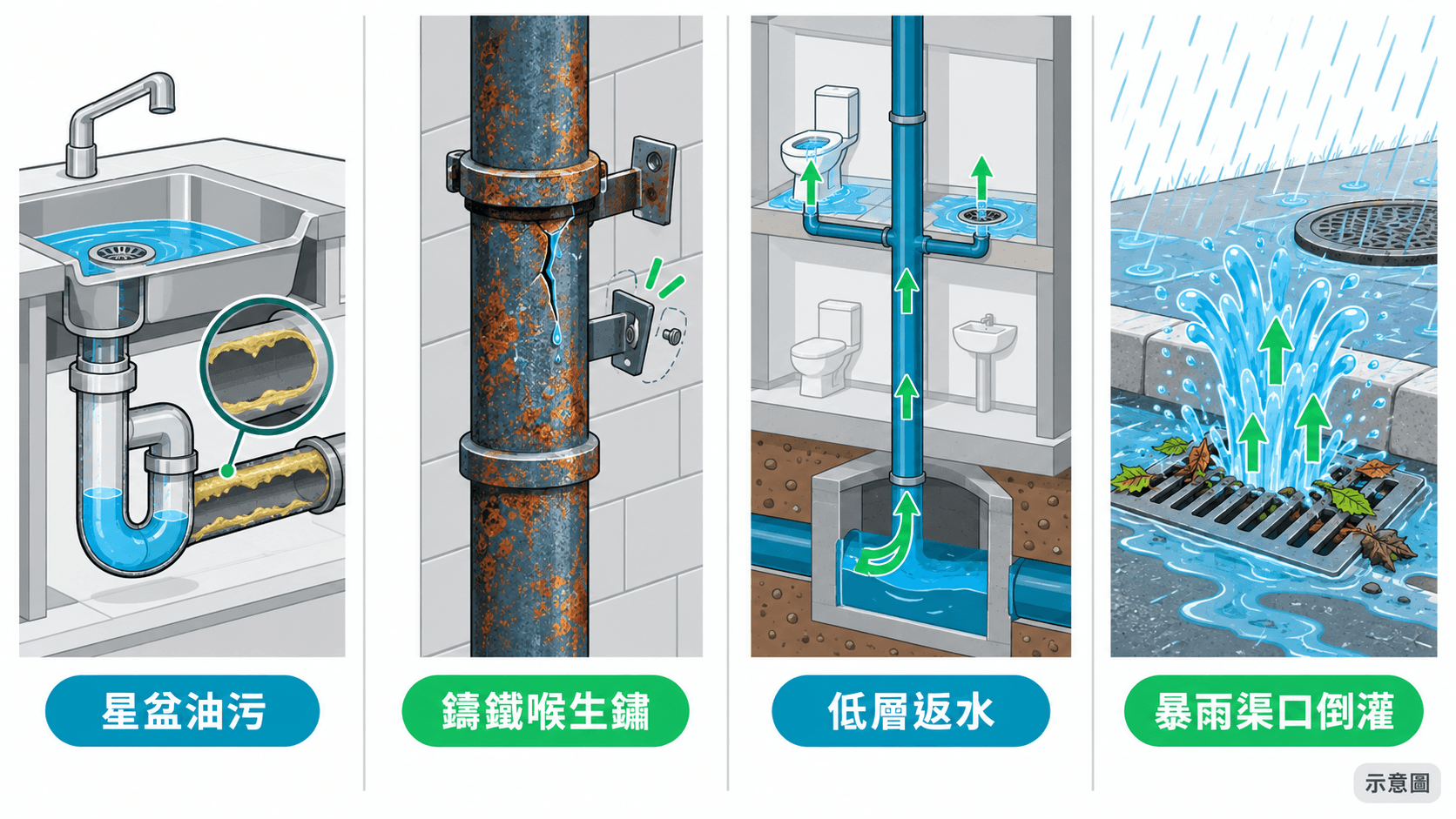
Choose the problem you are seeing to read the likely cause and next step.
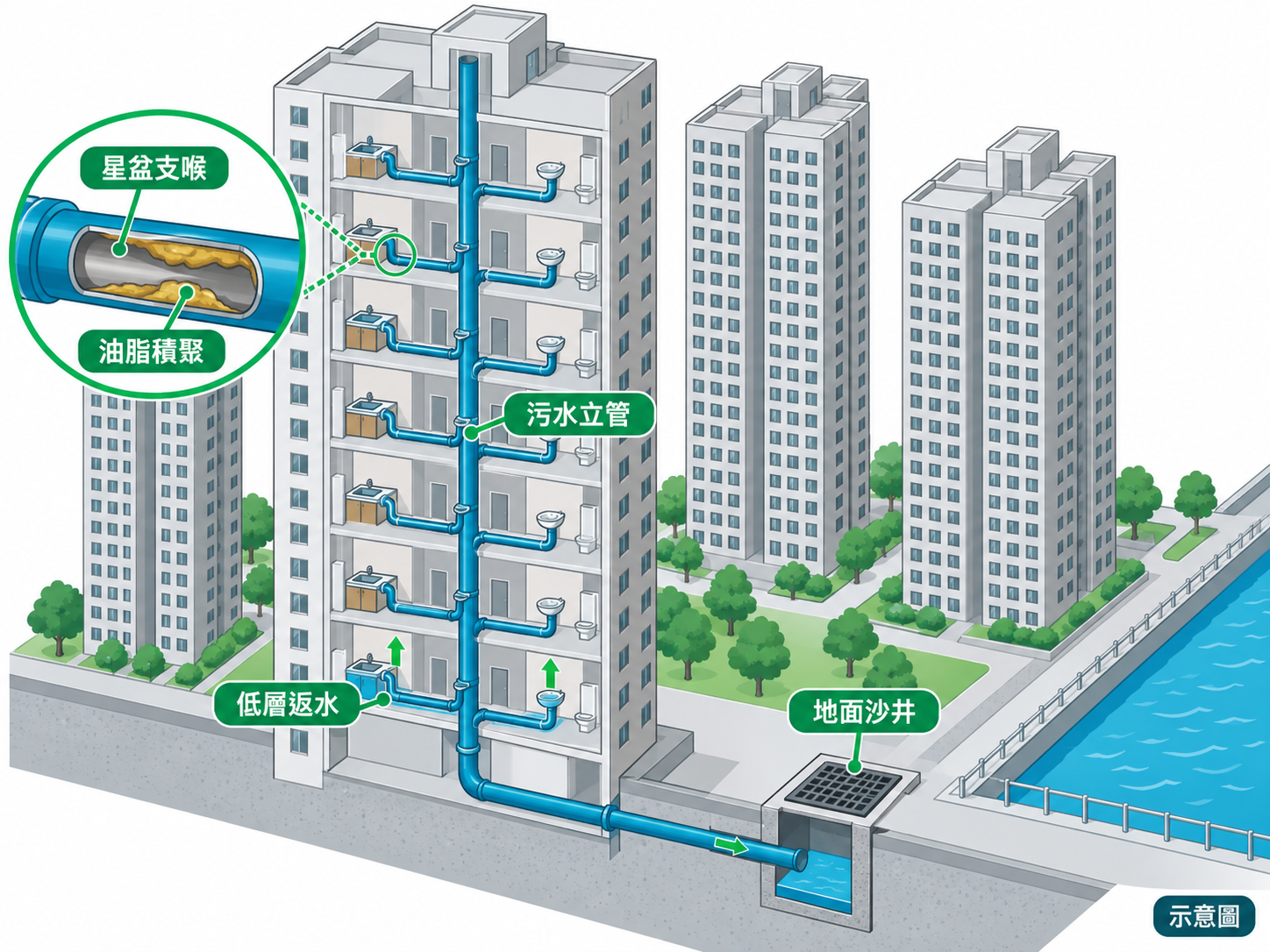
Flats here run from 389 to 1,018 sq ft, and in the smaller ones the kitchen is shallow and narrow, so washing up, scrubbing pans and rinsing vegetables all go through a single sink. The Environmental Protection Department notes that grease settles on the inside of pipes, reduces their capacity and causes overflows and odour. The first symptom is usually water that takes a moment to go down, then a stale cooking smell after washing up, and finally a sink that will not empty. At that stage drain cleaner tends to open only a narrow channel through the middle and the problem returns within weeks; the thorough approach is to check how much has built up in the trap and branch pipe, then decide between mechanical clearing and high-pressure jetting.
The Buildings Department's practice note APP-133 records premature rusting, leakage and corroded metal fixing supports in cast-iron pipes in some existing buildings. As a general inference from building age, the original stacks in the estate's stages are likely to be of that type; some blocks or flats will already have had sections replaced with plastic, others will not. So rust stains and water tracks on external pipes, hairline cracks, loose brackets or drips at joints should not be written off as normal for an old building — they are exactly what should be reported to the management office. The condition of the pipes serving any flat depends on that block's and that flat's repair history, not on which stage it belongs to.
The Buildings Department's APP-164 requires that in a new block over 20 storeys, fitments on the floor where the stack discharges to a manhole, and on the floor above, must not connect to the stack but have separate pipework straight to the manhole. That standard applies only from 31 August 2021, so blocks of 27 to 34 storeys completed in the 1980s were not built to that rule. Reasoning from that same layout, once the lower part of a stack or its outlet to the manhole is narrowed by grease and debris, low-floor toilets and bathroom floor drains are the first to rise when the floors above discharge. If only one fitment is slow, the flat's branch pipe is the likelier cause; if the toilet, floor drain and bathtub act up together and it is worst at peak hours, treat it as a shared stack and tell the management office first.
Sing Tao Headline reported on 30 May 2026 that during the yellow rainstorm warning on the evening of 29 May, several parts of Sha Tin flooded badly and Lion Rock Tunnel Road "turned into an ocean" — the footage described was shot near Tai Chung Kiu Road. At the underground bus terminus at New Town Plaza a drain cover surcharged, with the report describing water "gushing wildly and continuously from the outlet like a fountain" and suggesting the stormwater system was overloaded and the outlet partly blocked by silt washed in with the rain. Both were roads and public facilities elsewhere in Sha Tin, outside the estate, not City One's own pipes. Even so, the estate sits on reclaimed land beside the Shing Mun River, so it is worth checking ground-level and podium catchpits, planter outlets and manholes for leaves and silt before and after heavy rain. No street inside the estate appears in the Drainage Services Department's current list of locations prone to blockage for Sha Tin.
With blocks around forty years old and more than ten thousand flats stacked above one another, ceiling seepage queries are only to be expected in an estate of this age and density — we found no published figures for City One itself, and in any case seepage is not the same as a blockage. Since 16 July 2026 the Food and Environmental Hygiene Department and Buildings Department Joint Office has applied a new procedure: at the first stage it uses infrared thermography together with a moisture meter to identify the likely source, and where there is reason to believe the water comes from the flat above, it issues a repair advisory notice giving that owner 28 calendar days to check and repair. On a call-out we can help tell whether the staining comes from a leaking soil pipe, a surcharging rainwater pipe, or a burst fresh-water or flushing-water pipe — the last of these is a plumbing matter rather than a drainage one, and belongs with a plumber and the management office.
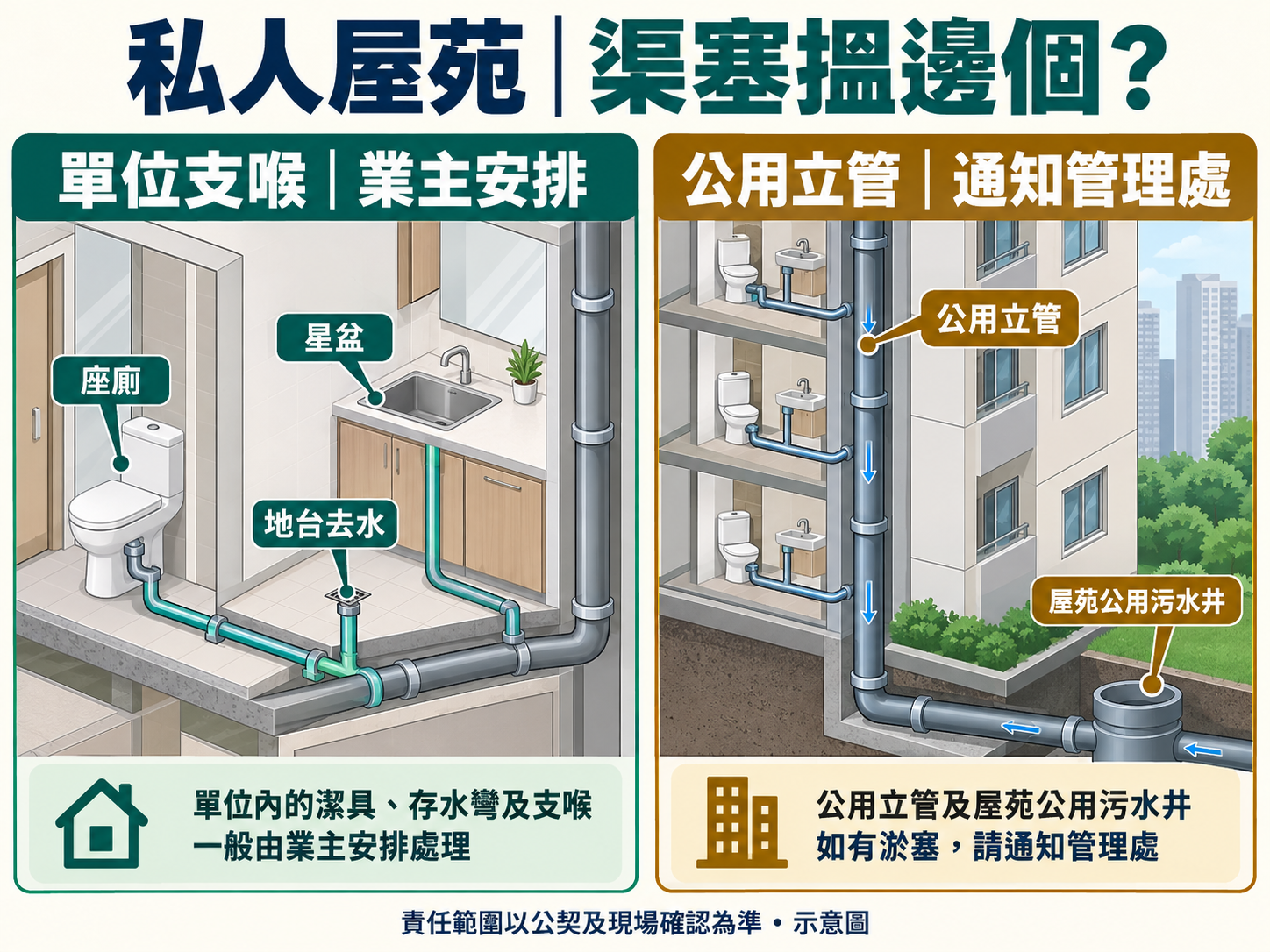
Photos or a short video on WhatsApp help us tell a single-fixture blockage from a shared-stack problem.
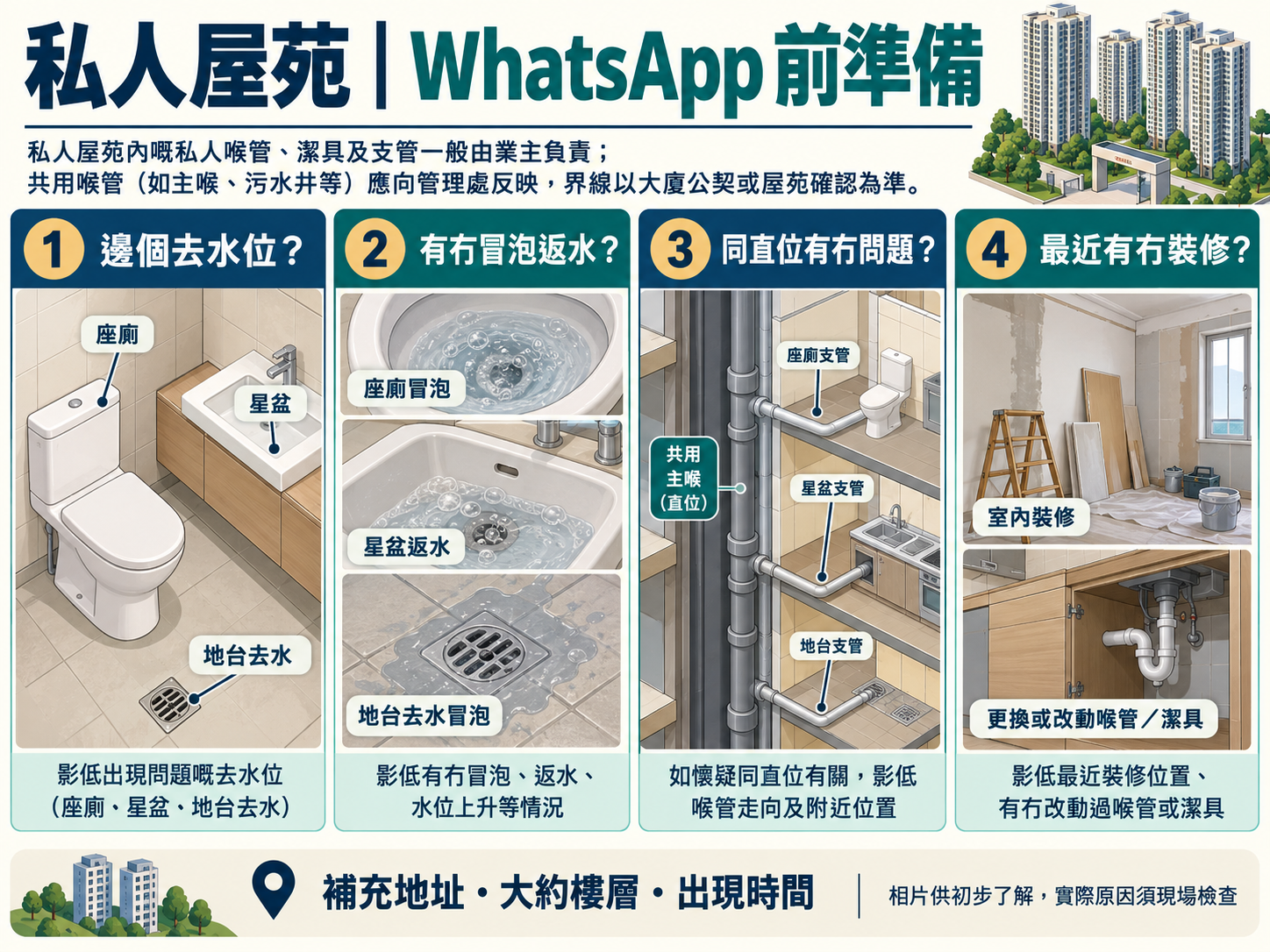
City One Shatin stands on reclaimed land at Yuen Chau Kok. Built in seven stages between 1981 and 1988, its 52 residential blocks of 27 to 34 storeys hold 10,642 flats, making it the largest private residential estate in Sha Tin District. The blocks come in four-, six- and eight-flat-per-floor types, and flats run from 389 to 1,018 sq ft (gross), so in the smaller flats the kitchen is shallow and there is usually a single sink, and grease and food waste settle easily in the branch pipe. When a drain runs slow, a smell appears or a low-floor flat backs up, the first step is not to pour in drain cleaner but to work out whether the fault is inside the flat, in its traps and branch pipes, or in the shared stack, podium and ground-level manholes.
The site was part of Tide Cove at Yuen Chau Kok until reclamation began in the 1970s, and the seven stages ran from August 1981 (Blocks 1–14) to January 1988 (Blocks 34–36). So within one estate the oldest and newest blocks are almost seven years apart, and it follows from that spread that their original pipe specifications and their later repair and replacement histories need not be the same. "The whole estate is old" is not a diagnosis for any particular block, and giving your block number and floor when you report a fault is far more useful than giving the estate name.
As a general inference from building age, high-rise blocks completed in the 1980s were normally built with cast-iron or galvanised-steel soil and waste stacks, and after forty-odd years some sections will have been replaced with plastic. The Buildings Department's practice note APP-133 records that cast-iron pipes in some existing buildings have shown premature rusting, leakage and corroded fixing supports. Once the bore of a cast-iron pipe roughens with rust, grease clings to it more readily, and the Environmental Protection Department notes that grease deposits reduce the capacity of pipes and cause overflows and odour. Flats here run from 389 to 1,018 sq ft, with a shallow kitchen and usually a single sink in the smaller ones but no small amount of cooking, so on that reasoning the kitchen branch pipe and the kitchen waste stack are the likeliest place for trouble to recur.
The blocks come in four-, six- and eight-flat-per-floor types. Inferring from that layout, the eight-flat lines have the most branch pipes joining each stack on each floor, so pressure swings inside the stack at morning and evening peaks are larger, and low-floor flats are more likely to see the toilet water level rise, the floor drain bubble, or water back up. New buildings today must follow the Buildings Department's APP-164: in a block over 20 storeys, fitments on the floor where the stack discharges to a manhole, and on the floor above, must not connect to the stack but need separate pipework straight to the manhole. That standard only applies to plans submitted after 31 August 2021, so blocks completed in the 1980s were not built to that rule. The estate also sits on reclaimed land beside the Shing Mun River, which makes the ground-level and podium catchpits and manholes worth watching too.
Note: statements based on building age and type are general inferences, not findings for any particular flat.
A clear process from enquiry and assessment to an agreed scope of work
Tell us the drain problem and district and ask about available timing.
Confirm timing based on the district and schedule, then inspect the blockage or odour issue.
Explain the proposed approach, scope and price before agreed work begins.
Use suitable tools for the site conditions and agreed scope of work.
After the agreed work, test drainage and explain the observed result and any next steps.
PipeButler is an independent drain-service provider with no affiliation to the developer, owners' corporation, management company or Housing Department of the places above. Facts come from public sources checked on the dates shown; work on common drains or common parts follows the management office's and deed of mutual covenant's arrangements.
WhatsApp with the problem and district, and we will confirm available timing.