
Loading page…
Loading page…
Ma On Shan · Private estate · HOS / PSPS · Tenants Purchase Scheme estate · Public rental housing · Village houses
First estate occupied 1987 · population 210,356 in 2021 · five tenures, five routes
Ma On Shan is the north-eastern extension of Sha Tin New Town: per the Chinese Wikipedia, the Government approved its development in 1979, and by 2021 the new town's population had reached 210,356.
Last reviewed ·
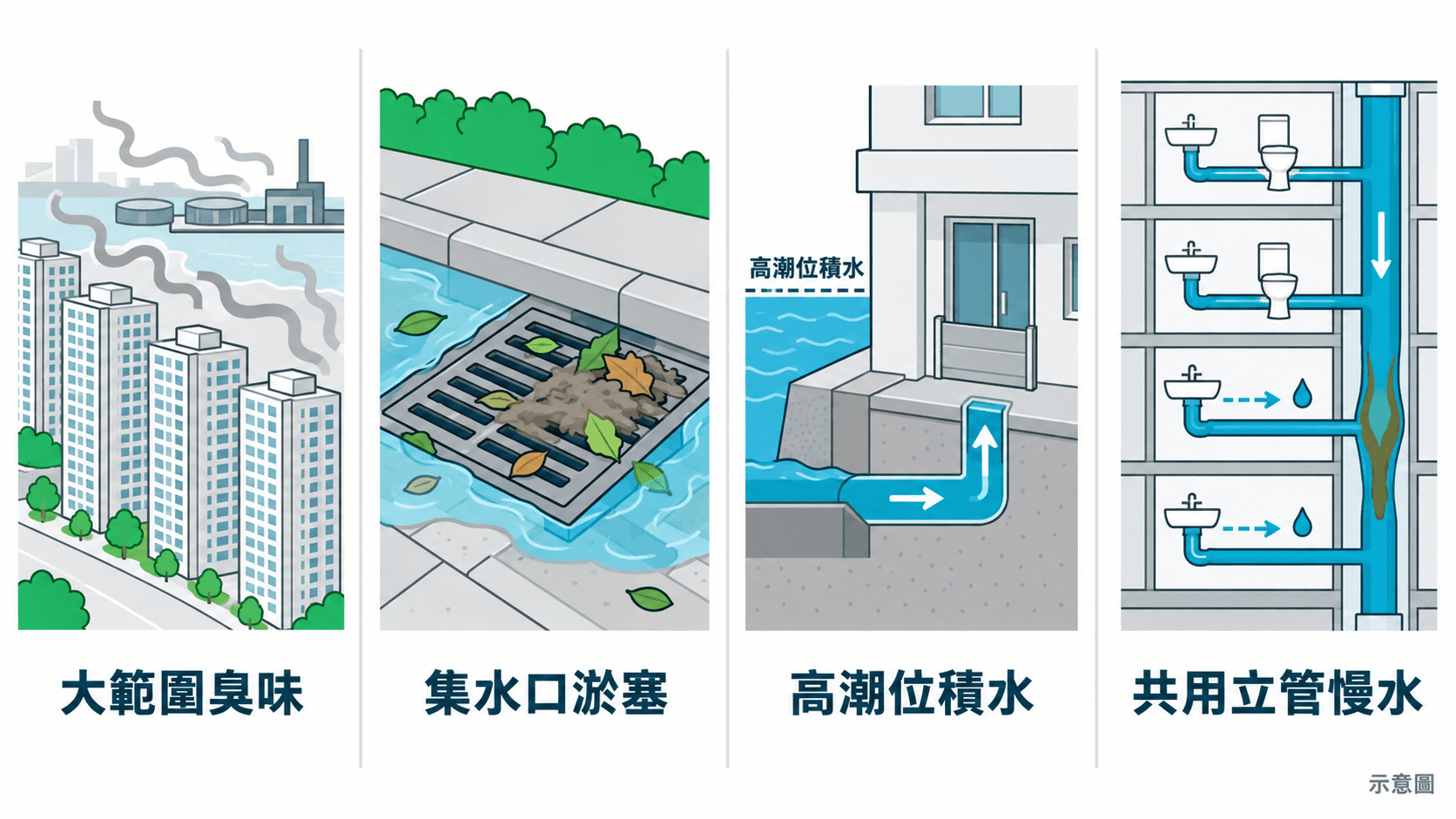
Choose the problem you are seeing to read the likely cause and next step.
According to a Hong Kong 01 report of 26 May 2024, a section of pipe in the sludge and food-waste co-digestion system at Sha Tin Sewage Treatment Works failed, a small amount of sludge overflowed within the plant, and the stench spread "from Sha Tin to Ma On Shan"; that evening the Drainage Services Department said the clean-up was finished and the facility shut down, and apologised for the effect on residents of Sha Tin and Ma On Shan. The episode suggests a useful order of checks. If neighbours, the mall downstairs and the footbridges all smell it at the same time, and pouring water into every outlet at home changes nothing, the source is probably outdoors: note the time and wind direction and tell the management office. If the smell is confined to your flat and grows stronger with the bathroom door shut and the fan running, look at the water seals in the floor drain and the basin trap.
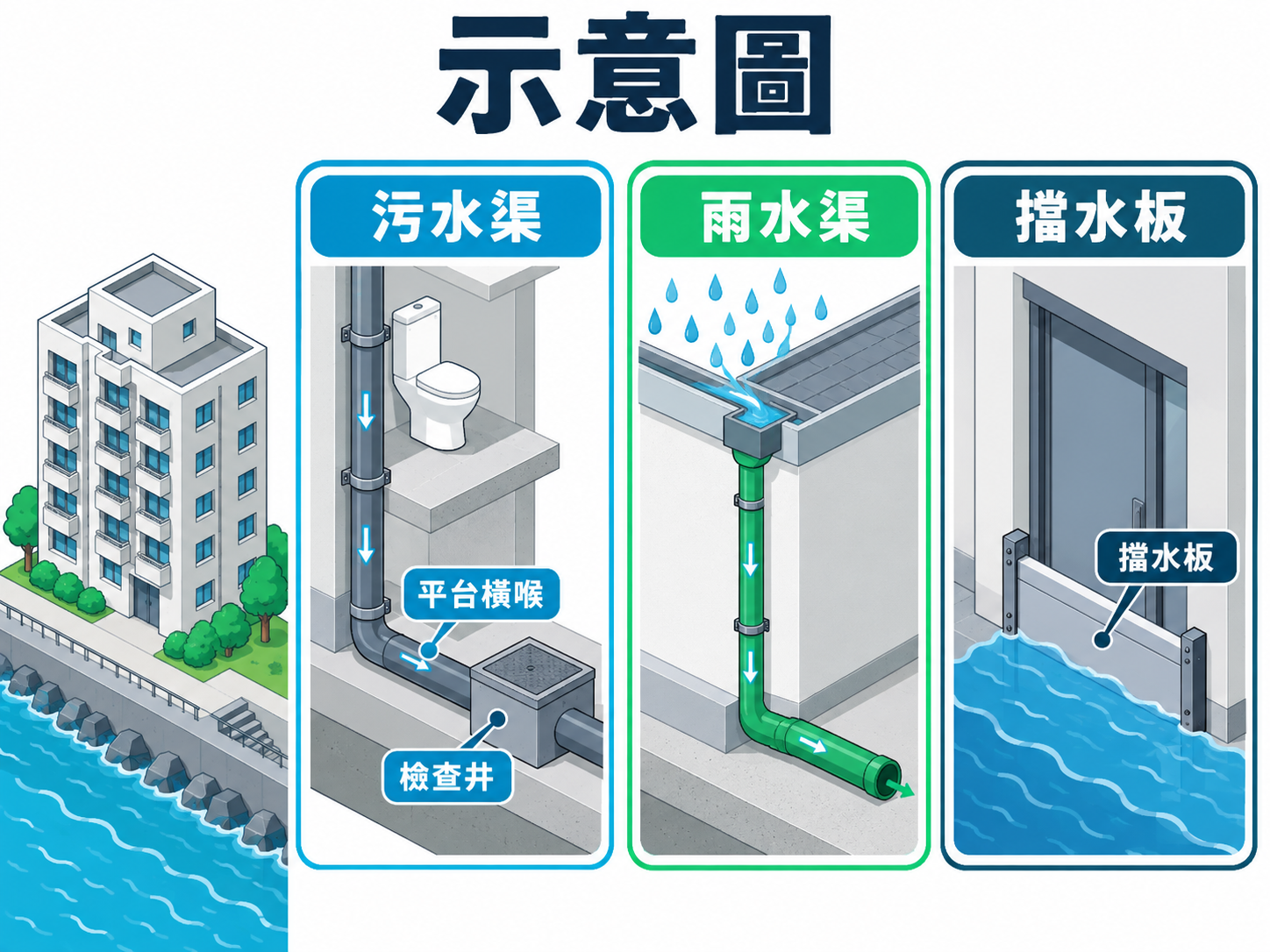
The Drainage Services Department's list of locations prone to blockage names eleven sites in Sha Tin District, and only one of them lies in Ma On Shan: the catchpit on On Shan Lane near the Ma On Shan ambulance depot. That one entry happens to illustrate a distinction many people miss. A catchpit takes street rainwater and carries it on to an outfall, while the water from your toilet and kitchen sink runs in a separate foul sewer that a pumping station sends to a treatment works; in normal conditions the two never meet. So when water sits on On Shan Lane, a pavement, a podium or a car-park entrance during heavy rain, the usual cause is a gully sealed over with silt and leaves, and the call goes to the management office or the department; a floor drain welling up indoors with a drain smell belongs instead to the foul side. Reporting to the wrong place costs days, so keep the two separate: where, what time, how hard it was raining, and a photo of each.
Of the 26 coastal low-lying or windy residential areas identified in the Civil Engineering and Development Department's coastal hazard study, item 18 is To Tau Wan Village in Ma On Shan, for which the proposed measures are demountable flood boards in front of residents' buildings plus management measures. The study also notes that Tolo Harbour is sheltered enough for wind waves to stay relatively small, but its coastal setting is more affected by inner-bay effects. Note what the study is about: storm surge, wave overtopping and seawater inundation — and on that list of 26 locations, To Tau Wan Village is the only one in Sha Tin District. By drainage reasoning — not a finding of the study — what low-floor flats by the water, podium shops and village houses usually meet is not big waves but a high tide that makes rainwater slow to discharge, so water stands on the ground and can back up through low-level outlets. Before the typhoon season, check that outdoor manhole covers are secure, that ground gullies are not sealed over with silt and leaves, and where the flood boards and sandbags are kept — all of it more useful than pumping out afterwards.
According to a Sing Tao Headline report of 14 May 2025, estates in Ma On Shan posted notices about people sending phone messages posing as the owner of the flat below, using the line "water is seeping through my ceiling and the management office told me to discuss it with you" to get the recipient onto WhatsApp; the estates concerned were Fu Po Garden and Kam Lung Court. Sha Tin North District Council member Anna Law Yi Lam told the paper that more than ten residents at Fu Po Garden and about three or four at Kam Lung Court had received the messages, and that on enquiry the police told her they had taken four to five similar reports in Ma On Shan; the notice at Kam Lung Court stressed that the management office "will never disclose any personal data to another owner without consent". So the first move on receiving such a message is not to arrange a visit but to ring the management office and verify it. Once a leak really is confirmed, work through three possibilities in turn: clean water dripping steadily, more or less regardless of whether anyone is using water, points to a supply pipe; a stain that appears only a while after someone has showered points to the bathroom waterproofing; and a leak that worsens the moment a toilet is flushed or a sink run, with a drain smell alongside it, is the one that points to the waste pipe. The way each is tested, the work it needs and who pays for it all differ, so establish which it is before anyone starts cutting — do not open the conversation with "the drain has burst".
The two large public estates in Ma On Shan use two generations of standard design: Heng On Estate, occupied in 1987, was Hong Kong's first Y3 estate, and Lee On Estate, occupied in 1993, is the only estate in Hong Kong built entirely of Harmony 2 blocks. Both generations repeat one standard plan, and by design the kitchens and bathrooms of neighbouring flats are lined up together on a limited number of shared stacks — which means the place that is actually blocked is often not your flat but a floor somewhere below you. The signs are recognisable enough: ask the neighbours in your line and find that everyone has noticed things slowing lately, or watch your own toilet, floor drain and kitchen sink all go slow together, worst while the flats above are showering or doing laundry. When that is the picture, tell the estate office or management office plainly that you suspect the building stack and that more than one flat is affected. Do not reach for drain cleaner at this stage either: the chemical sits trapped above the blockage, and whoever opens the pipe next can be burnt by what sprays out.
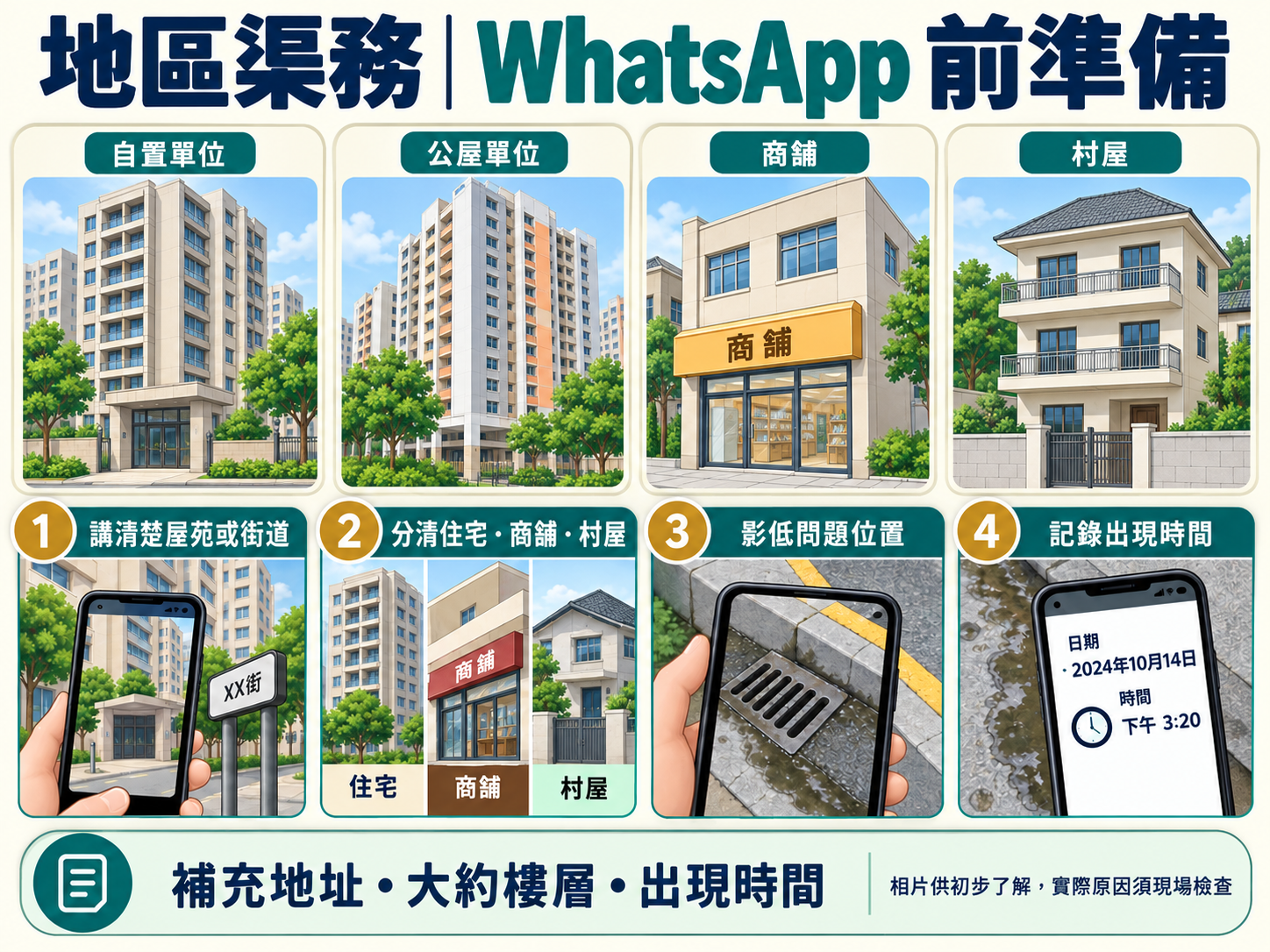
Photos or a short video on WhatsApp help us tell a single-fixture blockage from a shared-stack problem.
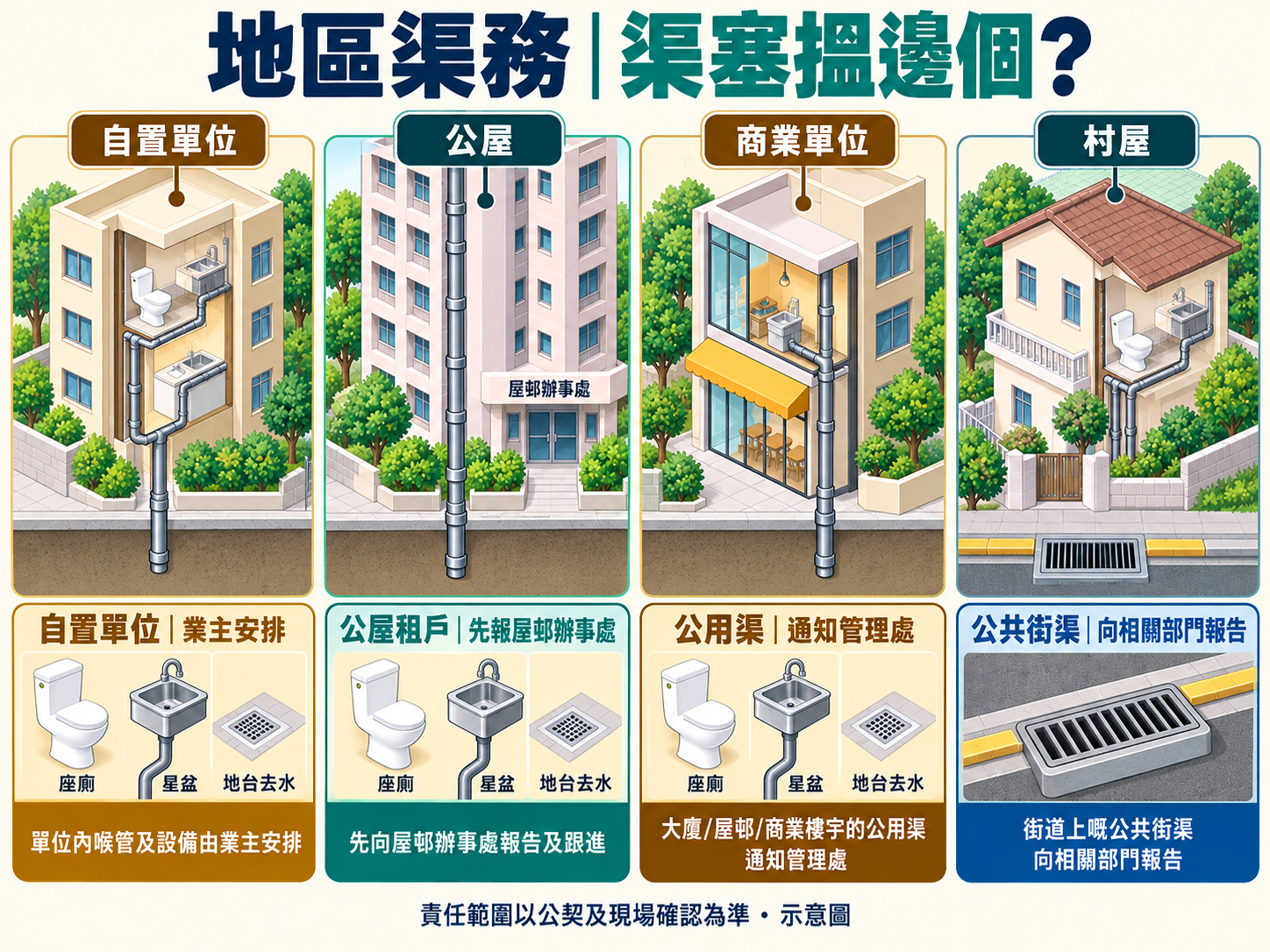
Ma On Shan is the north-eastern extension of Sha Tin New Town: per the Chinese Wikipedia, the Government approved its development in 1979, and by 2021 the new town's population had reached 210,356. Over some thirty-five years the same strip of land filled up with public rental estates — two of which were later brought into the Tenants Purchase Scheme — Home Ownership Scheme courts, private-sector participation courts, large private estates and waterfront towers, with the villages of Tai Shui Hang and Wu Kai Sha behind them. So the first step here is not to find a phone number but to work out which tenure your home falls under, because public rental tenants, TPS owners, HOS owners, private-estate owners and village-house owners each take a completely different route.
Ma On Shan is not an old district, but it stopped being new a long time ago. Per the Chinese Wikipedia, Sha Tin New Town was built largely on land reclaimed from Sha Tin Hoi, and the northern part of Ma On Shan belongs to that reclamation, while the strip near the foot of the mountain to the south is hillside. The two kinds of ground behave differently: a low-lying reclaimed edge depends on surface gullies and outfalls to move water away, whereas a hillside site washes silt and leaves into its catchpits as soon as it rains hard. Heng On Estate, occupied in February 1987, was the new town's first estate and the first in Hong Kong to use the Y3 block design; Yiu On Estate followed in 1988, Kam Ying Court in 1991 and Lee On Estate in 1993, and Sunshine City, the largest private estate, was occupied in five phases between 1992 and 1996. Those core estates are therefore thirty to forty years old and their pipework is entering the stage of renewal rather than mere rodding, while the estates occupied after 2000 are a good deal younger and ask for a different set of checks.
The housing mix in this sub-area is unusually scattered. The town centre is dominated by Sunshine City: five phases occupied between 1992 and 1996, 20 blocks and about 4,760 flats (the same Wikipedia article gives 4,765 elsewhere). In Phase 4 the market, the bus terminus and the mall are layered into the base one level above another, and footbridges tie the phases together. By design, a stack coming down into a base three to four storeys high has to turn horizontal there, and that run — shallow fall, plenty of bends — is where grease and sludge settle first; when it does leak, the stain usually shows on a mall ceiling or a car-park soffit before anything appears in the flat above. On the Tai Shui Hang side sits Chevalier Garden, a private-sector participation court of seventeen blocks approaching forty years of age, where every decision belongs to the owners: when the common pipework is renewed, and how the cost is shared, goes through the owners' corporation. The estates around Wu Kai Sha station and the more recent waterfront towers are much younger — mostly occupied from around 2000 through the 2010s — and mostly plastic-piped, so odour and slow draining there usually trace back to water seals, renovation changes and build-up in horizontal runs rather than to a stack rusting through.
Behind the estates are several villages. Per Environmental Protection Department statistics to the end of 2023, all 46 houses at Tai Shui Hang and all 167 at Wu Kai Sha New Village that are suitable for connection are already on public sewers. The same Sha Tin table, however, does not list To Tau Wan Village, Ma On Shan Village or Mui Tsz Lam Village, so whether those houses still rely on a septic tank has to be checked house by house rather than assumed. As for how the area's sewage leaves Ma On Shan: Drainage Services Department project 4445DS is moving Sha Tin Sewage Treatment Works into caverns at Nui Po Shan, and the works include modifying the six sewage pumping stations now serving Sha Tin and Ma On Shan, one of which is Ma On Shan Sewage Pumping Station; work began in July 2021 and is due to finish at the end of 2031. All of that is public infrastructure with no direct bearing on the branch pipe in your flat, but it is worth remembering the possibility of an outdoor source when a smell covers the whole area at once.
Note: statements based on building age and type are general inferences, not findings for any particular flat.
A clear process from enquiry and assessment to an agreed scope of work
Tell us the drain problem and district and ask about available timing.
Confirm timing based on the district and schedule, then inspect the blockage or odour issue.
Explain the proposed approach, scope and price before agreed work begins.
Use suitable tools for the site conditions and agreed scope of work.
After the agreed work, test drainage and explain the observed result and any next steps.
PipeButler is an independent drain-service provider with no affiliation to the developer, owners' corporation, management company or Housing Department of the places above. Facts come from public sources checked on the dates shown; work on common drains or common parts follows the management office's and deed of mutual covenant's arrangements.
WhatsApp with the problem and district, and we will confirm available timing.

