Loading page…
Loading page…
Fo Tan · Private estate · HOS / PSPS · Public rental housing · Village houses · Industrial buildings
Depot-deck estates, 1980 HOS, 2020 public housing, factories and villages
Choose the problem you are seeing to read the likely cause and next step.
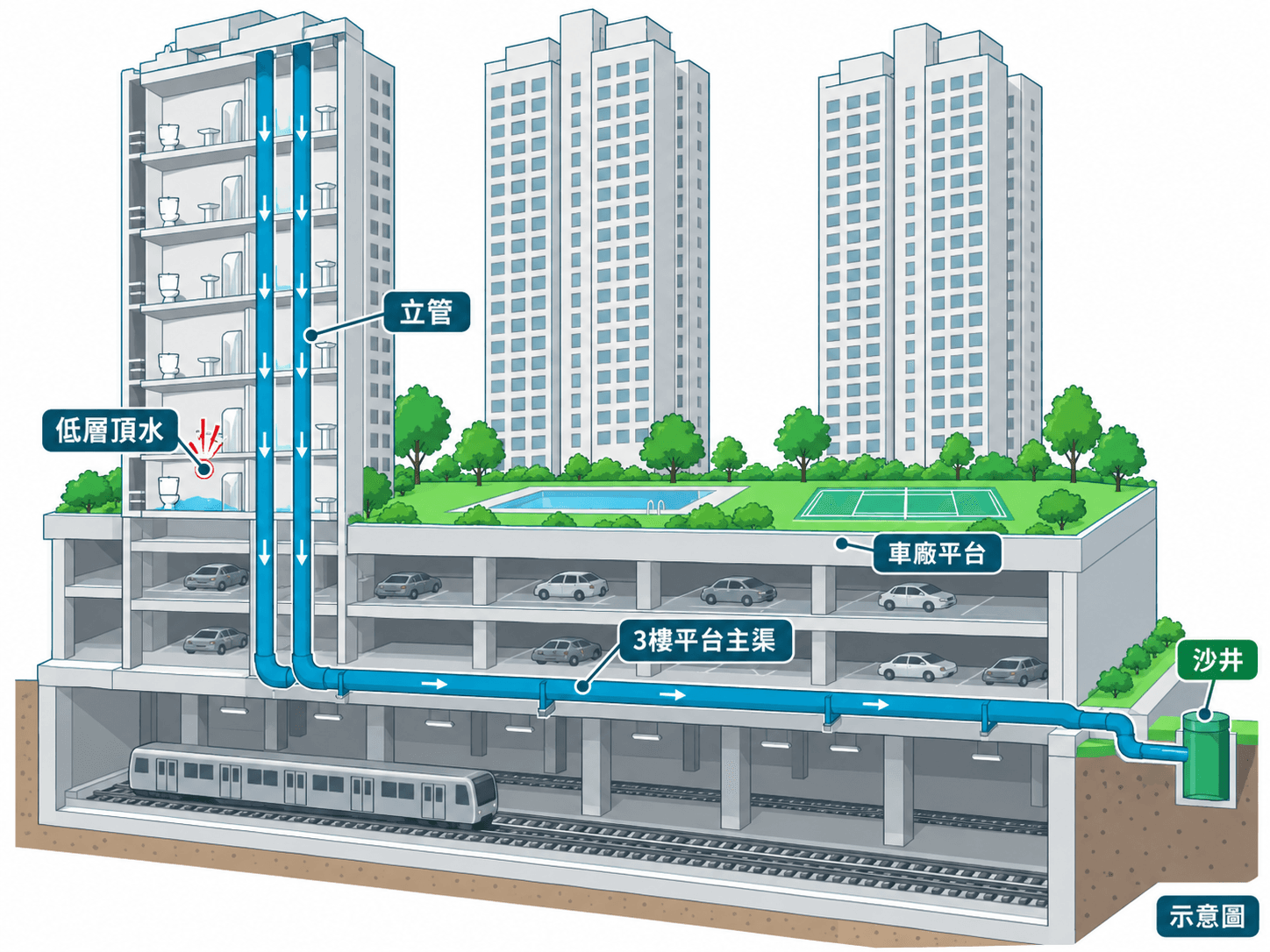
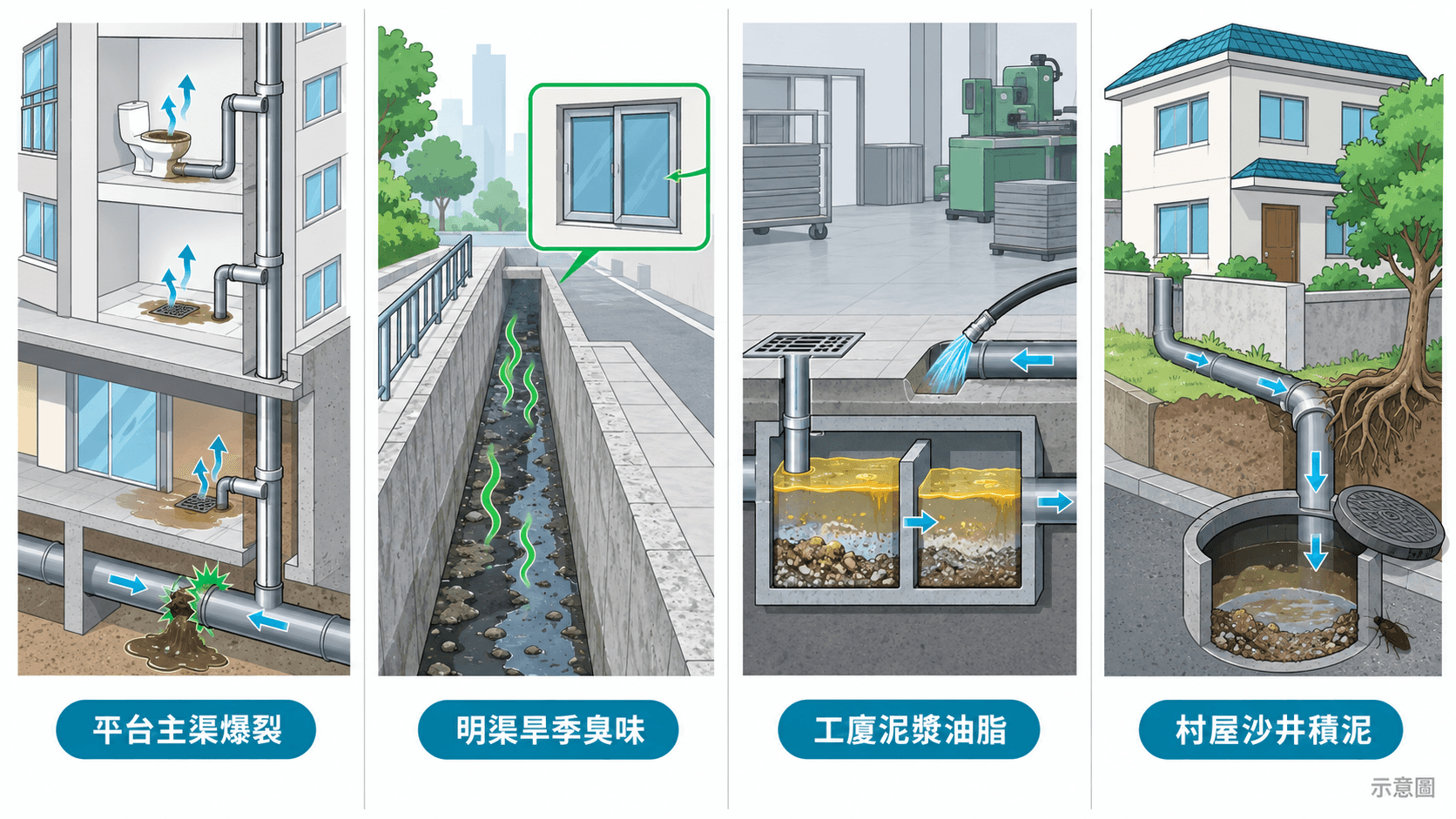
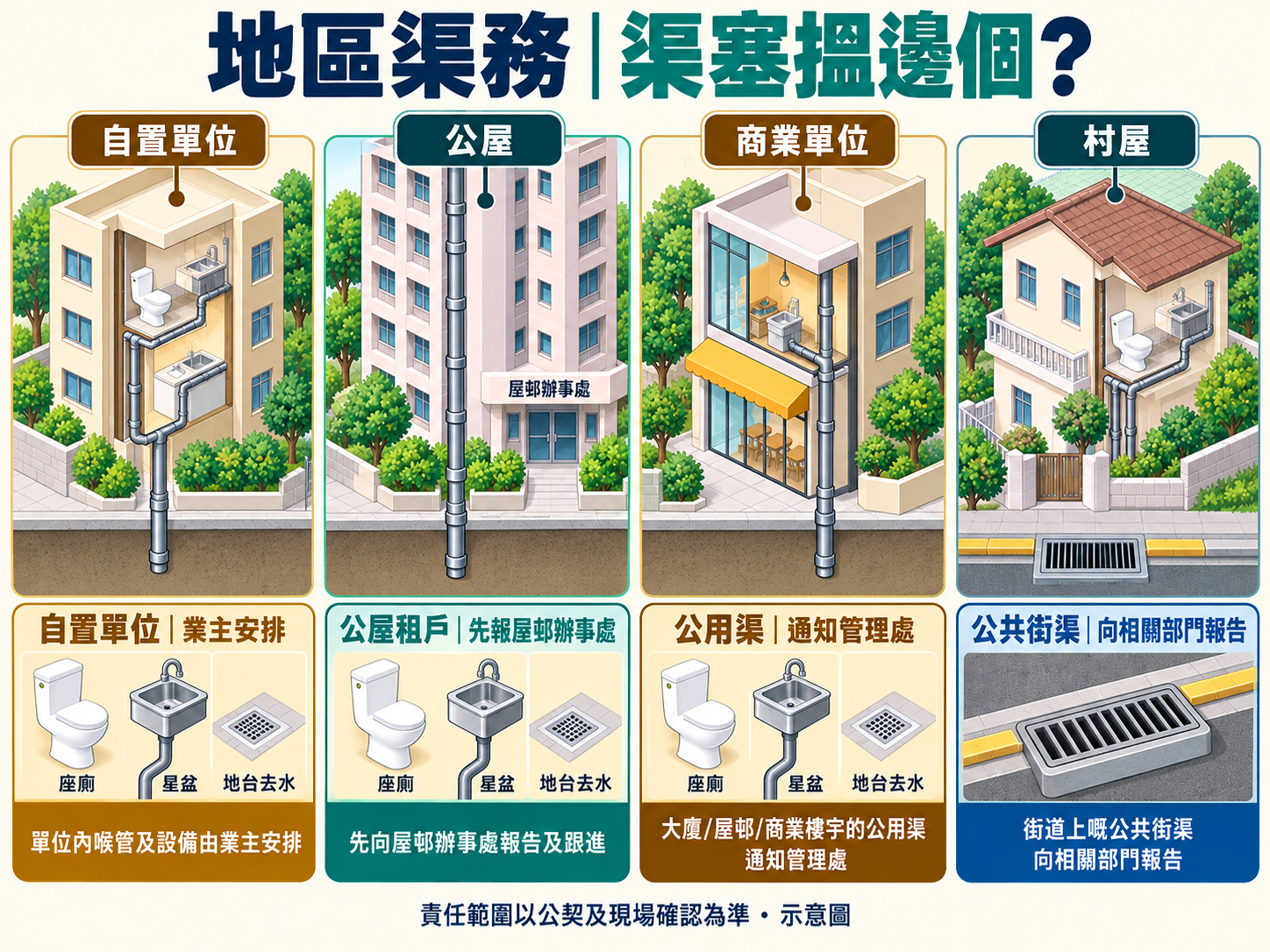
Chinese Wikipedia records that a social service centre on the 3/F podium of Jubilee Garden, "because the estate's main drain passes through the centre", had "repeated wall leaks, burst sewer pipes and sewage backflow" between 2008 and 2011; it moved out temporarily in June 2011 and only returned in July 2017. Nothing like that is solved by clearing a drain inside a flat. If you are in a deck-built estate and see a wall going damp for no reason, foul-smelling water seeping out, or a low-floor toilet and floor drain surging together, tell the management office at once so the shared horizontal pipes and estate manholes are checked, and photograph it with the time noted. Anywhere sewage has reached should be disinfected after clearing.
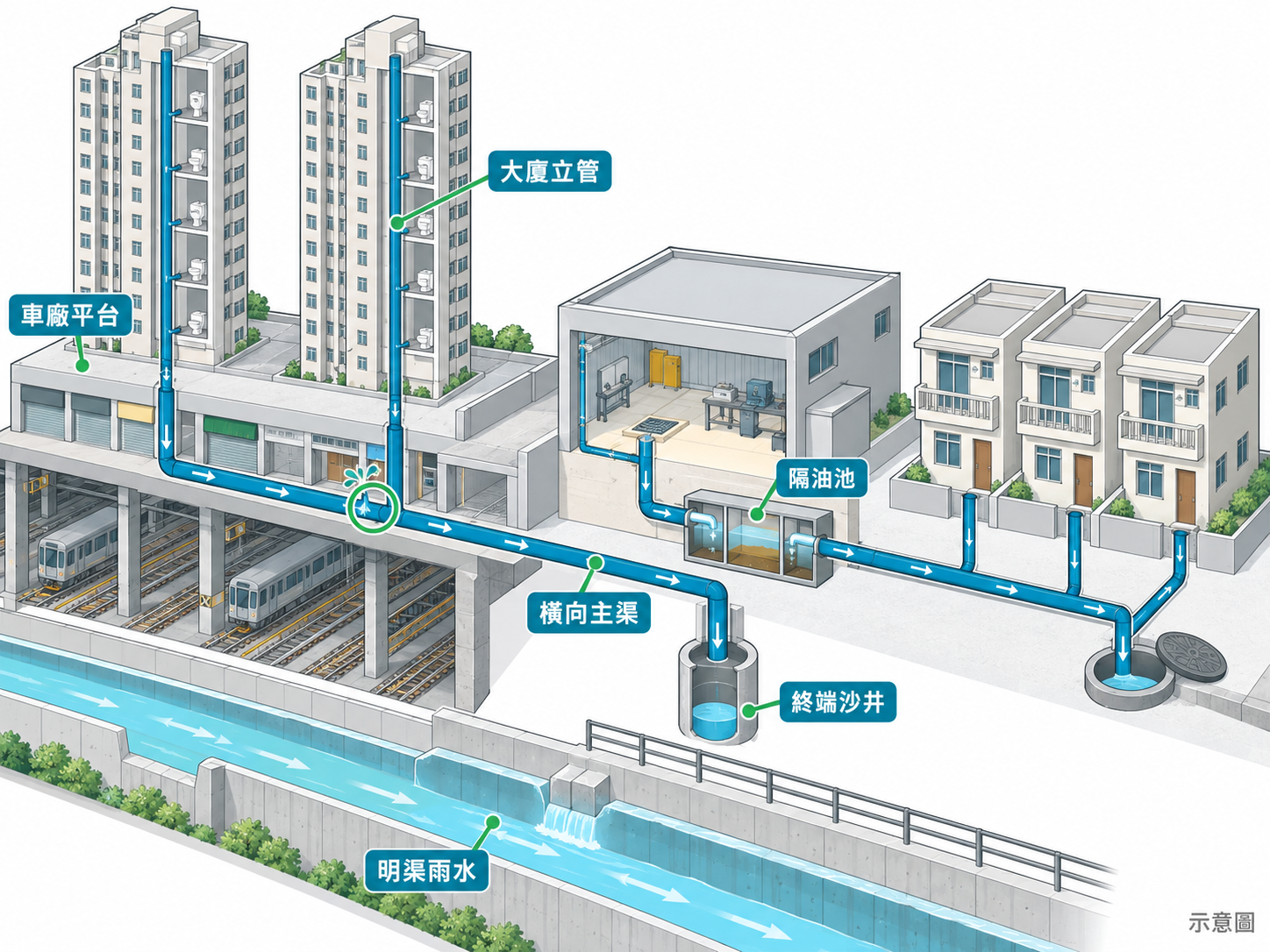
The Drainage Services Department's Fo Tan Nullah revitalisation project (4188CD) lists among its works the "provision of a dry weather flow interception system" and the improvement or modification of the drain connecting Kwei Tei Street; it is under planning and design. A dry weather flow interception system exists to catch foul flow entering a nullah when it is not raining — which means the nullah can smell in dry weather, and that smell belongs to the stormwater system, not to your flat's pipes. Telling them apart is simple: close the windows and sniff at each outlet indoors. If the smell only appears at a window, on the balcony or in the street near the nullah, there is no need to start dismantling traps. If it hits you as you walk into the bathroom, or as soon as the exhaust fan goes on, then the water seal or branch pipe indoors is the place to look.
Factory units in Fo Tan have housed studios in quantity since 2000, along with food workshops and converted eateries. Inferring from those uses, clay and plaster settle in a pipe and then harden, pigment and sawdust cling to the pipe wall, and grease sets into solid lumps in horizontal runs and manholes — none of which a plunger or a bottle of drain cleaner will shift. The Environmental Protection Department's grease-trap guidance is explicit: inspect the trap at least every three days and clean it promptly once greasy waste occupies the top 30% of the liquid depth, never dispose of trap waste into a toilet, gully or surface channel, and record maintenance in a log book. A blocked building main drain or manhole usually needs high-pressure jetting plus desilting, and the timing and water arrangements have to be agreed with the building management before work starts.
Chinese Wikipedia records that Sui Wo Court was occupied in 1980 and "38 years after intake, in 2018, received a statutory mandatory building inspection notice from the Buildings Department"; its owners' corporation then passed a repair resolution in June 2023 and works began that September, covering external-wall renovation among other items. As a general inference from age, several 1980s estates in Fo Tan are reaching the same point. What gets overlooked at this stage is that once the shared pipes are renewed, the traps, branch pipes and joints inside a flat may no longer match: a loose joint, a shallower water seal, or pipework already altered in an earlier renovation only shows up after the works, and the result is a smell that appears when the repairs finish. Checking your own outlets and traps while the scaffolding is still up is far less trouble than opening things back up afterwards.
In EPD's statistics as at the end of December 2023, every village house suitable for connection at Fo Tan, Wo Liu Hang, Lok Lo Ha and Pat Tsz Wo is connected to a public sewer, so for most houses there is no longer a septic tank to empty. The Environmental Protection Department's guidance is clear about what follows: the government provides the communal sewer and the length linking the terminal manhole to it, while the owner pays to build the terminal manhole and the pipework from the premises to it, and "should properly maintain" that part. This private run is usually buried under the forecourt or a parking space, and too little fall, tree roots forcing into a joint, or a steady flow of kitchen grease will leave the manhole silted and prone to backing up after rain. Lifting the manhole cover to look at the water level and the silt is the most direct check you can make.
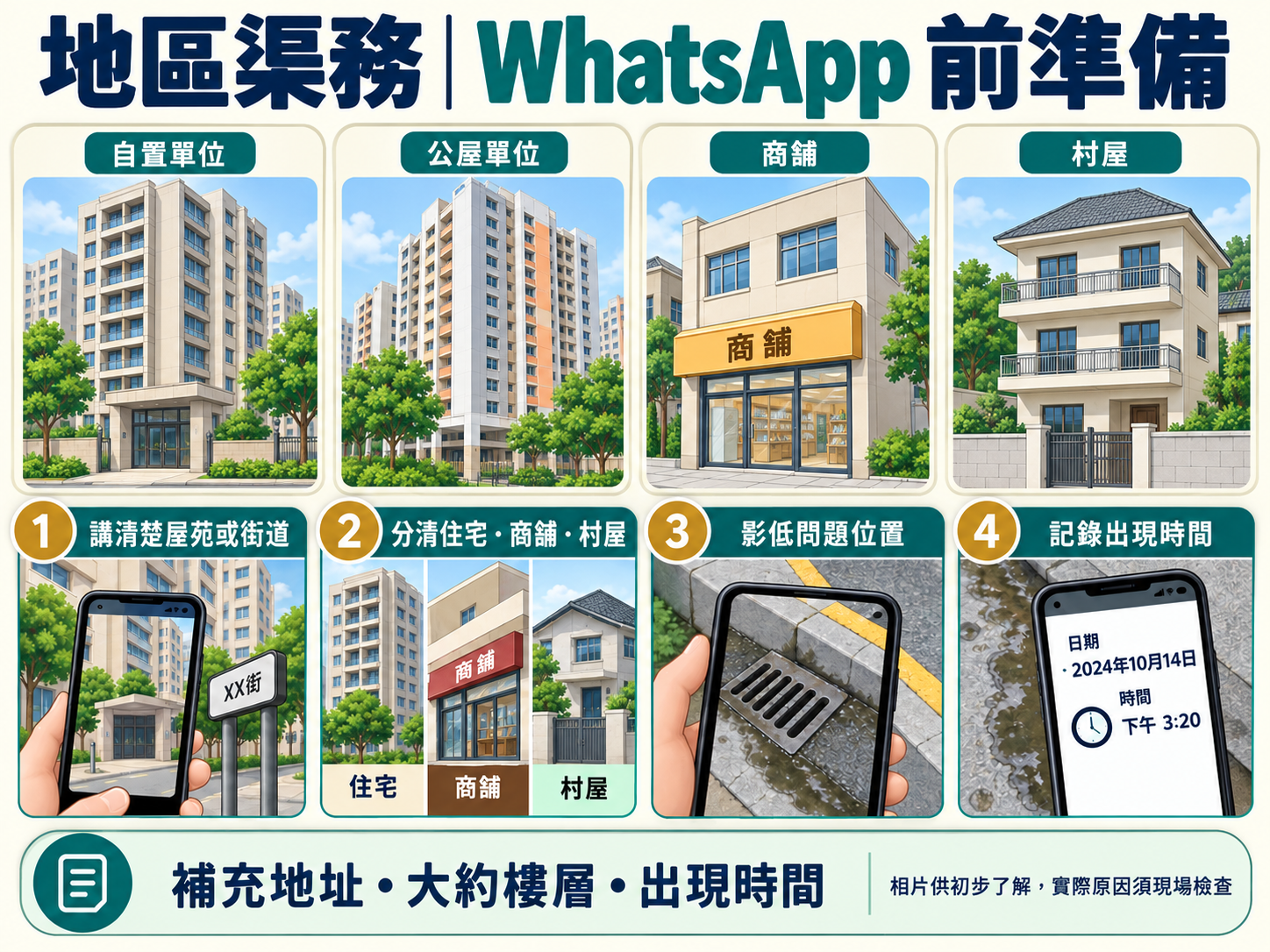
Photos or a short video on WhatsApp help us tell a single-fixture blockage from a shared-stack problem.
Fo Tan sits north of Sha Tin town centre and west of the Shing Mun River. Wikipedia describes it as the main industrial area of Sha Tin New Town, yet within one station's walk it holds several very different kinds of housing: private estates built over the Ho Tung Lau railway depot, the Sui Wo Court HOS estate of 1980 on the hillside, Chun Yeung Estate — public rental housing occupied only in 2020 — and, alongside them, the villages of Fo Tan, Wo Liu Hang and Pat Tsz Wo and a solid belt of factory buildings. The same sentence, "my drain is blocked", leads to a different person to call, a different place to look and a different set of details to have ready in each of those five settings, so the first step is to work out which one you are in.
Housing in Fo Tan falls into three clusters. Closest to Fo Tan station are the three estates built over the Ho Tung Lau depot: Jubilee Garden, occupied in two phases in 1985 and 1986 at 2-18 Lok King Street, with eight towers plus Jubilee Court — nine blocks and 2,260 flats; Royal Ascot, completed in 1995 and 1996; and The Palazzo, completed in 2009. On the hillside stands Sui Wo Court, the HOS estate occupied in 1980, with nine blocks of 36 storeys and 3,501 flats in a split-level cruciform layout. To the north-west, around Wong Chuk Yeung Street and Kwei Tei Street, is a newer cluster: Chun Yeung Estate (public rental housing, 5 blocks, 4,800 flats), occupied in 2020, with the Choi Wo Court HOS court beside it from 2021. A third new court, Yuk Wo Court, was also occupied in 2020 but stands near Fo Tan station. Between them lie the factory belt and more than a dozen villages.
Estates built over the depot share one very visible drainage trait. Inferring from the design, the soil stacks cannot drop straight to the ground: they stop at the deck and turn into horizontal runs that cross the podium before reaching the estate's manholes and the public sewer, and that same podium also carries shops, a market and community premises. Horizontal runs and bends collect grease and solids faster than vertical stacks, so when one blocks or bursts, the first to suffer are usually not the upper floors but the podium-level premises and the lowest few storeys of flats. There is a documented case at Jubilee Garden, set out below.
For the private and HOS blocks, building age is the other key factor. As a general inference from age, Sui Wo Court is now 46 years old and Jubilee Garden about 40, both well past the 30-year threshold of the Mandatory Building Inspection Scheme. Estates of that age have usually had pipes partly replaced, so trap types, branch-pipe routes and connection points can differ sharply between flats in the same block, and the estate name alone tells you little. Chun Yeung Estate and Yuk Wo Court, by contrast, were occupied only in 2020 and Choi Wo Court in 2021, so their blockages are far more often about use: wet wipes, hair, food waste and cement left behind by renovation.
Last come the factories and the villages. The industrial streets are named after the villages — Fo Tan Road, Au Pui Wan Street, Shan Mei Street, Wo Liu Hang Road, Wong Chuk Yeung Street and Kwei Tei Street. Artists began renting factory units as studios from 2000, and Wikipedia records about 50 individual or joint studios and more than 180 artists in the area, alongside food workshops, warehouses and gyms in converted units. Inferring from those uses, clay slip, plaster, pigment, sawdust and kitchen grease entering drains designed for general industrial use settle and set hard. As for the villages, EPD's statistics as at the end of December 2023 record every village house around Fo Tan suitable for connection as connected to a public sewer, so the problem is usually not a septic tank: it is the private length of drain running from the house out to the terminal manhole at the street.
Note: statements based on building age and type are general inferences, not findings for any particular flat.
Choose an enquiry route for your premises and work scope.
Pantry, washroom and shared-drain enquiries, with scope agreed before work
Scope and booking detailsUnit outlets, shared pipes and chamber enquiries assessed with site access
Scope and booking detailsDiscuss a defined maintenance scope using assets, usage and incident records
Scope and booking detailsA clear process from enquiry and assessment to an agreed scope of work
Tell us the drain problem and district and ask about available timing.
Confirm timing based on the district and schedule, then inspect the blockage or odour issue.
Explain the proposed approach, scope and price before agreed work begins.
Use suitable tools for the site conditions and agreed scope of work.
After the agreed work, test drainage and explain the observed result and any next steps.
PipeButler is an independent drain-service provider with no affiliation to the developer, owners' corporation, management company or Housing Department of the places above. Facts come from public sources checked on the dates shown; work on common drains or common parts follows the management office's and deed of mutual covenant's arrangements.
WhatsApp with the problem and district, and we will confirm available timing.