Loading page…
Loading page…
Po Lam · Tenants Purchase Scheme estate · HOS / PSPS · Private estate · Public rental housing
Two 1988 pioneer estates · three TPS estates · hillside meets reclamation
Po Lam and Tsui Lam were among the first parts of Tseung Kwan O to be developed.
Last reviewed ·
Choose the problem you are seeing to read the likely cause and next step.
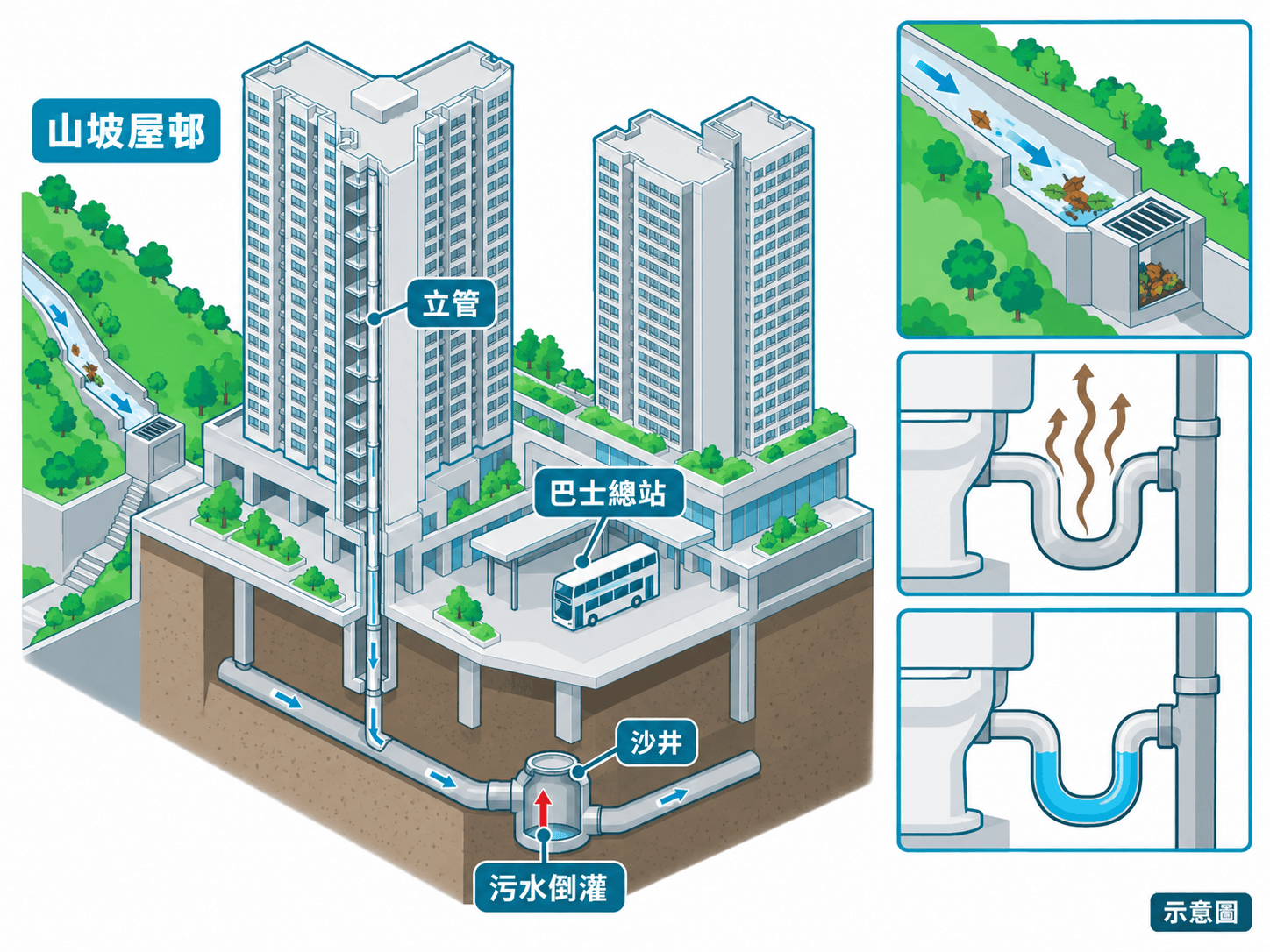
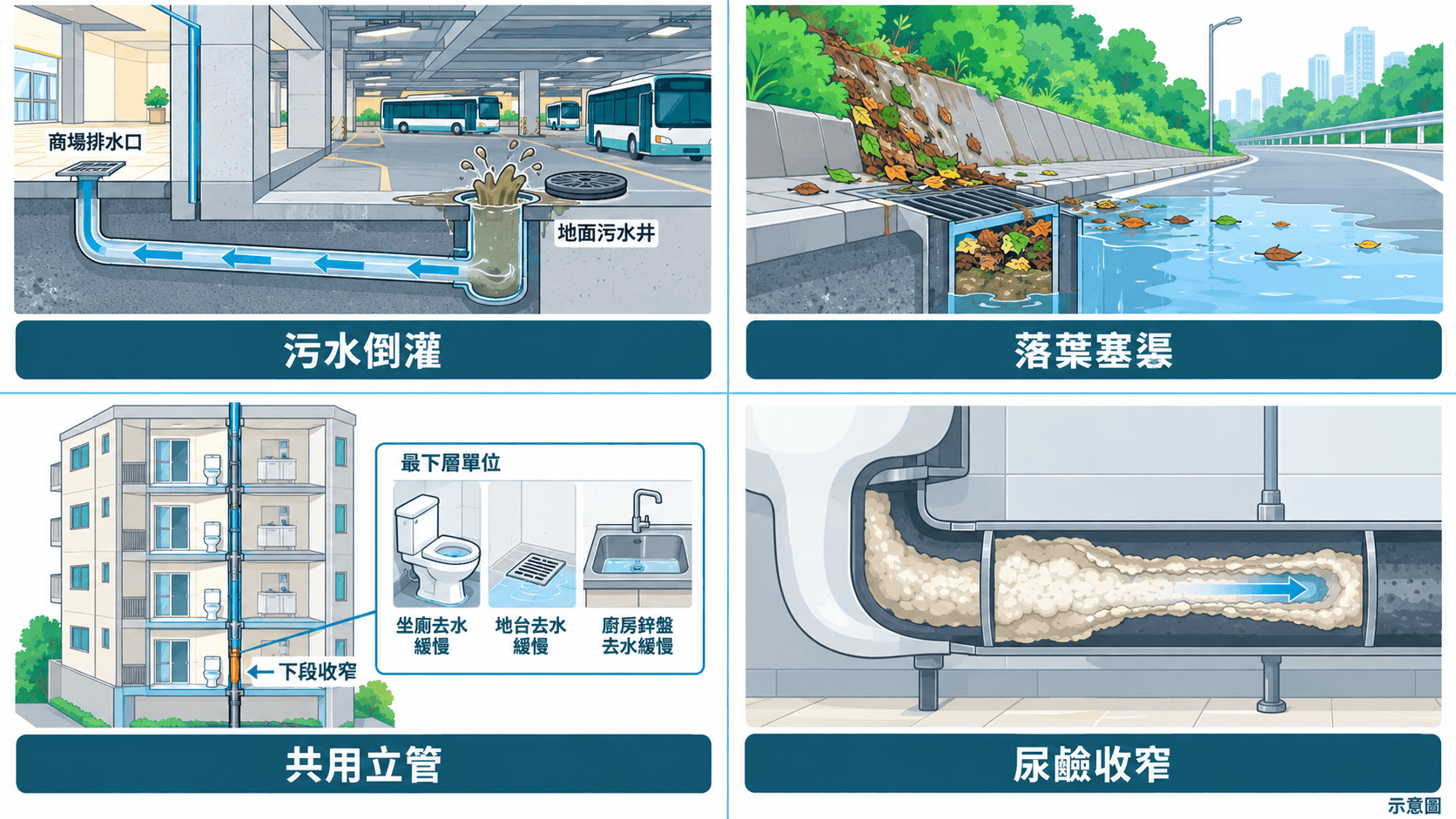
The minutes of the Sai Kung District Council meeting of 3 November 2020 record the Drainage Services Department's written reply that the seepage and odour at the location were believed to originate from blocked drains within Tsui Lam Estate, and that the department had passed its findings to the Housing Department. A Housing Department representative told the meeting that the drainage systems of the bus terminus and the mall are connected, so discharge from the mall can choke the terminus drains and cause backflow, and said the mall side had sent a jetting vehicle whenever blockages occurred in the past. A post-meeting note in the same minutes records that on 11 November that year the Housing Department, the councillor, the mall's manager and the managing agent engaged by the Tsui Lam Estate owners' corporation inspected the terminus together and found no blockage or smell at the time. Earlier, at the meeting of 6 March 2018, a councillor said the terminus had sewage seepage and odour in the middle or second half of every year. For residents the implication is simple: if the smell comes from ground level, a manhole or the podium, do not treat it as a problem inside your flat — note the time and place and tell the management office; only when the smell is confined to your own bathroom or kitchen should you start with the water seals and branch pipes indoors.
At the Sai Kung District Council meeting of 6 March 2018 the Drainage Services Department explained that the flooding on Po Lam Road and Po Hong Road happened because both are next to hillsides, so heavy rain washes dead leaves and soil from the slopes onto the lower-lying carriageway and chokes some of the catchpits. The Highways Department afterwards added more than a dozen catchpits nearby and widened the U-channels, and the Drainage Services Department sends a special squad to clear drains at those two spots whenever a rainstorm warning or a tropical cyclone warning is in force. In the minutes of the Council's third meeting of 2024, held on 7 May, a councillor reported a great deal of leaf fall around King Lam Estate in northern Tseung Kwan O, said leaves readily accumulate in the drains, and asked for more frequent sweeping. The same logic applies inside an estate: clearing the gullies on podiums, planters, rooftops and car-park entrances once in the leaf-fall season and once before the rains beats pumping water out afterwards.
At the Sai Kung District Council meeting of 3 March 2026 a councillor said that most flats in Po Lam Estate have been sold and that the small number left unsold were mainly flats with serious seepage, and proposed comprehensive repairs for flats with serious seepage or leaks. Another councillor said that an owners' corporation and its managing agent find sold flats harder to deal with, and that seepage between two sold flats in particular tends to be difficult and slow to resolve. That difficulty is a practical one: for common pipework a single call to the corporation sets someone moving, but where both the flat above and the flat below have been sold, two owners have to open their doors at the same time before anyone can see which floor and which fitment the water is coming from. So the first time a stain appears, do not settle for one photograph of the ceiling — note five things at once: where the stain is and how far it spreads, when you found it, whether anyone upstairs was showering or flushing at the time, whether the water is clear or carries a smell, and how long it takes to dry. With that much on record the corporation or its managing agent need not arrange a second visit, and it is already possible to tell a supply pipe from failed bathroom waterproofing and from a drain — the three call for different tests and different parties end up responsible, so do not open with the assumption that a drain has burst.
Po Lam, Tsui Lam and King Lam Estates all use Housing Authority standard plans, yet a single estate can hold two quite different kinds of block. At Po Lam Estate the Y2 blocks have 24 flats per floor and the New Slab blocks 52, more than double (the block-by-block detail is on the Po Lam Estate page below). At King Lam Estate, per the building data cited in the Chinese Wikipedia article on the estate, two of the seven blocks are single-wing New Slab blocks of only 20 storeys while the other five are 35-storey Trident 3 and Trident 4 blocks, with anything from 21 to 31 flats on a floor. As an inference from the design, a different number of flats per floor and a different block shape mean a different length of horizontal run on each floor and a different number of flats feeding one stack: a Trident block fans out into three wings, so a flat's waste reaches the stack after a short run, whereas a slab block depends on one long horizontal pipe collecting along its length, and the further the water travels the harder the flow is to sustain. So around here, which block you live in usually decides more than which floor whether your slow drain should be treated as a branch pipe or as a building drain. In practice: if one fitment alone is slow, start with the trap and the branch pipe; if the toilet, floor drain and kitchen sink slow together and it is worst at the peak hours when the flats above are using water, report it to the owners' corporation or the estate office so they start from the common pipework. While you wait, do not keep pouring drain cleaner in at home either — chemicals left standing in a section that is already blocked are a hazard for whoever opens the pipe next.
The minutes of the Sai Kung District Council meeting of 8 July 2025 record a councillor asking about the progress and extent of repairs to a stretch of underground fresh-water and seawater mains on Po Lam Road North, and reporting that a school in Po Lam Estate once had a seawater main leak and had to ask the Water Supplies Department to shut a valve before it could be repaired. That is a supply matter rather than a drainage defect, but it does establish that flushing here is on seawater. It follows, as an inference, that after more than thirty years the branch pipes and stacks serving the pans are more prone to scale and urine deposits narrowing the bore — and the symptom is usually not a sudden blockage but a flush that gets slower and slower, needs repeating, and backs up as soon as there is paper in the pan. A narrowing of that kind rarely yields to a plastic auger or drain cleaner: it needs mechanical rodding or high-pressure jetting, with partial pipe replacement considered only where the loss of bore is severe. The condition of the pipe wall is an inference; confirming it needs an opening or a camera inspection.
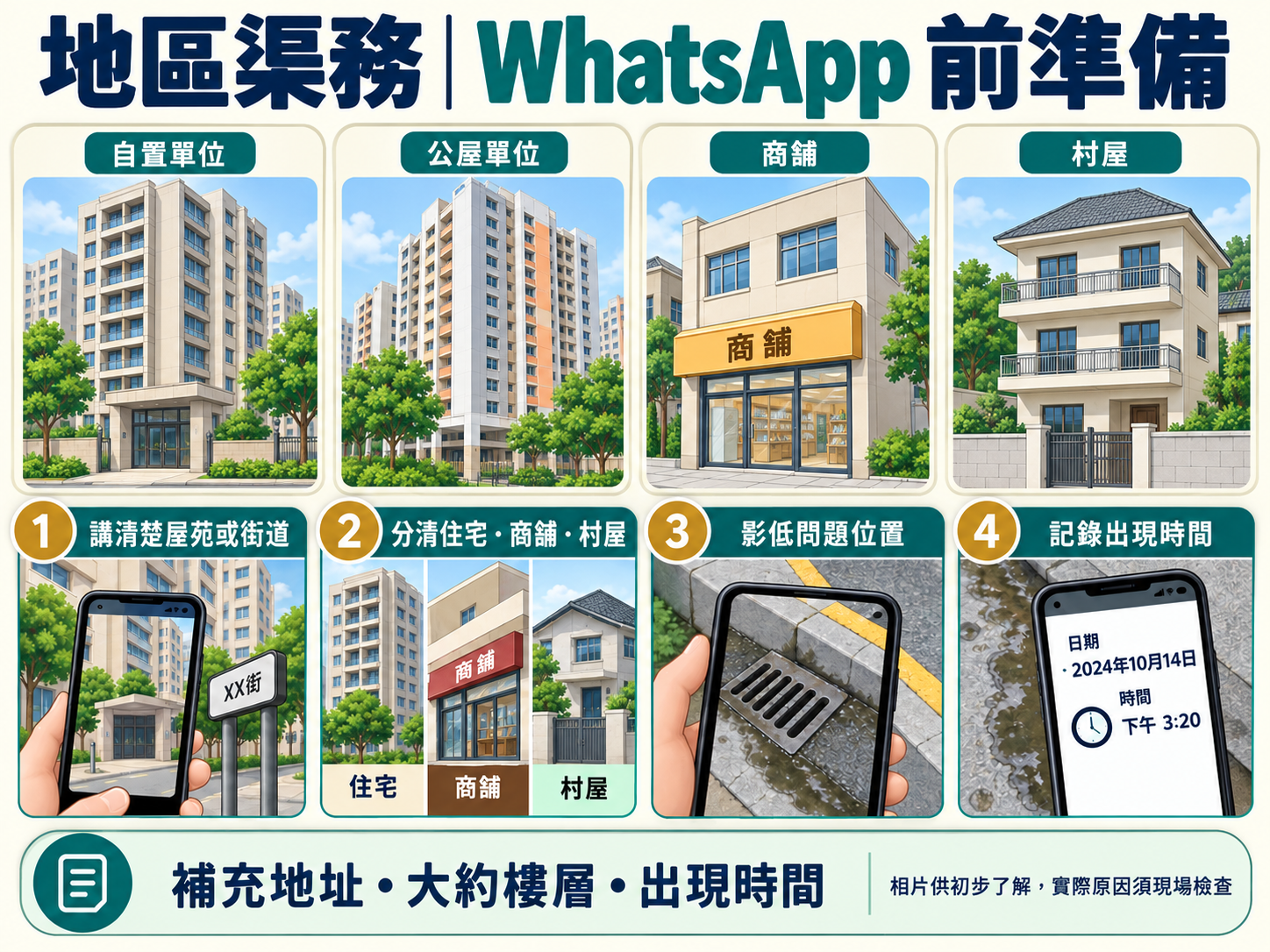
Photos or a short video on WhatsApp help us tell a single-fixture blockage from a shared-stack problem.
Po Lam and Tsui Lam were among the first parts of Tseung Kwan O to be developed. Per the Chinese Wikipedia article on Tseung Kwan O New Town, the Government committed to developing Tseung Kwan O as a third-generation new town in 1982, and the first phase, begun in 1983, covered the three residential areas of Tsui Lam, Po Lam and Hang Hau; Po Lam was largely reclaimed from the bay outside Tseung Kwan O Village, while Tsui Lam Estate was built on the hillside. One clarification before anything else: the estate is Po Lam Estate, while the road and the MTR station are Po Lam Road North and Po Lam station, spelt with a different second character in Chinese — the Wikipedia article on Po Lam Estate records that the estate was named after Po Lam Road, built in 1955, but that the Housing Authority altered that character when it planned the estate. The new-town article also notes that some people take Po Tat Estate, which stands on Po Lam Road, for an estate in the same neighbourhood, when it has belonged to Sau Mau Ping in Kwun Tong District since before it was built and has no connection with Tseung Kwan O in Sai Kung District. The area today rests on three Tenants Purchase Scheme estates — Po Lam, King Lam and Tsui Lam. Beside them sit HOS courts such as Ying Ming and King Ming, and private estates such as Metro City stand at the foot of the hill. So the first step with a blocked drain here is not to find a phone number but to work out whether your home is a purchased flat, a Housing Authority tenancy, an HOS flat or a private one.
This is not an old tenement district, but it stopped being new long ago. Po Lam Estate was occupied in 1988 as the first public housing estate in Tseung Kwan O; Tsui Lam Estate was completed the same year and formally opened on 13 November 1989; King Lam Estate was built in four phases between January 1990 and August 1991; and Metro City, the largest private estate at the foot of the hill, was occupied in three phases between December 1996 and April 2000. The public estates are therefore about thirty-five to thirty-eight years old and the private blocks twenty-six to thirty. As a general inference from building age, the stacks, branch pipes and traps in the older blocks are entering the stage of replacement rather than mere rodding, while the younger private blocks are mostly plastic-piped, where odour and slow draining usually trace back to dried-out water seals, traps altered during renovation, and grease and debris building up in horizontal runs — a different order of checks in each case.
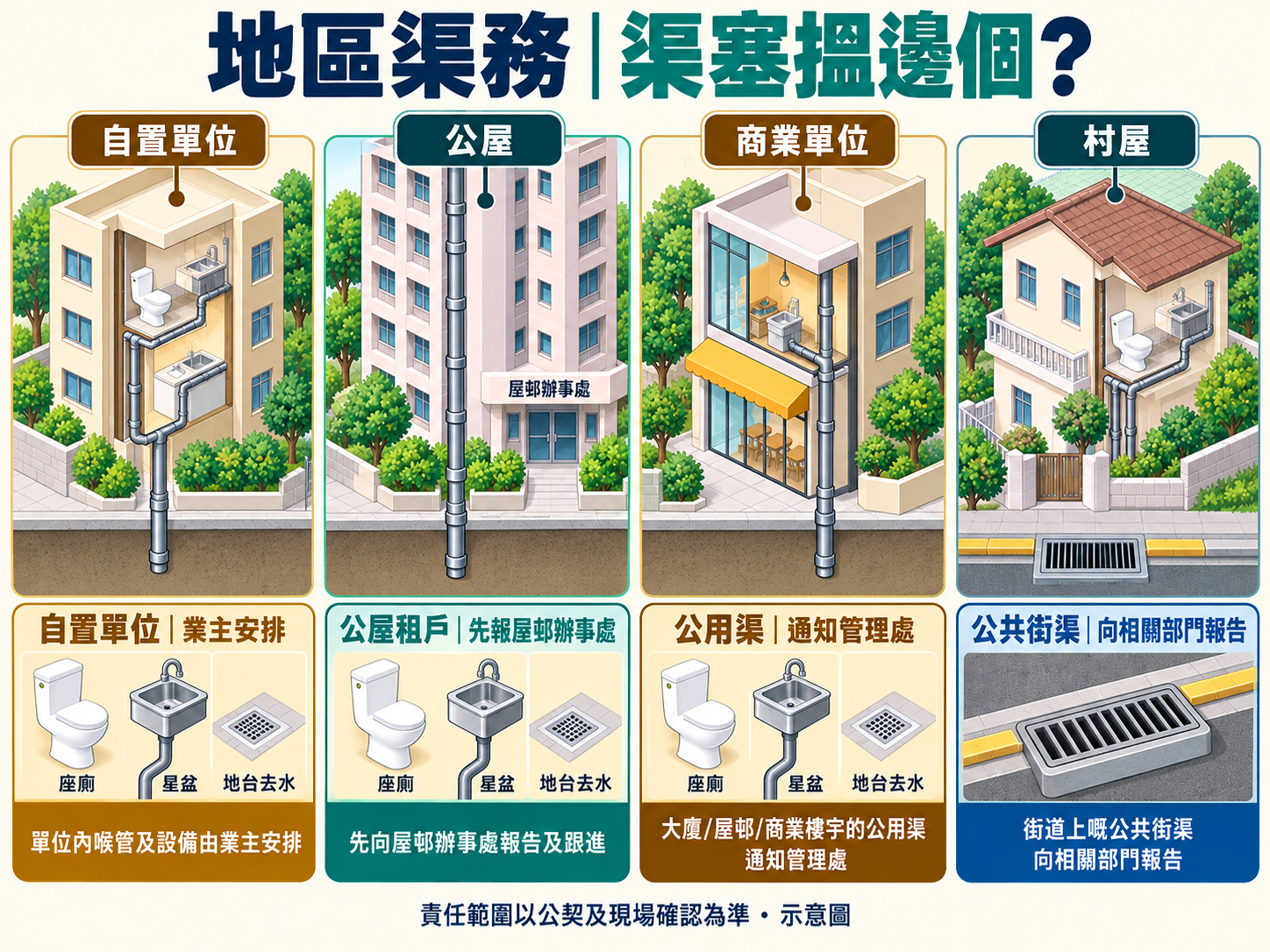
The defining feature of the sub-area is its layered tenure. Po Lam Estate has 7 blocks and 5,276 flats and was sold under Phase 6A of the Tenants Purchase Scheme; King Lam Estate has 7 blocks and 5,267 flats and was put on sale under Phase 4 in February 2001; Tsui Lam Estate has 8 blocks and 4,932 flats and was sold under the final phase in August 2005. All three now have owners' corporations, and the 2021 census recorded populations of 13,856, 13,144 and 13,364 respectively. Beside them sit three HOS courts — Ying Ming (5 blocks, 1,750 flats), King Ming (3 blocks, 1,050 flats) and Ho Ming (one block, 814 flats) — while Metro City's 6,768 flats wrap around Po Lam station below and link to it by footbridge. Two buildings on the same street can follow completely different repair routes: owners of purchased and HOS flats engage their own technician, households still renting go through the estate office, and private owners go through the management office under the deed of mutual covenant. The detail for Tsui Lam Estate and Po Lam Estate is on the two pages below.
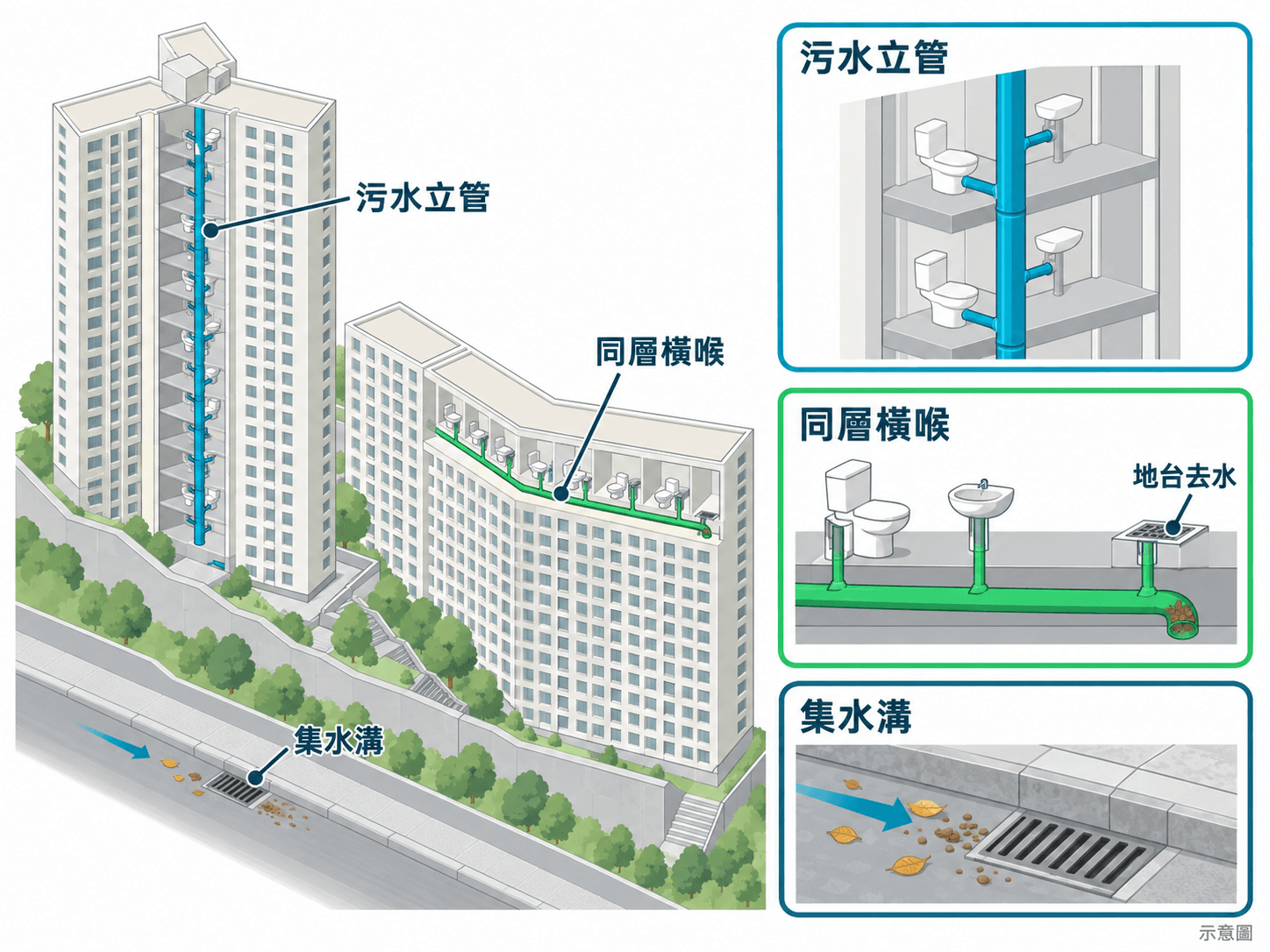
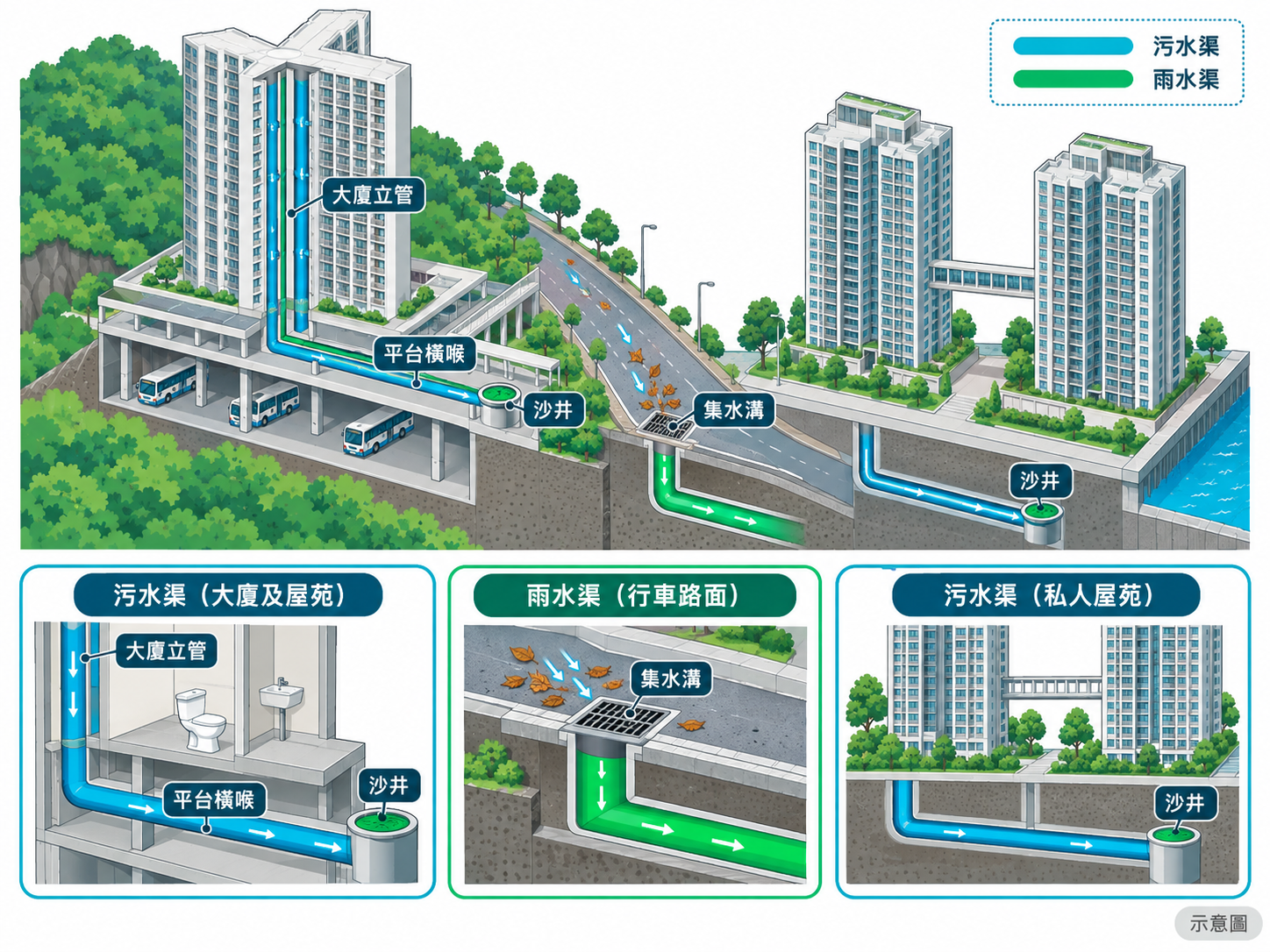
The ground explains a good deal too. Tsui Lam Estate sits on the hill, with its mall, market and bus terminus stacked into a podium; Po Lam and King Lam Estates stand on reclamation, with malls, markets and footbridges tying several estates together. As an inference from the design, where flats sit above a podium the stacks transfer into horizontal collector pipes at podium level before discharging to a manhole, and those runs have shallow falls and many bends, so debris and grease settle there; if a pipe leaks, the first stain may appear on a mall or car-park ceiling rather than in a flat. On the other side, the stormwater system on the hillside and the roads is entirely separate from the foul pipe serving your home — the Drainage Services Department's list of locations prone to blockage names two spots on Po Hong Road and the stretch of Po Lam Road between Mau Wu Tsai and Ma Yau Tong. Telling the two systems apart is what gets a report to the right place.
Note: statements based on building age and type are general inferences, not findings for any particular flat.
A clear process from enquiry and assessment to an agreed scope of work
Tell us the drain problem and district and ask about available timing.
Confirm timing based on the district and schedule, then inspect the blockage or odour issue.
Explain the proposed approach, scope and price before agreed work begins.
Use suitable tools for the site conditions and agreed scope of work.
After the agreed work, test drainage and explain the observed result and any next steps.
PipeButler is an independent drain-service provider with no affiliation to the developer, owners' corporation, management company or Housing Department of the places above. Facts come from public sources checked on the dates shown; work on common drains or common parts follows the management office's and deed of mutual covenant's arrangements.
WhatsApp with the problem and district, and we will confirm available timing.