
Loading page…
Loading page…
Kwun Tong, Tsui Ping Road · Tenants Purchase Scheme estate · Public rental housing
TPS Phase 5 · 12 blocks, 6,199 flats · owners and tenants differ
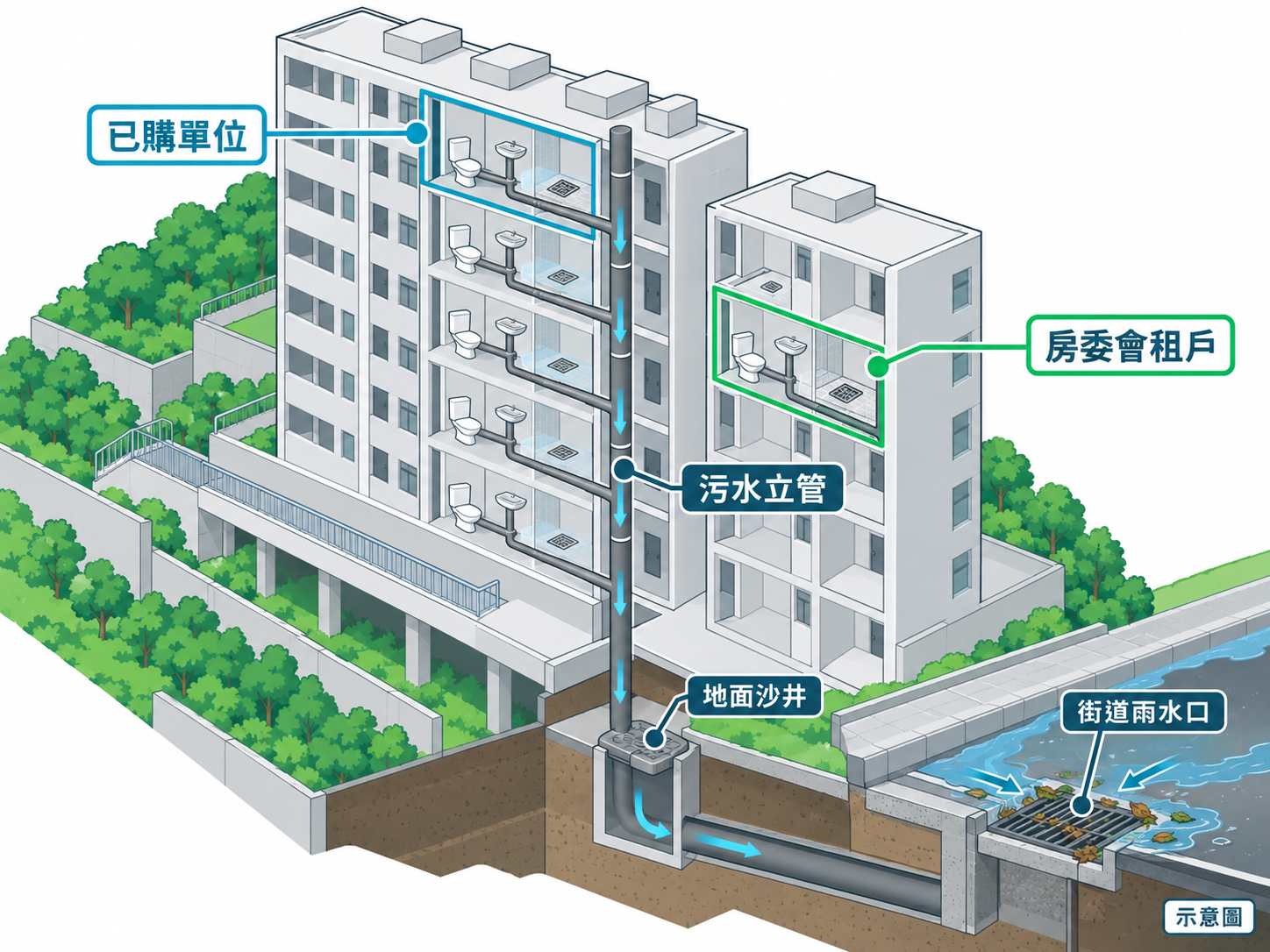
Tsui Ping North Estate stands at 19 Tsui Ping Road, Kwun Tong, redeveloped in stages from the old Kwun Tong resettlement area.
Last reviewed ·
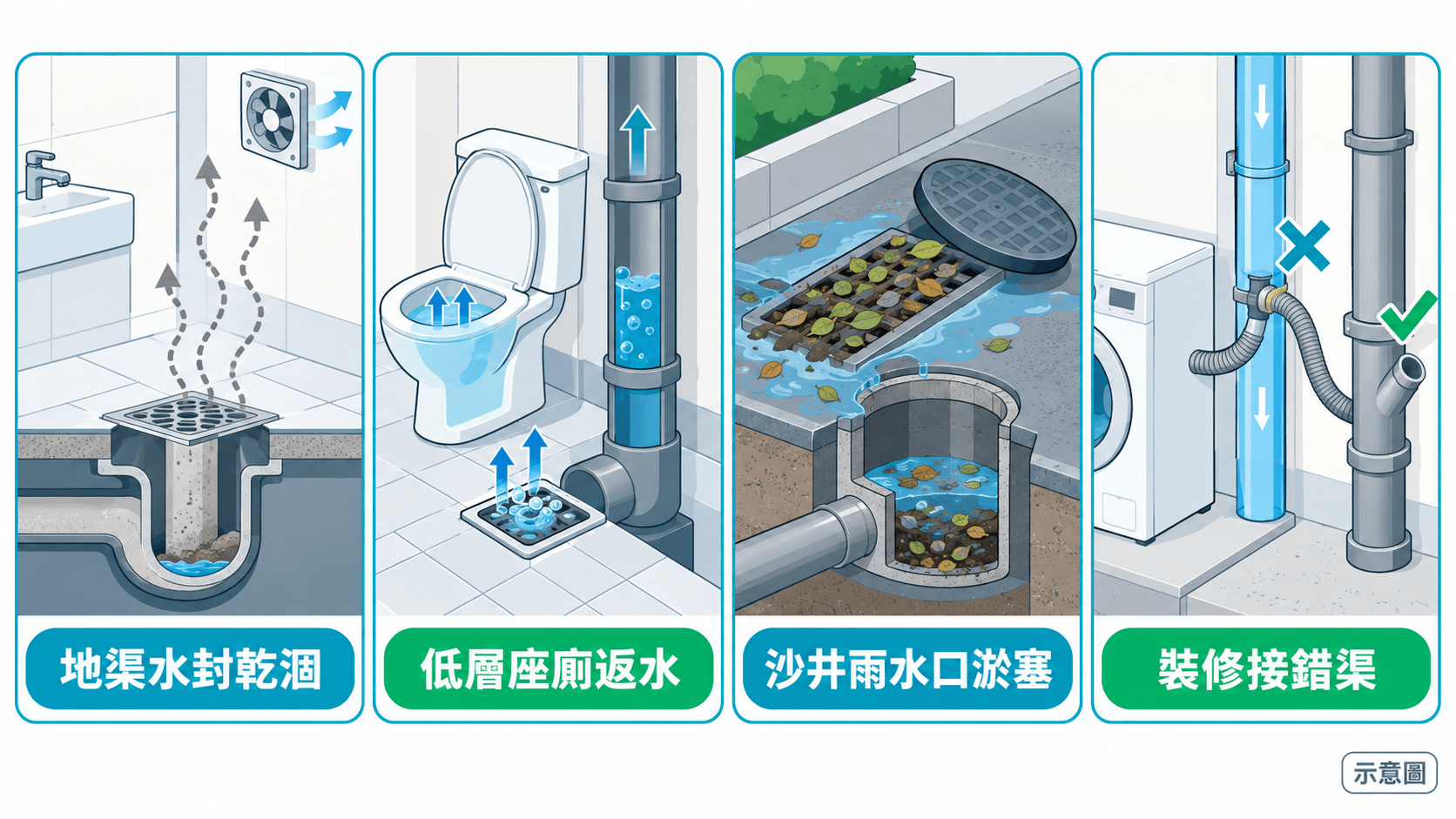
Choose the problem you are seeing to read the likely cause and next step.
Inferring from the layout, bathrooms in these 1980s and 1990s flats are small, and the floor drain usually only sees water when the floor is washed or someone showers. Used that seldom, the water seal in the trap slowly evaporates and sewer air rises through the floor drain into the room. The Buildings Department advises pouring about half a litre of clean water into every floor drain at home at least once a week so the seal keeps working. If the smell is still there two or three days after you do that, or it sharpens the moment you shut the bathroom door and switch the fan on, check the plastic trap for cracks, check whether a renovation replaced it with a shallower pattern, and check the branch-pipe joints for leaks — rather than covering the smell with bleach or fragrance.
The Housing Authority gives years of intake from 1982 to 1994, all of them well before the Buildings Department issued practice note APP-164 in April 2021, which applies only to drainage plans submitted after 31 August 2021. That note requires fitments on the lowest floor served by a stack — and the floor above it in buildings over 20 storeys — to discharge through separate pipework straight to a manhole, and it restricts branch connections within a zone above an offset bend. Inferring from the intake years, blocks here are unlikely to have either protection. So if a low-floor flat sees the toilet level rise, the floor drain bubble up or gurgle during the morning and evening peaks or in heavy rain, suspect the base of the stack or a manhole outside first, not the trap in your own bathroom.
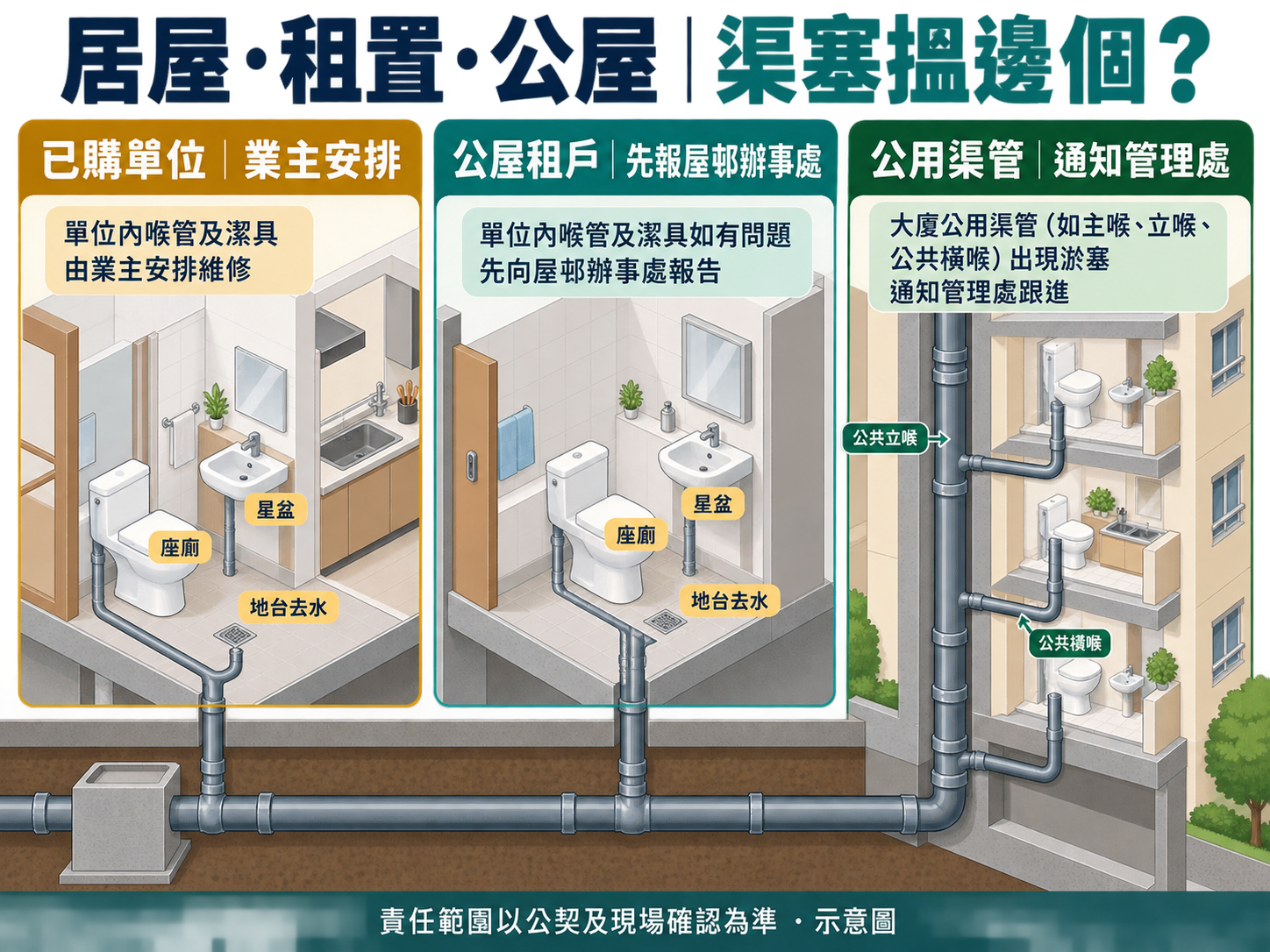
The DSD's Locations Prone to Blockage list has seven entries for Kwun Tong, and two of them — Fuk Tong Road near Tsui Ping Road, and Tsui Ping Road between Kai Lim Road and Kwun Tong Road — sit right by the estate. The DSD explains that such locations are identified from past records and observation as places that flood repeatedly in heavy rain when leaves, silt or refuse block the inlets. Residents need to keep two things apart: street rainwater drains and inlets are the DSD's, on its 24-hour hotline 2300 1110 for flooding and blocked-drain reports, while the manholes and gullies on the estate's podiums, back lanes and shopfronts should be reported to the estate management office or the owners' corporation, who arrange the desilting.
The 2019 LegCo paper on the Revitalisation of Tsui Ping River records that the DSD and the Environmental Protection Department surveyed sewer misconnections extensively across the King Yip Street Nullah catchment and adjoining areas in 2014 and 2015, finding 30 cases in all, 13 of them inside that catchment and mainly involving residential buildings, restaurants and shops; all were rectified in 2016, and a further 16 cases were found in Kwun Tong between 2016 and 2018. Tsui Ping lies inside that catchment. If an owner's own renovation routes a washing machine, a kitchen outlet or a newly added fitment into the rainwater drain, it not only leaves a smell in the nearby watercourse: the EPD traces the discharge under the Water Pollution Control Ordinance and refers building cases to the Buildings Department for rectification. Altering a trap, an anti-syphonage pipe or a drain position is minor works and must be carried out by a registered minor works contractor.
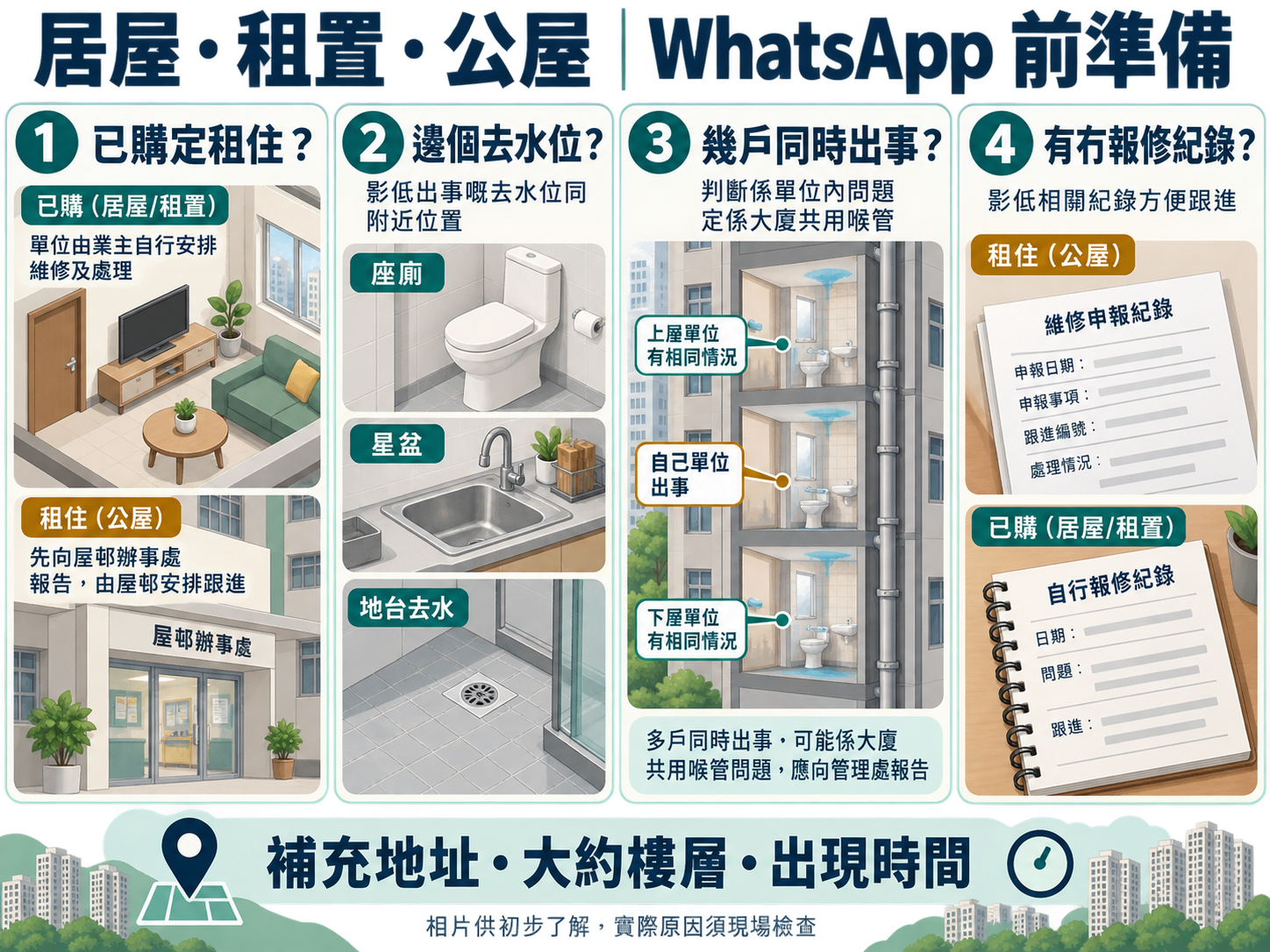
Inferring from the layout, a central-corridor Old Slab block such as Tsui Yeung House or Tsui To House puts an unusually large number of flats on one floor — roughly 40 and 49 respectively on the Wikipedia figures — and their sinks, basins and floor drains join a shared horizontal run on that floor before discharging together into the stack. Once grease and debris narrow that run, the one or two flats furthest along it, or lowest, drain slowly and bubble first — and clearing just one of them usually buys only a few weeks. When two or three flats on a floor go slow at the same time, or a clearance fails quickly, report it to the management office so the estate can inspect the whole horizontal run and its manholes, and arrange jetting or a camera survey if needed, instead of every household calling separately.
Photos or a short video on WhatsApp help us tell a single-fixture blockage from a shared-stack problem.
Tsui Ping North Estate stands at 19 Tsui Ping Road, Kwun Tong, redeveloped in stages from the old Kwun Tong resettlement area. The Housing Authority's list of Tenants Purchase Scheme (TPS) estates records 12 blocks and 6,199 saleable flats with years of intake from 1982 to 1994; the estate went on sale under TPS Phase 5 in January 2002, and Tsui Mei House, completed in 1998, was left out of the sale. The same blocks now house both owners who bought their flats and households still renting from the Housing Authority — and for something like floor-drain odour or a slow toilet, the two groups follow completely different routes. This page sorts out who to call first, then explains what the estate's age and layout mean for its drains.
The Housing Authority's list of TPS estates gives the block types at Tsui Ping North as Trident 2, Double H, Old Slab, New Slab and Linear 1 & 3, with years of intake from 1982 to 1994. In other words, the oldest and newest blocks in one estate are more than a decade apart and built to entirely different designs. Building data quoted on Wikipedia puts Tsui Yeung House and Tsui Nam House at 1982, and Tsui To House and Tsui Yung House at 1986. Tsui Tsz House, Tsui Lau House and a group of linear blocks followed in 1990, Tsui Tseung House in 1994, and Tsui Mei House — which was left out of the sale — only in 1998. So there is no single answer to what the drains here are like; the first question is which block you live in.
As a general inference from building age, the early-1980s blocks were most likely built with cast-iron or early plastic pipes, while the 1990s group leans towards plastic. Item 20 on the Housing Authority's tenant-to-pay repair list covers renewing a PVC trap of 50 mm diameter or less, which shows that traps inside public rental flats are plastic. Once a plastic trap cracks, or is swapped during renovation for a shallower pattern, the water seal is too thin and sewer air comes back up. The same Wikipedia data show that two central-corridor Old Slab blocks, Tsui Yeung House and Tsui To House, have roughly 40 and 49 flats per floor; inferring from that layout, so many flats on one floor means waste gathers along a long horizontal run on each floor before it reaches the stack, so grease, food waste, hair and wet wipes have more places to settle at bends and junctions.
Location matters just as much. The estate follows the hillside along Tsui Ping Road, and Wikipedia records that the redevelopment only found enough land once the resettlement blocks came down and a nullah was covered over, with some newly formed ground added. The 2019 LegCo Public Works Subcommittee paper on the Revitalisation of Tsui Ping River notes that the catchment of the King Yip Street Nullah — today's Tsui Ping River — takes in Tsui Ping, Sau Mau Ping, Yuet Wah and Shun Tin; Wikipedia separately records that the upper reaches of the channel have been covered into a box culvert, leaving about 1,000 metres open downstream, with the flow running down past Sau Mau Ping Estate and Tsui Ping Estate towards Kwun Tong. Inferring from that terrain, rainwater off the slopes above drains beside and beneath the estate. The DSD's Locations Prone to Blockage list bears this out: two of the seven Kwun Tong entries are on Tsui Ping Road.
On ownership, Wikipedia data show that as at 31 December 2024 about 2,100 households were still renting from the Housing Authority, excluding the flats already sold, with the rest held by owners who bought under TPS. Replying to press enquiries on 2 January 2026, the Housing Bureau stated that Tsui Ping North is a Tenants Purchase Scheme estate and that the owners' corporation is responsible for the estate's day-to-day management and maintenance. That dividing line decides who you should approach first when a drain blocks in your flat.
Note: statements based on building age and type are general inferences, not findings for any particular flat.
A clear process from enquiry and assessment to an agreed scope of work
Tell us the drain problem and district and ask about available timing.
Confirm timing based on the district and schedule, then inspect the blockage or odour issue.
Explain the proposed approach, scope and price before agreed work begins.
Use suitable tools for the site conditions and agreed scope of work.
After the agreed work, test drainage and explain the observed result and any next steps.
PipeButler is an independent drain-service provider with no affiliation to the developer, owners' corporation, management company or Housing Department of the places above. Facts come from public sources checked on the dates shown; work on common drains or common parts follows the management office's and deed of mutual covenant's arrangements.
WhatsApp with the problem and district, and we will confirm available timing.