
Loading page…
Loading page…
Tseung Kwan O South · HOS / PSPS
Occupied from Oct 2020 · 2 blocks of 26 storeys, 1,395 flats · low-floor backflow
Choose the problem you are seeing to read the likely cause and next step.
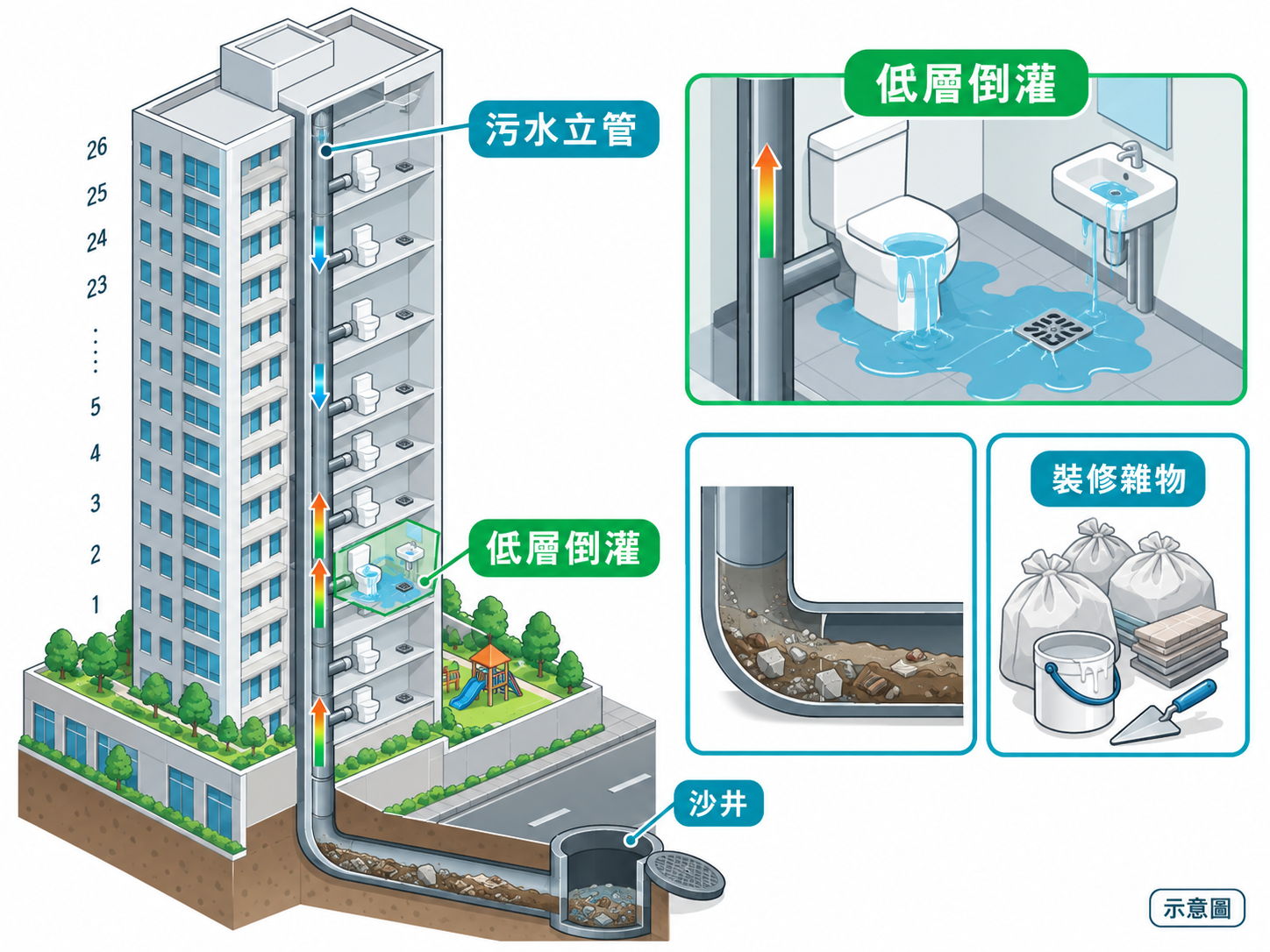
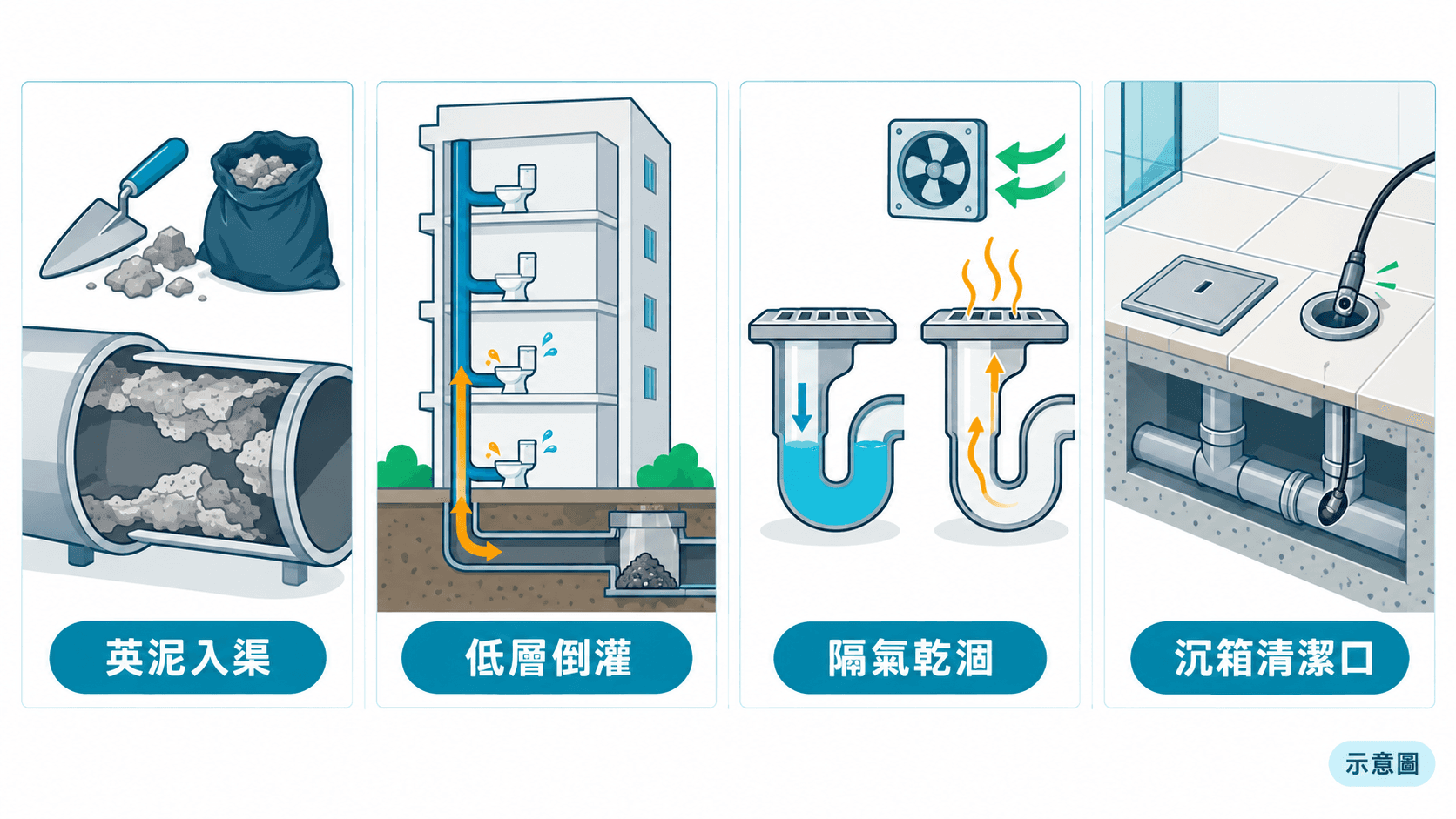
The Sai Kung District Council minutes of 2 March 2021 record the Housing Department saying that where residents of low-floor flats reported blocked pipes, the management company sent staff to inspect and carried out drain clearing on the pipework in the common areas, and posted a notice asking owners and renovation workers not to dispose of renovation waste or objects into the drains. By design, cement slurry, plaster crumbs and tile adhesive are heavier than ordinary waste and settle at the bottom of a stack and at horizontal bends. The Buildings Department's drainage guideline also notes that where materials such as cement cause a serious blockage, the affected length of pipe may have to be exposed and replaced, because rodding or jetting cannot always clear it. So when backflow keeps coming back, the question is the condition of the shared pipework, not just clearing the toilet in one flat.
Buildings Department practice note APP-93 requires, in buildings over three storeys, that the sanitary fitments on the floor level with the bottom of the stack discharge through separate pipework straight to a manhole. Only in 2021 did APP-164 extend that to the floor above for buildings over 20 storeys, and ban branch connections inside a restricted zone above the bend of an offset (1,000 mm for a building over five storeys) — and APP-164 applies only to drainage plans submitted after 31 August 2021. Yung Ming Court was occupied in 2020, so inferring from its age, the newer arrangement should not be assumed here. In practice that means when several flats in the same vertical line on the lower floors drain slowly together, or their toilets bubble or back up, the stack base and the building manhole are the things to look at rather than treating it as a single-flat problem.
Most Yung Ming Court owners took keys from November 2020 onwards and usually renovated before moving in, so flats often sat empty for months. The Buildings Department explains that a trap holds water to form a seal that keeps foul air in the drain out of the room, and that the seal is lost to evaporation, so it advises pouring about half a litre of water into every floor drain in the home at least once a week. The renovation period deserves extra attention: workers usually mop the floor rather than flush it, so a bathroom floor rarely gets wet, and once the door is shut and the extractor fan is on, sewer air is easily drawn back in through a dry outlet. If the smell comes with black staining around the outlet or with drain flies, check at the same time whether the trap has been altered or packed out.
Buildings Department practice note APP-93 says that where a sunken slab is used for a bathroom, lavatory or kitchen in a domestic flat, the void between the floor finish and the sunken slab should not be back-filled with concrete; and where back-filling is unavoidable, enough access must be provided — access panels of a suitable size, or cleaning eyes extended from the pipework up to the finished floor level — so that the pipes can later be inspected and cleared with a portable camera or CCTV. Inferring from the design of flats of this generation, Yung Ming Court bathrooms are likely to be of that type, so when a drain is slow and the cause is not obvious, the first move is to locate the access panel and cleaning eye rather than break up the floor. That matters even more when the slow draining started after a shower tray was fitted or a drain outlet was moved.
The minutes of 2 March 2021 record that after clearing the pipework in the common areas, the management company carried out cleaning and disinfection. The inside of the flat needs the same treatment: once the water has gone, organic matter stays in the tile joints, around the floor-drain outlet and along the base of cabinets, so wiping the surface and spraying an air freshener buys a few days at most. A sensible order is to remove solid waste first, then treat every floor and skirting that the sewage touched with diluted bleach or a suitable disinfectant, and finally pour water into each floor drain to restore the seal. Carpets, timber skirting and soaked cardboard cannot be disinfected reliably and usually have to go.
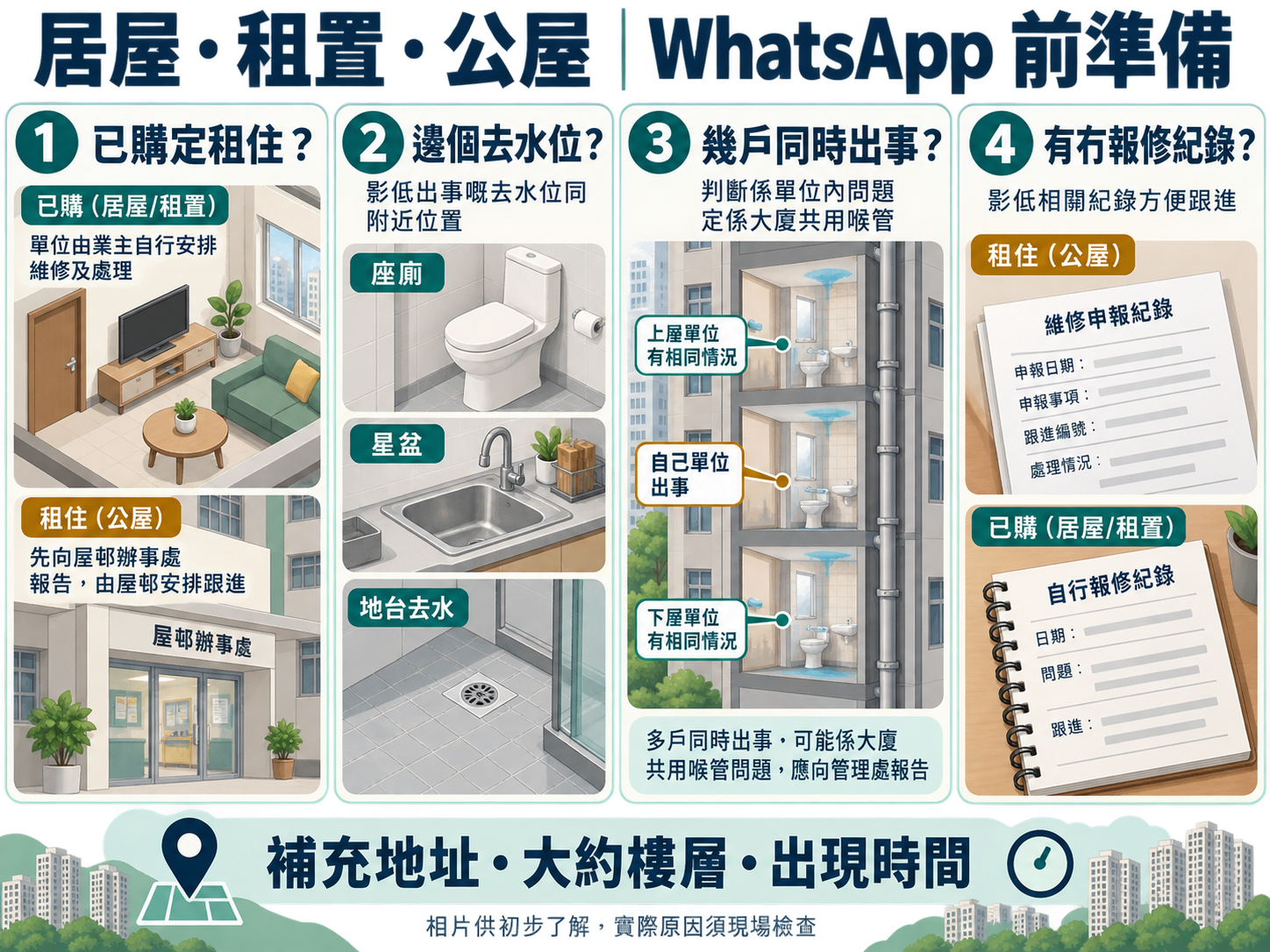
Photos or a short video on WhatsApp help us tell a single-fixture blockage from a shared-stack problem.
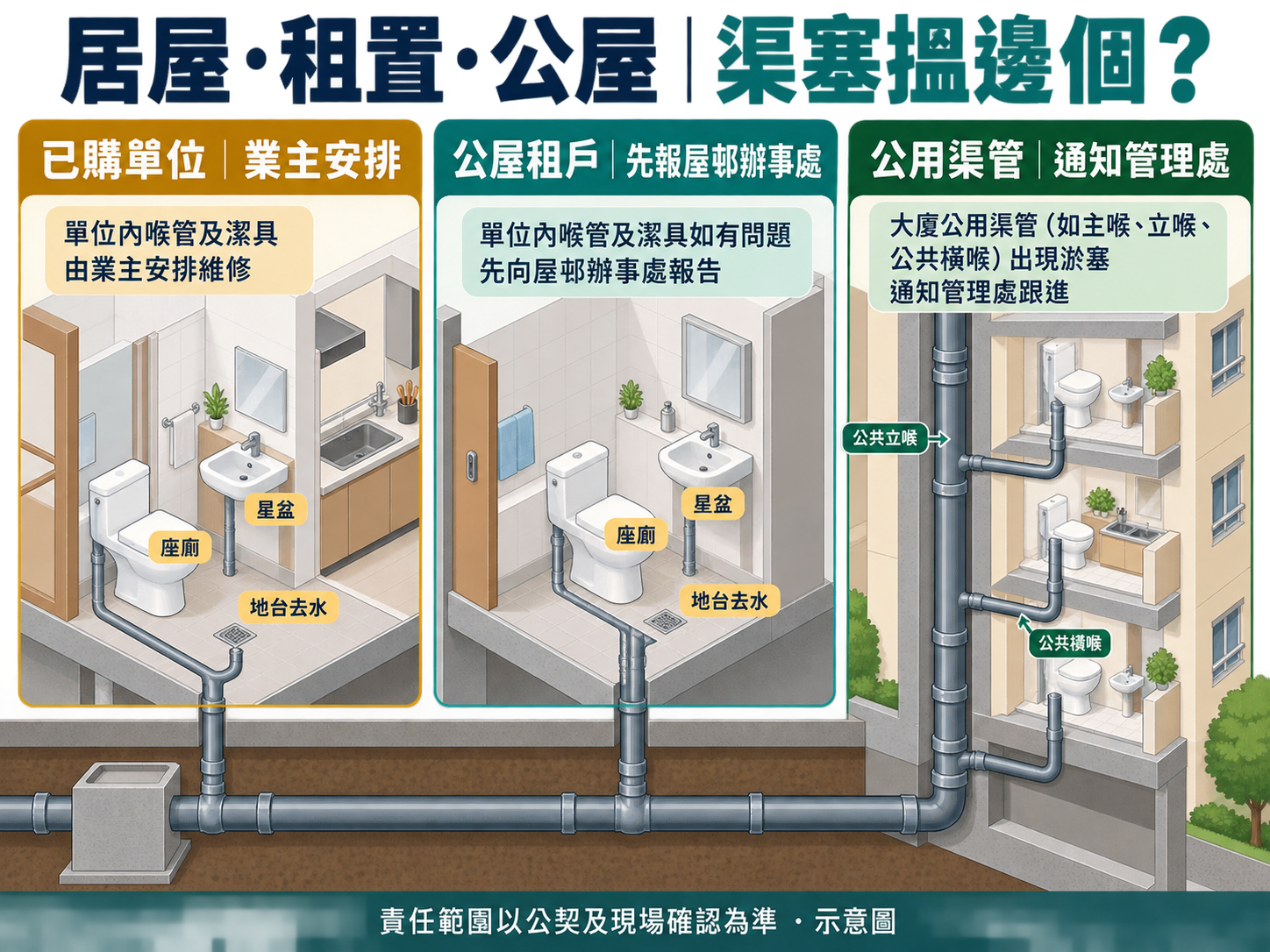
Yung Ming Court stands at 5 Chi Shin Street, Tseung Kwan O. It received its occupation permit on 22 October 2020, owners began taking keys that November, and its two 26-storey blocks hold 1,395 flats in total. In a subsidised-sale court only a few years old, the usual trouble is not ageing pipework but cement, rubble and debris left in the drains during the move-in renovation rush, which settles low in the shared stacks and makes toilets and bathroom floor drains on the lower floors run slowly or back up. The other common complaint is odour, because many flats stood empty between handover and moving in and their floor-drain traps dried out. The first step either way is to separate a fault in the flat's own traps and branch pipes from one in the shared stack, building drain or manhole.
Yung Ming Court was sold under the HOS 2019 programme as Housing Authority project SK04, and its two blocks, Yun Ming House (潤明閣) and Chak Ming House (澤明閣), are each 26 storeys tall. Published floor data gives Yun Ming House 30 flats per floor from 1/F to 12/F and 22 above 13/F, while Chak Ming House has 34 on 1/F, 38 per floor from 2/F to 12/F and 20 above 13/F. In other words the lower floors are noticeably denser than the upper ones. By design, that means each soil stack collects from more fixtures along its lower section than its upper section, and the lower floors are also where a stack turns and discharges to a manhole — which is why low-floor flats are the most sensitive to a blockage.
Handover began in November 2020, so a large number of owners took keys and renovated at the same time. The Sai Kung District Council minutes of 2 March 2021 record a councillor reporting that after move-in some flats had suffered sewage backflow 'suspected to be caused by the design of the pipework'. The Housing Department replied that the Housing Authority had carried out detailed inspection, testing and acceptance before the project was completed and had confirmed that the estate's drainage system met the Buildings Ordinance and the construction contract. It added that where residents of low-floor flats reported blocked pipes, the management company sent staff to inspect and carried out drain clearing on the pipework in the common areas, followed by cleaning and disinfection, and posted a notice asking owners and renovation workers not to dispose of renovation waste or objects into the drains.
A young building does not automatically mean today's drainage standard. The Buildings Department issued practice note APP-164 in 2021: for buildings over 20 storeys, the sanitary fitments on the floor where the stack discharges to a manhole — and on the floor above — must have separate pipework running directly to the manhole, and floor-drain traps must be topped up automatically by waste water from a basin or shower. That practice note, however, only applies to drainage plans submitted to the Building Authority after 31 August 2021. Yung Ming Court received its occupation permit in October 2020, so its plans predate that cut-off and residents should not assume those features are here. Inferring from the earlier APP-93, only the lowest floor of a stack normally needs its own pipework to a manhole, with the second-lowest floor still connected to the stack — so when several low-floor or second-lowest-floor flats have trouble together, that is a sensible place to start.
It is also worth separating water seepage from blocked drains. The Sai Kung District Council minutes of 2 February 2021 record Housing Department figures: 98 seepage cases had been received, of which 32 needed no follow-up because the owners were about to renovate, 43 involved leakage at the bathroom door frame without affecting the waterproofing layer, and 23 involved the waterproofing layer, with all repair works subsequently completed. Seepage is a waterproofing or structural matter handled through seepage testing and defect rectification; slow draining, odour and backflow are drainage matters. Reporting them separately saves a lot of going in circles.
Note: statements based on building age and type are general inferences, not findings for any particular flat.
A clear process from enquiry and assessment to an agreed scope of work
Tell us the drain problem and district and ask about available timing.
Confirm timing based on the district and schedule, then inspect the blockage or odour issue.
Explain the proposed approach, scope and price before agreed work begins.
Use suitable tools for the site conditions and agreed scope of work.
After the agreed work, test drainage and explain the observed result and any next steps.
PipeButler is an independent drain-service provider with no affiliation to the developer, owners' corporation, management company or Housing Department of the places above. Facts come from public sources checked on the dates shown; work on common drains or common parts follows the management office's and deed of mutual covenant's arrangements.
WhatsApp with the problem and district, and we will confirm available timing.