
Loading page…
Loading page…
Fo Tan · HOS / PSPS
Intake 1980 · Phase 2 completed 1981 · 9 blocks of 36 storeys · split-level cruciform
Sui Wo Court is one of the first Home Ownership Scheme courts, completed in 1980.
Last reviewed ·
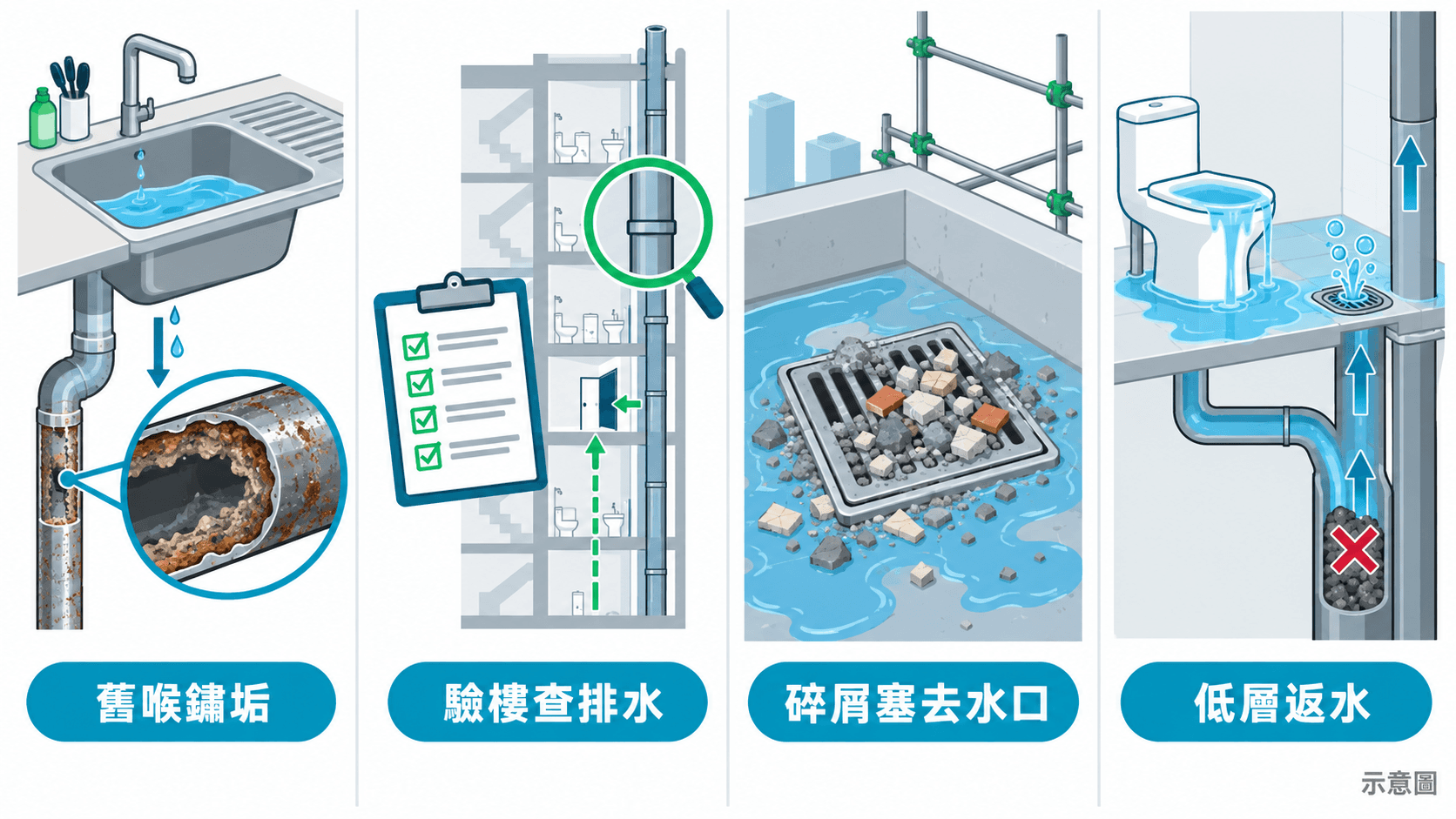
Choose the problem you are seeing to read the likely cause and next step.
As a general inference from age, the original cast-iron or galvanised pipes of the early 1980s build up scale on the inside, which then catches kitchen grease, hair and soap residue until the effective bore keeps shrinking. The symptom is rarely a sudden blockage: it is water that takes longer to go, a level that lingers for a few seconds, and then a full stop on a wet day or when the household is busy. Deal with it in order — clear the branch pipe inside the flat first, with a drain machine or high-pressure water to strip the build-up from the pipe wall. If it slows again within two or three months, a camera survey will show which section has narrowed, and you can then choose between replacing that length or putting it on a cleaning cycle.
Wikipedia records that the estate received its statutory inspection notice in 2018. The Buildings Department's code of practice sets out five prescribed inspection items — external elements, structural elements, fire safety elements, the "drainage system" and unauthorised building works — and the drainage item covers pipes on external walls, in common parts, in common pipe ducts and in the underground and above-ground common systems, anti-syphonage and vent pipes included. The code also provides that "for common exposed drain pipes / drain pipes laid within common vertical pipe ducts located inside individual private premises, inspection may be made by gaining access from the individual private premises at least every 3 floors and at pipe duct outlet". So a request from the management office to look at pipes inside your flat is part of the process, not an extra. What the inspector has to identify includes "corrosion, leakage, deformation, displacement, damage and blockage of drain pipes and traps including underground drains and misconnected common drains" and "corrosion, loosening or breaking of metal brackets". While this is going on, photograph your own outlets, traps and exposed pipes: the record is useful later.
Wikipedia records that the works begun in September 2023 include external-wall renovation and the removal of the old mosaic tiling. Programmes change, so check with the owners' corporation or management office whether work is actually on your block at the moment. Inferring from the nature of that work, hacking off the old finish and re-rendering produces a great deal of debris and mortar slurry, and once it washes into outlets on roofs, podiums, planters and ground-level channels, rain brings standing water and overflow into corridors or across podium surfaces. That is common-parts territory: photograph any outlet you find choked, or a podium that stays wet, and ask the management office to arrange clearing. On the flat side, if work is running on your block, the drain from the window-side pipes and the air-conditioner platform can also be obstructed by materials or temporary works, so it is worth a look.
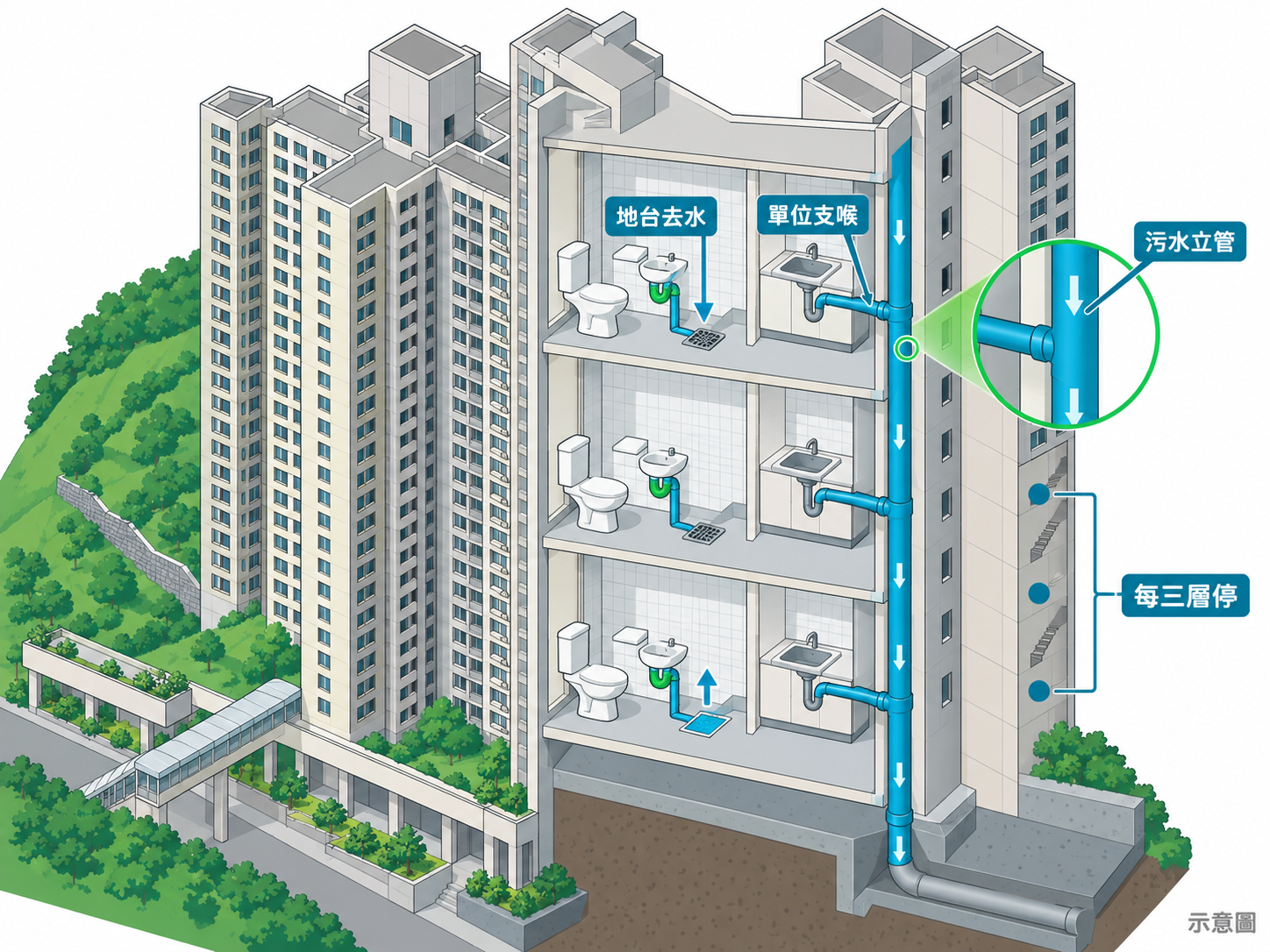
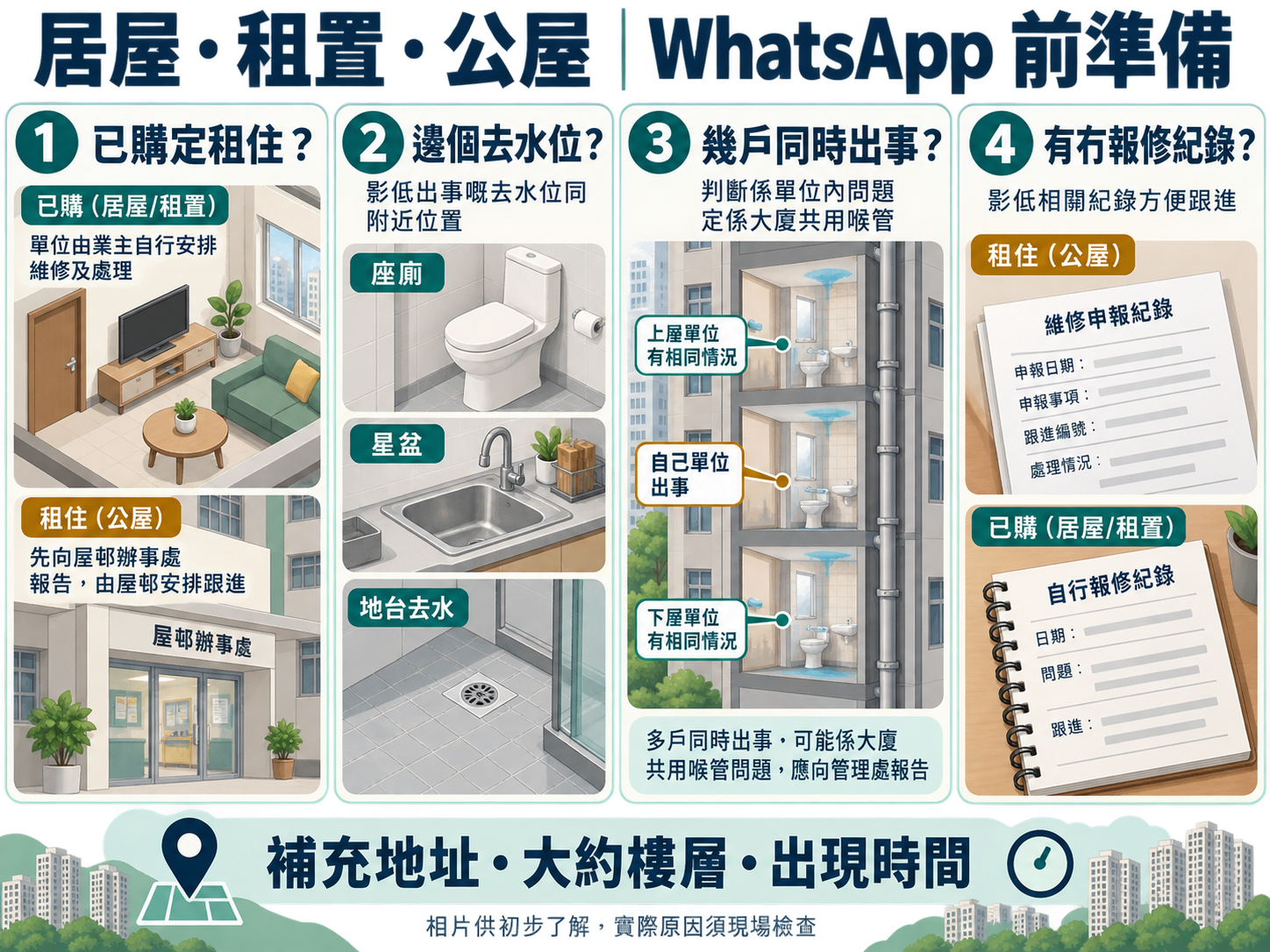
Inferring from the design, flats in the same wing and position share one soil stack from the top floor down. If the lower part of that stack or its outlet is narrowed by grease, tissue and debris, then when the upper floors discharge together the toilets and floor drains of the low-floor flats are the first to show a rising level, bubbling, or actual backflow. To judge which layer you are on, count how many points misbehave at once: a single slow fixture normally stays within the flat's own branch pipe and trap, whereas a toilet and a floor drain surging together — especially while flats above are washing or showering — is already a stack-level matter, so tell the management office the same day and write down the date, time and water level. Anywhere sewage has reached should be disinfected after it is cleared.
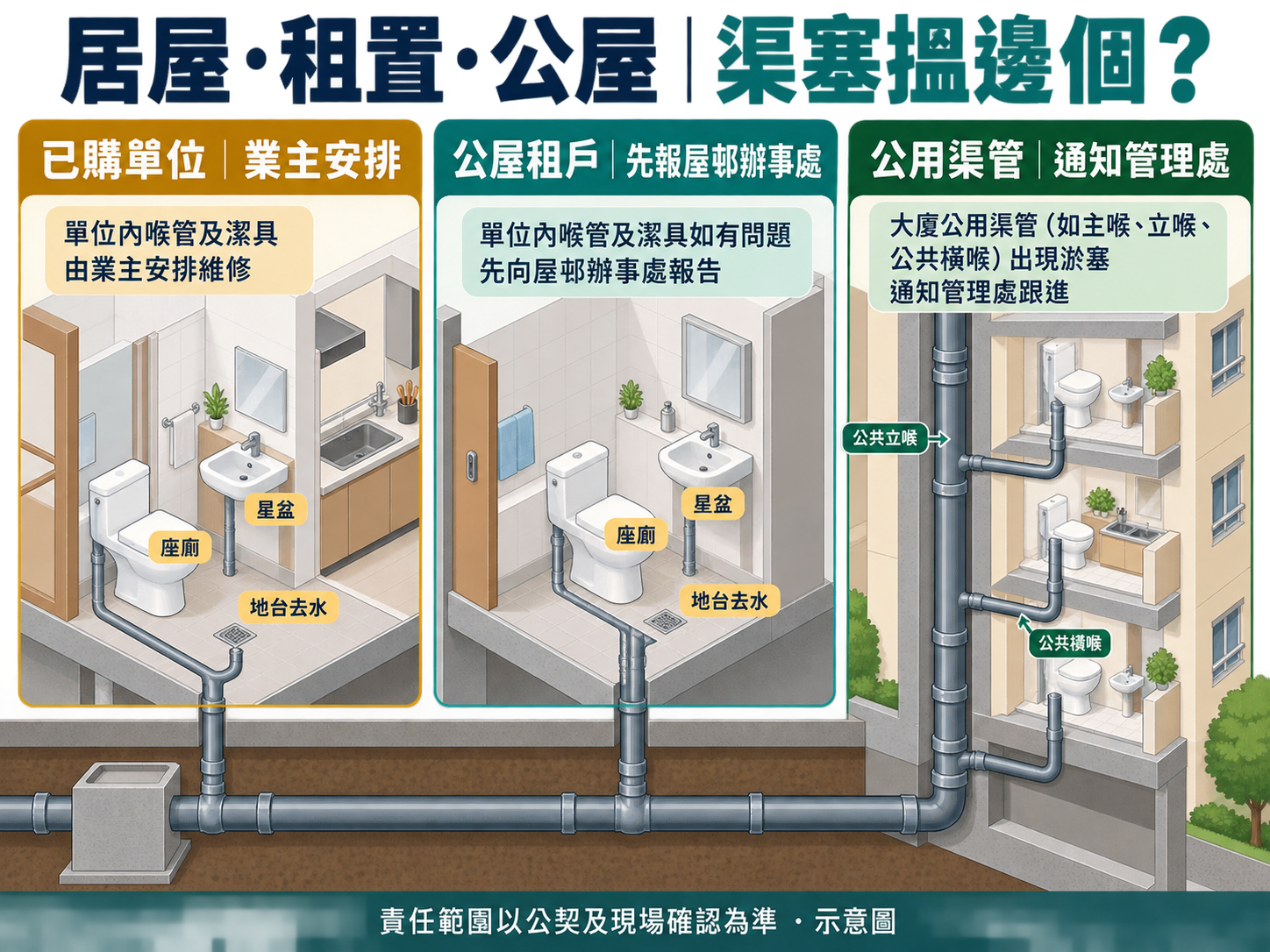
Most flats of this age have had their layout changed. The Buildings Department's pamphlet on maintaining drainage pipes is explicit: when a bathtub is replaced by a shower tray, a suitable trap must be fitted; a washing-machine outlet should also have a suitable trap and discharge to a waste pipe; anti-syphonage pipes must never be removed or altered; and an over-powerful exhaust fan should not be installed in a bathroom. If a smell started after renovation, or appears the moment the fan goes on, these are the places to look. Note too that altering a trap, an anti-syphonage pipe or the position of an outlet is minor works and must be carried out by a registered minor works contractor — and under the inspection code, a registered inspector who finds an unauthorised drainage alteration or a wrong connection has to report it to the Building Authority.
Photos or a short video on WhatsApp help us tell a single-fixture blockage from a shared-stack problem.
Sui Wo Court is one of the first Home Ownership Scheme courts, completed in 1980. It stands on the hillside in the south-west of Fo Tan: nine "split-level cruciform" blocks of 36 storeys, 3,501 flats in all, with the three Phase 2 blocks finished in 1981. Forty-six years on, the branch pipes, traps and shared stacks all need checking section by section. Wikipedia records that the estate received a statutory mandatory building inspection notice from the Buildings Department in 2018, and the department's code of practice lists the drainage system as one of the prescribed inspection items. So whether the kitchen sink is slow, the bathroom smells of drains, or a low-floor flat is backing up, the first step is the same: work out whether the fault is inside your flat or in the building's shared pipes.
The estate was designed by Palmer and Turner and built by Hsin Chong Construction. Its nine blocks are arranged in three groups of three, each group set out in a triangular cluster and the three groups forming another. Wikipedia records the architect, James Hajime Kinoshita, describing a scheme in which three blocks share a plaza, three floors share one lift — so the lifts stop only at G/F, 2, 5, 8 and so on up to 35 — and three flats share a staircase; it credits that set of unusual features, together with the open lobbies and the wings at differing heights, with winning the estate the 1981 Hong Kong Institute of Architects Silver Medal. For residents it means floor levels differ between wings within a single block, and anyone not on a lift-stop floor walks a flight of stairs to get home; whoever brings a drain machine or a jetting hose to your door has to allow for that last stretch too.
Wikipedia, citing Centadata, gives 389 flats in each block and about 12 on each floor. Inferring from the design, flats in the same wing and the same position share one soil stack from top to bottom, with bathroom and kitchen outlets gathered into a few pipe ducts, while the split-level plan means the horizontal branch from a flat to its stack does not run as regularly, in direction or in length, as in an ordinary cruciform tower. In practice that cuts both ways: a fault in one flat's branch pipe or trap does not necessarily stay in that flat, and when a stack or its outlet narrows, the water level usually rises first in the low-floor flats on the same vertical line.
Completed in 1980 and 1981, the oldest six blocks are now 46 years old. As a general inference from age, original soil and waste pipes of that generation were usually cast iron or galvanised steel; scale and rust reduce the effective bore over time and joints start to weep. Add four decades of resale and renovation and the trap types, outlet positions and connection details can differ sharply between flats in the same block, so the estate name tells you very little about the pipes in any one flat. Housing Authority records give saleable areas of 38–57 m². Inferring from that, bathrooms and kitchens are compact, the floor drain sits close to the exhaust fan, and a water seal that dries out tends to be noticed almost at once.
Wikipedia records that the estate received its statutory mandatory building inspection notice in 2018, that the owners' corporation passed a repair resolution in June 2023, and that works including external-wall renovation began that September. This bears directly on drainage: the Buildings Department's Code of Practice for the Mandatory Building Inspection and Window Inspection Schemes states that a prescribed inspection must cover the "drainage system", and that "for the avoidance of doubt, inspection of the common parts shall cover inspection of common drains in the non-common parts of a building" — in other words the shared pipe passing through a flat is inside the scope as well. Whether the works include pipe renewal, and how far they have got on your block, is not stated in Wikipedia, so ask the owners' corporation or the management office for the scope of works, the programme and the inspection report.
Note: statements based on building age and type are general inferences, not findings for any particular flat.
A clear process from enquiry and assessment to an agreed scope of work
Tell us the drain problem and district and ask about available timing.
Confirm timing based on the district and schedule, then inspect the blockage or odour issue.
Explain the proposed approach, scope and price before agreed work begins.
Use suitable tools for the site conditions and agreed scope of work.
After the agreed work, test drainage and explain the observed result and any next steps.
PipeButler is an independent drain-service provider with no affiliation to the developer, owners' corporation, management company or Housing Department of the places above. Facts come from public sources checked on the dates shown; work on common drains or common parts follows the management office's and deed of mutual covenant's arrangements.
WhatsApp with the problem and district, and we will confirm available timing.