
Loading page…
Loading page…
TKO Town Centre · Public rental housing · HOS / PSPS · Private estate
Occupied 1998–2005 on reclamation · PRH, HOS and private tenures side by side
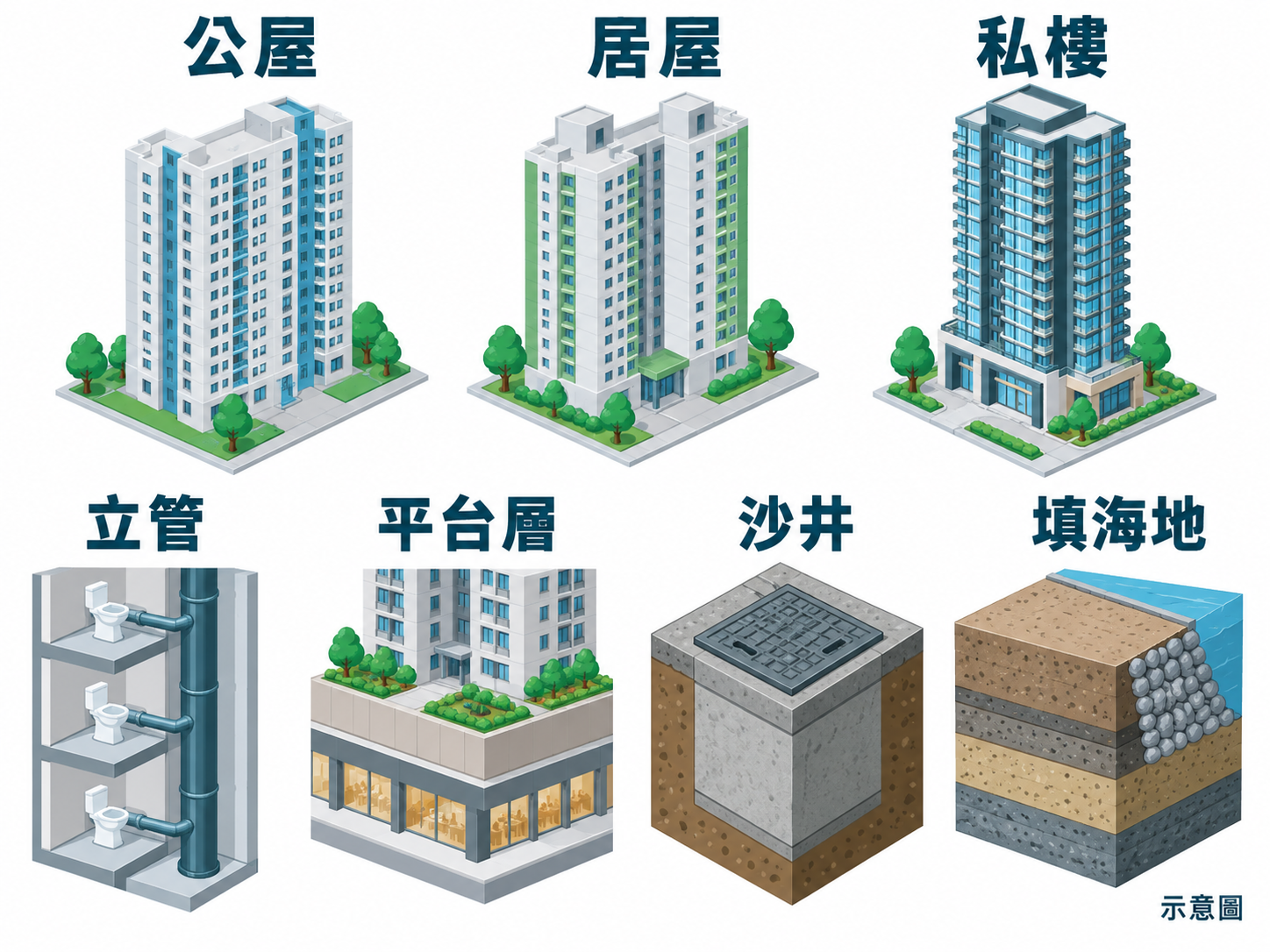
Tseung Kwan O Town Centre sits on land reclaimed in the new town's second phase.
Last reviewed ·
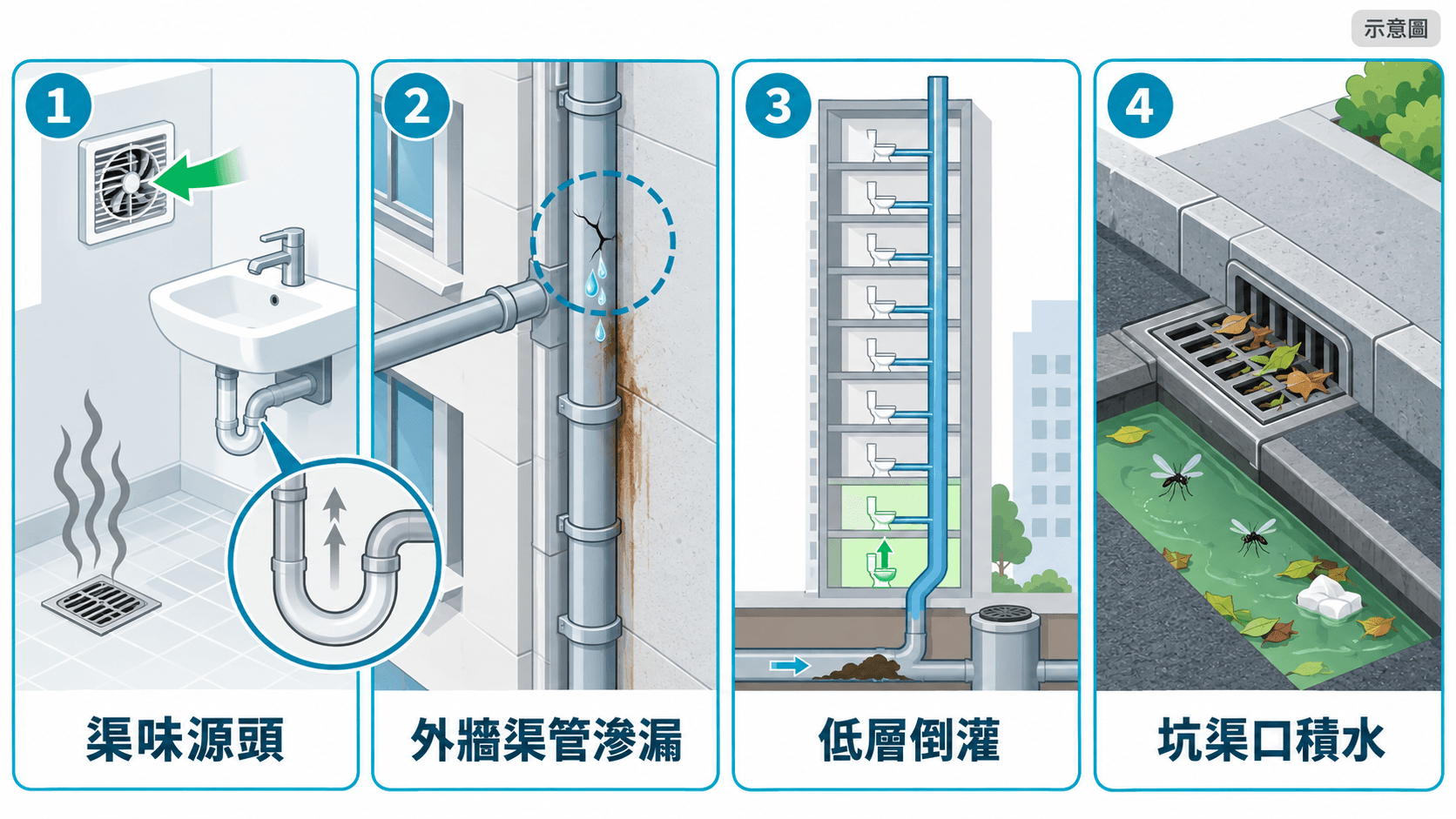
Choose the problem you are seeing to read the likely cause and next step.
The minutes of the Sai Kung District Council meeting of 6 March 2018, attended by the Director of Drainage Services, record a member saying he had "received many reports from residents of drain odour from the WC inside their flats, and the building's managing agent could not find the source of the smell either", and asking whether the department would give residents professional drainage advice or technical support. This kind of smell rarely has a single cause; it has to be eliminated in order. Pour about half a litre of water into each floor drain and smell again a day or two later. Then close the bathroom door, switch on the exhaust fan and see whether the smell immediately intensifies — if it does, some fitment has an inadequate water seal. Next check whether the traps under the basin and kitchen sink have dried out or were swapped for a shallower type during renovation. Only when all three draw a blank should suspicion move to the shared stacks and pipe ducts, for the management office or estate office to follow up.
At the Sai Kung District Council meeting of 3 May 2022, attended by the Director of Buildings, a member said that "many estates in Tseung Kwan O have already reached twenty or thirty years of age", that small owners struggle to meet inspection costs, and that "some cases have dragged on for five or six years without the damaged length of pipe being located", with affected owners repeatedly replacing window frames and gas pipes. The Director replied that the public may report damaged common drainage pipes to the department, and that where the damaged position cannot be established "the Buildings Department can only inspect or test floor by floor"; where a pipe is damaged or already broken, it can continue to enforce. For a household, the practical first step is to work out where the water is coming from: clean water dripping without let-up points to a fresh-water pipe; a stain that only appears a while after someone has showered points to the waterproofing; a smell that sharpens the moment water is used points to the drain. Photographs, dates and the weather at the time, handed to the management office or owners' corporation, can save months.
Homes in the town centre run from 38 storeys to a little over fifty (Tseung Kwan O Plaza's blocks are 45 storeys with floor numbers skipping up to 56), so one stack collects far more floors than in an older district. By design, the stack turns through ninety degrees at its foot before discharging into a manhole, and that bend is the slowest-flowing, most deposit-prone length of the whole run; when dozens of floors above discharge at once into a bend that has already narrowed, the toilets and floor drains on the lowest floors are the first to show a rising level, or to back up. Buildings Department practice note APP-93 has long required any building over three storeys to give the fitments on the floor at the foot of the stack separate pipework straight to a manhole, and APP-164 went further in 2021 by extending that to the floor above in buildings over 20 storeys. APP-164 applies only to drainage plans submitted for approval after 31 August 2021, so by date the buildings here, occupied between 1998 and 2005, were not designed to the newer requirement. If you live low down and the toilet level rises while the flats above do laundry or wash up after dinner, do not treat it as a single-flat blockage: say plainly that you suspect the foot of the stack, so the management office or estate office starts from the shared pipework.
At the Sai Kung District Council Food and Environmental Hygiene Committee on 14 March 2024, members asked departments to strengthen cross-departmental co-operation on mosquitoes and midges at several spots, the list including "the gully inlets at the Beverly Garden and Tong Ming Court roundabout" and "public housing estates such as Sheung Tak, Yee Ming and Kin Ming". Earlier, on 12 January 2017, members of the Housing and Environmental Hygiene Committee (minutes in the sources below) said that "cleanliness at the open channel by Sheung Tak's mall and at the lift lobbies of Kin Ming Estate is a serious problem, covered with cigarette butts and all kinds of rubbish, and worse still in bad weather", and asked Link Asset Management to instruct its contractor. A Link representative replied at the same meeting that it would keep the areas clean and step up supervision of its contractors. All of this is the surface rainwater system: standing water in a gully breeds mosquitoes and a litter-choked open channel leaves roads and podiums under water in heavy rain, but none of it connects to the foul drains serving your toilet and kitchen sink. If water stands on the street or the podium, tell the management office or the relevant department to clear the rainwater inlets; water welling up at an indoor floor drain with a smell belongs to the foul system. Recording the two separately makes both much quicker to resolve.
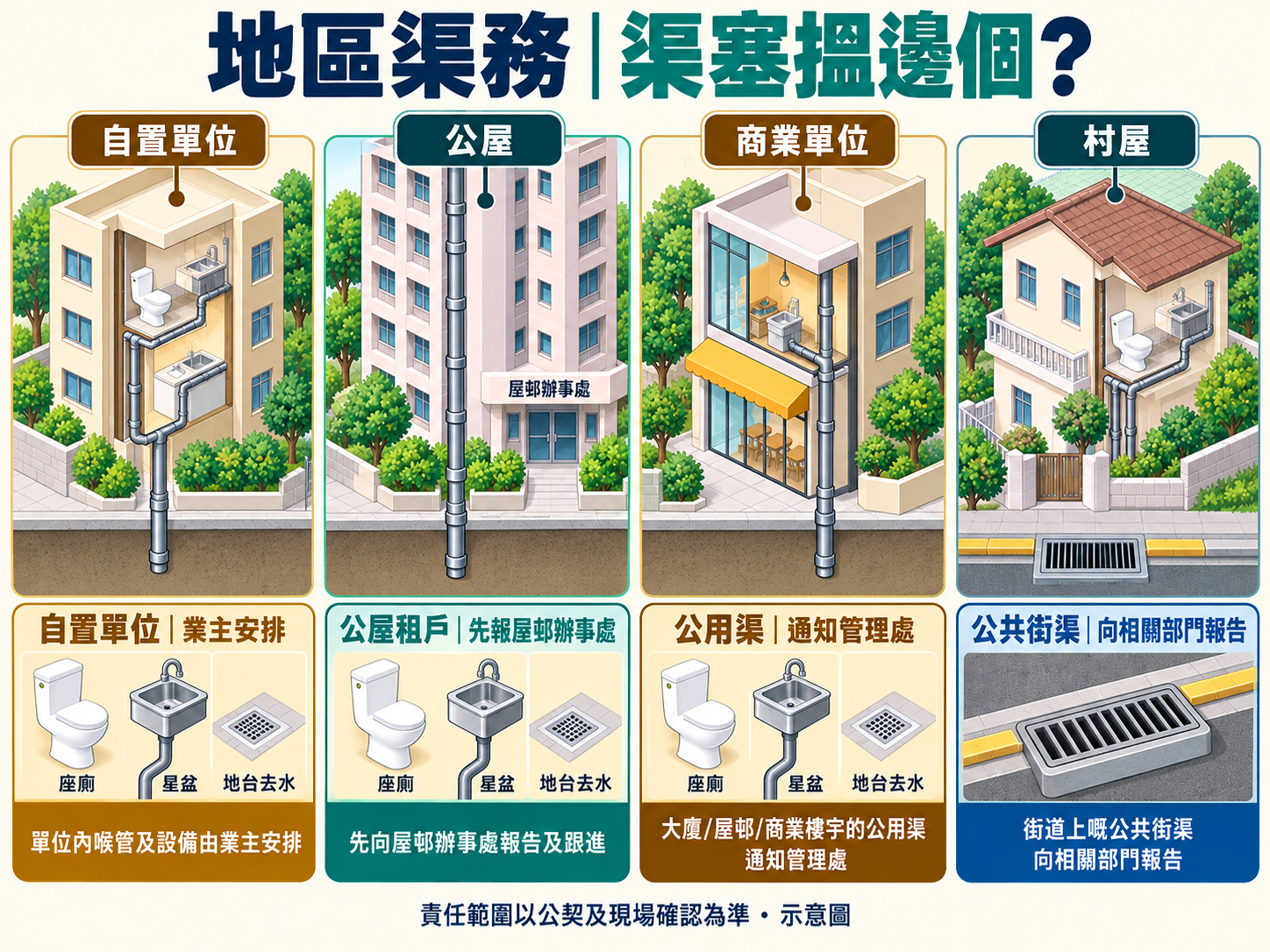
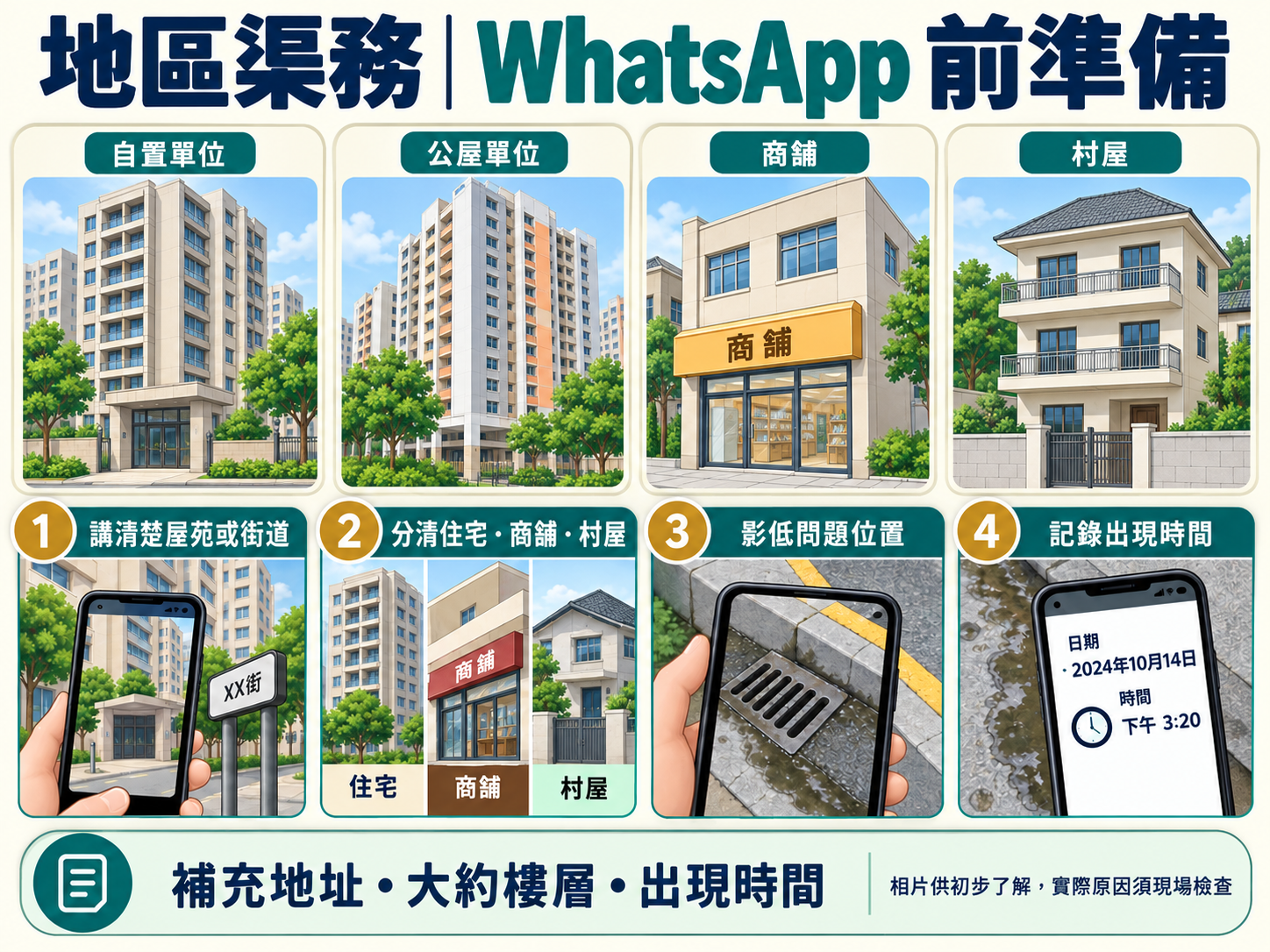
At the Sai Kung District Council Housing and Environmental Hygiene Committee on 10 November 2016, one member "asked which department is responsible for the manhole at the Sheung Tak Estate bus terminus", while another "pointed out that 'Sheung Tak Estate' is only a collective name, and that the area involved includes Kwong Ming Court, Po Ming Court and land managed by Link". That matters when you report a fault: on one patch of ground, the rental blocks answer to the Housing Department and the estate's managing agent, each HOS court to its own owners' corporation and managing agent, and the mall and some walkways to yet another owner. So before you ring anyone, photograph the exact spot — which street, which entrance, which manhole cover — and say whether it is inside the estate or on a public footway; it saves a round of referrals. For the roads outside, the Drainage Services Department explained at the Sai Kung District Council meeting of 6 March 2018 (minutes in the sources below) that the Highways Department clears road gully gratings and branch drains, the department itself looks after the trunk drains, and the Food and Environmental Hygiene Department removes litter.
Photos or a short video on WhatsApp help us tell a single-fixture blockage from a shared-stack problem.
Tseung Kwan O Town Centre sits on land reclaimed in the new town's second phase. Sheung Tak Estate was occupied in January 1998; Kwong Ming Court, Po Ming Court and Beverly Garden were completed the same year, Tong Ming Court followed in 1999, and Park Central and Tseung Kwan O Plaza handed over between 2001 and 2005. Within a five-minute walk there are four tenures — public rental, Home Ownership Scheme, private-sector participation and fully private — in blocks ranging from 38 storeys to a little over fifty. So "who do I call about a blocked drain" has more than one answer here: first work out which tenure your home falls under and whether the blockage is inside the flat or in shared pipework, then decide between the estate office, the management office and booking a technician yourself.
The buildings here are packed into a remarkably narrow span of years. Sheung Tak Estate was occupied in January 1998; the seven blocks of Kwong Ming Court were completed that March and April; the two blocks of Po Ming Court, originally planned as part of Sheung Tak Estate, were switched to HOS sale; Beverly Garden was completed on 11 September 1998; and all works at Tong Ming Court finished in February 1999. The private estates came a little later: Park Central in batches from 2001 to 2005, and Tseung Kwan O Plaza in 2003. Across these seven estates alone, close to seventy per cent of the homes were handed over inside the fourteen months from January 1998 to February 1999. The pipework across the whole sub-area is therefore of one generation and one specification, reaching twenty-seven or twenty-eight years of age together, on much the same ageing timetable.
On the public side, everything is a Housing Authority standard block. Sheung Tak Estate was in the last batch to use the 38-storey Harmony 3 design, and four of its blocks rise to 42 storeys; Kwong Ming Court's seven blocks are also Harmony blocks, and the sales brochure's sample plan is headed "Block C, 1/F to 38/F"; Po Ming Court's two blocks are Harmony blocks of 39 storeys each. By design, in a standard block the kitchens and bathrooms in the same vertical line connect to a limited number of shared stacks, so when the lower part of a stack narrows, several flats in that line slow down together and the lowest floors notice the water level rising first. The private towers are taller still: Park Central averages about 53 storeys, and Tseung Kwan O Plaza's blocks are 45 storeys numbered up to 56. The taller the block, the more floors one stack collects and the greater the peak flow its bottom bend has to take — which bears most directly on the lowest few floors.
The third thing to keep in mind is the ground underneath. The Chinese Wikipedia records that as Sheung Tak Estate, Tong Ming Court and their neighbours were occupied in the late 1990s, uneven settlement began to be noticed on the new reclamation; and at the Sai Kung District Council meeting of 6 March 2018 the Drainage Services Department said that after Tseung Kwan O "showed abnormal settlement more than ten years ago" it had paid particular attention to whether drain connections at the TKO Industrial Estate were fracturing abnormally, that monitoring had found fractured drains in the past, and that timely repairs had been made. Neither statement means any particular estate's drains are faulty. But by design, underground runs and podium-level collectors on reclaimed land carry more distortion at their joints than foundations on a hillside, so if the same spot blocks again and again, and returns a few months after each clearing, it is worth a camera survey to see whether the cause is build-up or a displaced joint rather than pouring in drain cleaner once more. On top of that, Park Central and Tseung Kwan O Plaza both carry their flats on retail podiums (Sheung Tak's own mall is a separate four-storey building with shops, a market and the bus terminus). By design, where flats sit on a podium the stacks transfer into horizontal collectors before reaching a manhole; those runs have shallow falls and many bends, and grease and debris settle there readily.
Note: statements based on building age and type are general inferences, not findings for any particular flat.
A clear process from enquiry and assessment to an agreed scope of work
Tell us the drain problem and district and ask about available timing.
Confirm timing based on the district and schedule, then inspect the blockage or odour issue.
Explain the proposed approach, scope and price before agreed work begins.
Use suitable tools for the site conditions and agreed scope of work.
After the agreed work, test drainage and explain the observed result and any next steps.
PipeButler is an independent drain-service provider with no affiliation to the developer, owners' corporation, management company or Housing Department of the places above. Facts come from public sources checked on the dates shown; work on common drains or common parts follows the management office's and deed of mutual covenant's arrangements.
WhatsApp with the problem and district, and we will confirm available timing.