
Loading page…
Loading page…
Tsuen Wan Town Centre · Private estate
Occupied 1983–84 · 17 blocks on a depot podium · 4,000+ flats
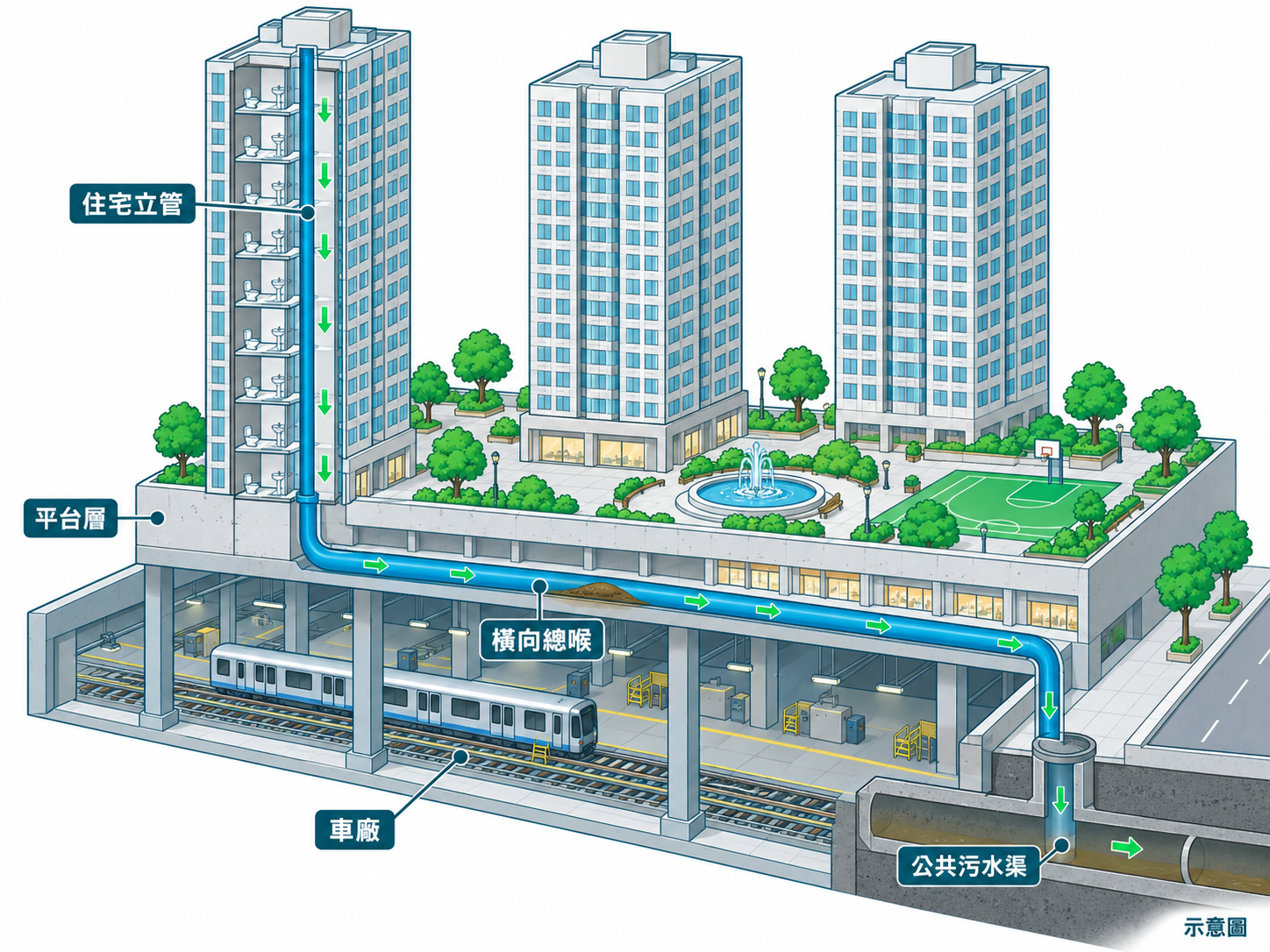
Luk Yeung Sun Chuen stands at 22–66 Wai Tsuen Road, Tsuen Wan, directly on the podium above Tsuen Wan MTR station and the Tsuen Wan Depot.
Last reviewed ·
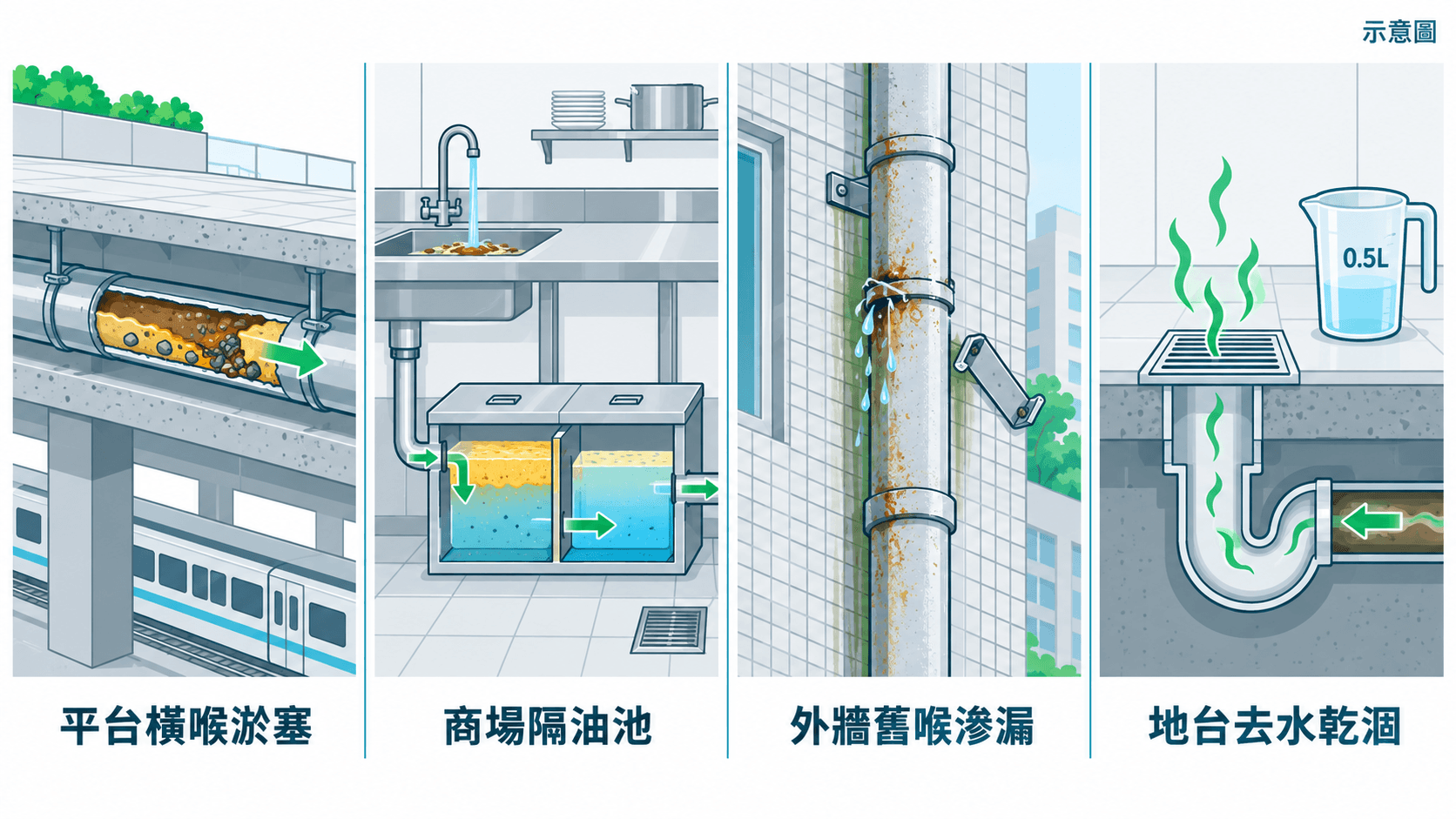
Choose the problem you are seeing to read the likely cause and next step.
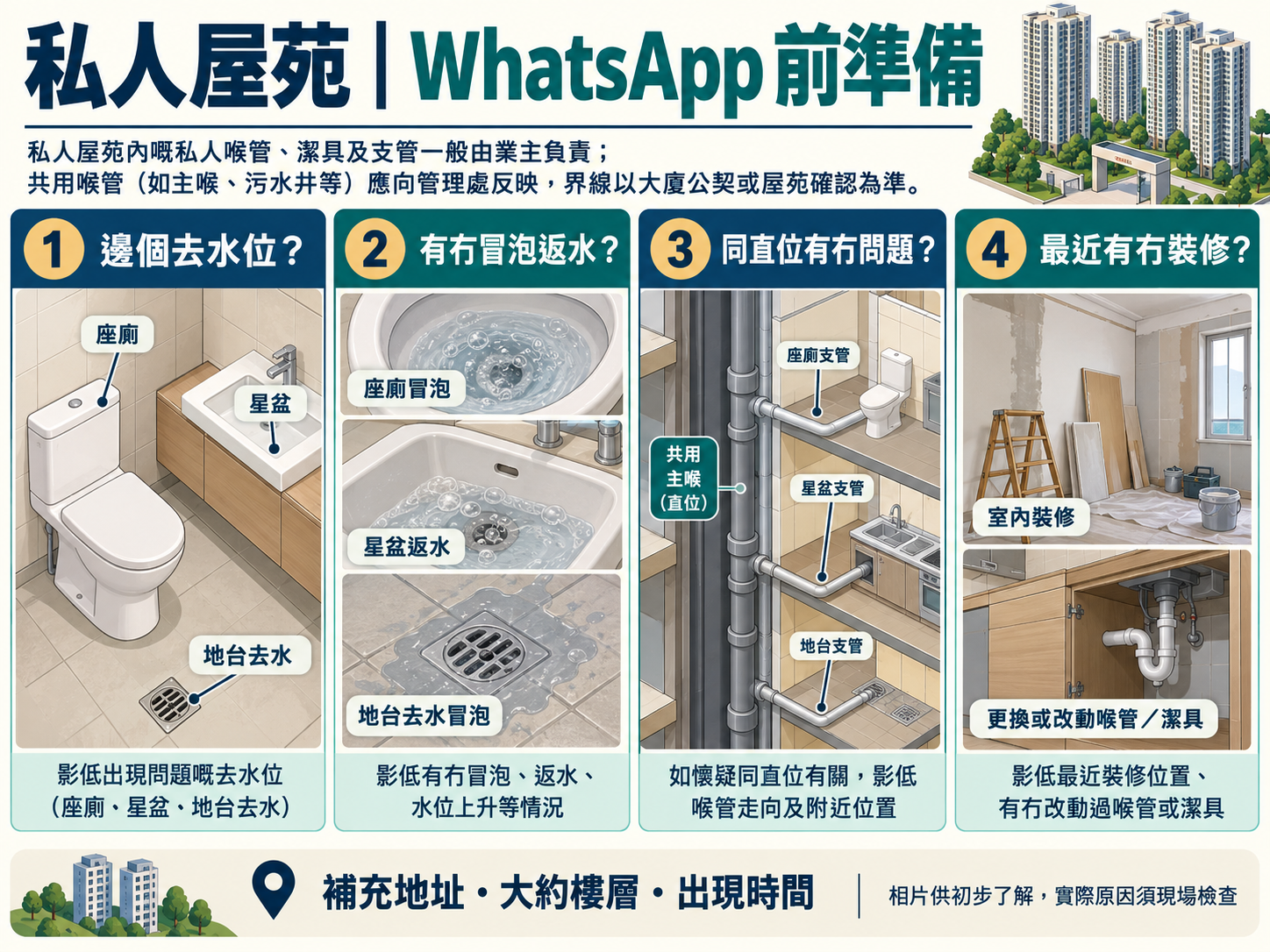
It follows from the structure that sewage from all 17 blocks turns into horizontal pipes at podium level before being led out past the depot. Once such a run is narrowed by grease, wet wipes or renovation debris, the first symptoms usually appear not on the upper floors but on the few floors closest to the podium: the water level in the toilet rises and the floor drain bubbles, especially at the busiest morning and evening times for water use. Another sign is staining on a podium, lobby or mall ceiling. If only one outlet is slow, the flat's branch pipe is the usual cause; if several flats in the same block are affected at once, tell the management office straight away and photograph the spot and the time so the podium-level check can be arranged.
Luk Yeung Galleria is a base mall of 170,000 sq ft; the 2007–08 refurbishment took the shop count from 63 to 85 and more than doubled the number of restaurants. The Environmental Protection Department's grease-trap maintenance guidance advises inspecting a trap at least every three days, cleaning it once greasy waste occupies the top 30 per cent of the liquid depth, and recording each clean in a log book. For a shop tenant, a slow sink or kitchen floor drain usually means grease has built up. For a resident, a drain smell around the podium, a back alley or the mall, or cockroaches and drain flies there, is normally for the mall side to follow up: pass it to the management office rather than dealing with shared pipes yourself.
The estate's external walls are finished in white and brown mosaic tiling; as an inference from the design of this generation, soil pipes, vent pipes and their brackets are usually run on the elevations or in the light wells. APP-133 notes that cast iron pipes in some existing buildings rust and leak prematurely, and that their fixing supports corrode too. As a general inference from building age, external pipes in their forties may show rust staining, weeping joints or loose brackets; inside the flat the clues are a smell near a window or light well that comes and goes, damp patches on a wall, or drips under a pipe. The Mandatory Building Inspection Scheme's list of prescribed items covers both the drainage system and external wall tiling, so external pipes are a common-parts inspection matter: report what you see to the management office rather than erecting scaffolding or altering pipes yourself.
As an inference from the design, the toilet, basin and bathroom floor drain in the same flat position most likely share one stack running from the top floor down to podium level. The Buildings Department explains that when an upper flat discharges a large volume at once, syphonage creates negative pressure in the branch pipes below, enough to suck out the water held in a trap, which is why an anti-syphonage pipe must extend to more than a metre above the roof to balance the pressure. If the water in your toilet drops for no reason, or the basin and floor drain make a sucking noise when a neighbour drains water and a smell follows, check whether the anti-syphonage pipe has been removed during renovation or blocked. The other half of the story is much simpler: in a rarely used bathroom or a vacant flat, the water seal evaporates. The Buildings Department's advice is to top up every floor drain at least once a week with about half a litre of water; if the smell survives two or three weeks of that, the trap may be cracked or may have been swapped for a shallow-seal type.
The podium garden is open to the public, footbridges link it to the transport interchange and nearby malls, and the mall itself sits next to Exit C of Tsuen Wan station, so it sees more people and more fallen leaves than an enclosed podium would. The Drainage Services Department says most recent flooding cases are not caused by insufficient drainage capacity but by other factors; its own list of locations prone to blockage is drawn up for places that flood repeatedly because leaves, silt or refuse block an inlet during a rainstorm. That is why podium and light-well rainwater inlets need clearing regularly. As district background, the Tsuen Wan Drainage Tunnel opened on 28 March 2013, runs 5.1 km with intakes at Wo Yi Hop, Lo Wai and Tso Kung Tam, operates only when an Amber rainstorm warning or above is in force, and mainly intercepts hillside runoff, while surface water in the town centre still relies on underground drains. That is background about Tsuen Wan and says nothing about this estate in particular. If water ponds on the podium during heavy rain, photograph the spot and the time for the management office, and when cleaning, keep leaves and litter out of the rainwater inlets.
Photos or a short video on WhatsApp help us tell a single-fixture blockage from a shared-stack problem.
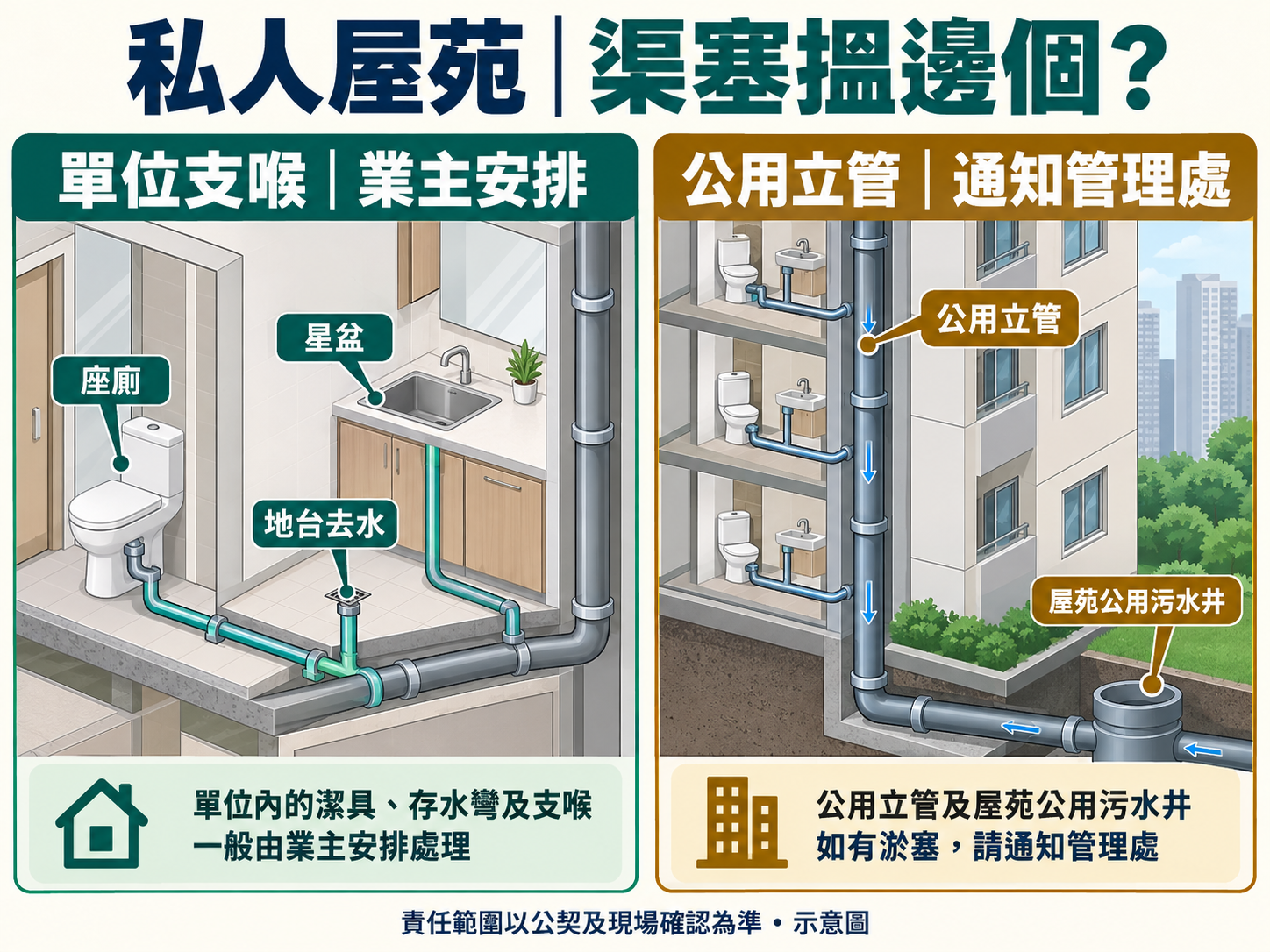
Luk Yeung Sun Chuen stands at 22–66 Wai Tsuen Road, Tsuen Wan, directly on the podium above Tsuen Wan MTR station and the Tsuen Wan Depot. It was occupied in stages in 1983 and 1984, with 17 residential blocks — the Wikipedia block table gives 30 storeys each — and more than 4,000 flats. On the evidence of the structure, drainage in a podium-top estate is best read in three layers: the traps and branch pipes inside your flat, the block's stacks and external-wall pipes, and the horizontal pipes below the podium that carry everything to the public sewer. When a toilet drains slowly, a bathroom smells or a low-floor flat backs up, work out which layer is involved first, then decide between booking a call-out yourself and reporting it to the management office.
Luk Yeung Sun Chuen was developed by the former Mass Transit Railway Corporation together with Kiu Kwong Investment, Hong Kong Land, Jardine Matheson and Dah Sing, receiving its occupation permits in stages: the Wikipedia block table gives 1983 for Blocks F to S and 1984 for Blocks A to E. The 17 blocks run through the alphabet but skip I and O, so they are lettered A to S, and the same table lists 30 storeys and 224 to 240 flats per block. At 240 flats a block, that works out at roughly eight flats a floor sharing the same set of stacks. The external walls are finished throughout in white and brown mosaic tiling, the base holds Luk Yeung Galleria with 170,000 sq ft and 81 shops, and the podium garden is open to the public with a fountain, a half basketball court and children's play equipment, plus footbridges to the transport interchange and nearby malls, with the mall itself next to Exit C of Tsuen Wan station.
What lies beneath the estate is not ground but the MTR Tsuen Wan Depot, which opened on 10 May 1982 with 18 stabling roads and 7 maintenance pits and can hold more than 40 trains; the English Wikipedia article records that the 1979 depot contract already covered the columns and podium slab for the topside development. It follows from that structure that once a block's soil stack reaches podium level it cannot simply drop into a manhole below, as it would in an ordinary building. It has to turn into horizontal pipes concealed in the podium structure or the mall ceiling and skirt the depot before reaching the public sewer. Those horizontal runs are long, shallow in gradient and full of bends, which is where grease and debris tend to settle; and because an operating railway facility sits underneath, opening a pipe for inspection has to fit the access and working times the management office can arrange. This is an inference from the structure — the actual pipe routes are shown on the drawings the management office keeps.
This year the blocks are about 42 to 43 years old. Buildings Department practice note APP-133 notes that cast iron pipes in some existing buildings have shown premature rusting and leakage, with corroded metal fixing supports as well. As a general inference from building age, estates of this generation were usually built with cast iron or early plastic pipework, and over four decades many flats have been renovated once or twice, so trap types and branch-pipe routes can differ widely between flats in the same block. The estate has also passed the 30-year threshold of the Mandatory Building Inspection Scheme, whose list of prescribed items includes both the drainage system and external wall tiling. That part is common ground, coordinated by the management office and the owners' side, while the section inside a flat is for the owner to keep an eye on.
Note: statements based on building age and type are general inferences, not findings for any particular flat.
A clear process from enquiry and assessment to an agreed scope of work
Tell us the drain problem and district and ask about available timing.
Confirm timing based on the district and schedule, then inspect the blockage or odour issue.
Explain the proposed approach, scope and price before agreed work begins.
Use suitable tools for the site conditions and agreed scope of work.
After the agreed work, test drainage and explain the observed result and any next steps.
PipeButler is an independent drain-service provider with no affiliation to the developer, owners' corporation, management company or Housing Department of the places above. Facts come from public sources checked on the dates shown; work on common drains or common parts follows the management office's and deed of mutual covenant's arrangements.
WhatsApp with the problem and district, and we will confirm available timing.