
Loading page…
Loading page…
Tsuen King Circuit · Private estate
Occupied 1978–1981 in four phases · 16 blocks · recorded external-pipe leaks
Allway Gardens was the first large private estate in Tsuen Wan, occupied in four phases between 1978 and 1981.
Last reviewed ·
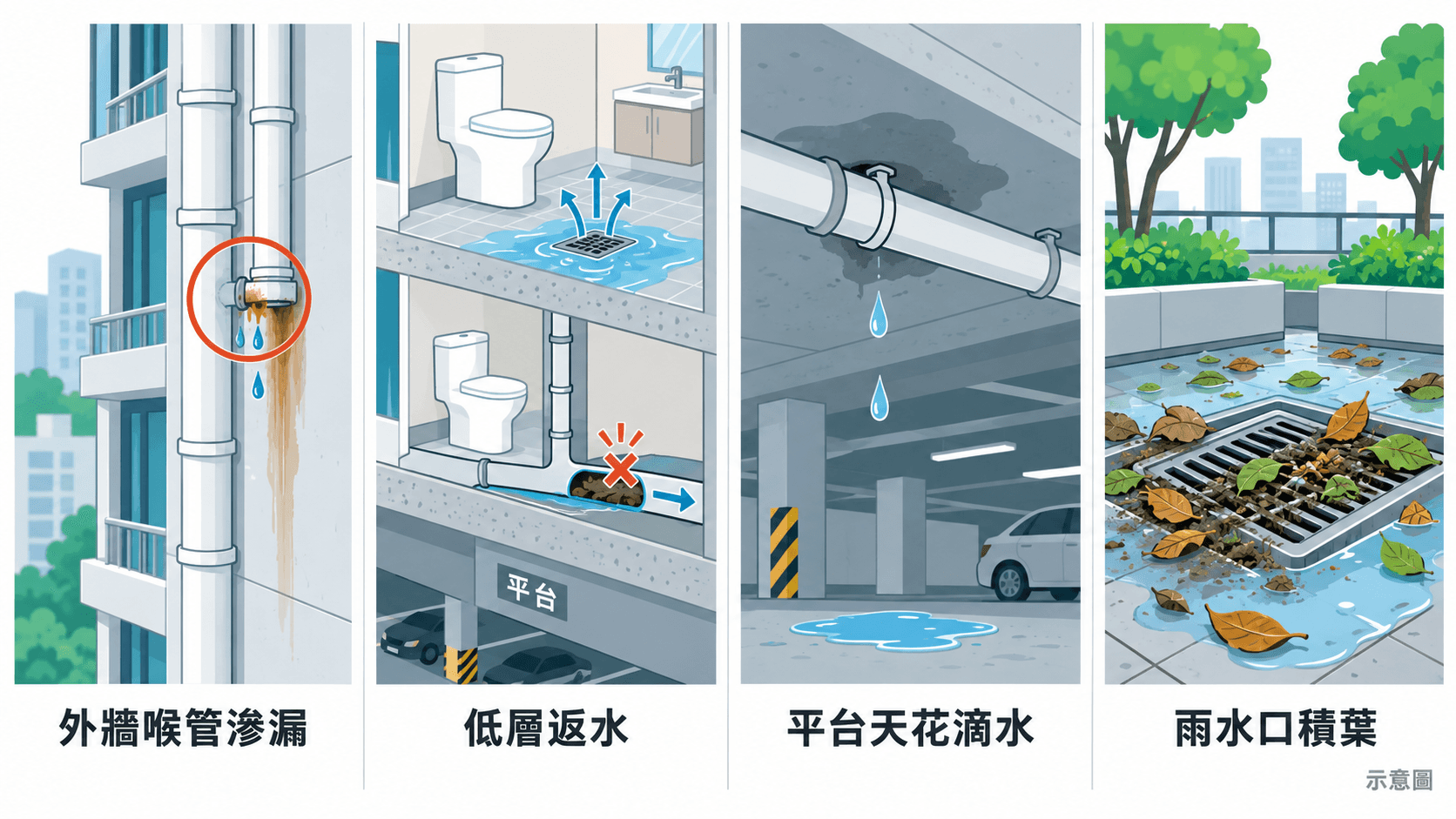
Choose the problem you are seeing to read the likely cause and next step.
The slide deck of the residents' briefing given by the management company on 20 September 2018 and published on the owners' corporation website documents leaking joints on external pipes, with long dark streaks and rust stains down the pipe runs. The slide carrying those photographs is headed “photographs of damaged external-wall pipes serving private flats”, and it records 41 external-pipe repairs completed and 37 waiting between the start of 2017 and 31 July 2018 (the slide prints the period as “2/1/2017 – 31/7/2018”), plus 28 cases of damage to private pipes referred to government departments. If you see a persistent wet patch, green algae or dripping on the pipes outside a window, beside an air-conditioner or off a utility platform, do not put it down to rain: photograph it with the location and time for the management office, and check whether the length running out of your own flat is loose.
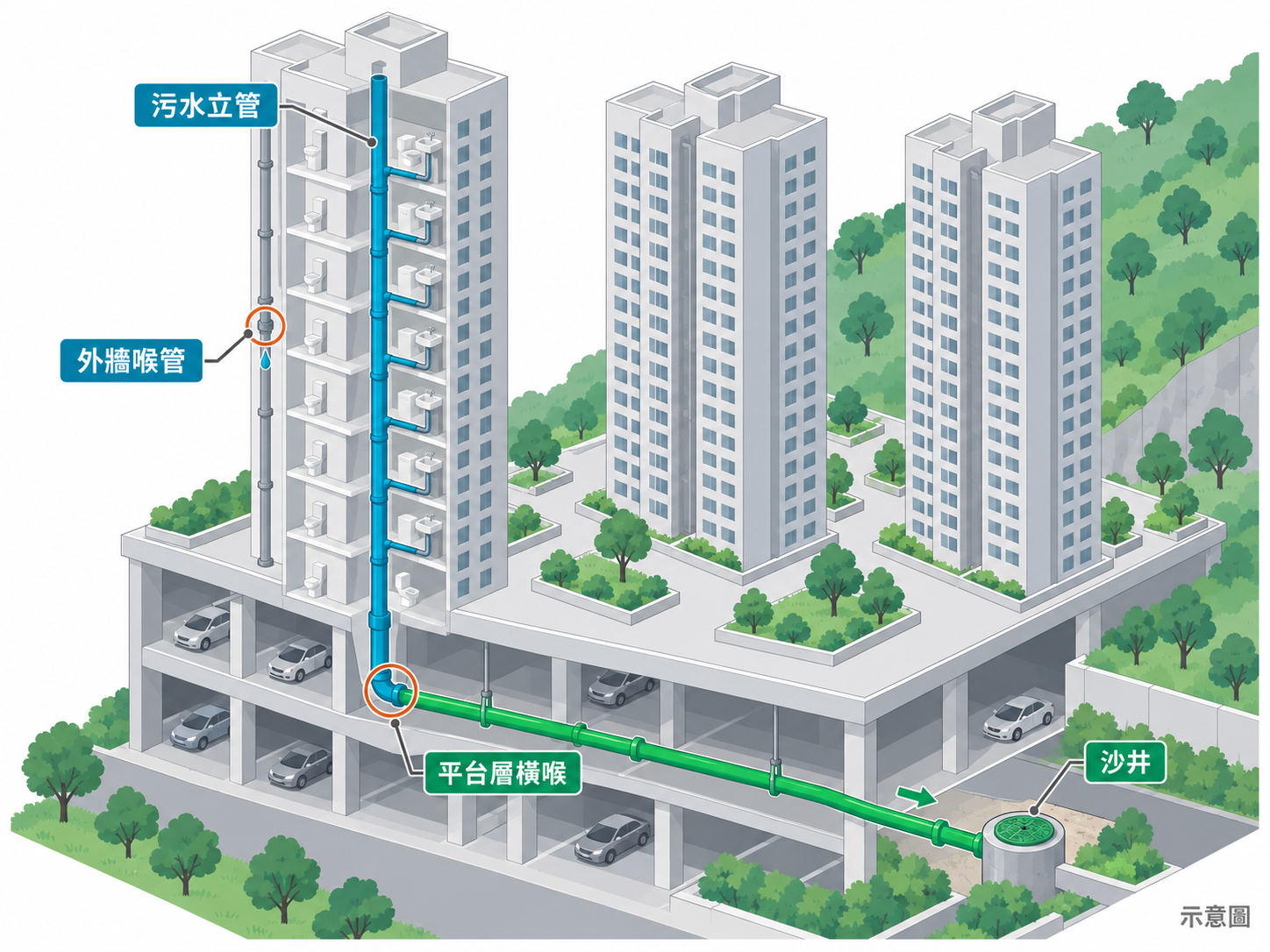
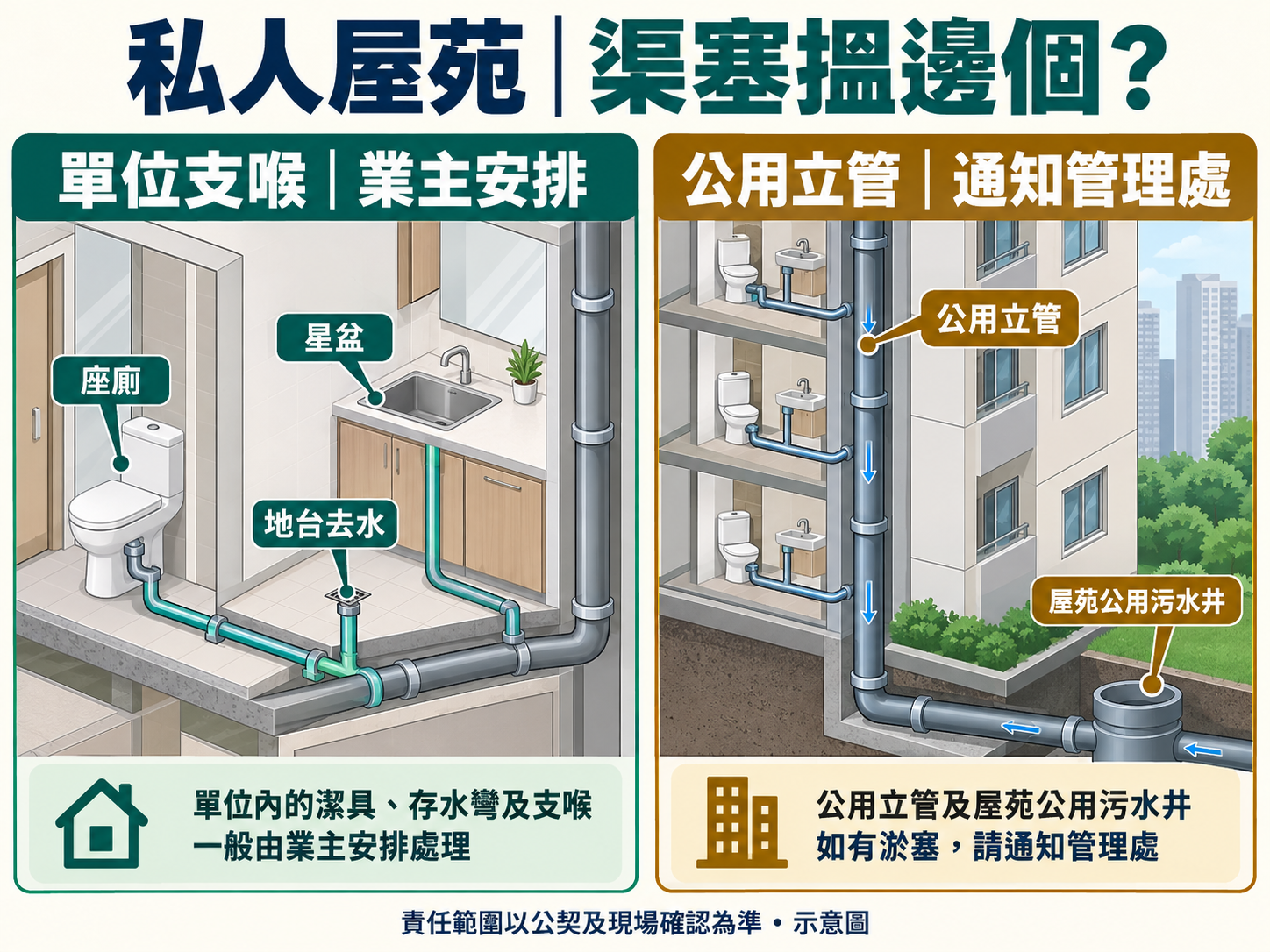
By design, flats in the same vertical line share one soil stack, so everything flushed or drained above you passes your floor. If the lower part of a stack or its outlet is narrowed by grease, tissue or hair, the first flat to react is usually not the one causing it but a low-floor flat: the toilet water rises, the floor drain bubbles, the bath empties slowly, and it is worst at the morning and evening peaks. There is a ready-made route for checking this here: in Blocks F to R one vertical line runs from 8/F up to 36/F, and in Blocks A to C from 3/F to 24/F, so follow your own line and ask the flat immediately above and the one immediately below. If only one of your fixtures is slow, it is usually your own length of branch pipe; if several flats up and down the same line slow together, treat it as the stack, and give the block letter and the floor when you report it so the office can check the whole run in one go.
The main entrances of Blocks F to R all sit on one large open podium garden, Blocks A to C stand on a two-storey shopping podium, and a car park is listed among the phase 3 and 4 facilities. By design, the soil and rainwater pipes of each block turn horizontal at podium and car-park level before running to the estate's underground drains and manholes. So a drip, a damp patch or a smell under the podium, in the mall's false ceiling or on a car-park soffit may come from those horizontal runs, a rainwater hopper or even a surcharging manhole rather than from a flat above. All of these are common parts and belong with the management office; what a resident can usefully do is note where the drip is, when it happens and the weather at the time, because dripping only during rain points somewhere quite different from dripping all day.
The estate stands at the highest point of Tsuen King Circuit, with Blocks F to R backing onto Ha Fa Shan beside the Tai Lam Chung catchwater footpath, and the site is well wooded — after Typhoon Mangkhut in 2018 the briefing published on the owners' corporation website recorded a large tree brought down outside the Block A mall, with the contractor notified at once. Inferring from that setting, the rainwater outlets on the podium gardens, roofs and driveway edges are the ones most easily narrowed by leaves, twigs and hill silt around the rainy season; when heavy rain cannot drain away it ponds on the podium and runs down stairs and lift towers to the levels below. Those outlets and channels are common parts, so do not sweep leaves into them — tell the management office. What you can do yourself is check before the rainy season that the drains on your utility platform and balcony are not blocked by debris or soil washed out of flower pots.
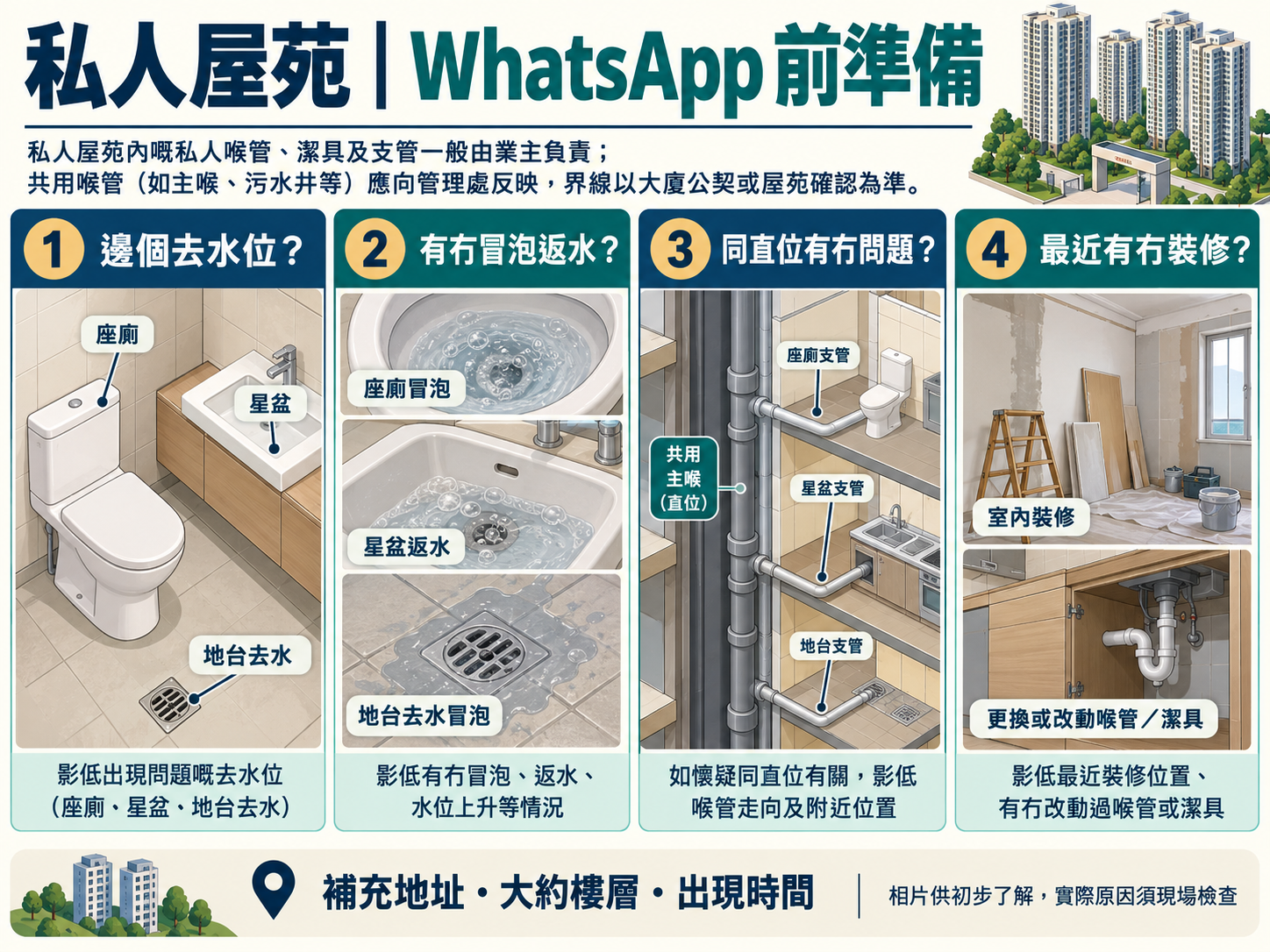
By inference from the age of the estate, the kitchens and bathrooms in most flats here have been renovated at least once over forty-odd years, and some more than once; the owners' corporation's website also carries an application form for in-flat renovation and repair works, which the estate requires to be filed with the management office before work starts. What commonly happens in practice is that, to fit a new floor level or shower screen, a contractor swaps in a shallower trap or removes or seals off the original anti-syphonage pipe. Nothing looks wrong at handover, and the smell only appears months later, typically just after flushing. The Buildings Department's drainage-health material is explicit: every sanitary fitment needs a suitable trap, and a trap must either be ventilated by an anti-syphonage pipe or be built so that the water seal cannot be lost; converting a bathtub to a shower tray still requires a trap, and an over-powerful extractor fan should not be installed in a bathroom. Its press release of 12 February 2020 adds that erecting, altering or removing a flat's drainage system, including the anti-syphonage pipe, goes through the Minor Works Control System with a registered contractor, so that the toilet, basin and bath keep an effective water seal. If the odour began after a renovation, check these points first rather than opening up pipework.
Photos or a short video on WhatsApp help us tell a single-fixture blockage from a shared-stack problem.
Allway Gardens was the first large private estate in Tsuen Wan, occupied in four phases between 1978 and 1981. Its 16 blocks of 22 to 29 storeys are set along the hillside at the highest point of Tsuen King Circuit. The estate is now over 45 years old, and the slide deck of a 2018 residents' briefing given by the management company and published on the owners' corporation website records how many external-pipe repairs had been completed and how many were still waiting. When a drain runs slowly, a ceiling drips or a bathroom smells, the first step is to separate a problem in the flat's branch pipes and traps from one in the external pipes or stacks, which are common parts, and then decide between booking a technician yourself and reporting it to the management office.
Allway Gardens was developed by Hopewell Holdings and designed by the engineer Gordon Wu. The first phase, Blocks A to C, was occupied in January 1978 and the fourth, Blocks M to R, in June 1981, giving 16 blocks and 3,423 flats — the first large private estate in Tsuen Wan. Wikipedia records that the four phases sit quite differently: Blocks A to C stand on a two-storey shopping podium and are 22 storeys counted from 3/F, with the management office and all three lobbies inside the mall; D and E are 24 storeys from 2/F with shops at street level; F to R are 29 storeys numbered from 8/F up to 36/F, with all their main entrances on one large open podium garden, a driveway running in from the end of On Yat Street behind the podium and past each lobby, lift towers and footbridges to Tsuen King Circuit Market and the bus terminus, and a car park among the phase 3 and 4 facilities.
As a general inference from building age, the communal soil pipes in estates of this generation were usually cast iron, with lengths later replaced in plastic as needed, while the branch pipes, traps and fitments inside flats have mostly been changed at least once over more than forty years — so no two flats in a block are necessarily alike. By design, flats in the same vertical line share one stack, and water from upper floors passes the lower floors on its way out. Because Blocks F to R begin at 8/F, their stacks must turn horizontal at podium or car-park level before reaching the estate's underground drains, and those bends and horizontal runs are exactly where grease, hair and debris collect and where ceiling drips most often appear.
On repairs, Wikipedia records a major refurbishment of the external walls, lobbies, residential floors, podium and mall that began in 2003 and finished around 2005, and a further major repair completed with an architect in 2007. In 2012 the owners' corporation began preparing another round of major repairs through the Hong Kong Housing Society's Operation Building Bright subsidy scheme, and a general meeting on 23 November 2015 voted that proposal down. The slide deck of the residents' briefing given by the management company on 20 September 2018 and published on the owners' corporation website gives, alongside the external-pipe figures, 199 concrete spalling repairs completed and 377 waiting between 1 February 2017 and 31 July 2018, itemised as 118 on block façades, 186 on car-park soffits and 73 on podium soffits, and lists improving external-pipe leakage among its proposed works. Concrete spalling is structural repair rather than a drainage fault, but the briefing counts podium soffits and car-park soffits as two separate slabs, which shows where the estate's maintenance effort sat in 2018; no more recent figures have been published on the owners' corporation website. The condition of any one flat's pipes ultimately depends on that block's and that flat's own repair and renovation history.
Note: statements based on building age and type are general inferences, not findings for any particular flat.
A clear process from enquiry and assessment to an agreed scope of work
Tell us the drain problem and district and ask about available timing.
Confirm timing based on the district and schedule, then inspect the blockage or odour issue.
Explain the proposed approach, scope and price before agreed work begins.
Use suitable tools for the site conditions and agreed scope of work.
After the agreed work, test drainage and explain the observed result and any next steps.
PipeButler is an independent drain-service provider with no affiliation to the developer, owners' corporation, management company or Housing Department of the places above. Facts come from public sources checked on the dates shown; work on common drains or common parts follows the management office's and deed of mutual covenant's arrangements.
WhatsApp with the problem and district, and we will confirm available timing.