
Loading page…
Loading page…
Tsuen King Circuit · Private estate
Occupied 1997–1998 in three phases · 12 blocks of 40 storeys on a mall base
Discovery Park stands at Tsuen King Circuit and 398 Castle Peak Road, Tsuen Wan.
Last reviewed ·
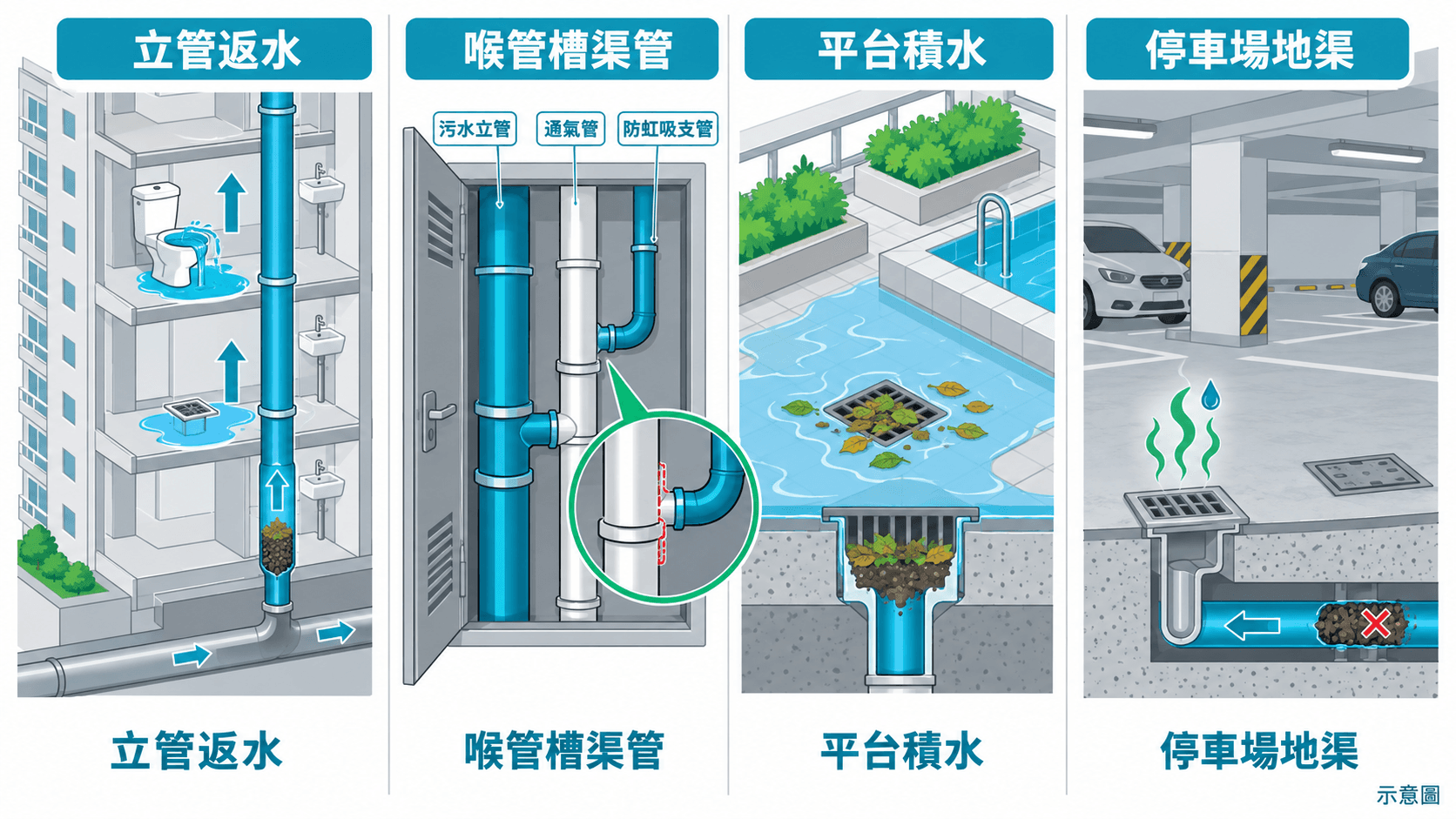
Choose the problem you are seeing to read the likely cause and next step.
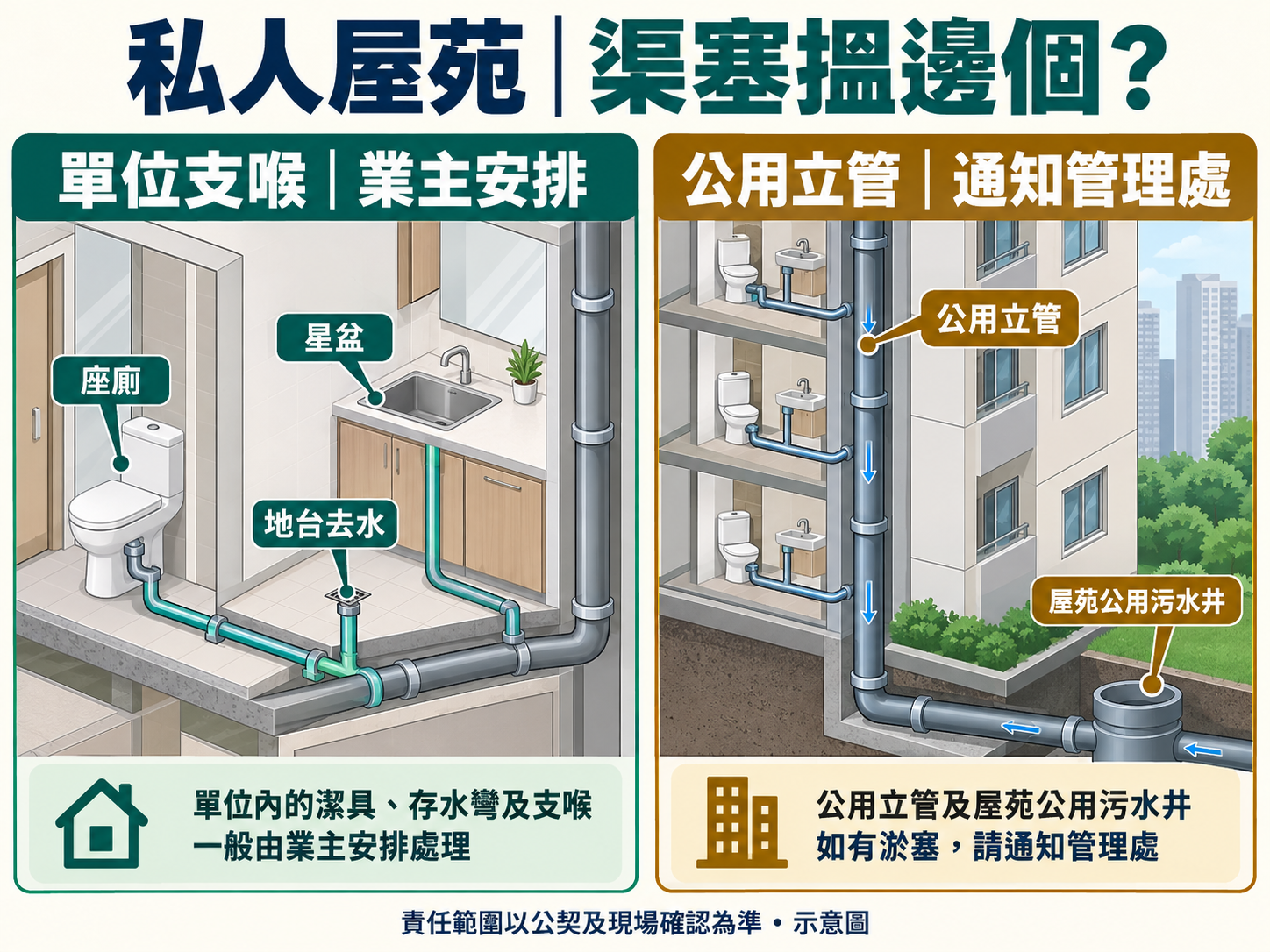
Twelve blocks and 3,360 flats work out, on the block and flat counts, at 280 flats a block and roughly seven a floor; stack 40 storeys of that and one vertical line holds close to 40 households whose toilets, basins and bathroom floor drains all discharge, by design, into a single soil stack. So it is worth a minute before you report anything to pin down which phase, which block and which vertical line you are in, and to ask the neighbours directly above and below. When the lower part of a stack or its outlet is narrowed by grease, wet wipes or cloths, the first flat to react is usually not the one causing it but a low-floor flat near the base, and it shows worst at the morning and evening peaks. One slow fixture is most often the flat's own branch pipe or trap; if the toilet and the floor drain surge together, or several flats in the same vertical line are hit at once, treat it as the shared stack and pass it to the residential management office.
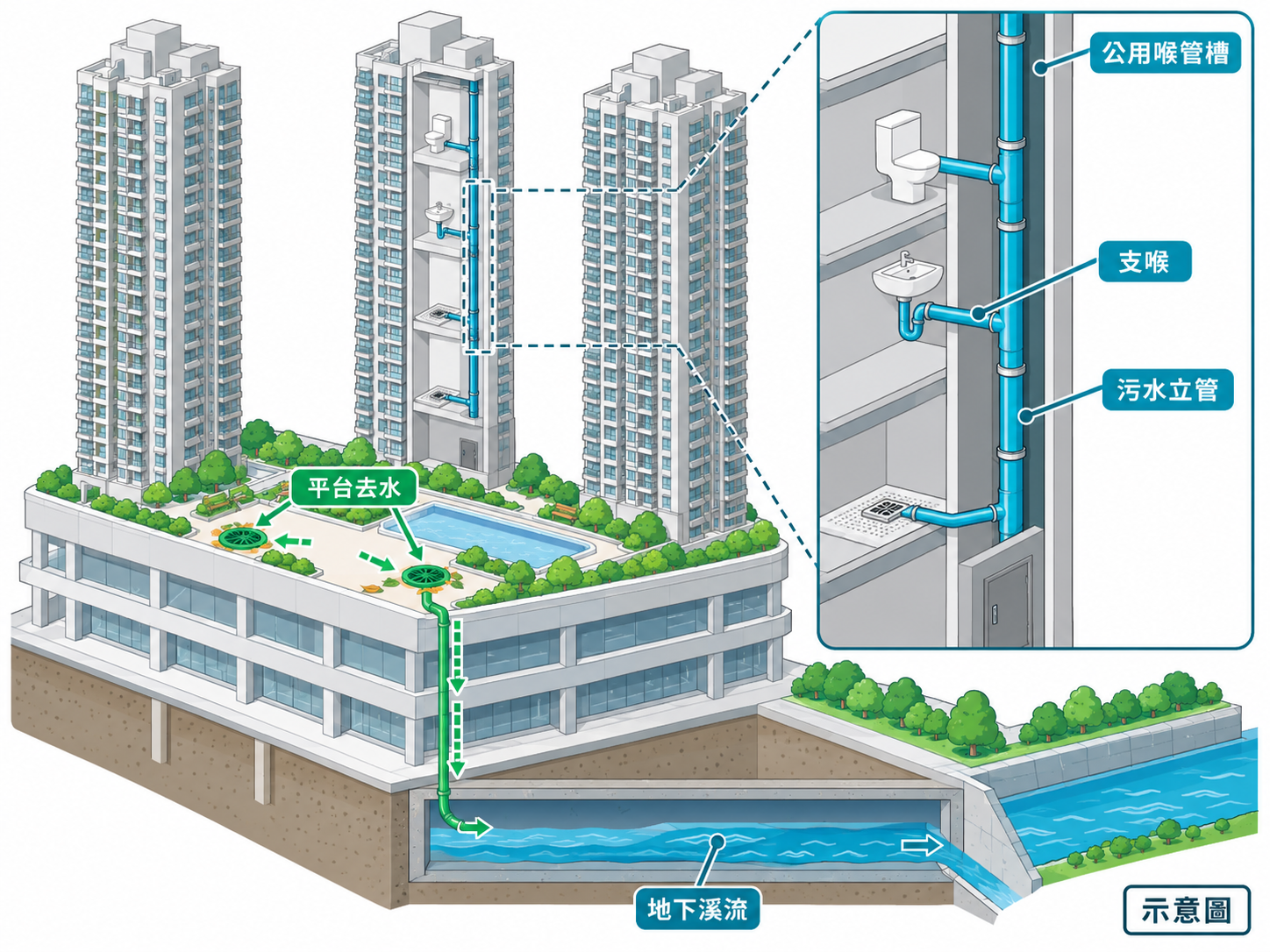
By the design conventions of the late 1990s, each block's stacks, vent pipes and anti-syphonage pipes sit inside shared pipe ducts rather than hanging visibly on an external wall. That difference matters when something has to be traced: standing in your own flat you can see only the short length of branch pipe running out of it, and reaching the stack itself means opening the duct's access door on the common corridor — behind which is common ground, so a time has to be arranged with the residential management office. On top of that the estate is approaching thirty, and many flats have been renovated at least once: a trap swapped for a shallower one to suit a new floor level, a bathroom or kitchen outlet moved, an anti-syphonage pipe sealed off. None of it looks wrong at handover, and it may surface months later as odour, gurgling drains or a neighbour's complaint. The Buildings Department warns that altering the drainage system can destroy the water seal, and that changing traps or anti-syphonage pipes is minor works which must be carried out by a registered minor works contractor. So if a smell began after a renovation, start with those alterations and the flat's own renovation records.
The podium carries a waterfall garden, a golf practice area and a jogging track, with the swimming pool listed among the clubhouse facilities. It follows from the structure that the mall base lies directly beneath the podium deck, so rainwater collected up there leaves through podium outlets and gullies and then drops to the ground-level drains through rainwater pipes inside the base — which means an unremarkable outlet on the podium is the start of a long route down. Leaves, silt and plant roots narrow those outlets over time; in heavy rain, once the water rises above the lip of an outlet it can run along corridors and stairs, or into lower outlets, and get into covered and indoor areas. Clearing the podium outlets, gullies and nearby manholes before and after the wet season costs less than de-silting after a flood, and it helps the management office record which spots pond most often.
Wikipedia's article on Tso Kung Tam records that the stream rises on Tai Mo Shan and runs south under Castle Peak Road into Rambler Channel, that the open channel nearest Castle Peak Road was covered over in the 1990s, and that the stretch was later developed into Discovery Park; the article on the estate itself says the stream runs "beneath it" on its way out to sea. The Drainage Services Department's Tsuen Wan Drainage Tunnel, with intakes at Wo Yi Hop, Lo Wai and Tso Kung Tam, opened on 28 March 2013 precisely to intercept upland runoff on the hillside and keep it out of the existing drains downstream. For residents the practical test is the weather: odour and slow draining on dry days usually point to the foul system or a trap, while ponding or backflow that only happens during heavy rain means the street gullies, manholes and podium outlets have to be looked at too. The two paths are dealt with differently.
The interests in the mall of about 630,000 sq ft, together with the 1,000-space car park, passed from New World Development to Chinachem Group in April 2024. Grease traps serving restaurants, the mall's own floor drains and the car park's gullies and sumps are the responsibility of that owner and its managing agent, while the residential lobbies, podium and block drains are arranged by the residential management office under the deed of mutual covenant. So if a car-park gully surges or smells, the residential office may not be able to take it up: report it to the mall or car-park management instead, and by the ownership split reports on each side will normally be handled by that side's own management office.
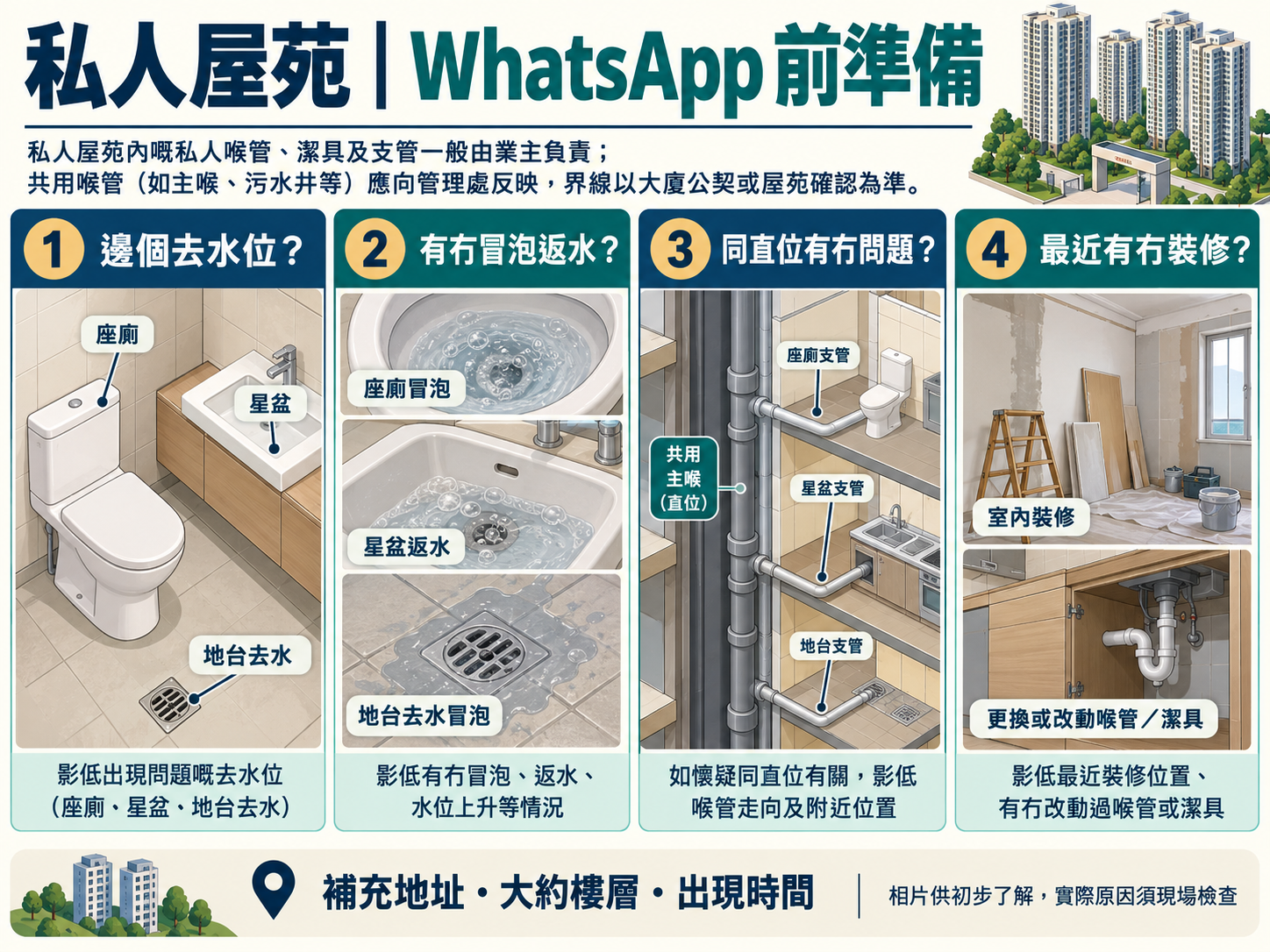
Photos or a short video on WhatsApp help us tell a single-fixture blockage from a shared-stack problem.
Discovery Park stands at Tsuen King Circuit and 398 Castle Peak Road, Tsuen Wan. It was occupied in three phases between April 1997 and November 1998: 12 blocks of 40 storeys, 3,360 flats in all, standing above the estate's shopping-centre base — a mall of three levels and about 630,000 sq ft. So the first move with a blocked drain here is to place it: which phase and block the fixture sits in, and whether it belongs to the flat's own branch pipe and trap, to a stack shut away inside a shared pipe duct, or to the rainwater drains on the podium above the mall base. The three lead to different people — some you can book a call-out for yourself, others belong with the residential management office from the start.
The estate was occupied in three phases between 30 April 1997 and 10 November 1998: Blocks 1–4 are Phase 1, Blocks 5–8 Phase 2 and Blocks 9–12 Phase 3. There are 12 blocks of 40 storeys and 3,360 flats, which works out at about 280 flats per block and roughly seven flats per floor. The towers do not sit directly on the ground: they stand on the base formed by the estate's shopping centre, which Wikipedia gives as three levels and 630,000 sq ft — that figure is the mall's floor area, not the size of the podium itself. The podium carries a waterfall garden, a golf practice area and a jogging track, while the swimming pool is listed among the clubhouse facilities.
As a general inference from the period of construction, late-1990s high-rise blocks were normally built with uPVC soil stacks rather than the cast iron of earlier decades, and the stacks, vent pipes and anti-syphonage pipes were usually gathered inside shared pipe ducts instead of being hung on the external wall. That keeps the facade tidy, but inspection means opening the duct's access door, and inside the flat you generally see only your own branch pipe. Phase 1 was taken into use in April 1997, so the phases reach 30 years from about 2027 onwards; the Buildings Department's Mandatory Building Inspection Scheme covers private buildings aged 30 or above, and its prescribed inspection expressly includes the drainage system — pipework on external walls, in common parts, inside shared pipe ducts, and the communal drains above and below ground. Building age under the scheme runs from the occupation permit rather than from a marketing hand-over date, and whether a statutory notice is served is for the Buildings Department to decide, so it is not a fixed deadline. The Urban Renewal Authority's Building Drainage System Repair Subsidy Scheme is not a route open to the estate either: its Category 1 was for private buildings aged 40 or above (again by occupation permit) with a low average rateable value, and Category 1 closed to applications after 31 May 2024, while the remaining Category 2 is not applied for at all — the Buildings Department selects buildings for it by risk assessment among those already served with a drainage repair order or an inspection notice whose owners cannot organise the works themselves.
Two events connected with the estate are easy to mistake for drainage faults, so it is worth separating them. Chinese Wikipedia records that a political party took drinking-water samples at the estate in 2015, and that a plant fault in one block in June 2021 interrupted the fresh-water supply to part of the estate. Both belong to fresh-water supply and electricity, not to drainage: supply pipes and soil pipes are two entirely separate systems. Separately, the interests in the mall and its 1,000-space car park passed from New World Development to Chinachem Group in April 2024, so they sit under different management from the residential common parts.
Note: statements based on building age and type are general inferences, not findings for any particular flat.
A clear process from enquiry and assessment to an agreed scope of work
Tell us the drain problem and district and ask about available timing.
Confirm timing based on the district and schedule, then inspect the blockage or odour issue.
Explain the proposed approach, scope and price before agreed work begins.
Use suitable tools for the site conditions and agreed scope of work.
After the agreed work, test drainage and explain the observed result and any next steps.
PipeButler is an independent drain-service provider with no affiliation to the developer, owners' corporation, management company or Housing Department of the places above. Facts come from public sources checked on the dates shown; work on common drains or common parts follows the management office's and deed of mutual covenant's arrangements.
WhatsApp with the problem and district, and we will confirm available timing.