
Loading page…
Loading page…
Tsuen King Circuit · Private estate
Occupied 1979–1982 · 19 blocks, about 4,400 flats · 2003–07 refit replaced worn pipes
Tsuen Wan Centre stands on Tsuen King Circuit, on the mid-levels of Chai Wan Kok.
Last reviewed ·
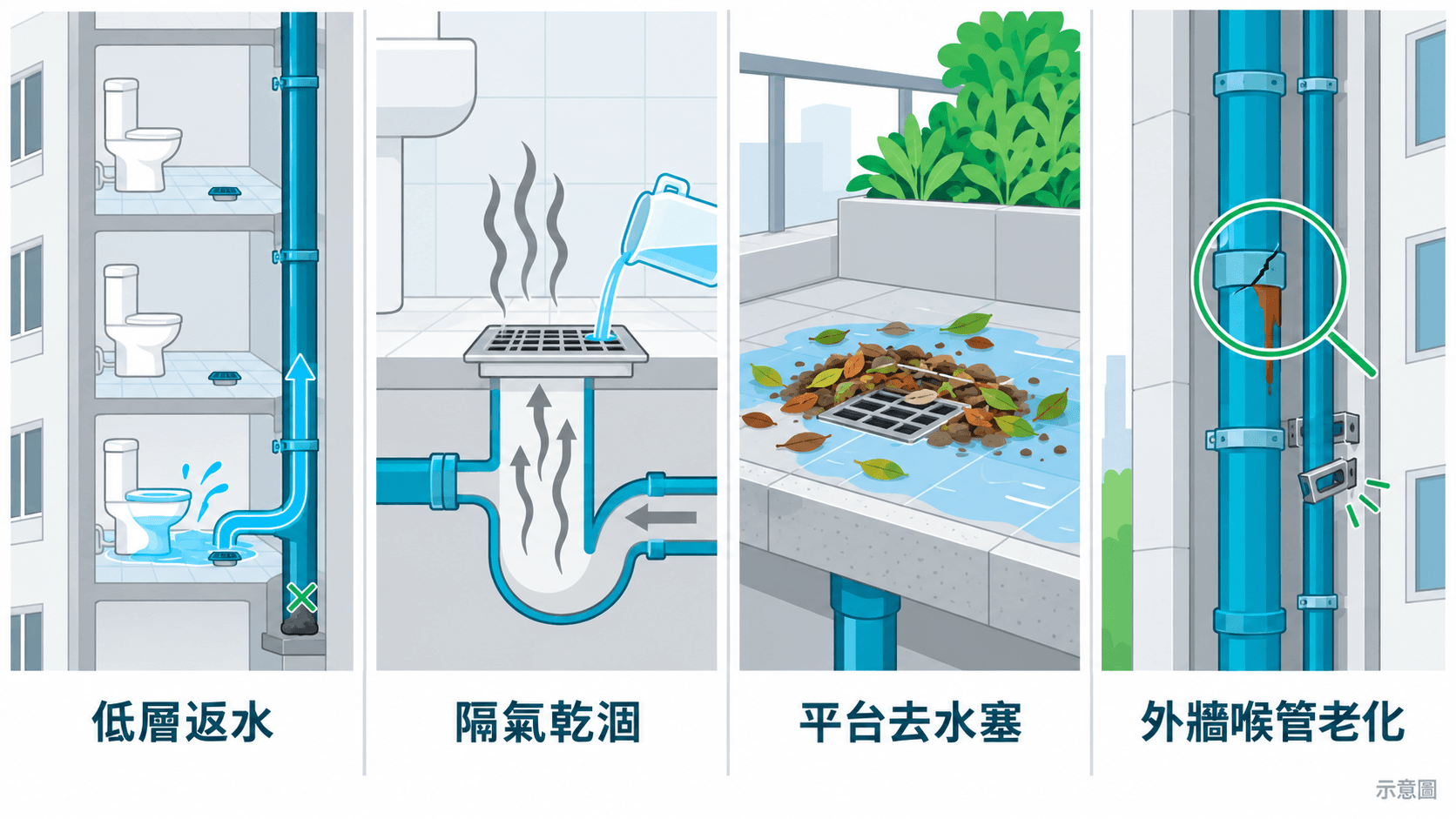
Choose the problem you are seeing to read the likely cause and next step.
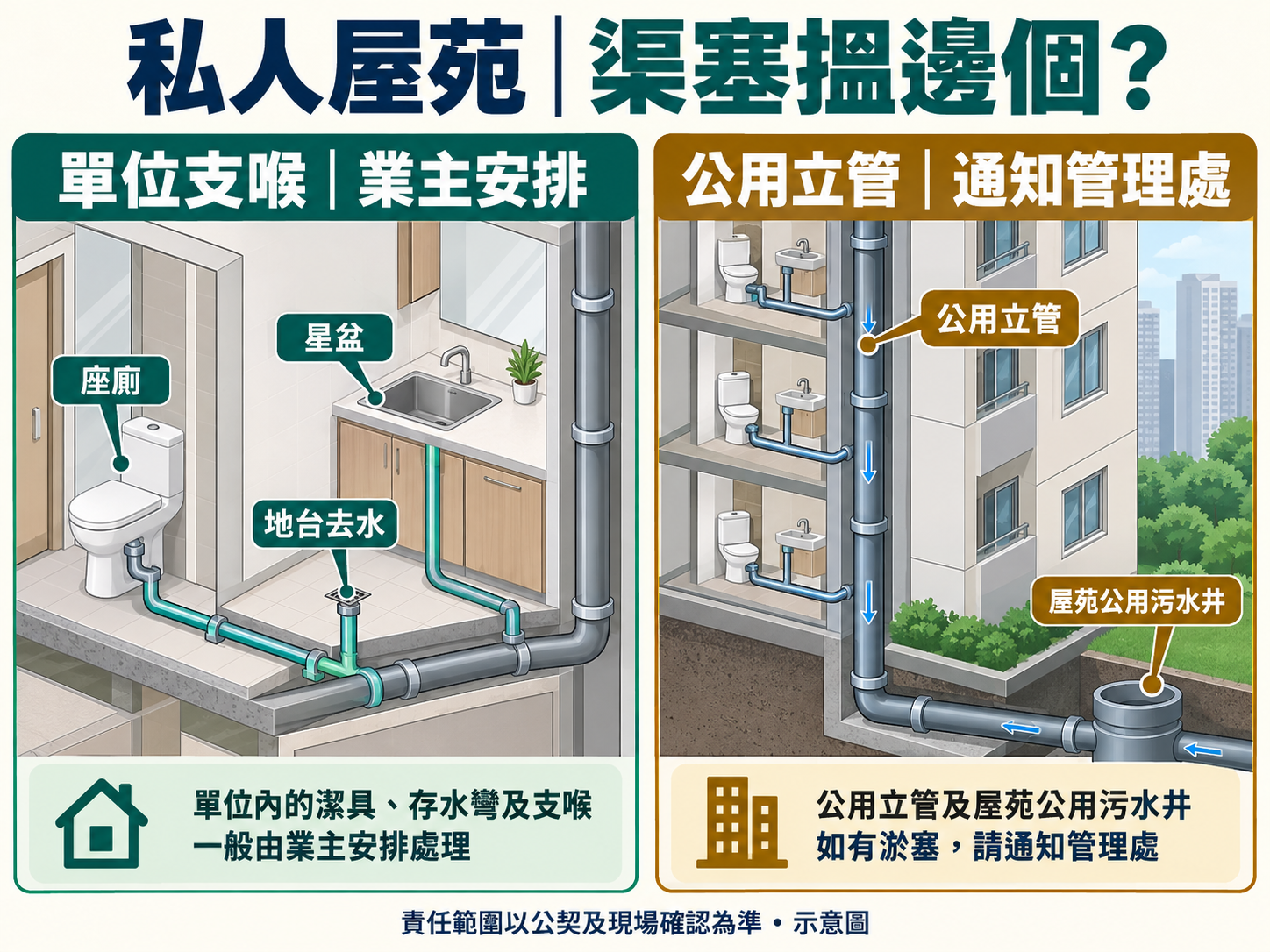
Chinese Wikipedia records that the 2003–2007 refurbishment included “replacing worn-out pipes”, but it does not list which pipes, nor whether the work went inside the flats. By inference from age, some of the branch pipes, traps and connections that have served a flat since it was first occupied are still original while others were changed during successive renovations, so they need not share an age with the common pipework. When chasing odour or slow draining here, therefore, start inside the flat — the bottle trap under the basin, the traps on the bathtub and floor drain, the kitchen sink waste and its joints — and only then look at the shared stack; doing it the other way round usually costs an extra visit.
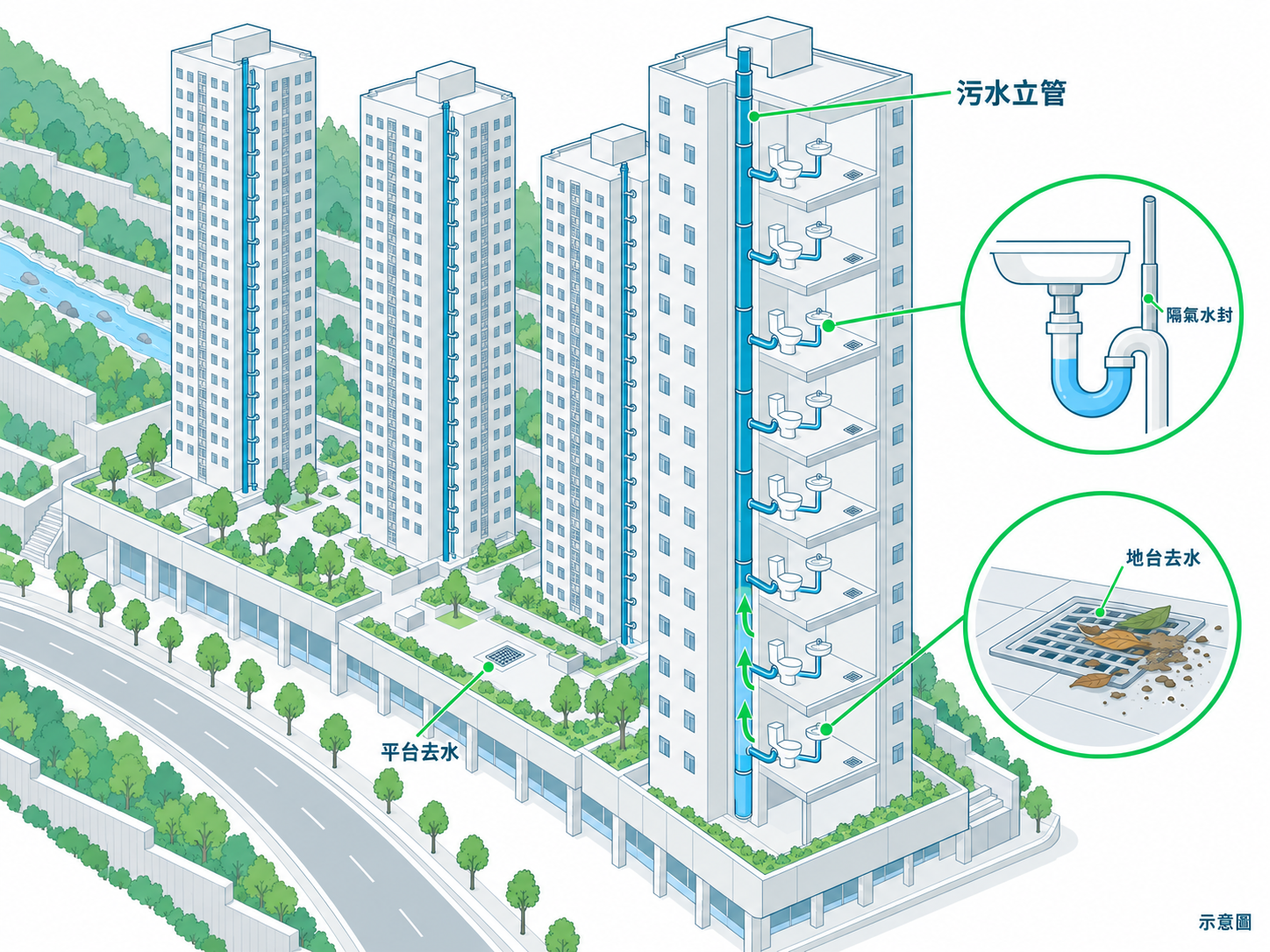
Stack lengths vary a great deal across this estate: Peking House is 26 storeys and 110 flats, while Tsinan and Shenyang Houses reach 34 storeys and 272 flats. Working from storeys and flat counts, fifteen of the nineteen blocks come to eight flats per floor, so the toilet, basin, bathtub and floor drain of one flat position all depend on a single stack gathering discharge from thirty-odd storeys above. Judging from the design, the longer the stack, the more the accumulated flow and pressure swings concentrate in its lower section; once that section or its outlet furs up inside with grease, fibre and debris, the floor that notices first is usually not the one causing it but a low one — at the evening peak for showers and washing-up the toilet level creeps up and returns after flushing, and the floor drain may gurgle. Symptoms on a low floor of Tsinan House therefore need not match those on a low floor of Peking House. Two things tell them apart: scope — a single slow fixture of your own usually points to the branch pipe or its trap — and timing — several fixtures slowing together, in step with heavy use upstairs, belongs to the common parts, and the management office can arrange a check of the stack.
The Buildings Department explains that an anti-syphonage pipe balances air pressure: when the flats above discharge beyond a certain volume, syphonage creates negative pressure in the branch pipes of the flats below, strong enough to draw the water seal out of a fitment's trap. In blocks of 26 to 34 storeys that matters: if a renovation removed or shortened the anti-syphonage pipe, or swapped in a shallower trap, a flush upstairs can send a waft of sewer air into your flat straight away. The department also advises pouring about half a litre of clean water into every floor drain in the home at least once a week so the seal does not slowly evaporate.
The estate is built on a hillside, and both Phase 1 and Phase 2 have an arcade, podium gardens and car parks, with a minibus terminus on the Phase 2 side. It follows from the design that outlets on a podium deck or at ground level are limited in diameter yet have to take rainwater, planter runoff and wash-down water together; once dead leaves, silt and litter blown down from the slope build up, heavy rain leaves standing water or even backflow at the outlets. The Cho Kung Tam intake of the Tsuen Wan Drainage Tunnel handles catchment runoff intercepted on the hillside and does nothing for the estate's own podium drains. Clearing silt out of the pipe itself generally needs desilting plus high-pressure washing; sweeping the surface debris away is often not enough.
It is close to twenty years since the external walls were repaired in 2003–2007. By inference from age, the soil and vent pipes on the walls, and the joints and brackets inside the pipe ducts, will be ageing again. If the smell is strongest by a window, at the kitchen window or near a pipe duct, or if you can see rust stains, water marks, cracks or loose brackets on the external pipes, bring the common pipework into the check instead of pouring drain cleaner down the outlets indoors. The prescribed inspection under the Mandatory Building Inspection Scheme already covers drainage on external walls and drainage laid within common pipe ducts, so if the building has completed a prescribed inspection, you can ask the management office or the owners' corporation for the inspection and repair records before deciding what to do.
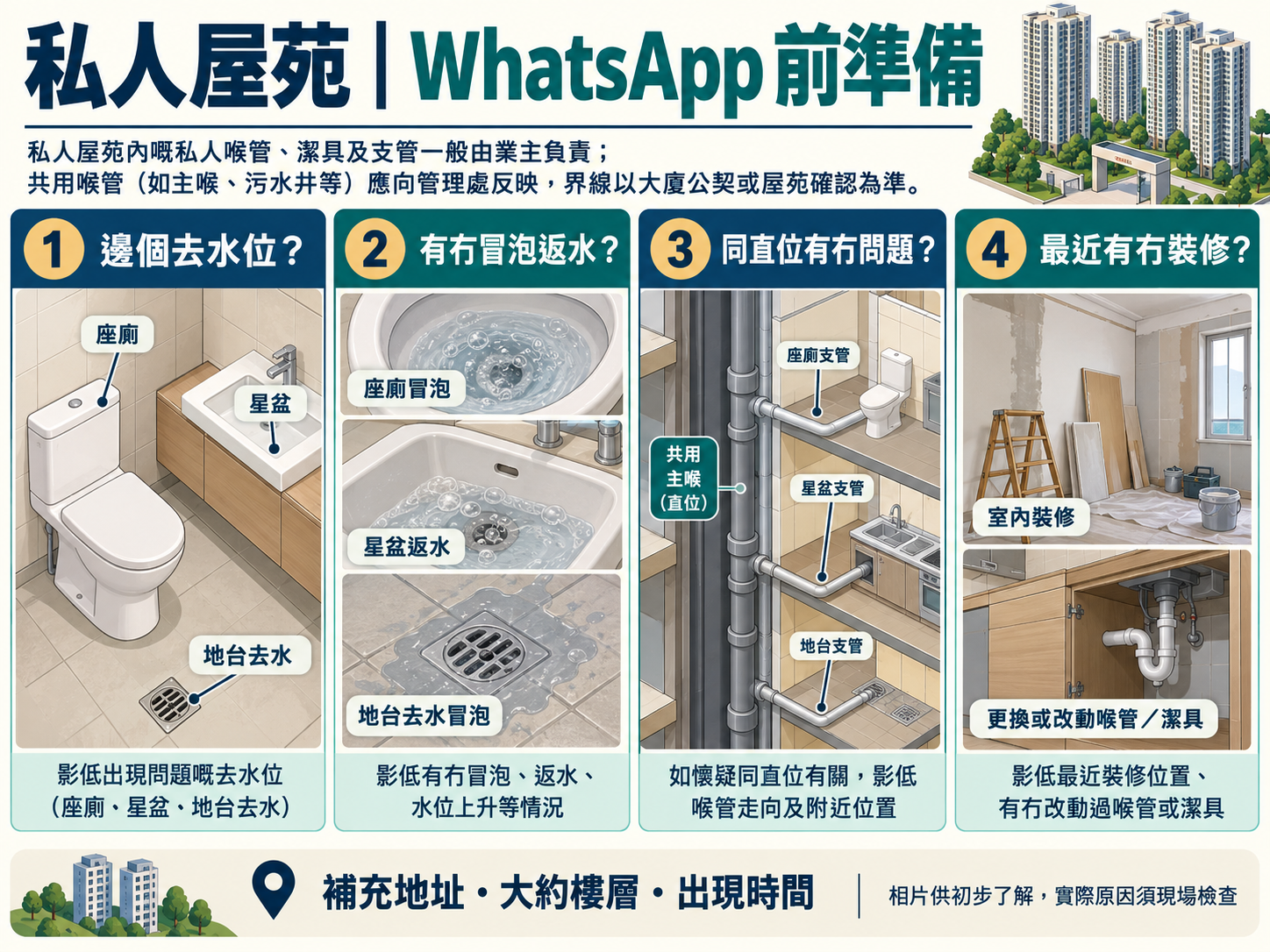
Photos or a short video on WhatsApp help us tell a single-fixture blockage from a shared-stack problem.
Tsuen Wan Centre stands on Tsuen King Circuit, on the mid-levels of Chai Wan Kok. Its 19 residential blocks were occupied in batches from October 1979 to August 1982, rise 26 to 34 storeys and hold about 4,400 flats. Chinese Wikipedia records a refurbishment between 2003 and 2007 that, besides repairing the external walls, also “renewed the ground-floor lobbies of every block and replaced worn-out pipes”, without saying which pipes those were. So when a bathroom smells of drains, a toilet drains slowly or water stands on the podium here, the first step is not to start rodding but to work out whether the fault is in the flat's own branch pipes and traps, or in the building's stacks, podium drains and manholes.
The 19 residential blocks are named after mainland Chinese cities and are numbered 86 to 105 Tsuen King Circuit. The per-block table shows that Hangchow House and Soochow House were occupied first, in October 1979, and Blocks 11–14 last, in August 1982; heights run from Peking House at 26 storeys to Tsinan and Shenyang Houses at 34, with between 110 and 272 flats per block. Note that block numbers do not follow the phases in order: Blocks 1–10 are Phase 1, Blocks 11–14 are Phase 3, and only Blocks 15–19 are Phase 2, so naming the building (Chengtu House, say) is clearer than giving a block number. The estate covers about 22,296 sq m with roughly 4,400 flats, and the 2016 by-census recorded 10,742 residents at an average household size of 2.5.
As an inference from the 1979–1982 occupation dates, the original soil stacks in high-rise blocks of this generation were usually cast iron, with galvanised steel or early plastic for waste and rainwater pipes. Working from each block's storeys and flat count, fifteen of the nineteen blocks come to eight flats per floor (248 flats over 31 storeys, 272 over 34), which means the toilet, basin, bathtub and bathroom floor drain of the same flat position very probably share one stack running from the top floor to the ground; Shanghai and Tiantsin Houses (160 flats over 30 storeys), Nanking House (192 over 32) and Peking House (110 over 26) have fewer flats per floor. Flats range from one bedroom to four bedrooms with two living rooms, and Wikipedia notes that most have an efficiency ratio above 80 per cent. How the kitchens and bathrooms are laid out, and where the outlets sit in relation to the extractor fan, is not on public record and has to be seen on site.
The 2003–2007 refurbishment is recorded as covering external wall repairs and repainting, along with renewed ground-floor lobbies and the replacement of worn-out pipes. That record does not say which class of pipe was replaced, nor whether the work reached inside the flats, so the safer reading is this: some worn-out pipes were replaced during that refurbishment, but the public record does not say which kind — soil, waste, rainwater or fresh-water — nor whether they were common parts or inside the flats. The age of the branch pipes and traps in your own flat still depends on that flat's renovation and repair history, and the extent of any common-pipe renewal has to be checked with the management office or the owners' corporation. Meanwhile the buildings are 44 to 47 years old, past the 30-year threshold of the Buildings Department's Mandatory Building Inspection Scheme, and the prescribed inspection already covers the drainage system — drainage on the external walls, in the common parts, within common pipe ducts, and the shared drains both underground and at ground level — so if the building has been served an MBIS notice and has completed its prescribed inspection, a report on the common drains can be requested from the owners' corporation or the management office. Note that the Buildings Department serves notices on target buildings it selects each year, so not every 30-year-old building has been inspected.
As for the setting, the estate sits on the mid-levels of Chai Wan Kok, halfway along Tsuen King Circuit, with Tsuen King Garden below, Tsuen King Circuit Playground above and Cho Kung Tam behind. Cho Kung Tam is also one of the three intakes of the Tsuen Wan Drainage Tunnel: opened in March 2013 and 5.1 km long, it intercepts hillside stormwater at Wo Yi Hop, Lo Wai and Cho Kung Tam and discharges it to the sea at Yau Kom Tau. The Drainage Services Department lists it as one of four stormwater tunnels now in operation, and it only runs when an Amber rainstorm warning or above is in force. The tunnel deals with catchment-scale runoff; the outlets on the estate's own podium, planters and ground level still have to be cleared locally, and the two should not be confused.
Note: statements based on building age and type are general inferences, not findings for any particular flat.
A clear process from enquiry and assessment to an agreed scope of work
Tell us the drain problem and district and ask about available timing.
Confirm timing based on the district and schedule, then inspect the blockage or odour issue.
Explain the proposed approach, scope and price before agreed work begins.
Use suitable tools for the site conditions and agreed scope of work.
After the agreed work, test drainage and explain the observed result and any next steps.
PipeButler is an independent drain-service provider with no affiliation to the developer, owners' corporation, management company or Housing Department of the places above. Facts come from public sources checked on the dates shown; work on common drains or common parts follows the management office's and deed of mutual covenant's arrangements.
WhatsApp with the problem and district, and we will confirm available timing.