
Loading page…
Loading page…
Tsuen Wan West · Private estate
Three phases 1987–1991 · 19 blocks, 6,016 flats · hillside & podium drains
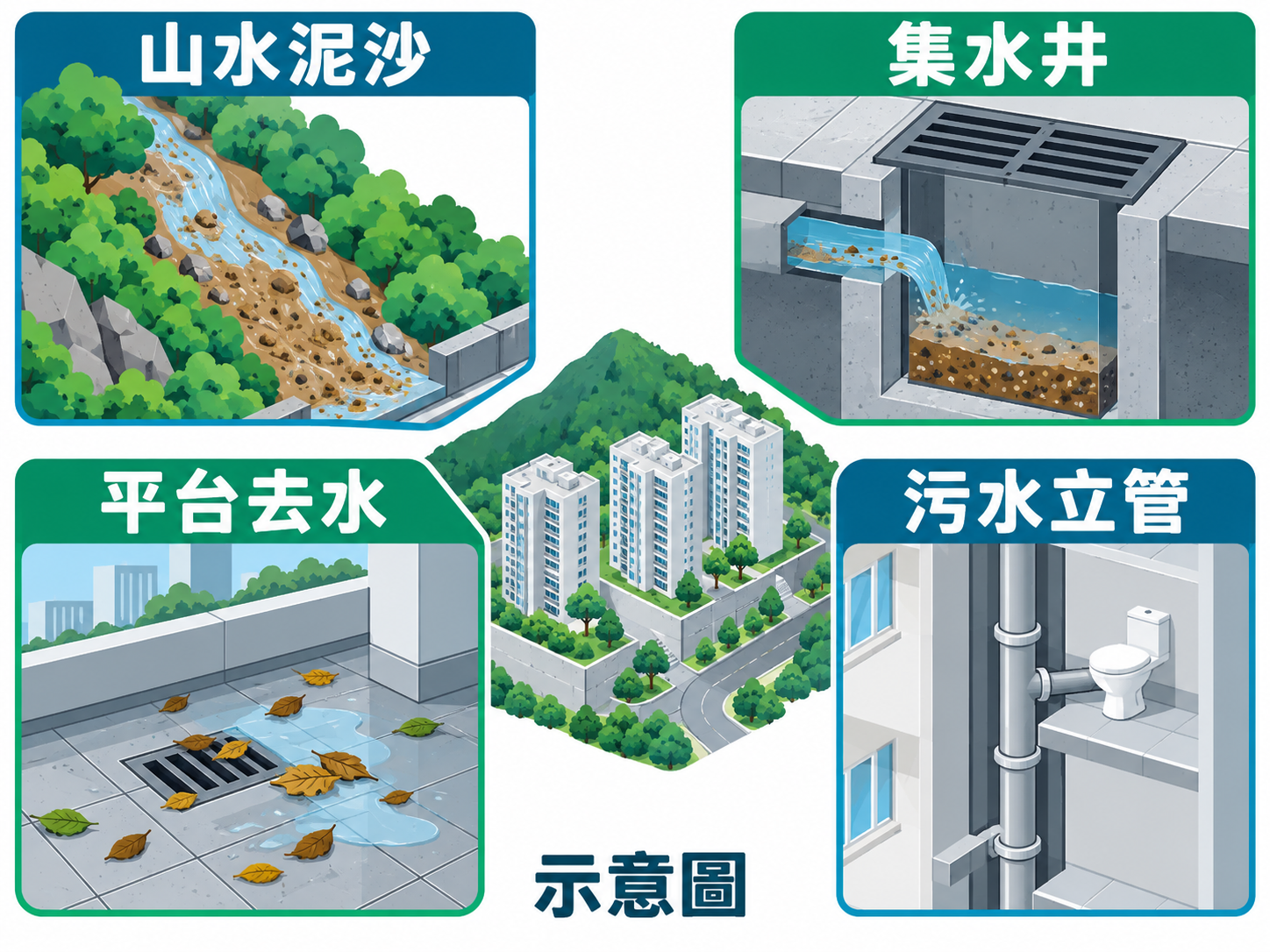
Belvedere Garden stands at 530–625 Castle Peak Road – Tsuen Wan, occupied in three phases between 1987 and 1991, with 19 residential blocks and 6,016 flats — one of the largest private estates in Tsuen Wan.
Last reviewed ·
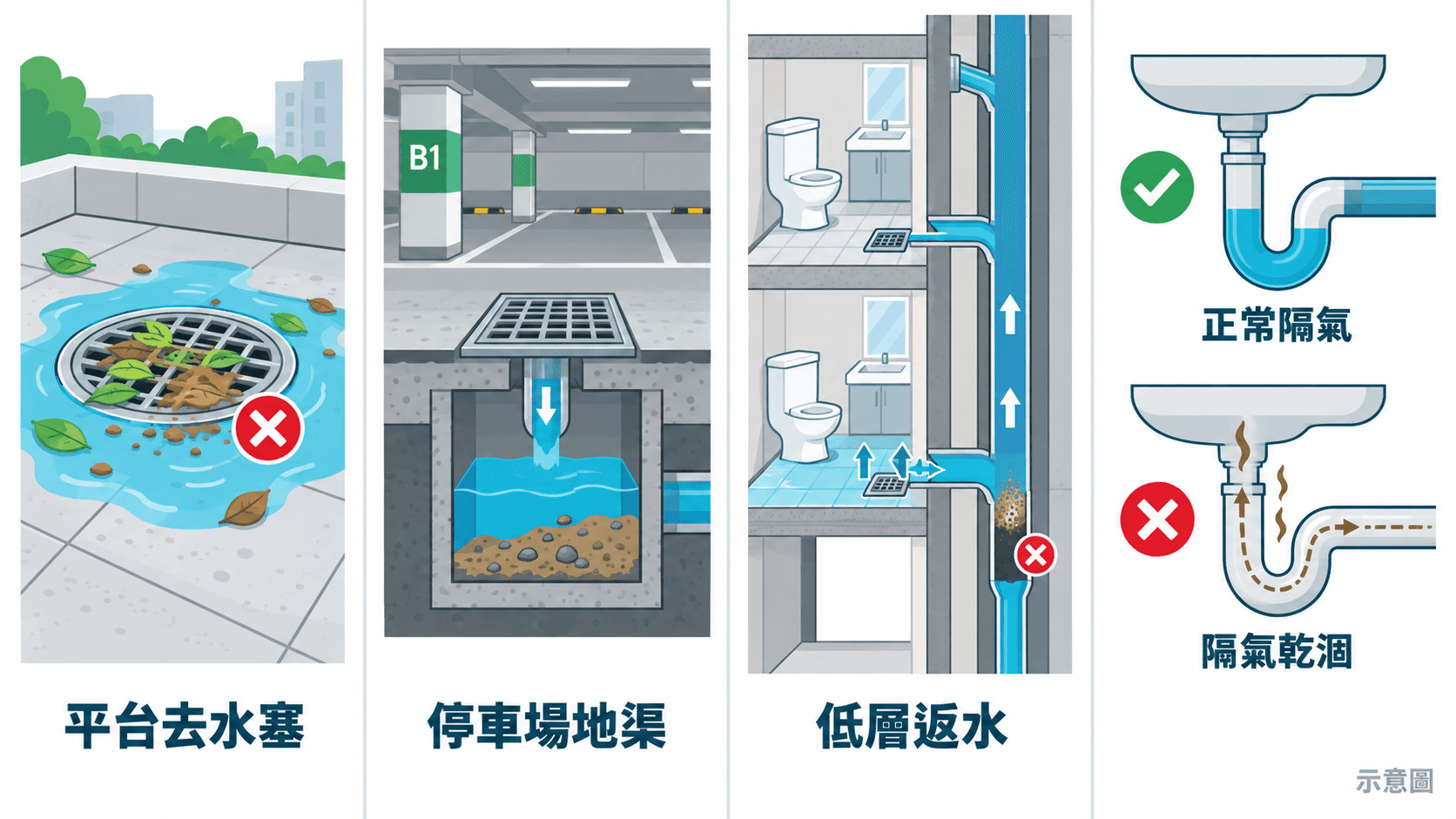
Choose the problem you are seeing to read the likely cause and next step.
The Drainage Services Department's investigation recorded that on 9 June 2001 heavy rain in Tsuen Wan sent very large quantities of muddy water down a streamcourse from the catchment above the estate, and that “the drainage catchpit at Fat Yip Lane next to Belvedere Garden was blocked” by boulders and debris washed down. Floodwater flooded parts of Castle Peak Road opposite the estate, ran down the steep Lai Chi Road and eventually flooded Hoi On Road; the same location flooded again on the 11th, 12th, 23rd and 27th of that month. On the remedial side, the department's 2001/02 annual report records that it immediately carried out local drainage improvement works as interim measures — clearing loose boulders and debris from the streamcourse, shotcreting the eroded channel, fitting screens at the drain intakes and building intercepting channels at Fat Yip Lane, Castle Peak Road – Tsuen Wan, Lai Chi Road and Hoi On Road — that no flooding occurred there during the heavy rain of July and August that year, and that consultants had been engaged to design long-term improvements. Separately, none of the six Tsuen Wan entries on the department's latest list of locations prone to blockage (file dated August 2026) is in this area. By inference from the terrain, the ground drains, podium outlets and planters still collect leaves and silt after heavy rain, so clearing them before the wet season is worthwhile.
The per-block figures show that Phase 2 flats begin on the 4th floor, which by design implies a podium, car park and shopping base below; Fortune REIT's portfolio record for Belvedere Square also lists 329 car park lots, so the parking floors in that base are substantial. A podium takes rainwater, planter runoff and wash-down water through many outlets of limited diameter, while the floor drains and catchpits in the base-level car park collect grit and tyre-borne debris. Blockages here are rarely noticed at once — they usually show up as ponding or backflow during heavy rain or when the podium is washed down. The remedy is desilting plus high-pressure cleaning of the pipe, not just scooping the surface litter.
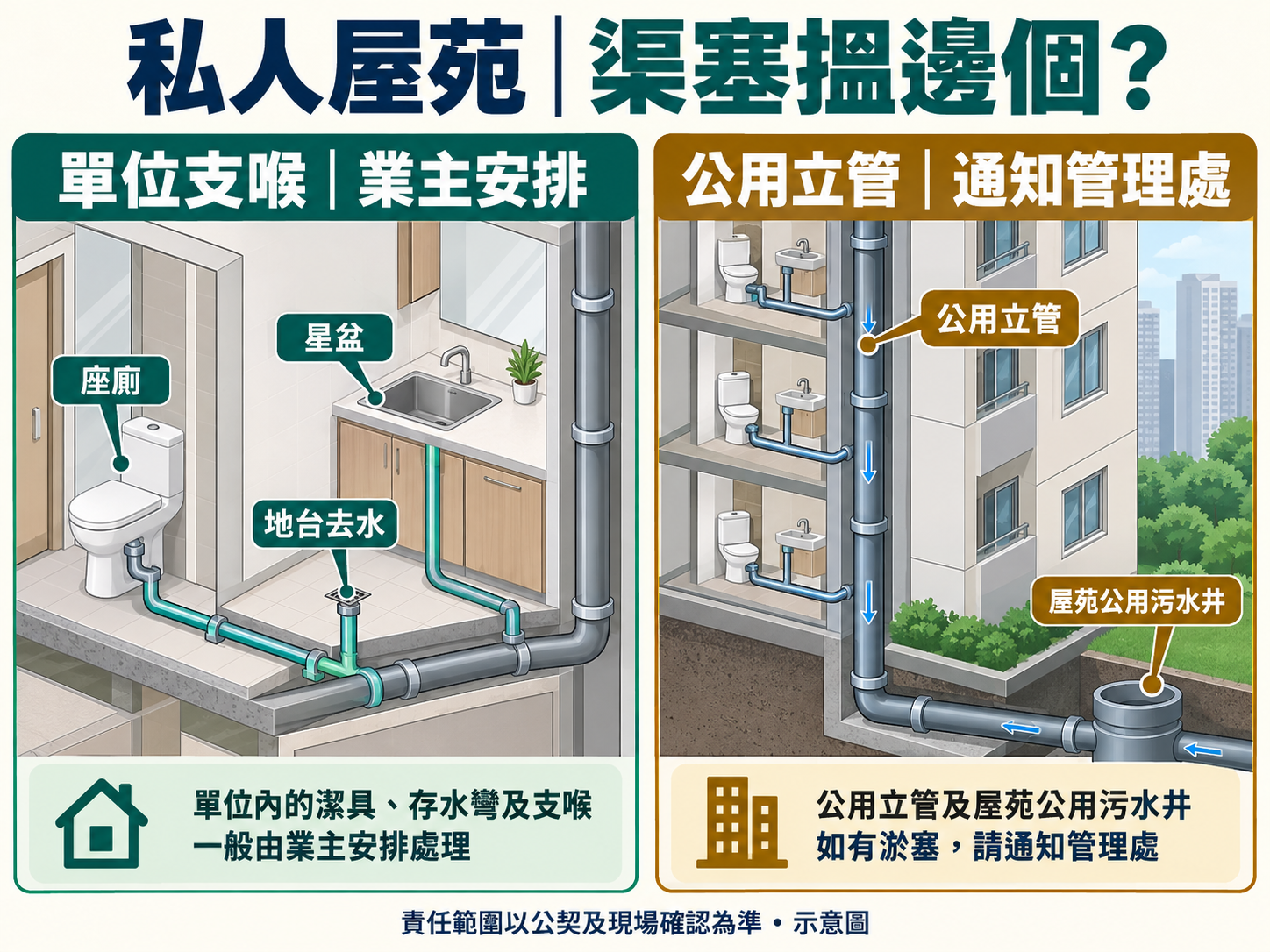
Each block rises 35 to 42 storeys and holds 280 to 336 flats. By design, each has several vertical soil stacks, with the toilet, basin, bathtub and bathroom floor drain of the same flat position sharing one stack. Where grease, tissue and other waste have built up in the lower run of a stack or at its outlet, the toilet in a low-floor flat is the first to rise during peak use upstairs — the evening shower hour, for instance — and the floor drain bubbles or backs up. Judge by scope: one slow fixture usually points to a branch pipe or trap, while several fixtures failing at once should be treated as a shared stack and reported to the management office straight away.
By inference from age, most flats here have been renovated at least once. Replacing the original trap with a shallower type, or removing the anti-syphonage pipe, leaves the water seal too weak, so sewer odour appears when the extractor fan runs or when the flats above discharge heavily. The Buildings Department is clear that tampering with drainage pipework can leave the water seal gone, letting sewer gas back in through the outlet; erecting, altering or removing a flat's drainage system — traps and anti-syphonage pipes included — should go through the minor works control system, with a contractor registered for it under the Buildings Ordinance. If the smell started after a renovation, begin the check at these points — it usually beats pouring drain cleaner down the outlet.
In a dense estate of this age, the hard part about a dripping ceiling is telling where the water comes from. It may come from a branch pipe or fixture connection in the flat above, from a shared stack or pipe duct, or from failed bathroom waterproofing — three different parties, three different routes. Start by photographing and filming where it drips, when and how much, then talk to the upstairs household and your phase's management office; if the source still cannot be found, report it to the joint office of the Food and Environmental Hygiene Department and the Buildings Department. Once foul-water seepage is confirmed and repaired, the affected surfaces still need disinfecting and deodorising.
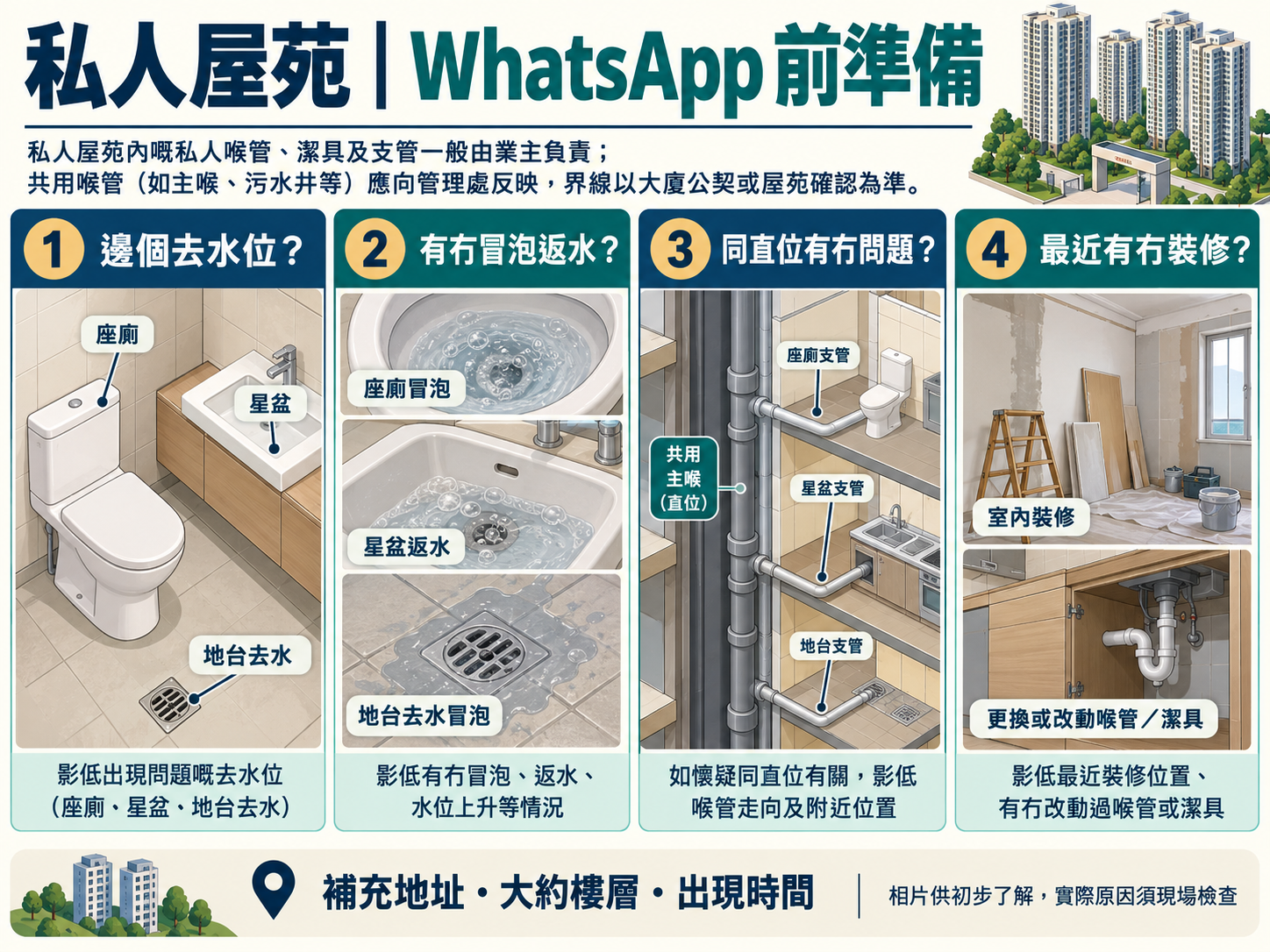
Photos or a short video on WhatsApp help us tell a single-fixture blockage from a shared-stack problem.
Belvedere Garden stands at 530–625 Castle Peak Road – Tsuen Wan, occupied in three phases between 1987 and 1991, with 19 residential blocks and 6,016 flats — one of the largest private estates in Tsuen Wan. It backs onto Ha Fa Shan and faces the Rambler Channel, and in Phase 2 the flats start on the 4th floor, which by design implies a podium and base levels below. Whether the problem is a slow toilet, bathroom odour or standing water at a podium or ground-level drain, the first step is to separate the branch pipes and traps inside the flat from the building's stacks, podium drains and manholes.
The estate replaced the South Sea Textile mill: staged demolition and redevelopment began between 1980 and 1985, stopped for two years from 1983, and resumed in stages in 1985. Phase 1 (Blocks 1–3) was occupied in July 1987, with 35 storeys and 280 flats per block. Phase 2 (Blocks 1–9) followed in October 1989 with 38 to 42 storeys; the per-block table on Chinese Wikipedia records that the flats begin on the 4th floor, for example Blocks 6–8 as “42 (4/F–45/F)”. Phase 3 Blocks 4–7 were occupied in December 1990 and Blocks 1–3 in April 1991, each with 41 storeys and 328 flats. The three phases use three separate street numbers — 530–590, 620 and 625 — and the same Wikipedia table records them as being under different management companies, so naming your phase and block when you report a problem saves a great deal of time.
The Drainage Services Department's 2001 flood investigation described the local terrain: the drainage catchpit at Fat Yip Lane sits at the toe of “a small, steep, largely natural catchment in Ha Fa Shan above Belvedere Garden”, and three main streams run down that catchment into the catchpit. Higher up, a catchwater conveying water to Tai Lam Chung Reservoir has two overflow weirs above the estate that discharge surplus flow into one of those streams during severe rainstorms. In other words, hillside runoff — with its silt and leaves — has to leave through the surface drainage here, a condition estates on flat ground do not have.
Nearly four years separate the phases: Phase 1 was occupied in 1987 and is about 39 years old this year, Phase 3 in 1991 and is about 35, so the pipework within one estate is not of a single vintage. As an inference from age, private blocks completed in the late 1980s were mostly piped in uPVC mains with metal fittings, and three decades of renovation have left trap depths and branch-pipe routes very different between flats in the same block — which is why a neighbour's experience does not necessarily apply to your home. Buildings over 30 years old fall within the Buildings Department's Mandatory Building Inspection Scheme, which works by the department serving statutory notices on target buildings; only then must owners appoint a registered inspector for a prescribed inspection. Where such an inspection has been carried out, its drainage scope covers drainage on external walls, in common parts, in common pipe ducts and the shared drainage underground and above ground — ask your phase's management office or owners' corporation whether an inspection and repair record exists. Inside a flat, it depends on the owner's own repair history.
Note: statements based on building age and type are general inferences, not findings for any particular flat.
A clear process from enquiry and assessment to an agreed scope of work
Tell us the drain problem and district and ask about available timing.
Confirm timing based on the district and schedule, then inspect the blockage or odour issue.
Explain the proposed approach, scope and price before agreed work begins.
Use suitable tools for the site conditions and agreed scope of work.
After the agreed work, test drainage and explain the observed result and any next steps.
PipeButler is an independent drain-service provider with no affiliation to the developer, owners' corporation, management company or Housing Department of the places above. Facts come from public sources checked on the dates shown; work on common drains or common parts follows the management office's and deed of mutual covenant's arrangements.
WhatsApp with the problem and district, and we will confirm available timing.