
Loading page…
Loading page…
Yau Ma Tei · Older buildings · Private estate · Commercial & restaurants
Mostly post-war tenements · open hopper heads · back-lane channels and retrofitted pipes
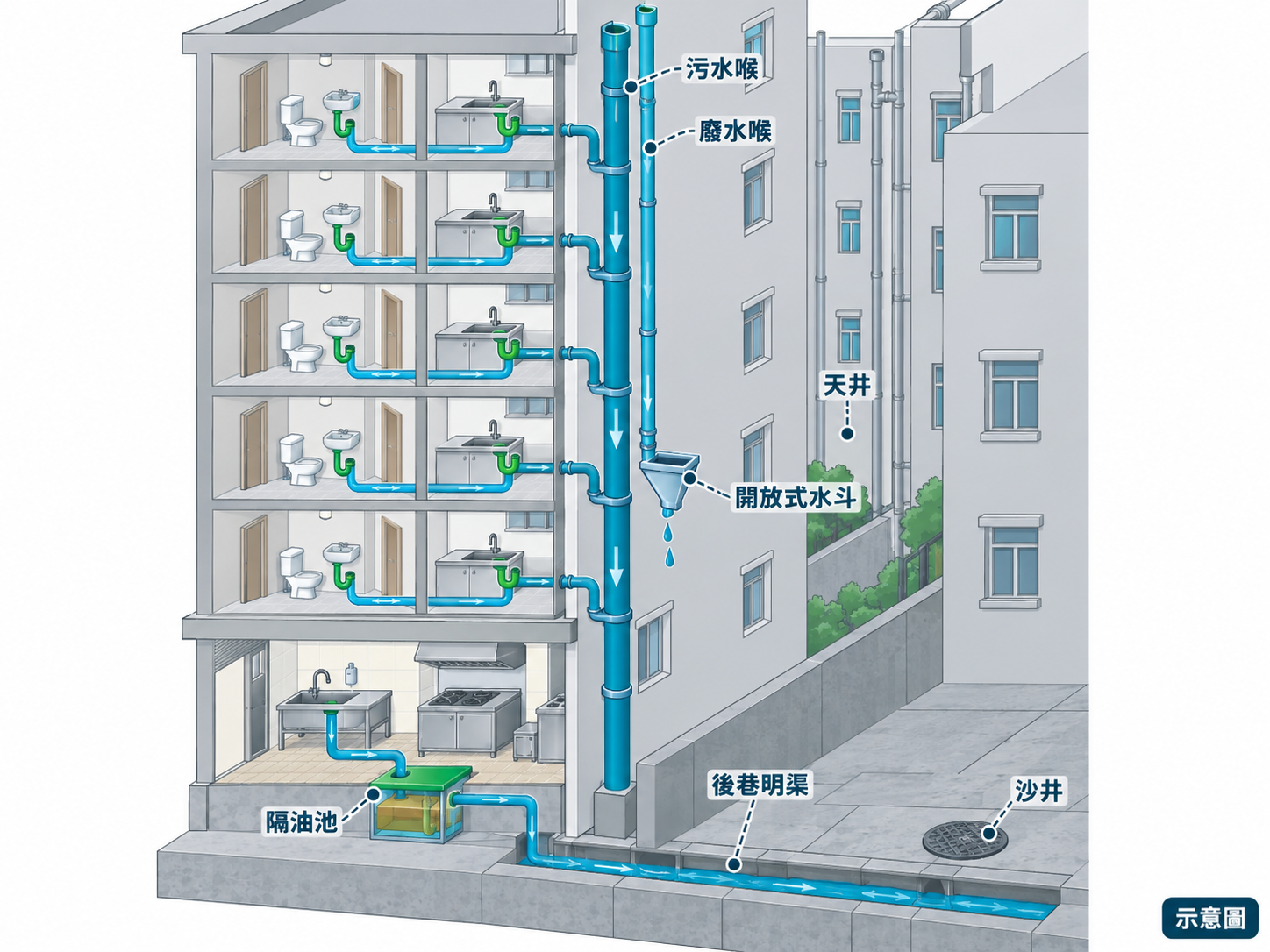
Yau Ma Tei runs from Dundas Street, its boundary with Mong Kok, down to Saigon Street where it meets Kwun Chung, and the land here was reclaimed early: Reclamation Street was built in 1880, and before that the west Kowloon shoreline was today's Shanghai Street.
Last reviewed ·
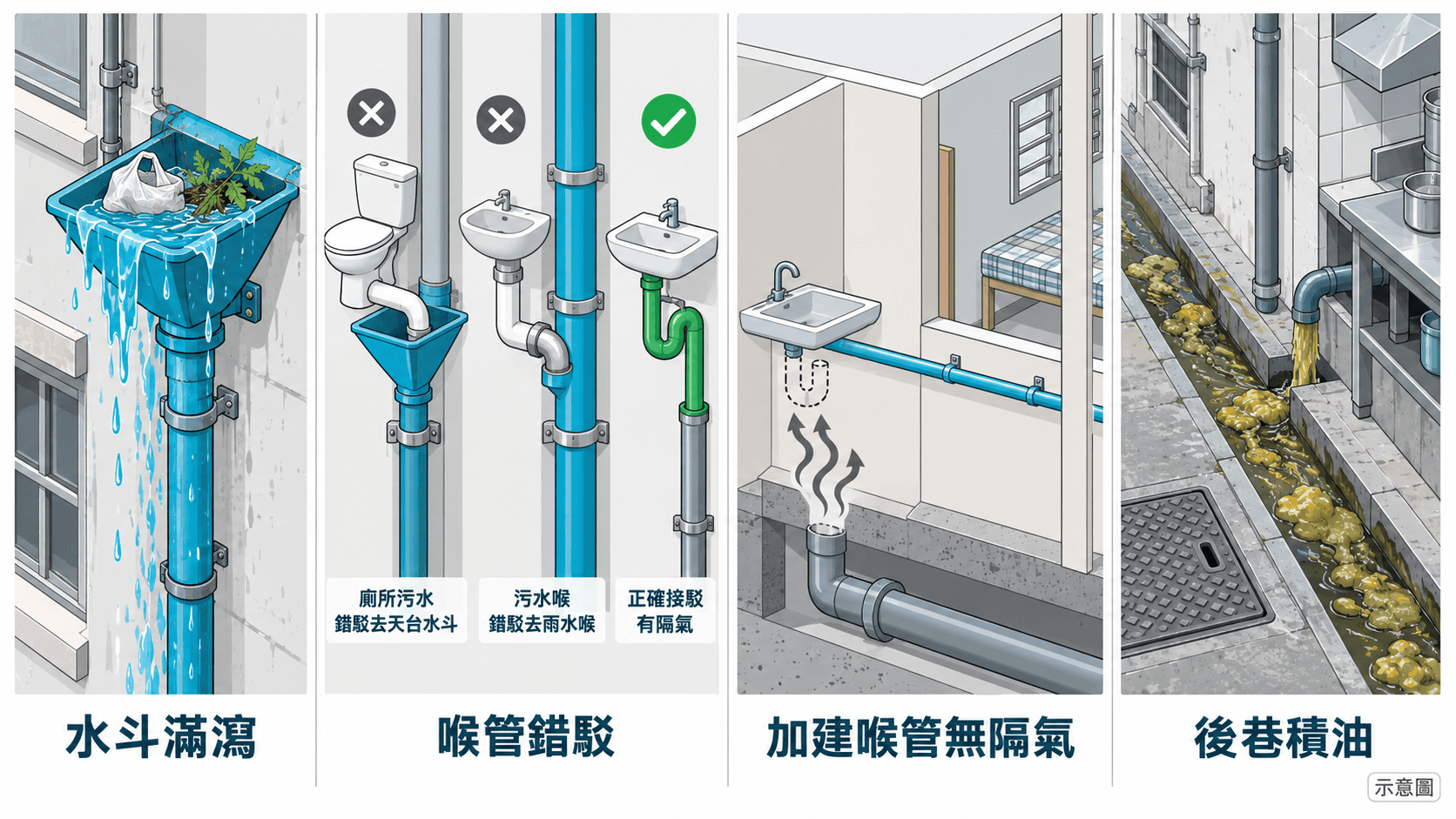
Choose the problem you are seeing to read the likely cause and next step.
Ta Kung Pao's on-site report of 14 January 2021 found that many older buildings in Yau Ma Tei and Jordan still drain through hopper heads (open funnel-shaped collectors): on Shanghai Street alone the reporter counted more than 40 buildings using hopper-head pipework. HK01 reported on 15 January 2021 that Hong Kong Toilet Association vice-chairman Hung Chi-kuen explained that because the hopper is open, water splashes as it discharges, and a plastic bag or piece of clothing thrown in can block the hopper so that it overflows; professionals have also seen plants growing in them. Buildings Department practice note APP-164 advises authorised persons to consider not providing hopper heads in the aboveground drainage systems of their development projects, so that debris and vegetation do not have to be cleared constantly to keep a hopper from blocking, and advises authorised persons handling drainage repair or comprehensive maintenance works in an existing building to tell their clients to consider replacing an open hopper-head system with a closed system fitted with suitable traps. An overflowing, dripping or smelly hopper is part of the building's common parts, so ask the owners' corporation or the owners collectively to have it cleared and inspected.
In January 2021 the Buildings Department told HK01 that under the Building (Standards of Sanitary Fitments, Plumbing, Drainage Works and Latrines) Regulations an open hopper head may only receive waste water from fitments such as basins and bathtubs, and that soil water from a toilet may under no circumstances discharge into an open hopper. The department added that some buildings have misconnected pipes — for example a waste pipe with no trap to prevent loss of the water seal, connected straight into a soil pipe. On 15 January that year it served a drainage repair order under the Buildings Ordinance on the owners of 26 Reclamation Street, whose drainage system it had found defective. A second kind of misconnection sends sewage into the stormwater system: HK01 reported on 30 January 2019 that the department told a district council committee it had issued eight warning letters over the previous year about private buildings in Yau Tsim Mong connecting soil pipes to rainwater drains. Unblocking does not fix this; a registered contractor has to correct the connection.
Ta Kung Pao reported on 14 January 2021 that Mok Kwan-hung, chairman of the Licensed Plumbers Association, said some tenements had added soil pipes with no anti-syphonage pipe, so air can only enter and not leave; once pressure builds below, gas can be pushed back into a flat. The report also described newly installed soil pipes in the area with no proper fall and no anti-syphonage pipe, so a large discharge from upstairs sets up syphonage that draws the water seal out of the traps in flats below and lets sewer gas back in through the fittings. By design, when a subdivided flat puts a toilet or shower where there was no drain, the branch pipe has to run some distance before it reaches the original stack or the external pipe, and too little fall combined with a missing trap produces slow draining and odour at the same time. If a tenant suspects a smell at an outlet or a leaking, cracked pipe, the Buildings Department advises contacting the owner promptly so that a qualified person or contractor can inspect it.
HK01 reported on 30 January 2019 that a Yau Tsim Mong district councillor had raised with the council's food, environmental hygiene and works committee that restaurants in the back lanes around Arthur Street, Temple Street, Pitt Street and Waterloo Road were pouring waste liquid and dishwater into the lanes and street drains, leaving grease and a smell in the open channels. At the committee meeting on 17 January 2019, a Food and Environmental Hygiene Department representative said it was illegal for restaurant staff to wash utensils and prepare food in the back lane so that waste water ran into an open channel; a night operation that month brought two prosecutions and five verbal warnings against seven restaurants in the area, with four prosecutions and 19 verbal warnings over the previous year, and licensing conditions forbid dumping food waste or waste water in back lanes and streets or discharging it into open channels and stormwater drains. For a restaurant, the in-shop outlets, grease trap and the private drain up to the public sewer have to be cleaned regularly by the operator; once grease reaches the back-lane channel or the building's manhole, it becomes a problem for the whole block or the whole lane.
The Drainage Services Department's list of Locations Prone to Blockage includes, in Yau Tsim Mong, the stretch of Nathan Road between Kansu Street and Saigon Street — the southern edge of Yau Ma Tei, where it meets Jordan — along with the Mong Kok entry at the junction of Waterloo Road near Wylie Road. Inferring from what the list is for, the rainwater inlets at these points are easily narrowed by litter and silt, so the road drains slowly in heavy rain. Remember that the stormwater drains and the building's soil pipes are two separate systems: water on the road does not usually make upper-floor flats back up, but shops, ground-floor units and half-basement stores with thresholds at street level feel it first. Rather than waiting for a flood, it is more effective to clear silt from the inlet in front of the shop, the back-lane channel and the grease trap before the rainy season; a blocked road inlet is for the Drainage Services Department to deal with.
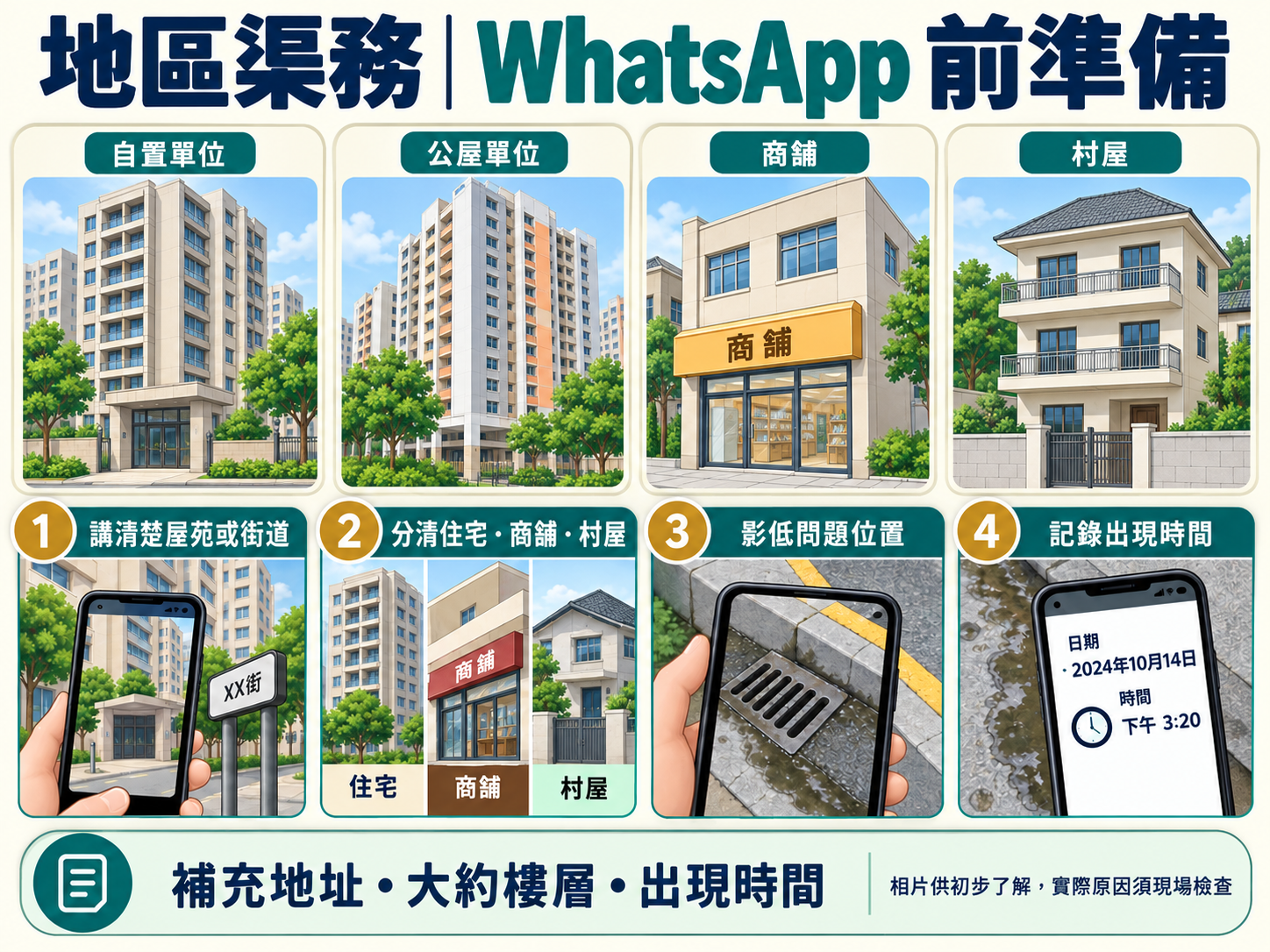
Photos or a short video on WhatsApp help us tell a single-fixture blockage from a shared-stack problem.
Yau Ma Tei runs from Dundas Street, its boundary with Mong Kok, down to Saigon Street where it meets Kwun Chung, and the land here was reclaimed early: Reclamation Street was built in 1880, and before that the west Kowloon shoreline was today's Shanghai Street. The area is mostly post-war tenements and 1960s–70s composite buildings, with shops on the ground and second floors (G/F and 2/F) and flats above, many of them subdivided; open hopper heads are still visible on external walls, and the back lanes carry open channels and the buildings' own manholes. When a drain blocks or smells, the first step is to work out whether the problem is in the flat (traps and branch pipes), in the shared external pipes and hopper heads, or in the back-lane channel and manholes — because each one is handled by different people.
Yau Ma Tei was built up one reclamation at a time. Wikipedia records that local landowners reclaimed land themselves in 1876 and Reclamation Street was formed in 1880, before which the west Kowloon shoreline was Shanghai Street; further government reclamation in 1900 pushed the shore out to Ferry Street, and between 1909 and 1915 the street was extended into Mong Kok as the typhoon shelter was built. Temple Street, Shanghai Street and Reclamation Street therefore run roughly parallel across several decades of reclamation and construction, with narrow streets, dense back lanes, thresholds close to road level and drainage added layer by layer. Wikipedia also notes that most buildings here use the ground and second floors (G/F and 2/F) for business with flats above, which means the lower part of a residential stack usually passes through the shops and restaurants below.
The URA managing director's blog of November 2017 set out the baseline figures for the Yau Mong District Study: about 212 hectares and 3,350 buildings, an average age of 48 years, 90% of buildings over 30 years old and close to half over 50, with density reaching more than 100,000 people per square kilometre. Further up the same street, at the Reclamation Street/Shantung Street corner, a 2012 URA redevelopment project covered 20 street numbers, all built between 1959 and 1963, six to eight storeys high and without lifts — the same generation of building as the Yau Ma Tei stretch. As a general inference from building age, the original pipes in this generation of buildings are mostly cast iron or galvanised steel run on external walls and in light wells, so rusted brackets, leaking joints and cracks in external soil pipes are the expected signs of ageing. Add the many flats that have been subdivided, and pipework has often been extended and re-routed more than once, so two floors of the same building can be plumbed quite differently.
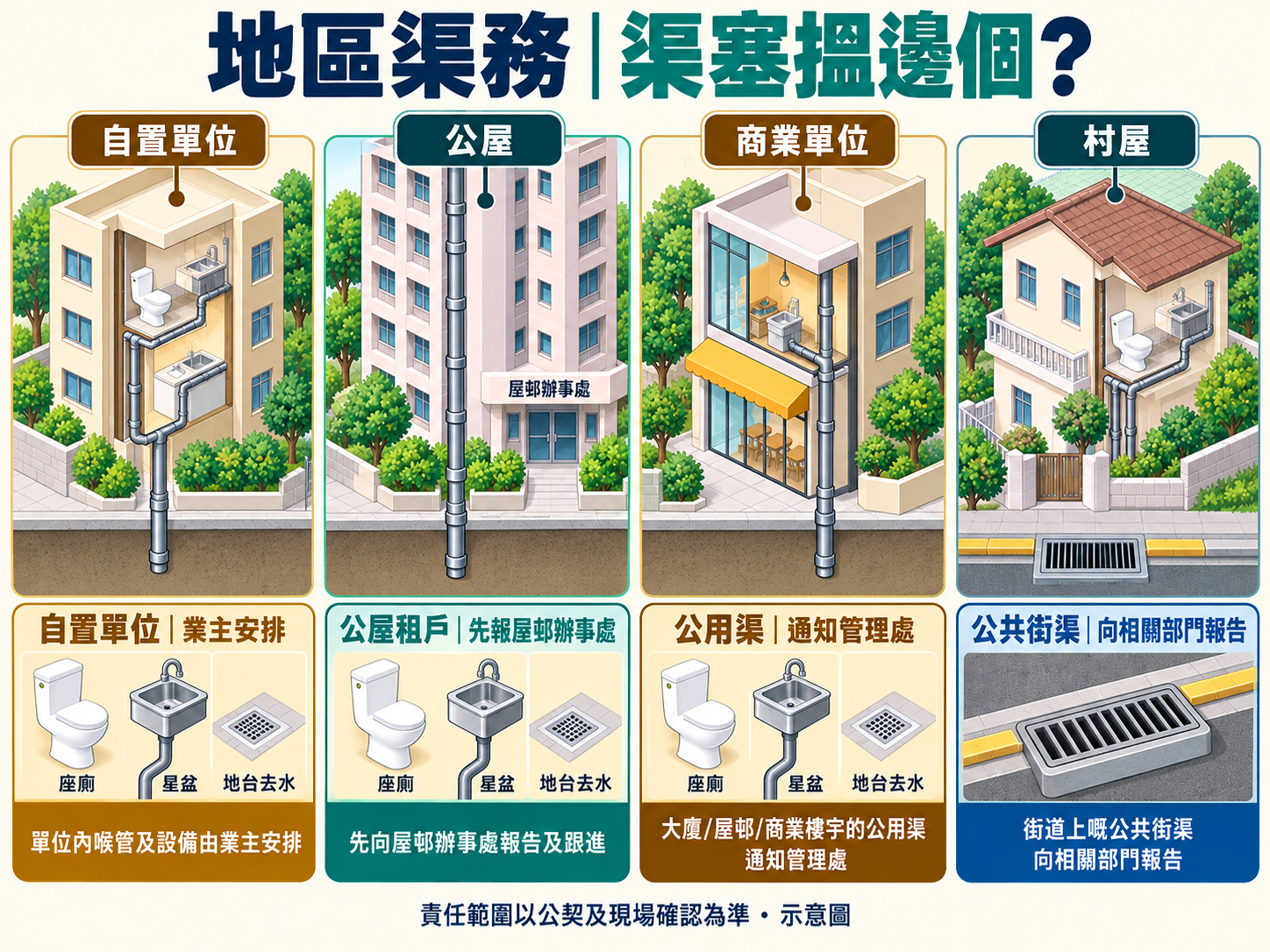
The mix of housing here is simple, but responsibilities differ sharply. Most of it is tenements and single older blocks where the owners are responsible, some without even an owners' corporation, so repairs to shared pipes depend on the owners organising themselves. Prosperous Garden, at the junction of Canton Road, Tung Kun Street and Public Square Street, is a Housing Society development: four of its five blocks hold 896 flats sold to owners, while one holds 668 Group B rental flats whose fixtures the Housing Society maintains, and the sold flats are the owners' own responsibility like any private flat. The URA also notes that the Yau Mong area lacks large public rental estates, so there is almost no "report it to the Housing Department through the estate office" route here. Shops, restaurants and market stalls cluster along Temple Street, Reclamation Street, Shanghai Street and Battery Street, and their in-shop drains, grease traps and back-lane channels form yet another split of duties; the older building clusters in neighbouring Jordan, Ferry Point and Tai Kok Tsui are comparable and worth reading alongside this page.
Note: statements based on building age and type are general inferences, not findings for any particular flat.
Choose an enquiry route for your premises and work scope.
Pantry, washroom and shared-drain enquiries, with scope agreed before work
Scope and booking detailsUnit outlets, shared pipes and chamber enquiries assessed with site access
Scope and booking detailsDiscuss a defined maintenance scope using assets, usage and incident records
Scope and booking detailsA clear process from enquiry and assessment to an agreed scope of work
Tell us the drain problem and district and ask about available timing.
Confirm timing based on the district and schedule, then inspect the blockage or odour issue.
Explain the proposed approach, scope and price before agreed work begins.
Use suitable tools for the site conditions and agreed scope of work.
After the agreed work, test drainage and explain the observed result and any next steps.
PipeButler is an independent drain-service provider with no affiliation to the developer, owners' corporation, management company or Housing Department of the places above. Facts come from public sources checked on the dates shown; work on common drains or common parts follows the management office's and deed of mutual covenant's arrangements.
WhatsApp with the problem and district, and we will confirm available timing.