
Loading page…
Loading page…
Jordan / Ferry Point · Older buildings · Private estate · Commercial & restaurants
Completed 1964–1970 · 8 blocks of 18 storeys · documented shop-level sewage backflow
Man Wah Sun Chuen stands at Ferry Point in Jordan, where Jordan Road meets Ferry Street.
Last reviewed ·
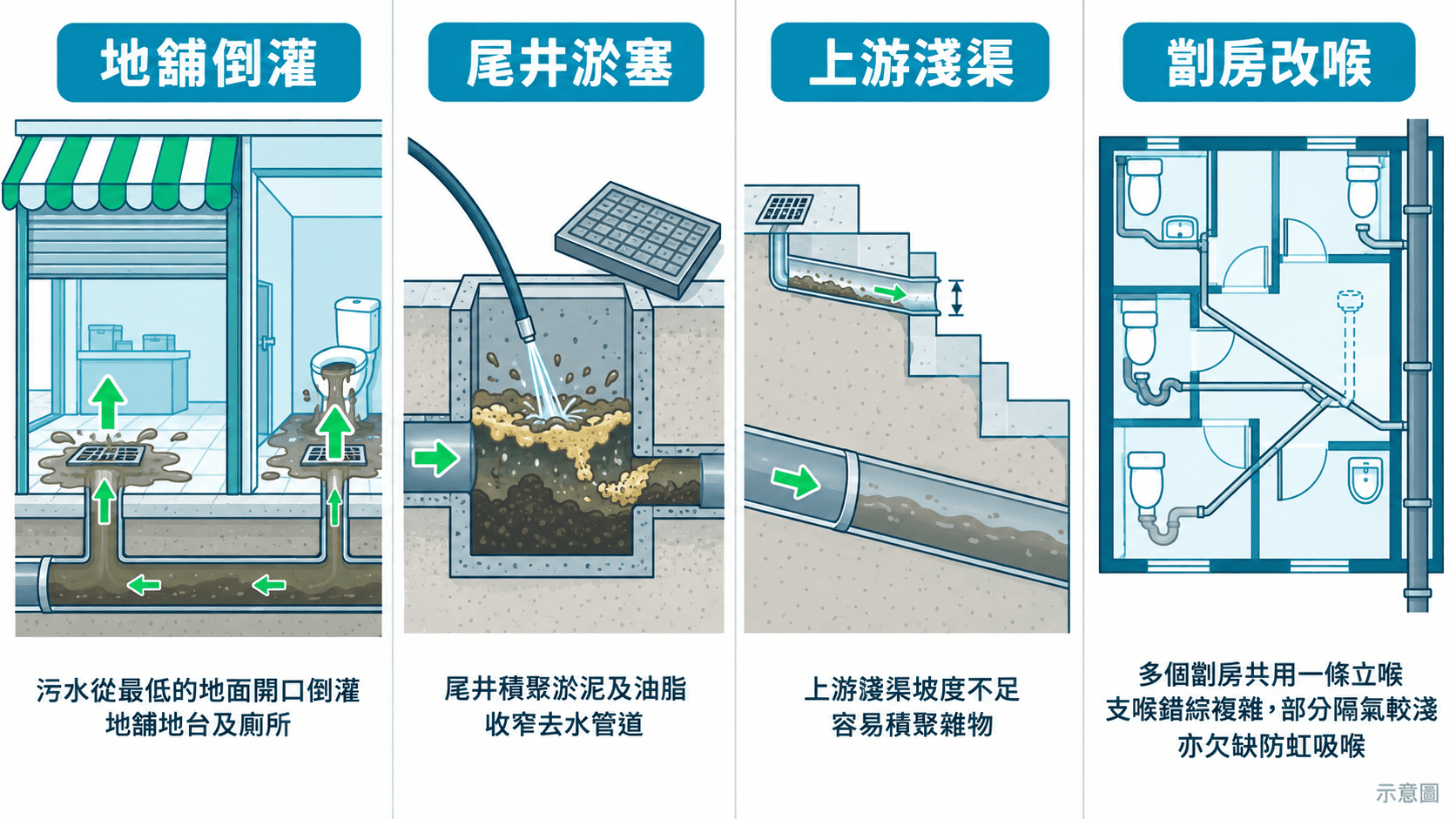
Choose the problem you are seeing to read the likely cause and next step.
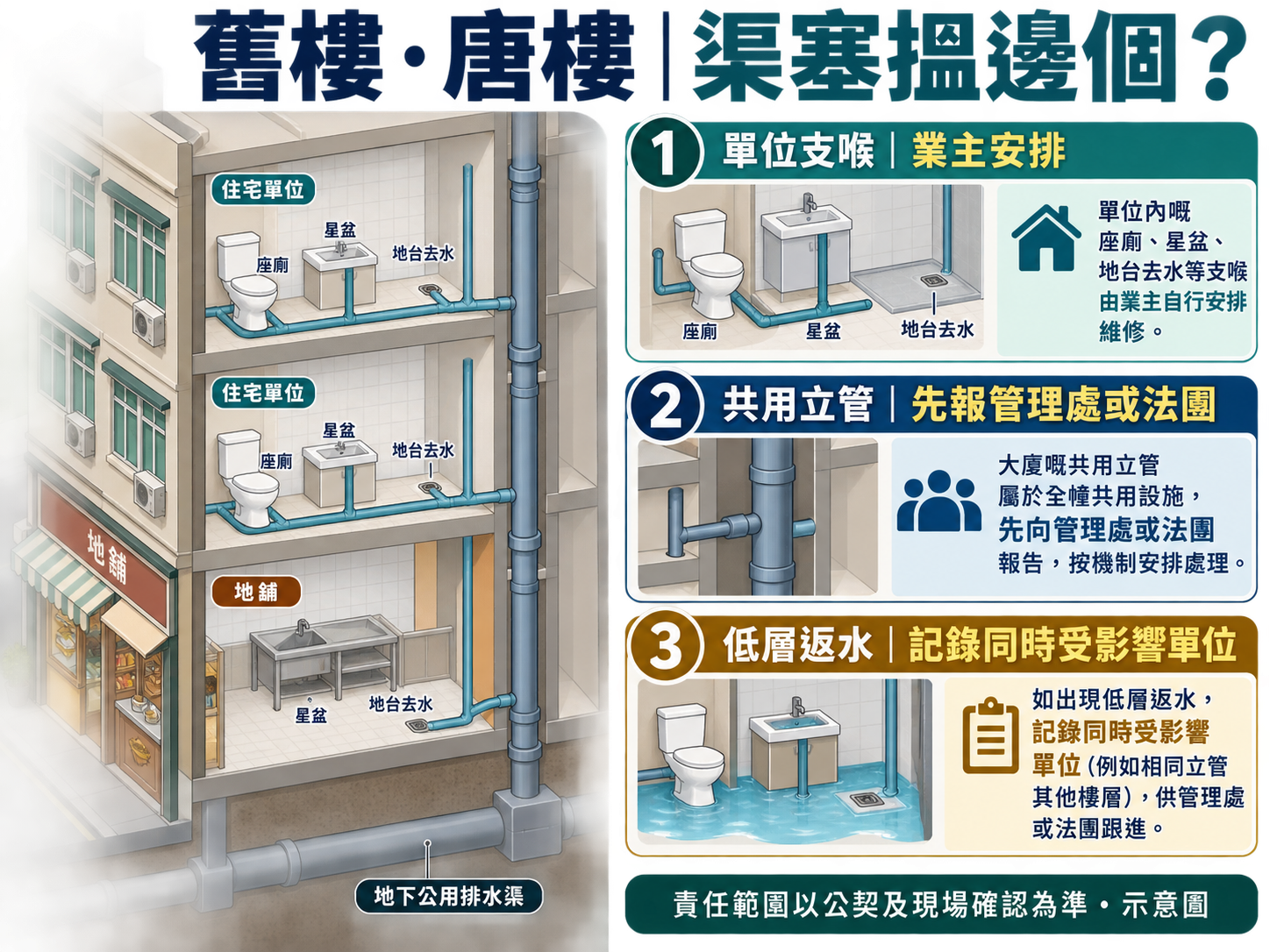
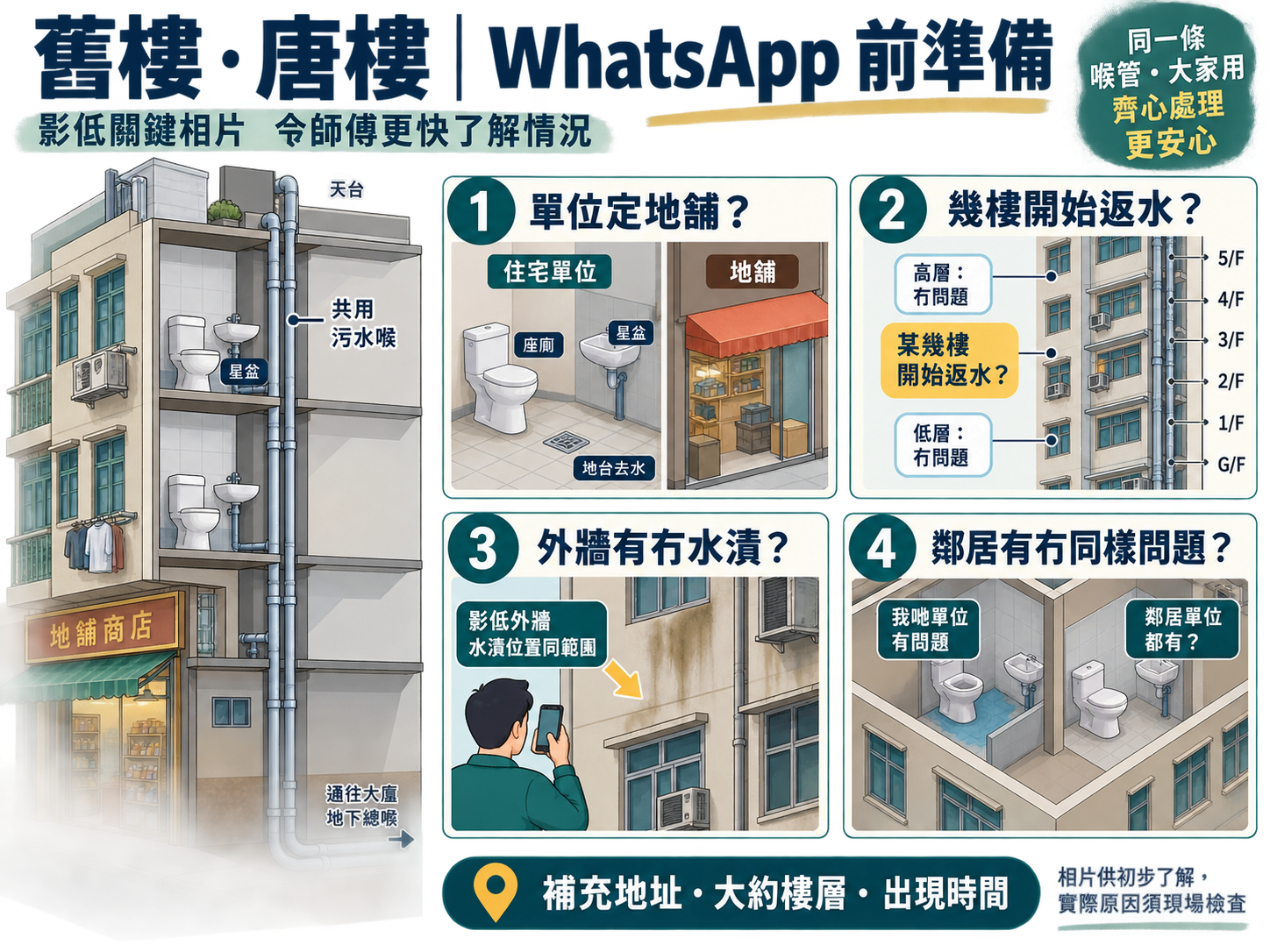
On 7 January 2016 on.cc reported that during an Amber rainstorm warning on the afternoon of 5 January, shops around Ferry Point suffered serious sewage backflow, with sewage surging out of shop toilets and drain outlets into the street and water 5 cm deep in some shops. A hardware-shop owner on Man Yuen Street said he heard a loud gurgling from the floor drain at the back of his shop, after which sewage poured out of the outlet. The report also noted slight backflow at toilets in low-floor flats of nearby blocks. The same report said that after investigation the authorities found a burst section of sewer about 500 m away, suspected to be obstructed by debris; a DSD spokesman said the badly damaged trunk sewer had led to manholes overflowing at the low-lying upstream end around Man Ying Street at peak flow, and that tankers had been arranged to pump the sewage out of the manholes. On 19 January 2025 Wen Wei Po reported that at about 10 am the previous day a suspected blockage in the Ferry Street sewer caused the soil drain of Man Ying Building to back up, with sewage pouring off the first-floor canopy. If a shop or a low-floor flat sees the water level rise, bubbles form or hears gurgling, note the time and the weather immediately and tell the management office or owners' corporation.
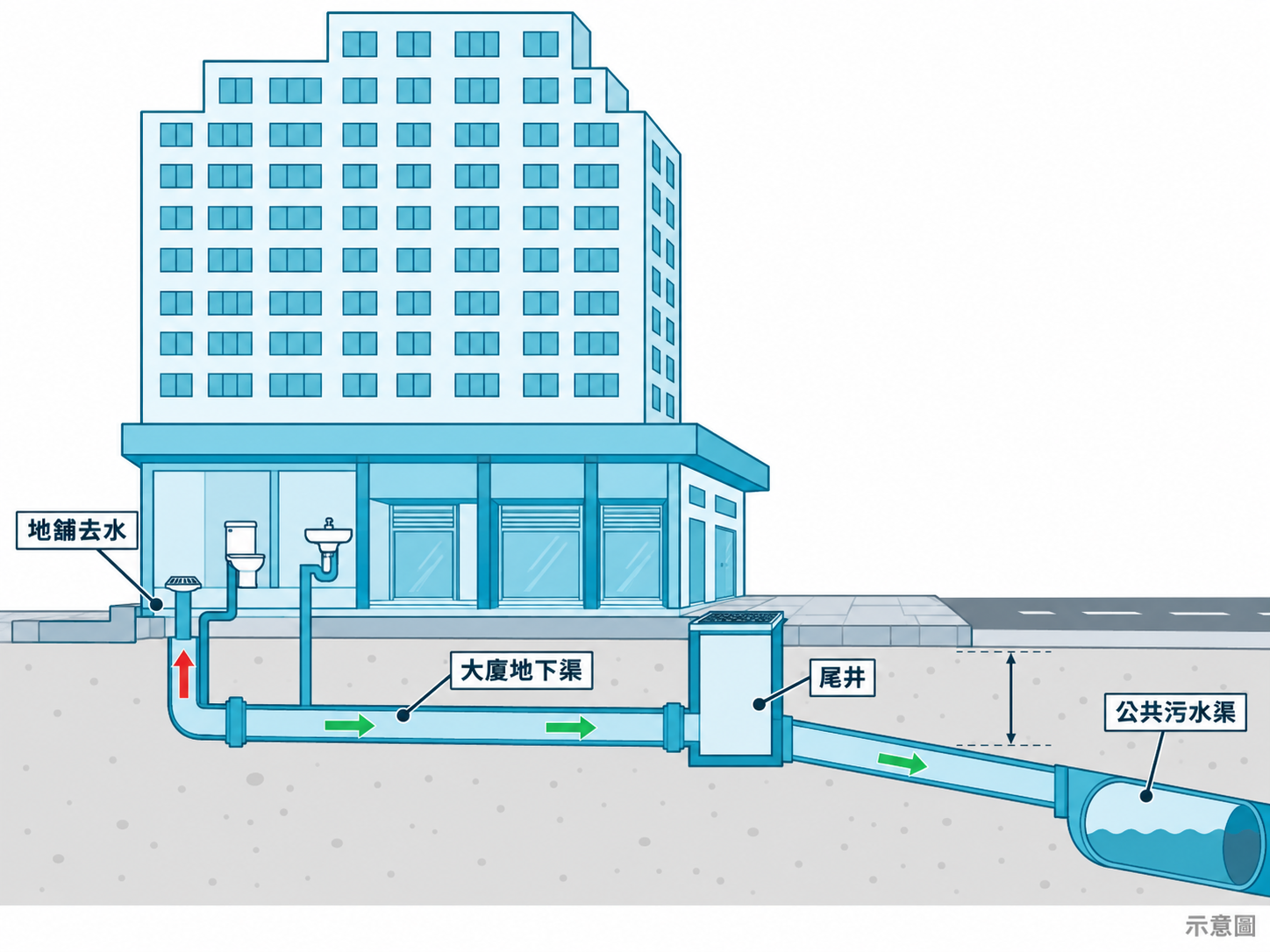
HK01's report of 19 December 2024 records an important distinction. The Drainage Services Department said the public sewers in Man Wai Street and Man Yuen Street beside Nos. 9 to 16 of Man Yuen Building were operating normally, and that it had completed sewer rehabilitation works in those two streets in 2021; its investigation also found a pipe laid in the pavement that was not part of the public sewerage system, and the case was referred to the Buildings Department and the EPD. The Environmental Protection Department said the cause was a blockage in the building's own sewer system that led to backflow. The Highways Department said in the same report that the building had engaged a drainage contractor to clear its internal drains and terminal manhole. So a "normal" street sewer does not mean the ground floor is safe: the building's own underground drain and terminal manhole have to be opened, checked and cleared separately, with a camera survey where the silted length needs to be pinpointed — and it is worth establishing which of the pipes outside are public sewers and which belong to the building.
In Wen Wei Po's report of 19 January 2025 the Highways Department said that, as it understood the position, improper discharge into manholes and associated sewers serving buildings around the estate had caused silting, and that this affected the operation of the public sewerage system to some degree. HK01's December 2024 report quoted district councillor Chan Siu-tong as saying that some shops had connected other pipes to the shared sewer on their own initiative, adding to the load. He also noted that the DSD had been replacing pipes in batches across the old district, Ferry Point included, and that the Central Kowloon Route works required some pipe alignments to be changed — a run that may once have been straight gained extra bends and no longer flowed as freely. Combined with the 150 to 200 mm depth of the pipe running from ground level down to the drain on Man Yuen Street, that extra load and settled grease tend to build up in the same upstream stretch. Where a shop has added or altered a drain, the connection point and the direction of fall are worth checking together.
Wikipedia records that eateries moved in steadily after Austin station opened in 2009, and that by 2014 a large cluster of restaurants occupied the ground floors, turning the area into an evening dining district. The EPD's grease-trap maintenance guidance requires that the trap be inspected at least every three days and cleaned promptly once greasy waste occupies the top 30% of the liquid depth, with maintenance recorded in a log book; it also states plainly that grease-trap waste must not be disposed of to toilets, gullies, surface channels or manholes. By design, when several restaurants share one building drain and terminal manhole, grease that cools and sets narrows the pipe from the wall inwards, and the upstream shops and low-floor residents feel it first. Scheduled high-pressure jetting alongside grease-trap cleaning reduces the chance of a sudden blockage, and the EPD notes that traps larger than 1,000 litres are difficult to clean well by hand and recommends hiring an external maintenance contractor to ensure they are emptied completely and properly.
On 27 January 2021 Bastille Post quoted a tenant of a subdivided flat in Man Fai Building who said some flats had been split six ways, that the toilet sat in a different position in each unit, that the pipe alterations were chaotic and that some toilets had no window. By design, common outcomes of such conversions include traps replaced with shallower ones, anti-syphonage pipes removed, or a new toilet's branch pipe connected to a waste pipe that was never intended to carry soil water. The Buildings Department states that every fitment needs an effective water seal, and that altering traps, anti-syphonage pipes or drain positions is minor works that must be carried out by a registered minor works contractor. When the smell only started after a conversion, these are usually the quickest points to check first.
Photos or a short video on WhatsApp help us tell a single-fixture blockage from a shared-stack problem.
Man Wah Sun Chuen stands at Ferry Point in Jordan, where Jordan Road meets Ferry Street. All eight blocks begin with the character 「文」, so locals call them the "eight Man blocks" (reference sources record the Chinese name as 文華新村; an unrelated Mid-Levels property, Mandarin Villa, shares the homophone 文華新邨). They were completed in two phases between 1964 and 1970, each 18 storeys, with shops and restaurants at street level and flats above. Drainage here has two local characteristics. The toilets and floor drains of the ground-floor shops are the lowest openings on the whole building drainage system, so when the building's underground drain or the street sewer narrows, that is usually where sewage appears first. And the ground at Ferry Point falls from one side to the other — a district councillor has likened it to a flight of steps — so the pipes along the upstream streets are unusually shallow. Before reporting a problem, the first job is to tell apart the branch pipes and traps inside the shop or flat, the building's shared stacks and terminal manhole, and the public sewer in the street.
Wikipedia records that Man Wah Sun Chuen was developed by Kar Nin Properties and designed by Eric Cumine Associates, and that its eight composite buildings were completed in two phases: the four nearer Ferry Street in 1964–1965, and the four seaward blocks after the reclamation, between 1966 and 1970. Each block has 18 storeys and between 405 and 419 flats, 3,287 in all. Streets run between all eight blocks — Man Wui, Man Ying and Man Yuen Streets among them — so the blocks form a grid, and their upper floors are stepped back to suit the shadow rules of the day. Each block is further divided into front, middle and rear sub-blocks, each with two entrances. That "blocks within a block" structure matters when you diagnose a problem: the question "do the flats above and below in the same line have this too?" should be asked within the sub-block, not the whole block.
As a general inference from building age, composite buildings of the 1960s were typically built with cast-iron or galvanised soil and waste stacks, with waste from bathrooms and kitchens collected at hoppers on the external wall. The toilets and floor drains of the ground-floor shops, together with the building's underground drain, sit at the lowest point and reach the public sewer in the street only through the last manhole within the building's own boundary — the terminal manhole. By design, if the terminal manhole, the underground drain or any length of street sewer narrows, sewage works its way back up to the lowest opening it can find, and that opening is usually a shop's toilet, a floor drain or a kerbside drain outlet. Wikipedia also records that building-wide repairs were completed on all eight blocks in the third quarter of 2014; with flats renovated one by one on top of that, old and new pipe sections and joints now sit side by side within the same block, so the actual condition matters more than the age alone.
Location matters just as much. Wikipedia describes Man Wah Sun Chuen as the first large waterfront estate on Kowloon's west shore, with the sea on three sides, until the West Kowloon reclamation of the mid-1990s enclosed it with land. On 19 December 2024 HK01 quoted Yau Tsim Mong district councillor Chan Siu-tong, who likened the Ferry Point terrain to a flight of steps: around Man Yuen Street, at the upstream end, the pipe running from ground level to the drain below is only 150 to 200 mm deep, against about 200 to 300 mm mid-way and 400 to 500 mm downstream. As he put it in the report, water runs naturally from high to low, and the shallowest point at the head of the run is the easiest to block. A shallow drain has little depth of cover and little margin for error, so a modest amount of grease, tissue or debris is enough to hold the flow back.
On the residential side, many flats in the area have been subdivided. On 27 January 2021 Bastille Post quoted a tenant of a subdivided flat in Man Fai Building who said that some flats had been split six ways, that the toilet was in a different position in each unit, that the pipe alterations were chaotic and that some toilets had no window; the report also noted a subdivided-flat toilet whose exhaust fan discharged towards the shared corridor. By design, turning a flat with two or three drainage points into six toilets adds discharge points without adding stack capacity, which raises the chance of a shallow water seal, numerous joints and insufficient fall.
Note: statements based on building age and type are general inferences, not findings for any particular flat.
Choose an enquiry route for your premises and work scope.
Pantry, washroom and shared-drain enquiries, with scope agreed before work
Scope and booking detailsUnit outlets, shared pipes and chamber enquiries assessed with site access
Scope and booking detailsDiscuss a defined maintenance scope using assets, usage and incident records
Scope and booking detailsA clear process from enquiry and assessment to an agreed scope of work
Tell us the drain problem and district and ask about available timing.
Confirm timing based on the district and schedule, then inspect the blockage or odour issue.
Explain the proposed approach, scope and price before agreed work begins.
Use suitable tools for the site conditions and agreed scope of work.
After the agreed work, test drainage and explain the observed result and any next steps.
PipeButler is an independent drain-service provider with no affiliation to the developer, owners' corporation, management company or Housing Department of the places above. Facts come from public sources checked on the dates shown; work on common drains or common parts follows the management office's and deed of mutual covenant's arrangements.
WhatsApp with the problem and district, and we will confirm available timing.