
Loading page…
Loading page…
Kwun Tong Town Centre · Older buildings · Commercial & restaurants
1960s mid-density blocks on Yuet Wah Street · single blocks · low-floor backflow
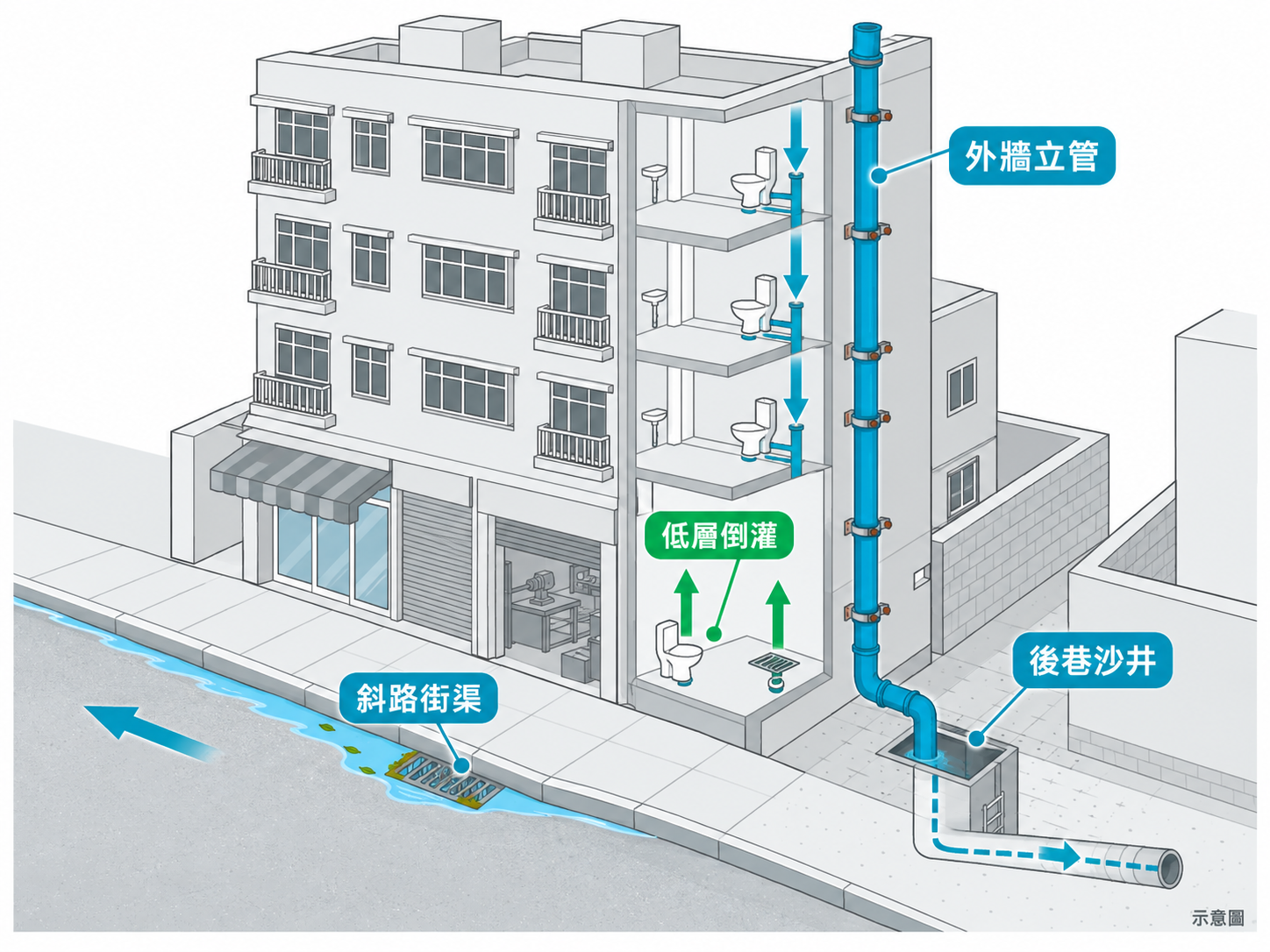
The older buildings of Kwun Tong town centre are mainly the 1960s private blocks around Yuet Wah Street and Tin Heung Street, plus the single residential and composite blocks along Shung Yan Street, Shui Wo Street, Mut Wah Street and Hong Ning Road.
Last reviewed ·
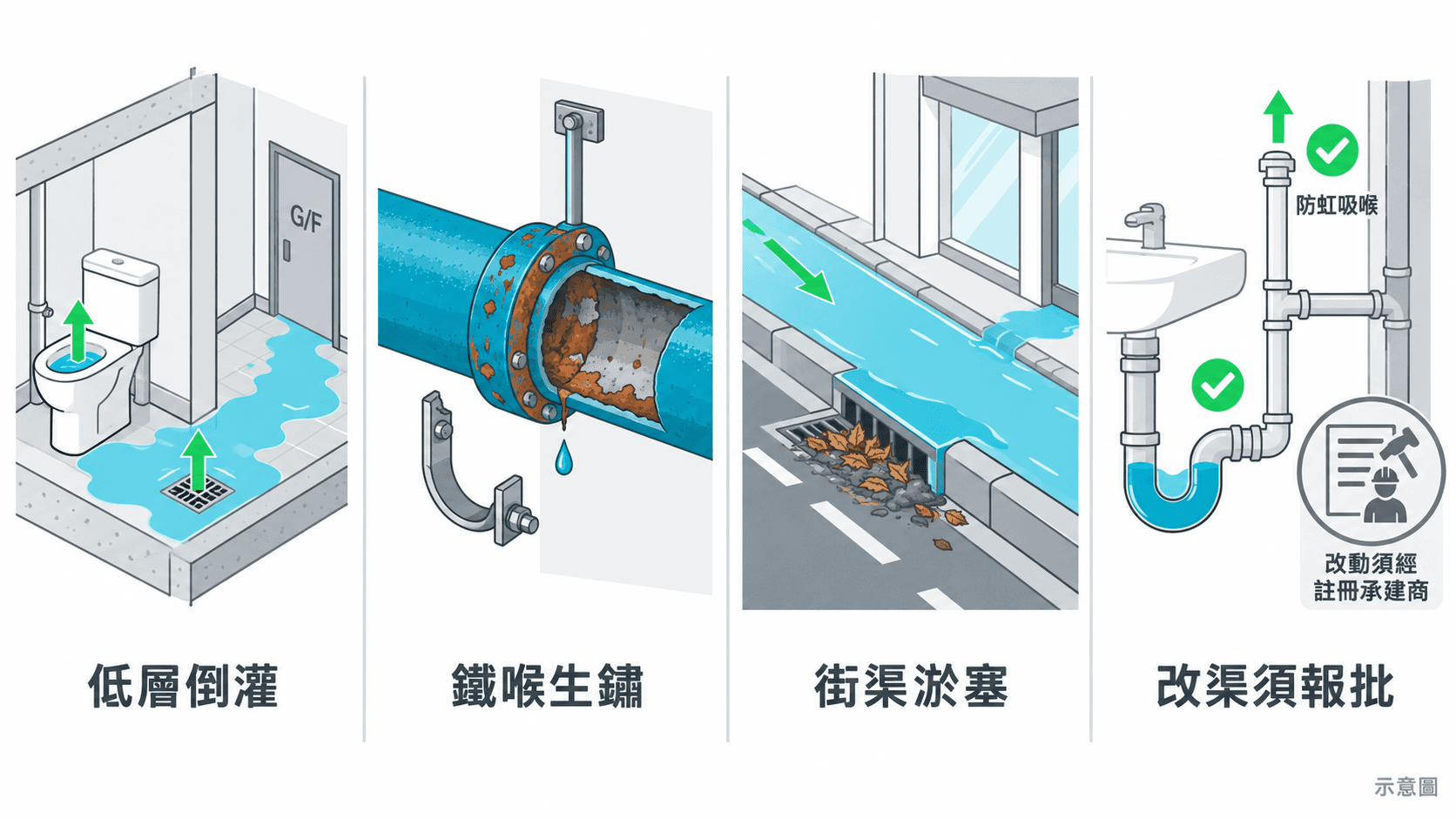
Choose the problem you are seeing to read the likely cause and next step.
According to a HK01 report of 1 February 2020, in an older building of more than 50 years in Kwun Tong town centre, a first-floor flat had sewage backing up out of the toilet for three days in a row and spilling into the corridor on that floor. The report quotes the resident as saying that after she asked the Drainage Services Department for help, staff checked the manhole outside the building, found nothing blocking the drain and therefore judged that the building's own pipes were blocked, advising her to engage a drain company; the management company told the paper it had sent a drain company on the first day and that the burst had since been resolved. The same report quotes the architect Kwan Siu-lun as saying that burst soil pipes often occur in tong lau and older buildings, and that pipes on low floors bear the most pressure, so the problem is common in low-floor flats. The order of steps is worth remembering: first establish whether the problem is the flat's branch pipe, the building's stack or the street drain, and only then decide whom to call. Where sewage has reached a corridor or rear lane, the area also needs cleaning and disinfecting after the drain is cleared.
The Buildings Department says drainage systems in buildings of every type and age develop defects of various kinds and degrees, the common examples being leaking or broken external drainage pipes, rusty internal pipes and unauthorised alterations to the drainage system. As an inference from building age, blocks completed between 1963 and 1972 were normally built with cast-iron or steel pipes, and after half a century thinning walls, weeping joints and rusted, loose brackets are all common. The HK01 report of 2020 also quotes an architect saying that older buildings generally use metal pipes such as iron drains, and that clearing them improperly — with a high-pressure jet, or by overusing chemical drain cleaner — can corrode the iron and open a hole. The Environmental Protection Department adds that buildings completed before the mid-1980s may contain asbestos cement sewage pipes, which cannot be identified by appearance or colour, so suspect material should be treated as asbestos-containing — and not cut or drilled — until a registered asbestos consultant has confirmed what it is. Pipe material and condition therefore have to be established first, and the tool and pressure chosen to match.
The Drainage Services Department's list of locations prone to blockage has seven entries in Kwun Tong, two of which — Kwun Tong Road near Hong Ning Road, and Tsui Ping Road between Kai Lim Road and Kwun Tong Road — sit on the edge of this cluster of older buildings. The department explains that such locations are identified from past records and observations of frequent flooding in heavy rain caused by leaves, silt or refuse blocking the inlets. The whole of Hong Ning Road is on a slope, so given the terrain rainwater concentrates towards Kwun Tong Road; once the street drains are full the building's private drain has nowhere to discharge, and what comes up first is usually the shops at the foot of the slope, followed by the toilets and bathroom floor drains in the low-floor flats. Wikipedia's account of the September 2023 rainstorm records that the Observatory issued that year's first Black Rainstorm Warning at 11.05pm on 7 September 2023, after districts including Kwun Tong recorded more than 70 mm of rain in an hour. In rain like that, clearing gullies and manholes before the wet season and having flood boards or sandbags ready matters a great deal.
In a statement of 12 February 2020 the Buildings Department said owners altering a drainage system, including anti-syphonage pipes, must appoint a contractor registered under the Buildings Ordinance through the Minor Works Control System, and that every sanitary fitment — water closet, wash basin, bathtub — must have an effective water seal. The statement says expressly that these requirements also apply to drain pipes erected or altered when a flat is subdivided, and that the department would step up site audits of in-flat drainage alterations. As an inference from building age, most flats here have been renovated more than once: bathtubs replaced by shower trays, a washing-machine outlet added, kitchens and bathrooms moved, so trap types and connection points often differ from the original plans. If the smell or the slow draining started after a renovation, begin with the traps, the anti-syphonage pipe and the connection of any new outlet.
URA records show that Park Metropolitan in Development Area 1 of the Kwun Tong Town Centre project was completed in July 2014 and Grand Central in Development Areas 2 and 3 in April 2021, while Development Areas 4 and 5 are carrying out underground utility diversion works, with the revised draft plan approved by the Chief Executive in Council in September 2024. Given the nature of such works, the buildings still standing may meet rear lanes and streets closed in stages, drain inlets moved, or temporary street connections, so in heavy rain the drainage route differs from before. If the same point keeps silting up, a CCTV drain inspection is worth doing to confirm where the pipes actually run before deciding between desilting and correcting a connection. When booking a visit, please say which street a vehicle can park on and whether the manhole is inside a closed-off area.
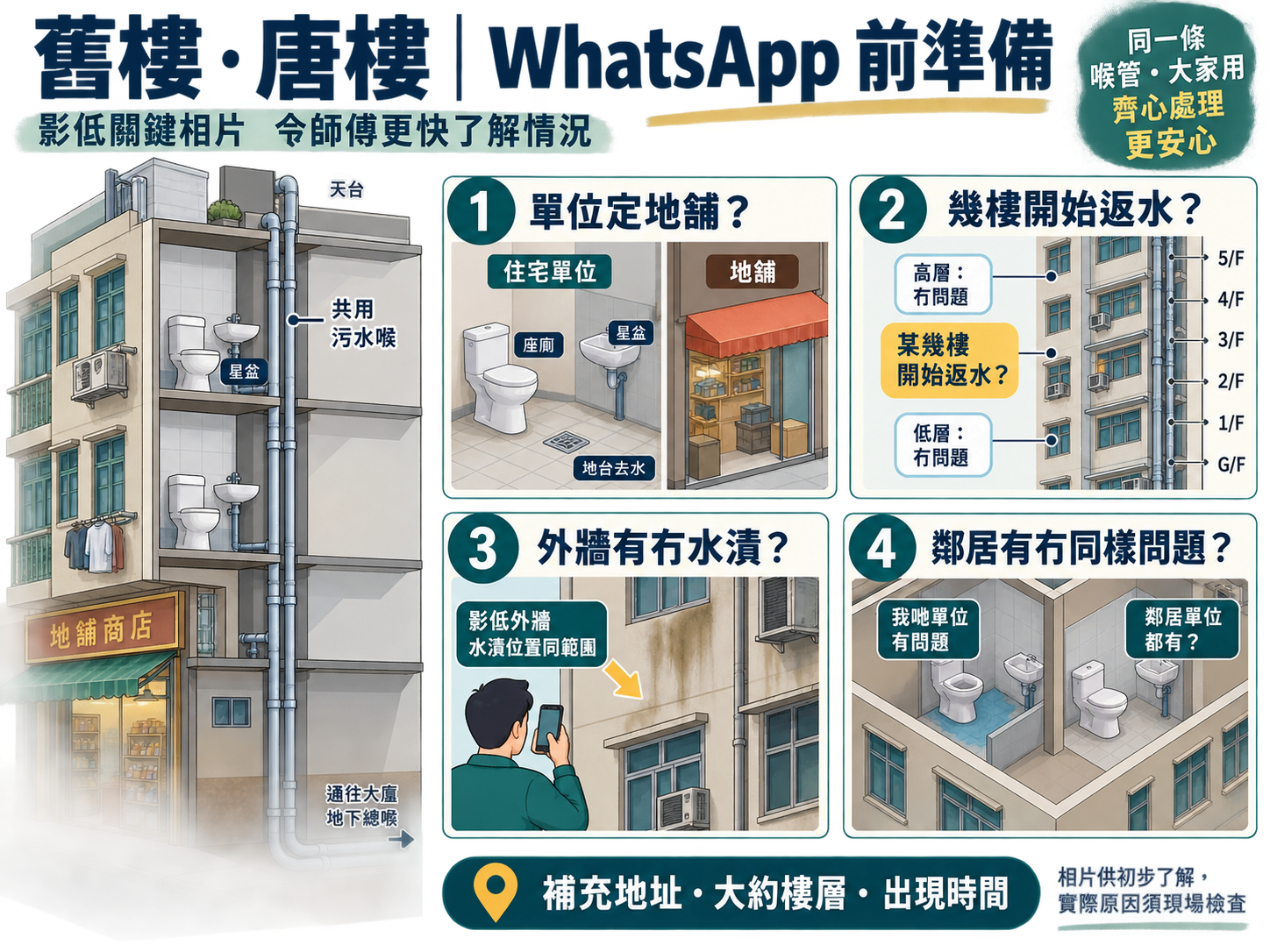
Photos or a short video on WhatsApp help us tell a single-fixture blockage from a shared-stack problem.
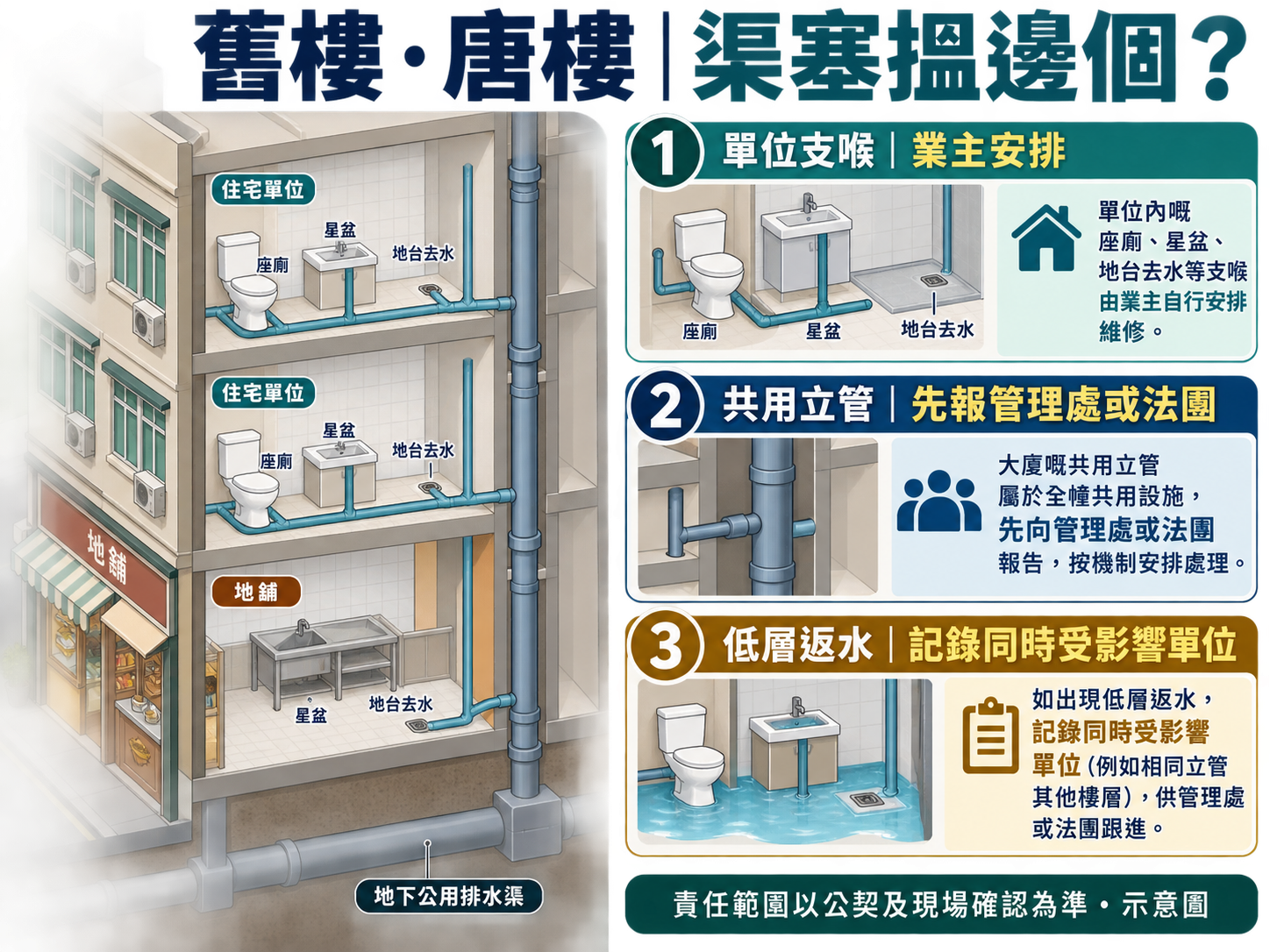
The older buildings of Kwun Tong town centre are mainly the 1960s private blocks around Yuet Wah Street and Tin Heung Street, plus the single residential and composite blocks along Shung Yan Street, Shui Wo Street, Mut Wah Street and Hong Ning Road. Many have no resident management office at all, so when a shared stack, an external pipe or a rear-lane manhole gives trouble it falls to the owners to act, on their own or through the owners' corporation. Whether sewage appears in a corridor, a low-floor toilet backs up or a bathroom smells of drains, the first step is the same: work out whether the problem lies in the flat's branch pipe, the building's shared drains or the street drain, and only then decide between booking a call-out and reporting it to the owners' corporation or a government department.
Kwun Tong was Hong Kong's first satellite town. From the 1950s the government reclaimed the seabed off Kwun Tong, the reclaimed land became an industrial area, and north of Kwun Tong Road many residential blocks went up to house factory workers. Wikipedia records that both sides of Yuet Wah Street are lined with homes built in the 1960s, a rare mid-density development for the area, with lifts and private car parks; the older private blocks on that street date from 1963 to 1972, while Park Metropolitan at No. 8 is a URA redevelopment completed in July 2014. On the north side is the Housing Authority's Wo Lok Estate, completed in stages between 1962 and 1966 with 11 blocks, of which those closer to the inner street are "new-type seven-storey blocks". On the other side of the town centre, Mut Wah Street, Shui Wo Street and Shung Yan Street are mostly markets and small shops — the Shui Wo Street market is the main market in the area — and many of them still keep the fittings and selling style of the 1960s and 1970s.
By design, the single blocks around Yuet Wah Street usually have a shop or workshop on the ground floor and flats above: waste from the kitchens and bathrooms comes down a light-well or external stack to ground level, meets the shop's waste water at a manhole in the rear lane or at the pavement edge, and only then joins the street sewer — so the flats in one vertical line, and the shop below them, in fact share a single outlet. Practice Note APP-93, first issued by the Buildings Department in August 1997, requires new buildings over three storeys to provide separate pipework discharging to a manhole for the fitments on the floor level with the bottom of the stack; as an inference from building age, blocks completed between 1963 and 1972 pre-date that requirement, so the toilet and floor drain on the lowest floor are usually tied straight into the base of the stack — which is why low-floor flats come under pressure first when a stack narrows. Pipe materials also show their era: Practice Note APP-133 states that for drainage plans approved after 1 November 2004 cast-iron pipes must be coated inside and out against corrosion and fixed with corrosion-resistant supports such as stainless steel brackets, so as an inference from building age, rust, thinning pipe walls and weeping joints are common in the original ironwork here. What any individual block is like today depends on its own repair and renovation history, and cannot be judged from the street name.
URA's Kwun Tong Town Centre project (K7) covers 53,500 m² and 24 buildings. Park Metropolitan in Development Area 1 was completed in July 2014 and Grand Central in Development Areas 2 and 3 in April 2021, while Development Areas 4 and 5 are carrying out underground utility diversion works. During those works the buildings still standing may face rear lanes and streets closed in stages and drain inlets moved. One of Kwun Tong's main drainage channels is Tsui Ping River — the Kwun Tong Nullah before its revitalisation — which runs along Tsui Ping Road, King Yip Lane and King Yip Street out to Kowloon Bay; given the terrain, surface water from the western side of the town centre runs that way. The Drainage Services Department's revitalisation works began on 3 July 2020 at a cost of HK$1.342 billion, the section near King Yip Street opened on 12 December 2024, and the channel now has a smart sluice gate and a dry-weather-flow interceptor that catches foul-smelling sewage and sends it to a treatment works, with the bed deepened by 0.2 to 0.7 m and 1.2 m flood boards added. All of that work stops on the public side of the line — the street drains and the nullah; past a building's own boundary, the stacks, branch pipes and private manholes are still the owners' to maintain.
Note: statements based on building age and type are general inferences, not findings for any particular flat.
Choose an enquiry route for your premises and work scope.
Pantry, washroom and shared-drain enquiries, with scope agreed before work
Scope and booking detailsUnit outlets, shared pipes and chamber enquiries assessed with site access
Scope and booking detailsDiscuss a defined maintenance scope using assets, usage and incident records
Scope and booking detailsA clear process from enquiry and assessment to an agreed scope of work
Tell us the drain problem and district and ask about available timing.
Confirm timing based on the district and schedule, then inspect the blockage or odour issue.
Explain the proposed approach, scope and price before agreed work begins.
Use suitable tools for the site conditions and agreed scope of work.
After the agreed work, test drainage and explain the observed result and any next steps.
PipeButler is an independent drain-service provider with no affiliation to the developer, owners' corporation, management company or Housing Department of the places above. Facts come from public sources checked on the dates shown; work on common drains or common parts follows the management office's and deed of mutual covenant's arrangements.
WhatsApp with the problem and district, and we will confirm available timing.