
Loading page…
Loading page…
Yuen Long Town Centre · Older buildings · Commercial & restaurants
New market built 1915 · single-block buildings on Castle Peak Road · shop grease & misconnections
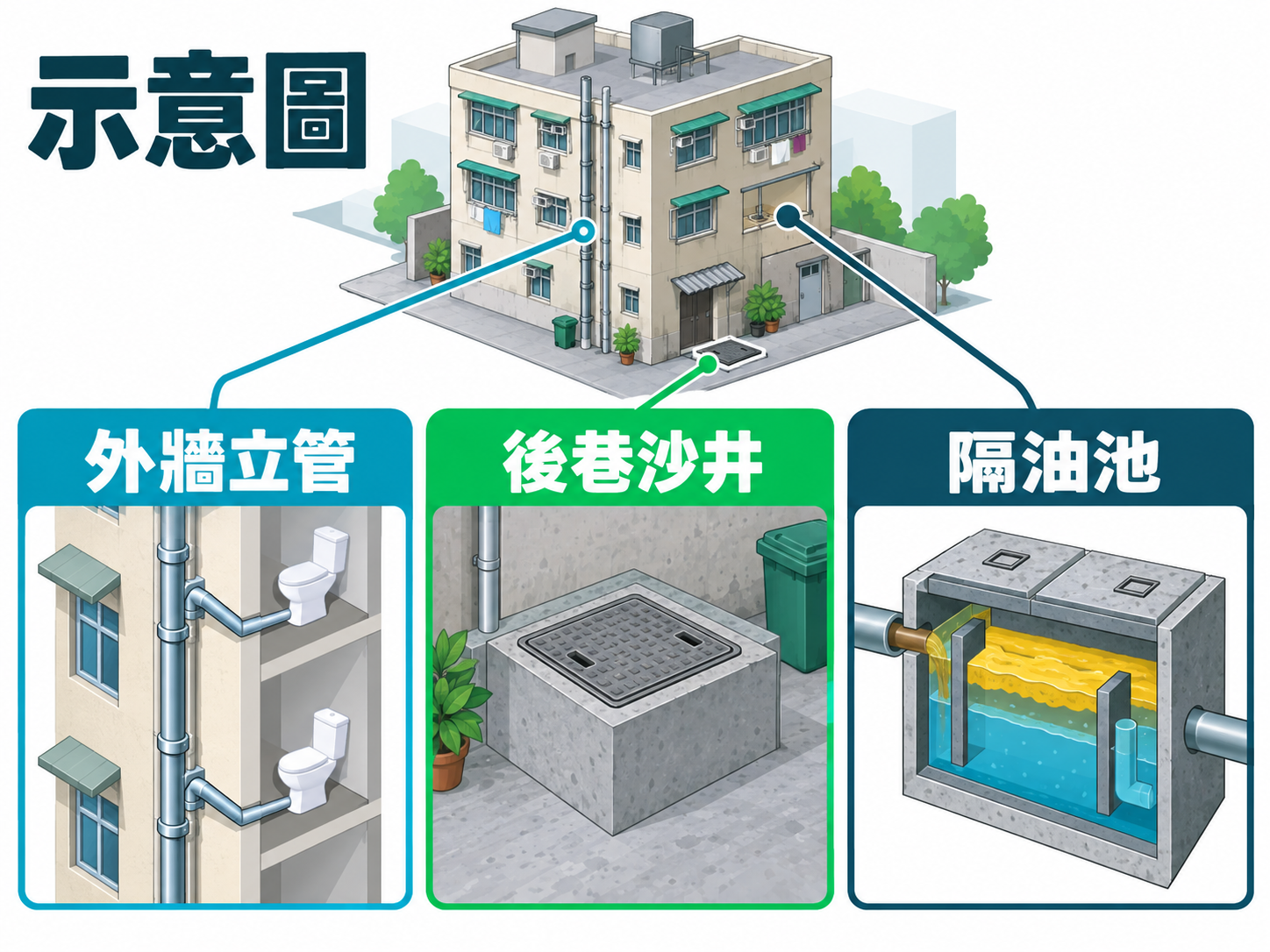
Yuen Long town centre grew out of the Yuen Long Old Market and the New Market built in 1915.
Last reviewed ·
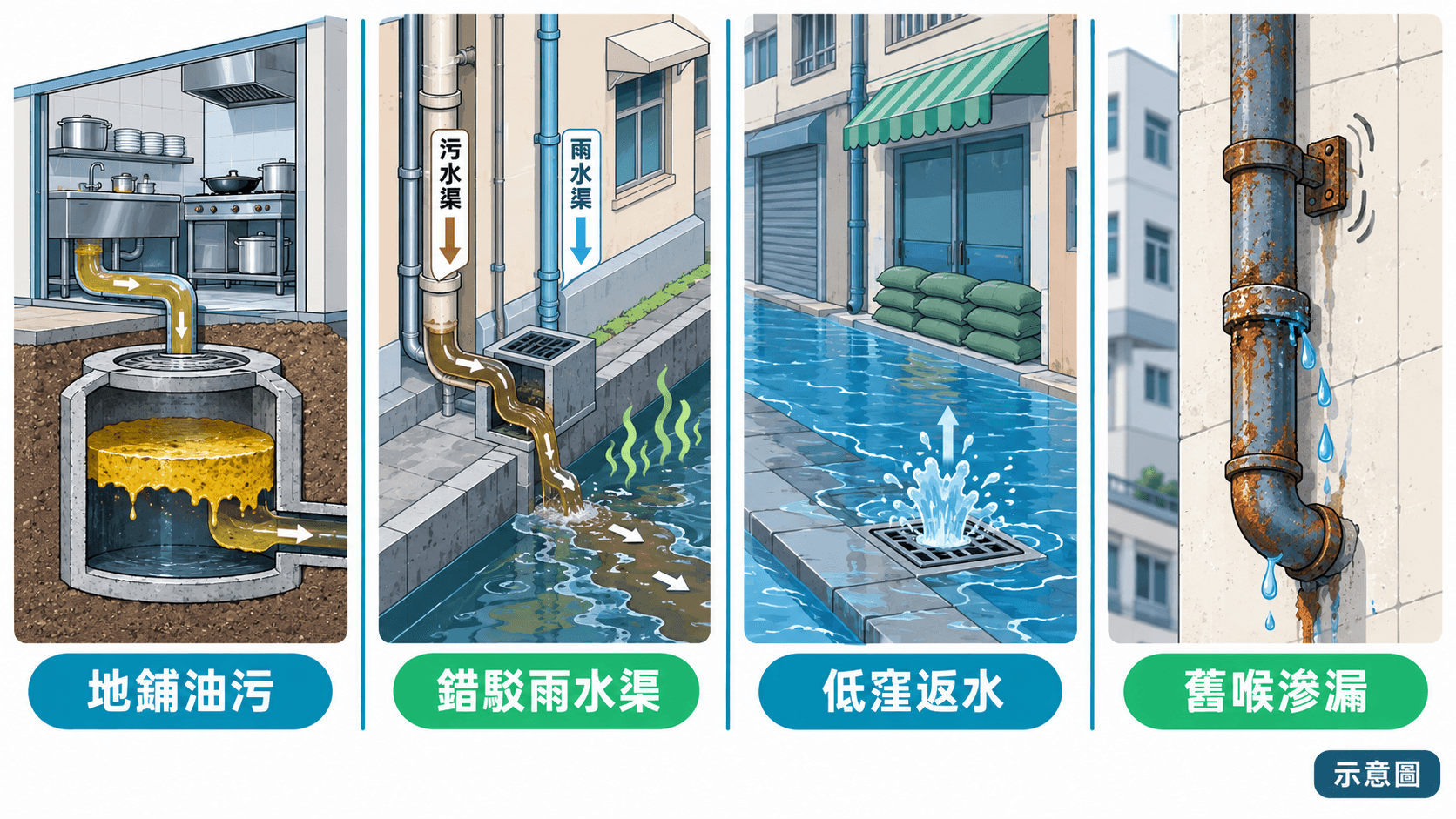
Choose the problem you are seeing to read the likely cause and next step.
In October 2020 the Environmental Protection Department made surprise inspections of restaurants in Yuen Long and found two, on Kin Yip Street and Fung Kam Street in the town, discharging wastewater into public storm drains; the grease content exceeded the legal standard by 25 and 10 times respectively, and the operating companies were convicted in May 2021. By design, where a ground-floor kitchen's wastewater meets domestic sewage in a rear-lane manhole or a shared underground drain, the grease cools, sticks to the pipe wall and narrows the manhole outlet, so the shop and the low-floor flats usually back up first. The order of work is to clear the silt out of the manhole first, then feed the tools in from the manhole or a cleaning eye and jet the runs section by section, and finally check whether the shop's grease trap is being cleaned regularly.
According to a HK01 report in April 2025, the Drainage Services Department said that after years of development some commercial, industrial and residential buildings in Yuen Long had wrongly connected sewage pipes to the stormwater system, sending sewage into the Yuen Long Nullah and causing water-quality and odour problems. As a general inference, misconnections in older buildings tend to appear after kitchens or toilets are added, pipes are re-routed or rear-lane drains are altered. Suspect one if a storm-drain gully still runs with dirty water in dry weather, or you can see tissue or grease in it. CCTV drain inspection can trace where the pipes actually go; correcting a misconnection is work on the building's shared drains, so the owners or the owners' corporation must arrange a qualified contractor.
Before Super Typhoon Ragasa in September 2025, the Drainage Services Department and the Civil Engineering and Development Department listed "low-lying areas in central Yuen Long (including Tai Tseng Wai, Wang Chau, Shan Pui Village, Yuen Long Town Centre)" among the areas with a higher possibility of serious flooding. Given the terrain, when street drains and the nullah run high the building's drains cannot discharge, so ground-floor floor drains, rear-lane manholes and low-floor toilets overflow first. Before the rainy season, clear the rear-lane gullies and manholes and have sandbags or flood boards ready; once the water recedes, remove the silt and clean and disinfect anywhere sewage has reached.
The Buildings Department lists common defects as leaking or broken external drainage pipes, rusty internal pipes and unauthorised alterations to the drainage system, and it can serve drainage repair orders on owners under section 28 of the Buildings Ordinance. As an inference from building age, the external stacks on single-block buildings along the main road have been in use for decades, so loose brackets and leaking joints are common, and without an on-site management office a fault in a shared pipe often goes unattended. The Environmental Protection Department also notes that suspected asbestos-containing materials can be found in buildings put up before the mid-1980s, cement sewage pipes among the examples; asbestos cannot be told from a material's appearance or colour, so every suspect material should be treated as asbestos-containing until a registered asbestos consultant certifies that it is not. Do not hammer, cut or drill such a pipe before the material is confirmed, and if it does have to be taken out, the owner or occupier must engage a registered asbestos contractor and give the department written notice at least 28 days before the work starts.
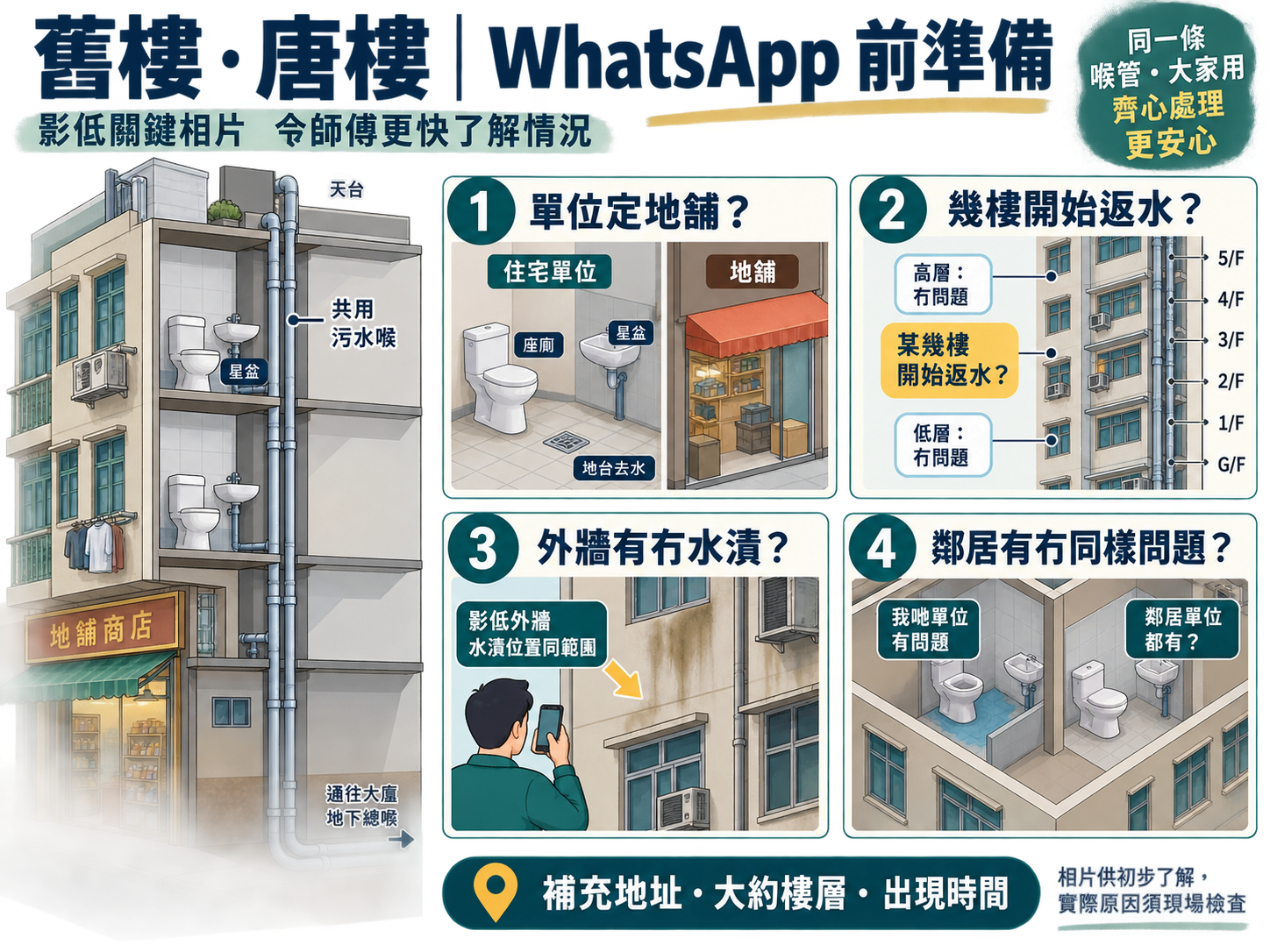
Photos or a short video on WhatsApp help us tell a single-fixture blockage from a shared-stack problem.
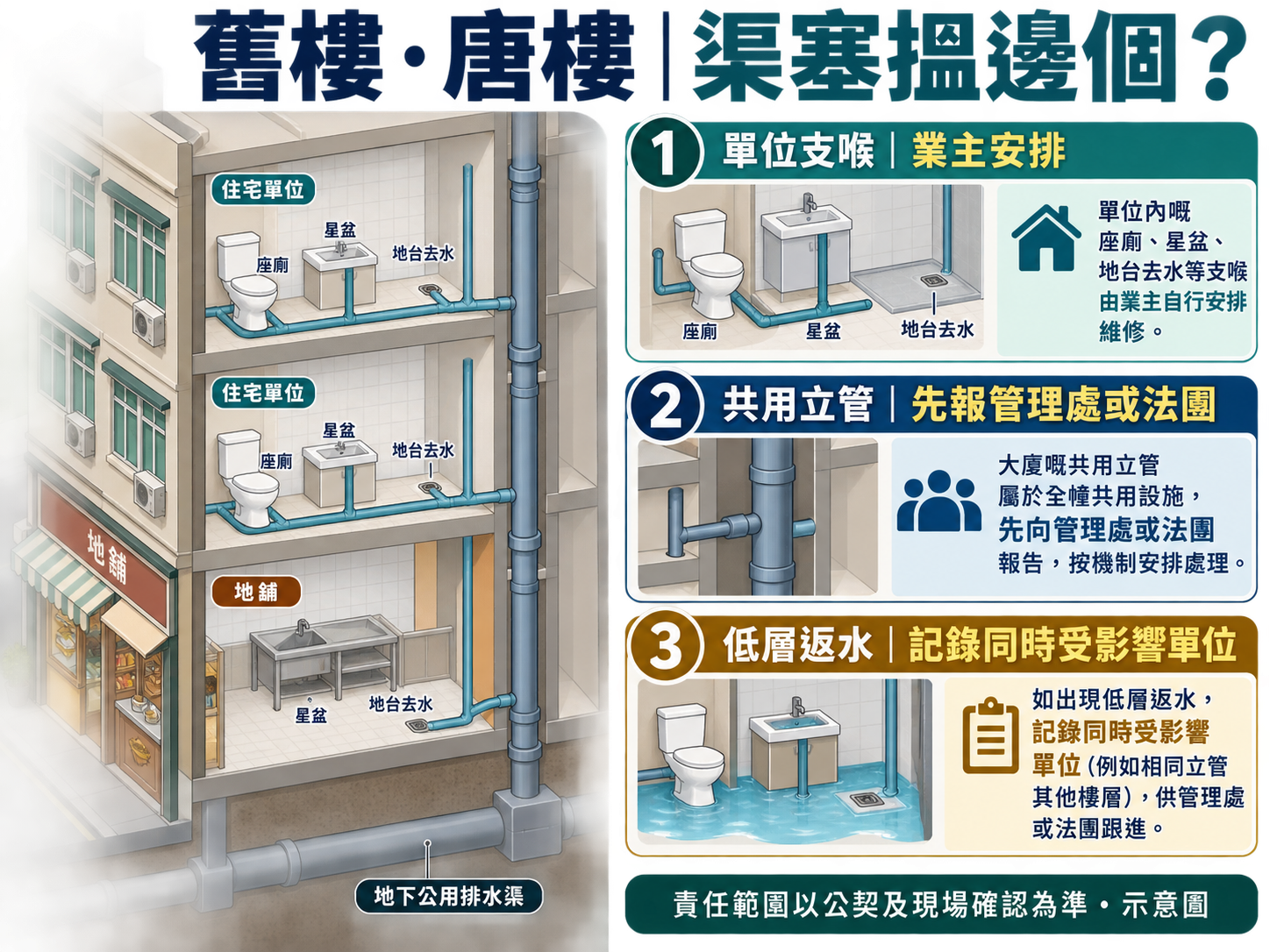
Yuen Long town centre grew out of the Yuen Long Old Market and the New Market built in 1915. Along the long-developed western section of Castle Peak Road – Yuen Long (still known locally as Tai Ma Lo, the "main road") there are no large estates; most roadside buildings are single residential blocks, with restaurants and shops on the ground floor. Older blocks like these may well have no on-site management office, so the owners or the owners' corporation must look after the building's stacks, external pipes and rear-lane manholes themselves. If a kitchen sink drains slowly, a toilet backs up or the area around the building smells of drains, first work out whether the problem is in the flat's branch pipe, the building's shared drains or the street drain, then decide what to do.
Yuen Long town centre grew from two markets: the Old Market, established in 1669, and the New Market, completed in 1915 south-west of the old one and close to Castle Peak Road. The New Market's two- to three-storey houses had shops on the ground floor and storage, workshops or homes above, and all of them had been demolished by April 1984. The main road itself had long been developed: no large estates were built on its western section, where most roadside buildings are single residential blocks, joined by commercial buildings from the 1980s onwards.
"Older buildings" in Yuen Long today mainly means the single-block tong lau and composite buildings along Castle Peak Road, Kau Yuk Road, Tai Tong Road, Kuk Ting Street and On Ning Road; each building's completion year should be checked on its occupation permit. By design, most have a shop on the ground floor and flats above. Kitchen and bathroom waste runs down external or light-well stacks to ground level and then through a rear-lane manhole to the street sewer. Flats in one vertical line share a stack, and a ground-floor kitchen's waste may join at the same manhole. Newer estates on the eastern section of the road, such as Sun Yuen Long Centre, and Long Ping Estate to the north of the centre have their own management or estate offices, so their drain arrangements differ from those of single-block older buildings.
Rainwater in the town centre drains mainly through the Yuen Long Nullah, built more than 50 years ago. In May 2023 the Drainage Services Department began the Yuen Long town-centre nullah improvement works, which include a dry-weather-flow interception system, and the Yuen Long barrage scheme is being built in stages. These projects deal with street drains and the nullah; the stacks, branch pipes and private manholes within a building's own boundary remain the owners' to maintain.
Note: statements based on building age and type are general inferences, not findings for any particular flat.
Choose an enquiry route for your premises and work scope.
Pantry, washroom and shared-drain enquiries, with scope agreed before work
Scope and booking detailsUnit outlets, shared pipes and chamber enquiries assessed with site access
Scope and booking detailsDiscuss a defined maintenance scope using assets, usage and incident records
Scope and booking detailsA clear process from enquiry and assessment to an agreed scope of work
Tell us the drain problem and district and ask about available timing.
Confirm timing based on the district and schedule, then inspect the blockage or odour issue.
Explain the proposed approach, scope and price before agreed work begins.
Use suitable tools for the site conditions and agreed scope of work.
After the agreed work, test drainage and explain the observed result and any next steps.
PipeButler is an independent drain-service provider with no affiliation to the developer, owners' corporation, management company or Housing Department of the places above. Facts come from public sources checked on the dates shown; work on common drains or common parts follows the management office's and deed of mutual covenant's arrangements.
WhatsApp with the problem and district, and we will confirm available timing.