
Loading page…
Loading page…
Tsim Sha Tsui · Commercial & restaurants · Older buildings · Private estate
Restaurant back-lane manholes · grease traps · converted guesthouse floors
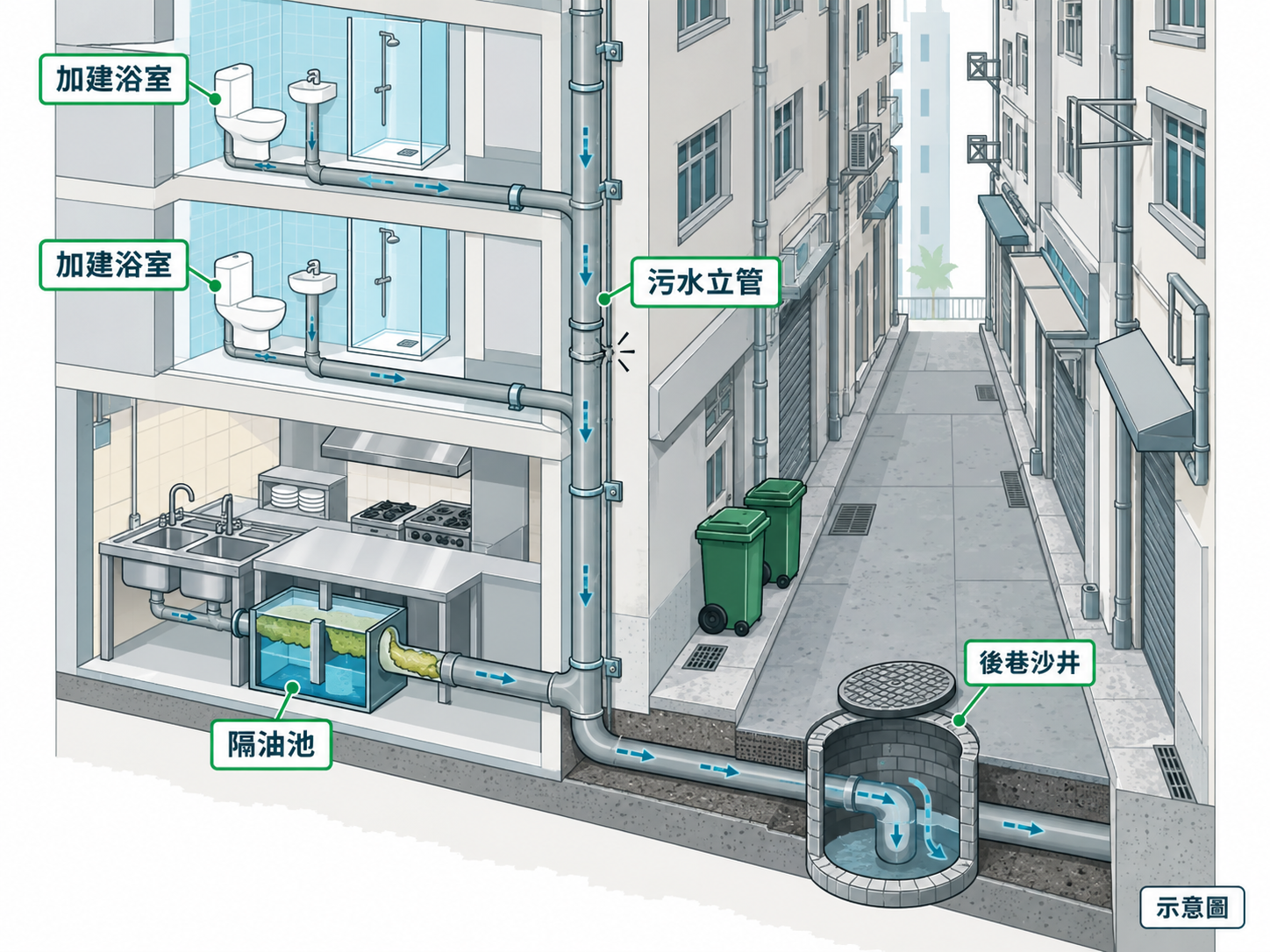
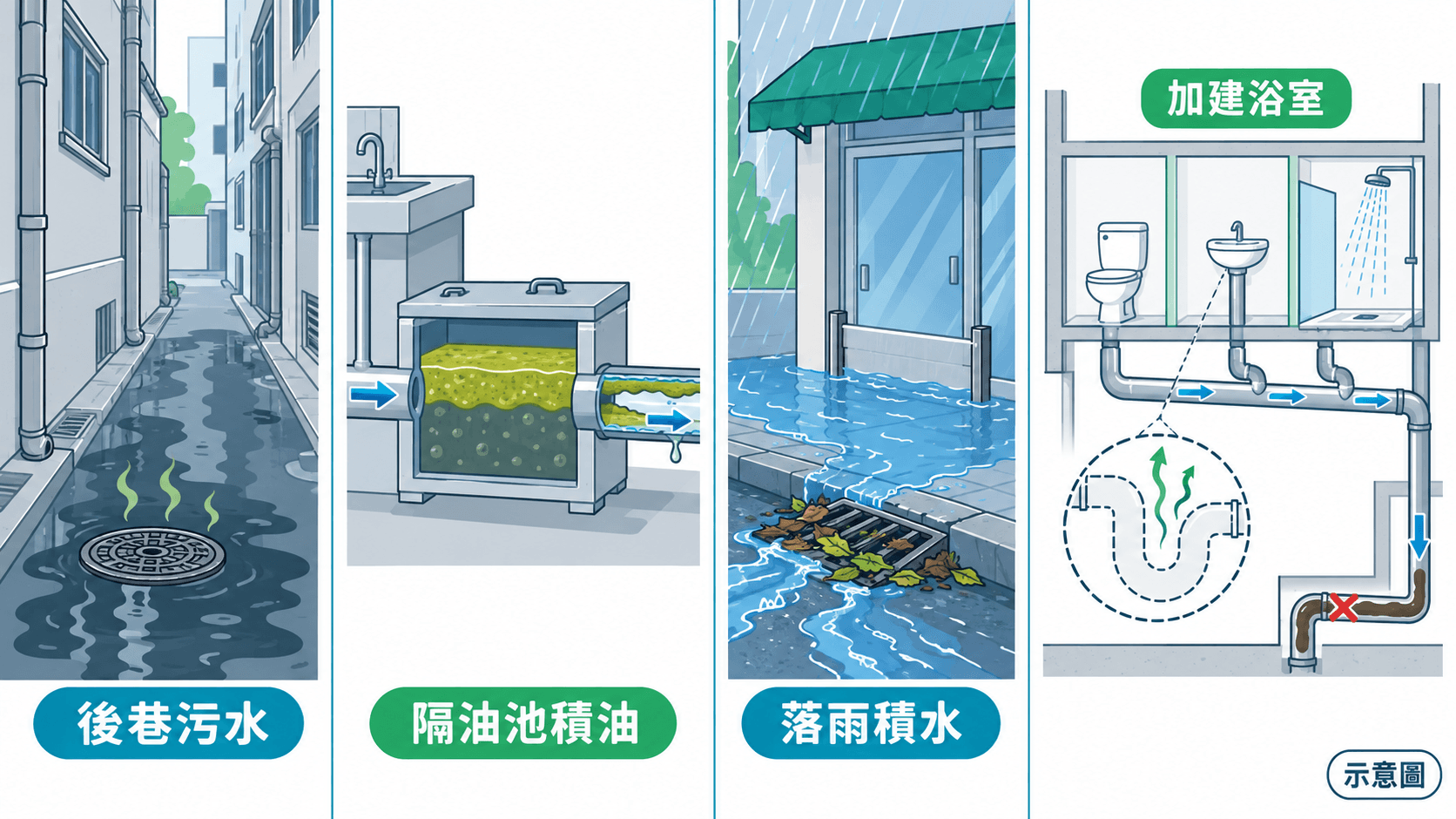
Choose the problem you are seeing to read the likely cause and next step.
Oriental Daily reported on 24 February 2016 that a diner at Knutsford Terrace noticed a stench and found the adjoining back lane holding a large pool of sewage mixed with tissue and what looked like faeces, which he suspected was leaking from the drainage of a building on Kimberley Road next door. The Food and Environmental Hygiene Department replied that it had received two complaints about defective drainage at that address in the previous month and had referred them on; staff later inspected and the problem had been resolved. The key with cases like this is to identify the source: standing sewage in a lane can come from a building's external soil pipe or an overflowing manhole, or from restaurants' floor-washing water and leachate from waste. The safest approach is to photograph it, note the date and time, raise it with the management office and the FEHD, and have your own outlets and horizontal drains checked for signs of backflow — never lift a manhole cover or climb in yourself.
The Environmental Protection Department explains that grease discharged into sewers accumulates, congealing with other solid waste and "causing blockage of drains, sluggish flow, odour and unhygienic conditions", and that removing grease from a sewer is difficult, hazardous and expensive. It also states that restaurants and food manufacturing are the main source of grease, and that the discharger is responsible for properly designing, installing and maintaining the grease trap and for disposing of the waste taken out of it. Tsim Sha Tsui packs food premises densely and the run from kitchen to back lane is short, so grease cools and sets first on horizontal pipes and at the mouth of a manhole. In practice: fit strainers on sinks and floor drains, clean the trap on a regular cycle and keep the cleaning and disposal records, and investigate slow draining at once rather than waiting for the whole lane to smell.
The Drainage Services Department's list of locations prone to blockage includes, for Yau Tsim Mong, "Chatham Road South (between Granville Road and Austin Avenue)" and "the junction of Cameron Road and Carnarvon Road, Tsim Sha Tsui". The same department started its Tsim Sha Tsui drainage improvement works on 19 August 2022, building an underground stormwater pumping station beside Chatham Road South and laying new stormwater drains, with the stated aim of "enhancing the flood-carrying capacity of the Tsim Sha Tsui drainage system to reduce the flooding risk on Chatham Road South and its surroundings", due mid-2027. Until then, ground-floor shops and basements can clear their floor drains and grease fittings before the wet season, keep flood boards or sandbags ready, and clear debris from the back-lane outlets. Road gullies and street manholes belong to the DSD (1823), so report any overflow promptly.
Inferring from design, a unit in one of these older composite buildings originally had only one or two drain points; once it becomes guesthouse rooms, an upstairs shop or a party room, several extra toilets, basins and shower trays have to be connected, so the horizontal branch pipe grows longer, gains bends and loses fall. Tissue and soap scum settle at the bends, and one room smelling when another flushes is a common result. The Buildings Department notes that a trap relies on its water seal to keep sewer air out, that anti-syphonage pipes must not be removed, and that unauthorised alteration of a drainage system can break the seal; altering traps, anti-syphonage pipes or drain positions is minor works that must be done by a registered minor works contractor. Rooms left empty for long periods also need water poured into the toilet and floor drain regularly to keep the seal.
Broken pipework in TST's older buildings is not a hypothetical. on.cc reported an incident at Chungking Mansions on 30 September 2015: police said someone poured corrosive liquid into a drain while an upper-floor unit's external wall was being renovated, the liquid was believed to have escaped at a break in the pipe, and seven passers-by were splashed; a coloured-water test on the pavement that evening showed liquid leaving the pipe at the same point. (The full account, and that building's own background, are on the Chungking Mansions page linked below.) The lesson for old TST generally: once an external-wall or light-well pipe has a break, a chemical poured in leaves the pipe at that break and may never reach the blocked length — and below it is usually a crowded pavement and a row of shopfronts. Work out which length is actually blocked, and whether the pipe itself is damaged, before anyone clears it mechanically.
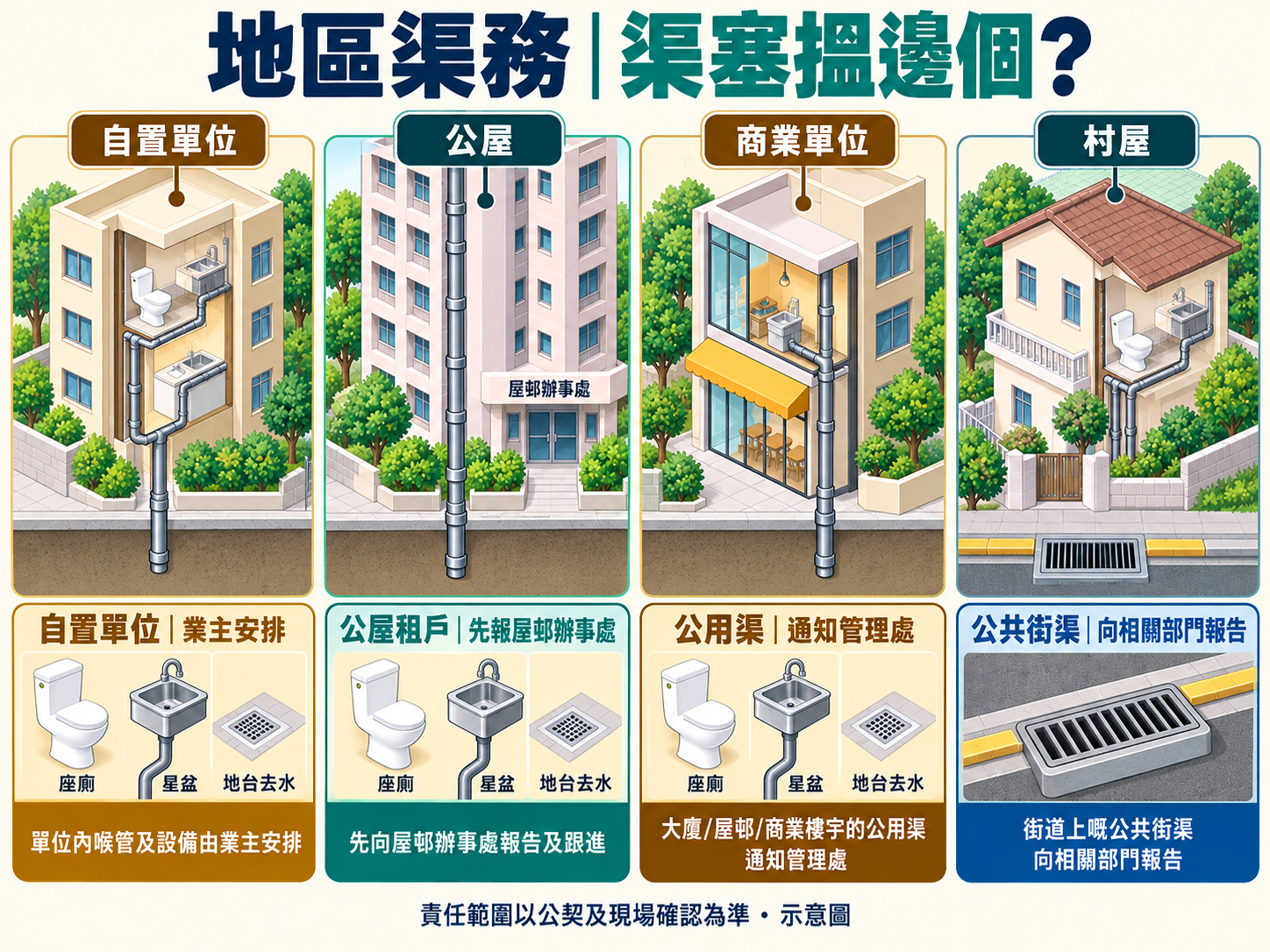
Photos or a short video on WhatsApp help us tell a single-fixture blockage from a shared-stack problem.
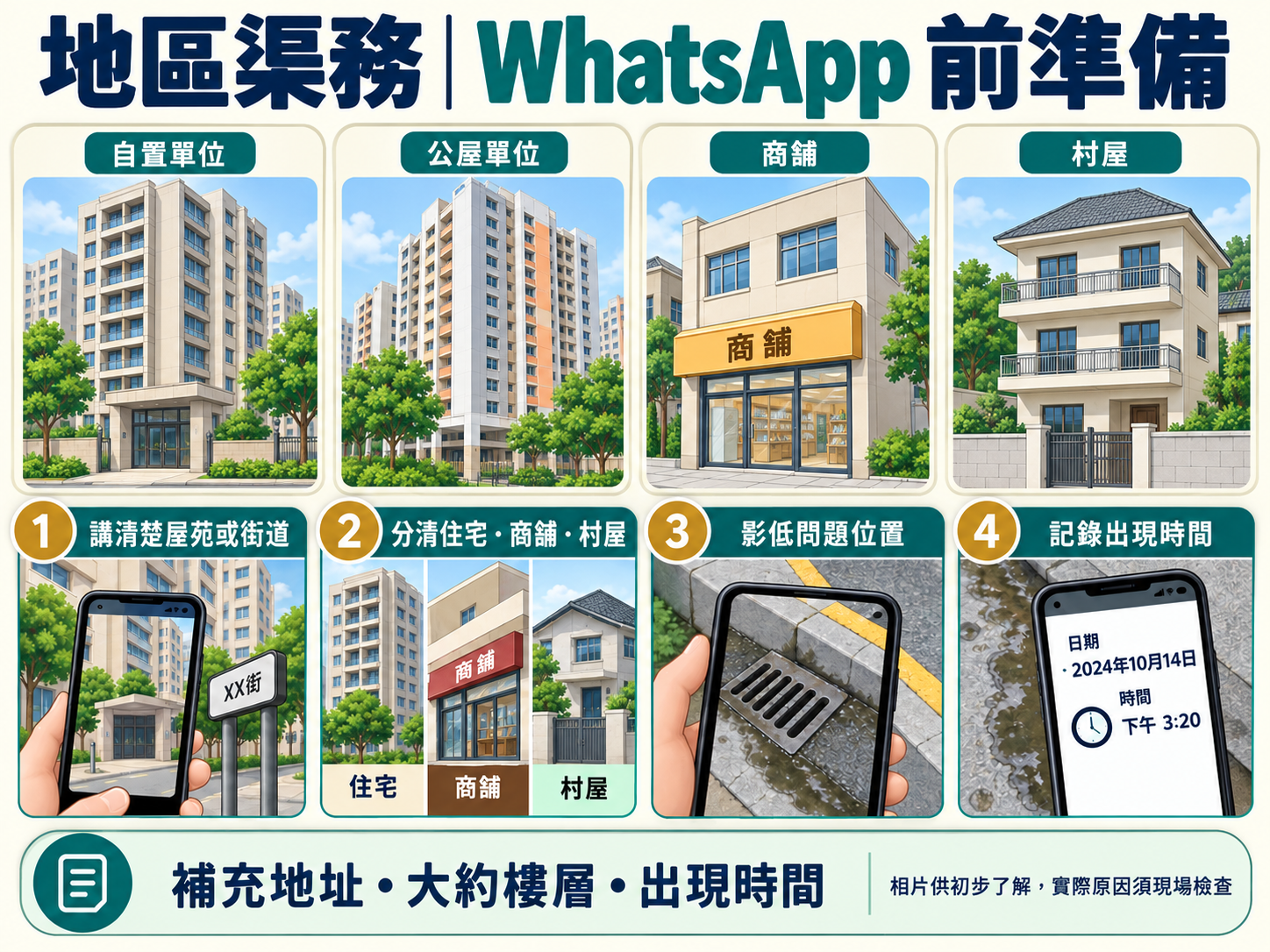
Drainage in Tsim Sha Tsui behaves quite unlike a residential estate. West of Chatham Road South lies the old TST street grid where, judging by building age, Granville Road, Carnarvon Road and Kimberley Road are lined mostly with 1950s–70s composite buildings: restaurants and shops at street level, offices, upstairs shops and guesthouses above. East of Chatham Road South, TST East is an office and hotel district built on reclaimed land and developed from the late 1970s. So the common complaints here are not one flat's bathroom smelling, but back-lane manholes overflowing, grease building up in traps and horizontal drains, rooms that drain slowly, and water entering ground-floor shops in heavy rain. The order of work is the same in every case: decide first whether the problem sits in your own shop or unit — its branch pipes and traps — in the building's shared stack and back-lane manholes, or in the public sewer in the street.
Tsim Sha Tsui splits roughly in two. West of Chatham Road South is the old TST grid, which by building age is dominated by 1950s–70s composite buildings: restaurants, jewellers and pharmacies at street level, with offices, upstairs shops, flats and guesthouses above. Searching the Licensing Authority's licensed hotel and guesthouse register (updated to 15 September 2026) for addresses containing "Tsim Sha Tsui" returns 591 records, many of them concentrated in a handful of older composite buildings on Nathan Road; Chungking Mansions on Nathan Road has its own page, listed below. East of Chatham Road South, TST East stands on the Hung Hom Bay reclamation, and Wikipedia records that those lots were only divided and sold from the late 1970s, after which more than ten new office blocks and hotels went up within a few years — so it is mostly offices, hotels and malls, and by building age its pipework belongs to a different generation from the post-war composite blocks to the west.
The second defining feature is the back lane. Bars and restaurants crowd Knutsford Terrace, Minden Avenue, Prat Avenue and Hillwood Road, and Hau Fook Street is known as a "food street"; their kitchen waste water, floor-washing water and rubbish all converge in one rear lane, which is also where the building's manholes, external pipes and drain outlets sit. From 7 November 2022 the Food and Environmental Hygiene Department ran a pilot in nine rear lanes connected to food premises, placing shop-labelled 240-litre bins there; the Yau Tsim site was the rear lane of 9–13 Hau Fook Street, Tsim Sha Tsui. The department noted that trade waste from food premises generally contains a great deal of food debris and, if poorly handled, readily gives off odour and feeds and shelters rodents. The Environmental Protection Department is equally blunt: grease discharged into sewers builds up and "causes blockage of drains, sluggish flow, odour and unhygienic conditions", with restaurants and food manufacturing the main source of grease.
Inferring from building age, the original soil stacks in these older composite buildings are typically cast iron or early plastic, many of them still running on the external wall or in a light well; after decades of renovation the joints, brackets and bends are no longer as built, and breaks and leaks are not unusual. The 2015 corrosive-liquid incident at Chungking Mansions showed exactly how a break in a pipe can throw back out into the street whatever was poured into the drain (see below). Inferring from design, a unit originally served by one or two drain points often has to serve several bathrooms and basins once it is converted into a guesthouse, an upstairs shop or a party room: horizontal branch pipes grow longer, gain bends and lose fall, so slow draining, siphoned-out traps and odour are all likelier than in an unaltered unit. The Buildings Department warns that unauthorised changes to a drainage system can break the water seal, and that altering traps, anti-syphonage pipes or drain positions is minor works requiring a registered minor works contractor.
As for who is responsible, Tsim Sha Tsui is nothing like a public housing estate. Almost everything here is private: fixtures, traps and branch pipes inside a shop or unit belong to the owner, while the shared stack, external pipes, light well and the manholes within the building's boundary belong to the owners' corporation or the owners as a whole. There is no estate office to report to, and no village septic tank to empty. In the street, the Drainage Services Department began its Tsim Sha Tsui drainage improvement works on 19 August 2022, building an underground stormwater pumping station beside Chatham Road South and laying new stormwater drains, due for completion in mid-2027; its Central and East Kowloon sewerage improvement works, stage 3, finished on 31 January 2024 and covered areas including Tsim Sha Tsui, upgrading about 8 km of sewers and rehabilitating about 315 m. In other words, public sewer capacity here has had recent attention — so when the same building or the same back lane keeps failing, the building's own stacks, manholes and grease fittings deserve a closer look.
Note: statements based on building age and type are general inferences, not findings for any particular flat.
Choose an enquiry route for your premises and work scope.
Pantry, washroom and shared-drain enquiries, with scope agreed before work
Scope and booking detailsUnit outlets, shared pipes and chamber enquiries assessed with site access
Scope and booking detailsDiscuss a defined maintenance scope using assets, usage and incident records
Scope and booking detailsA clear process from enquiry and assessment to an agreed scope of work
Tell us the drain problem and district and ask about available timing.
Confirm timing based on the district and schedule, then inspect the blockage or odour issue.
Explain the proposed approach, scope and price before agreed work begins.
Use suitable tools for the site conditions and agreed scope of work.
After the agreed work, test drainage and explain the observed result and any next steps.
PipeButler is an independent drain-service provider with no affiliation to the developer, owners' corporation, management company or Housing Department of the places above. Facts come from public sources checked on the dates shown; work on common drains or common parts follows the management office's and deed of mutual covenant's arrangements.
WhatsApp with the problem and district, and we will confirm available timing.
