
Loading page…
Loading page…
Kwun Tong & Kowloon Bay Business Areas · Industrial buildings · Commercial & restaurants
Industrial land reclaimed 1954–57 · rezoned Business from 2001 · grease traps & main drains
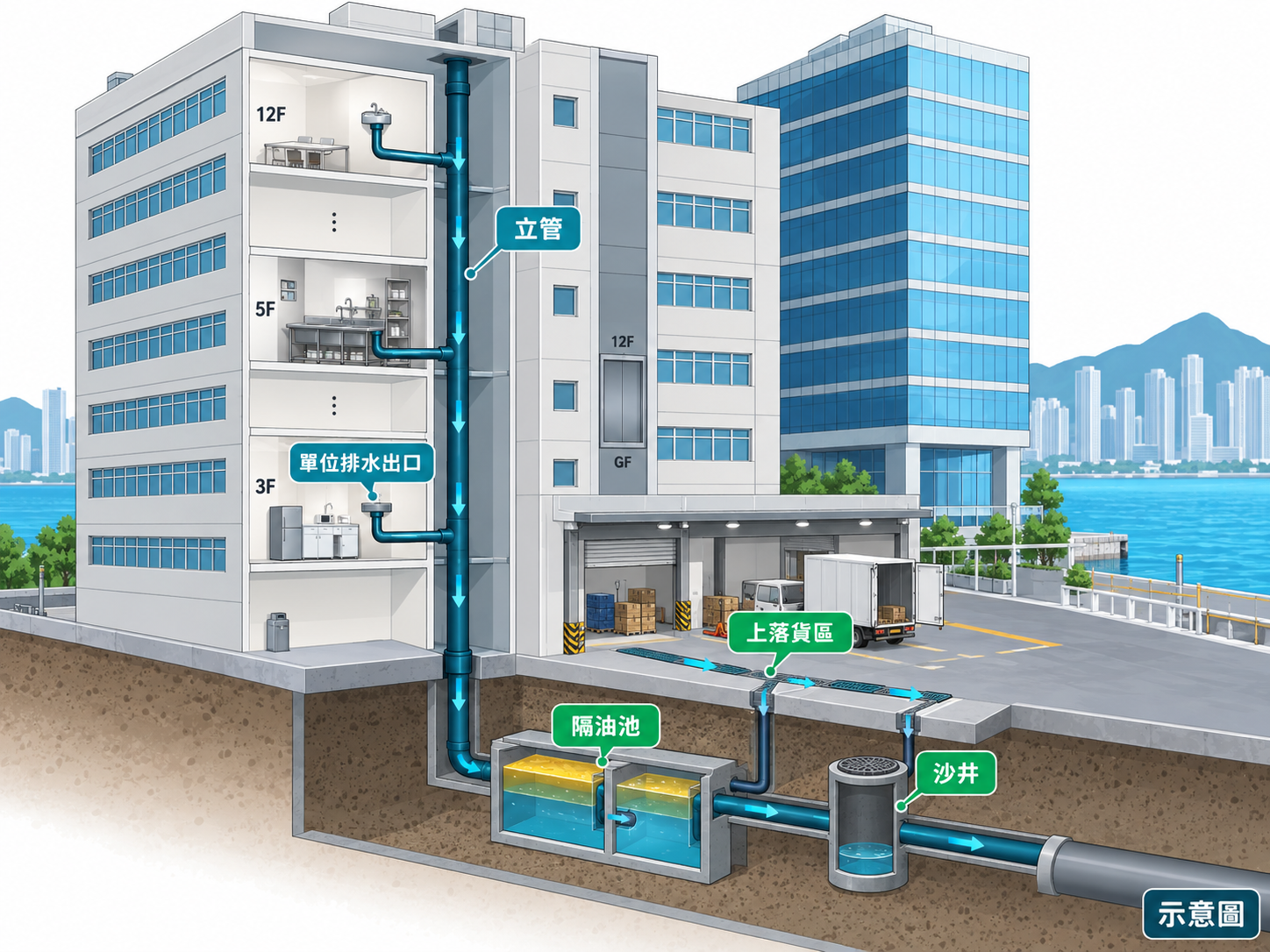
The Kwun Tong Business Area was formerly the Kwun Tong Industrial Area, built on land reclaimed between 1954 and 1957, and most of the Kowloon Bay Business Area also stands on land reclaimed in the 1970s.
Last reviewed ·
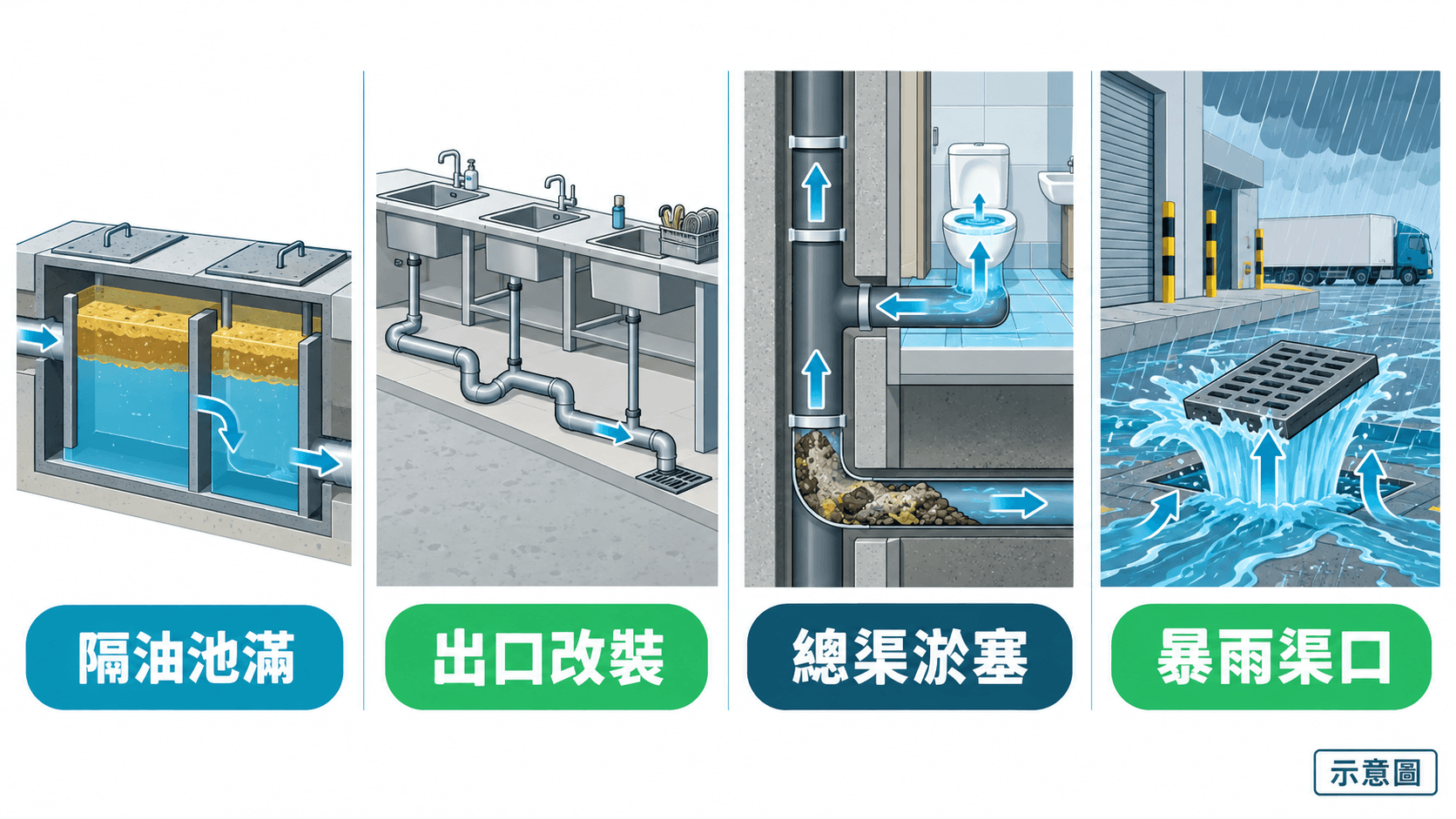
Choose the problem you are seeing to read the likely cause and next step.
Food workshops in industrial buildings and the restaurants in office towers and shopping centres are the main sources of grease. EPD guidance says a grease trap should be inspected at least every three days and cleaned once greasy waste fills the top 30% of the liquid depth, with each clean recorded; trap waste must never be poured into toilets, gullies or manholes. When a trap is neglected, grease sets in the main drain and manholes, and every tenant on that drain line is affected. If blockages keep coming back, check the trap outlet pipe and the downstream manholes as well, rather than only clearing the unit's drain.
Under Buildings Department note APP-46, each unit in a flatted factory building should have one drain outlet connected to the foul water system, which may be temporarily sealed while unused. As an inference from the design, some of these outlets stay sealed or little used for years, and once the trap's water seal dries out the unit starts to smell of drains. Others are connected to several sinks and basins during a conversion, sometimes through long branch pipes run above a false ceiling or under a raised floor; with too little fall and too many bends, coffee grounds and food scraps build up easily. Before leasing or fitting out a unit, find the drain outlet, confirm it connects to the foul system, and then decide how new fixtures should be connected.
The Energizing Kowloon East Office's 2023 survey of business establishments found that nearly 60% of establishments in the area occupy less than 1,000 sq ft, so one industrial building can have dozens of small tenants sharing the same stacks and main drain. As an inference from these uses, tissue, wet wipes, ink from washing brushes, silt from floor washing and pantry grease slowly narrow the drain at bends, horizontal runs and manholes, and low-floor units or ground-floor shared toilets are usually the first to back up. If the same stretch of drain blocks several times a year, punching a small hole through it will not last; consider high-pressure jetting and desilting, use a CCTV survey to look for deposits or misconnections, and then agree regular maintenance with the management office.
Oriental Daily reported in March 2016 that grease was repeatedly welling up from a manhole onto the pavement beside a minibus terminus on Kwun Tong Road. The Drainage Services Department said it had received 11 related complaints in a year; it found the public storm drain blocked, suspected that a private building's foul drain had been wrongly connected to the storm drain, and carried out emergency clearing. APP-46 likewise states that drain outlets in industrial units must not be connected to storm drains. If a new sink or wash-down drain is tied into the nearest rainwater pipe during a fit-out, grease goes straight into the street drains; if the gully outside your building is persistently greasy or smelly, ask the management office to check for misconnections.
HK01 reported in August 2022 that, during an amber rainstorm, a drain cover in the ground-floor car park of a large shopping centre in Kwun Tong kept being lifted by water, and the Drainage Services Department said the cover was not managed by the department. An engineer interviewed estimated that when rain coincides with a high tide, water rushing into an underground drain near the sea compresses the air in the pipe enough to lift a cast-iron cover. DSD also lists the Kwun Tong Road underpass at the junction with Hoi Yuen Road as a location prone to blockage. Gullies, silt traps and drain covers on private ground are maintained by the building, so clear out silt and packaging scraps before the rainy season.
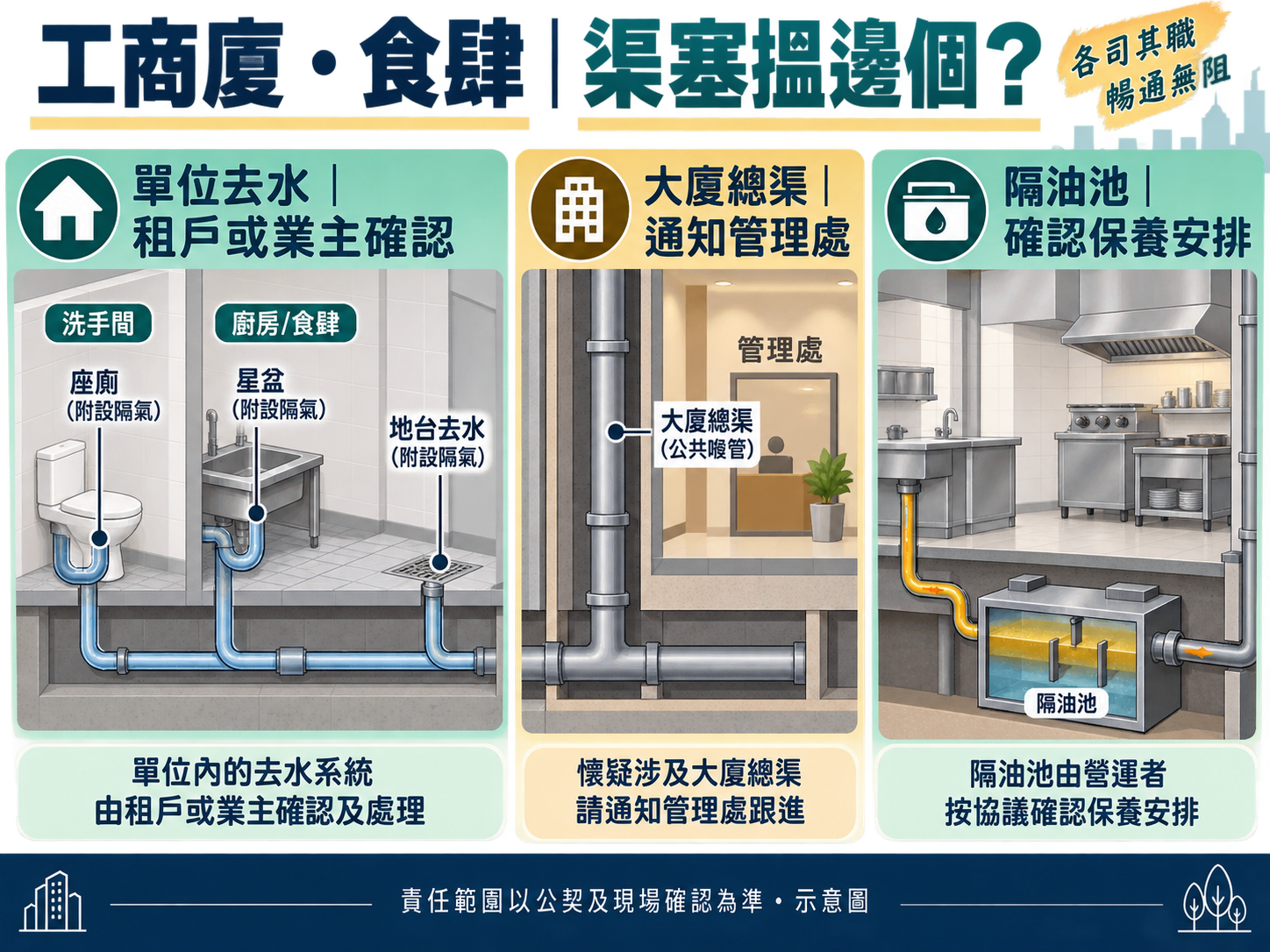
Photos or a short video on WhatsApp help us tell a single-fixture blockage from a shared-stack problem.
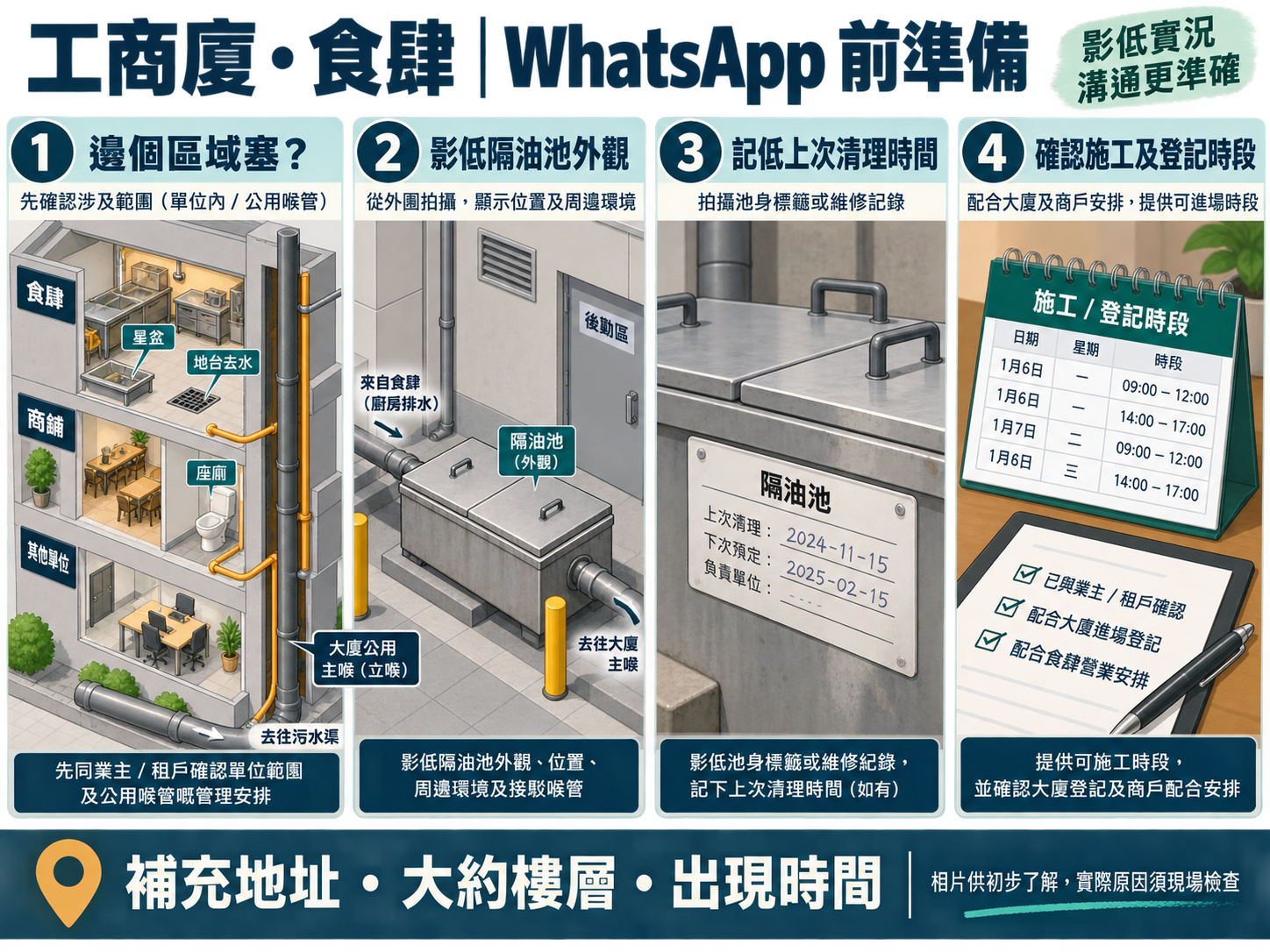
The Kwun Tong Business Area was formerly the Kwun Tong Industrial Area, built on land reclaimed between 1954 and 1957, and most of the Kowloon Bay Business Area also stands on land reclaimed in the 1970s. Industrial land in both areas has been rezoned to "Business" use step by step since 2001, so a single industrial building today may hold offices, studios, warehouses, food workshops and restaurants; as an inference from these uses, the waste water discharged is quite unlike what the building was designed for. When a drain blocks in an industrial or commercial building, the first step is to work out whether the problem lies in the unit's drain outlet, a pantry branch pipe or a grease trap, or in the building's main drain and manholes, and then decide between unblocking, desilting or handing it to the management office.
Factories were built in the Kwun Tong Industrial Area from the 1950s, and activity peaked in the 1970s. After manufacturing restructured in the 1990s, many industrial buildings were turned into offices, warehouses, upstairs shops and studios, and some were redeveloped as office towers and shopping centres. The Energizing Kowloon East Office says that by the end of 2025, approved applications with completed lease modifications for wholesale conversion or redevelopment under the industrial-building revitalisation policy in Kwun Tong, Kowloon Bay and San Po Kong made up more than half of all such projects in Hong Kong. Today older flatted factory buildings stand next to newly completed Grade A office towers, with drainage of different ages, designs and management arrangements.
Buildings Department practice note APP-46 (the first note on the subject was issued in May 1987) states that, unless specific facilities are provided, each industrial unit in a flatted factory building should have one adequately trapped drain outlet to receive the unit's treated effluent, connected to the foul water system and never to any storm-water system. For units under 1,000 m² of usable floor area the outlet is 100 mm in diameter. Petrol interceptors are also required where vehicles are serviced or parked. As an inference from the design, a factory building's drainage was originally intended for process water and the shared toilets on each floor. Once a unit becomes an office, studio or food workshop, the pantry sinks and basins added to it are usually connected back to that outlet or a nearby stack, so the volume and type of waste differ from the original design.
Most of the Kowloon Bay Business Area is newly reclaimed land, and from 1981 parts of it were used as an industrial area and a cargo handling area. Being close to the old Kai Tak Airport, it once had many logistics companies running warehouses in industrial buildings; after the airport closed they moved on to Kwai Chung and Tsing Yi, and office buildings have been added steadily since 2006. As an inference from building type, warehouse buildings usually have loading bays, car parks and floor gullies, where wash-down water carries silt, while shopping centres and office towers drain mainly from restaurant kitchens, pantries and shared washrooms.
This page covers drainage in industrial and commercial (non-domestic) buildings; the residential estates of Kowloon Bay and the older buildings of Kwun Tong town centre have their own pages. In general, in an office building held entirely by one owner, the shared drains are handled by the management company that owner appoints; in a strata-titled industrial building, the owners' corporation or management company looks after the common parts under the deed of mutual covenant.
Note: statements based on building age and type are general inferences, not findings for any particular flat.
Choose an enquiry route for your premises and work scope.
Pantry, washroom and shared-drain enquiries, with scope agreed before work
Scope and booking detailsUnit outlets, shared pipes and chamber enquiries assessed with site access
Scope and booking detailsDiscuss a defined maintenance scope using assets, usage and incident records
Scope and booking detailsA clear process from enquiry and assessment to an agreed scope of work
Tell us the drain problem and district and ask about available timing.
Confirm timing based on the district and schedule, then inspect the blockage or odour issue.
Explain the proposed approach, scope and price before agreed work begins.
Use suitable tools for the site conditions and agreed scope of work.
After the agreed work, test drainage and explain the observed result and any next steps.
PipeButler is an independent drain-service provider with no affiliation to the developer, owners' corporation, management company or Housing Department of the places above. Facts come from public sources checked on the dates shown; work on common drains or common parts follows the management office's and deed of mutual covenant's arrangements.
WhatsApp with the problem and district, and we will confirm available timing.