
Loading page…
Loading page…
Kowloon Bay · HOS / PSPS
PSPS flats occupied 1985 · 22 blocks, 5,904 flats · one stack per flat position
Richland Gardens, at 80 Wang Kwong Road in Kowloon Bay, is a Private Sector Participation Scheme (PSPS) estate occupied in 1985: 22 blocks with 5,904 flats, each block 33 or 34 storeys high with eight flats per floor.
Last reviewed ·
Choose the problem you are seeing to read the likely cause and next step.
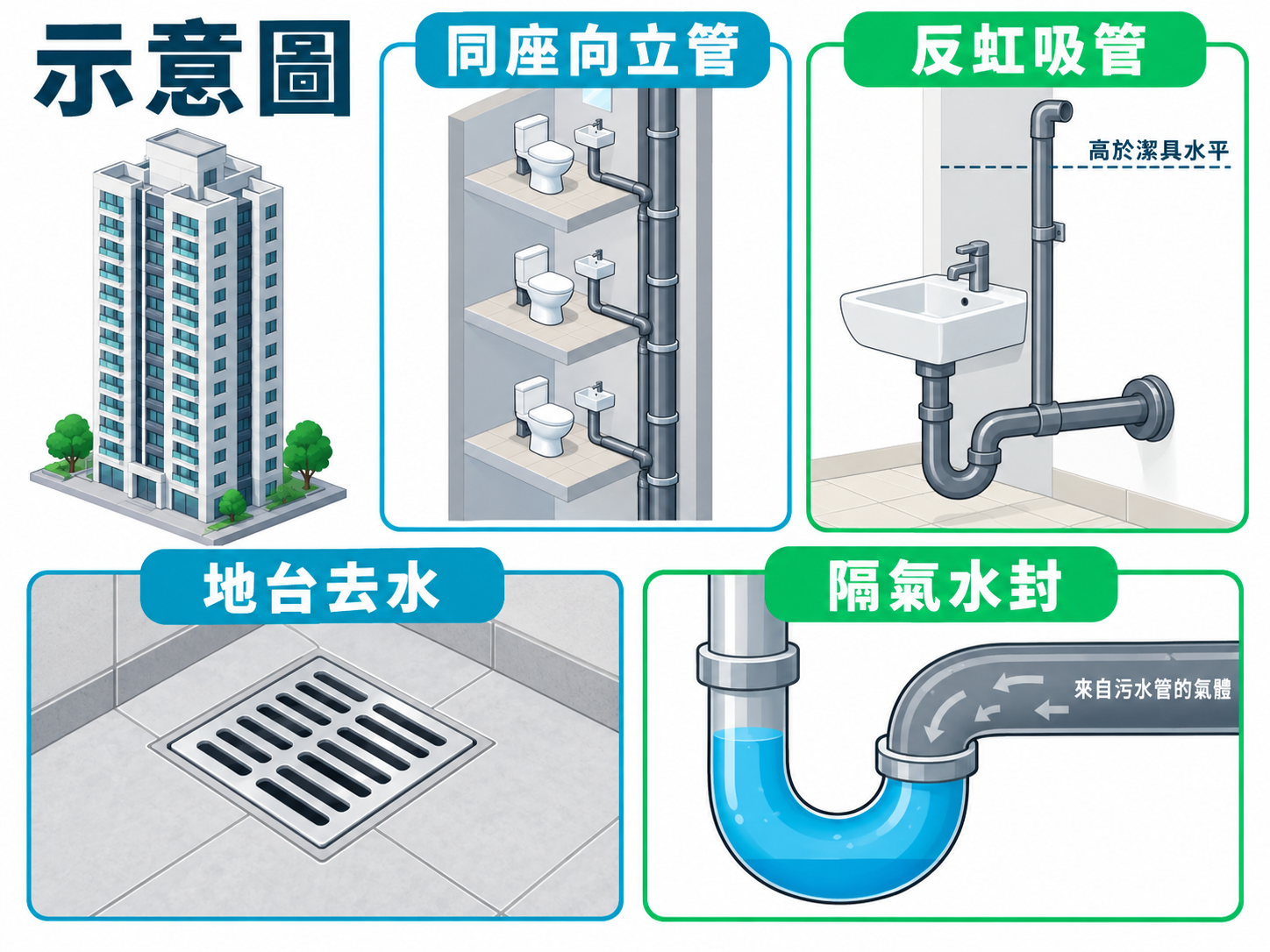
On 10 December 2020 the Centre for Health Protection announced seven recent confirmed cases in Block 6 involving Unit D flats on four different floors. It said it was investigating whether the infections were linked and, before the relevant departments had finished inspecting the toilet vent pipes, moved Unit D residents to quarantine centres. The notice did not identify any drain defect, and the episode was a public-health investigation. What it does show clearly is that flats in the same position are connected, top to bottom, to one soil stack and venting system, so a lost water seal or an altered pipe in one flat may not keep sewer air or backflow inside that flat. If flats above and below have odour or slow drains at the same time, report it to the management office together.
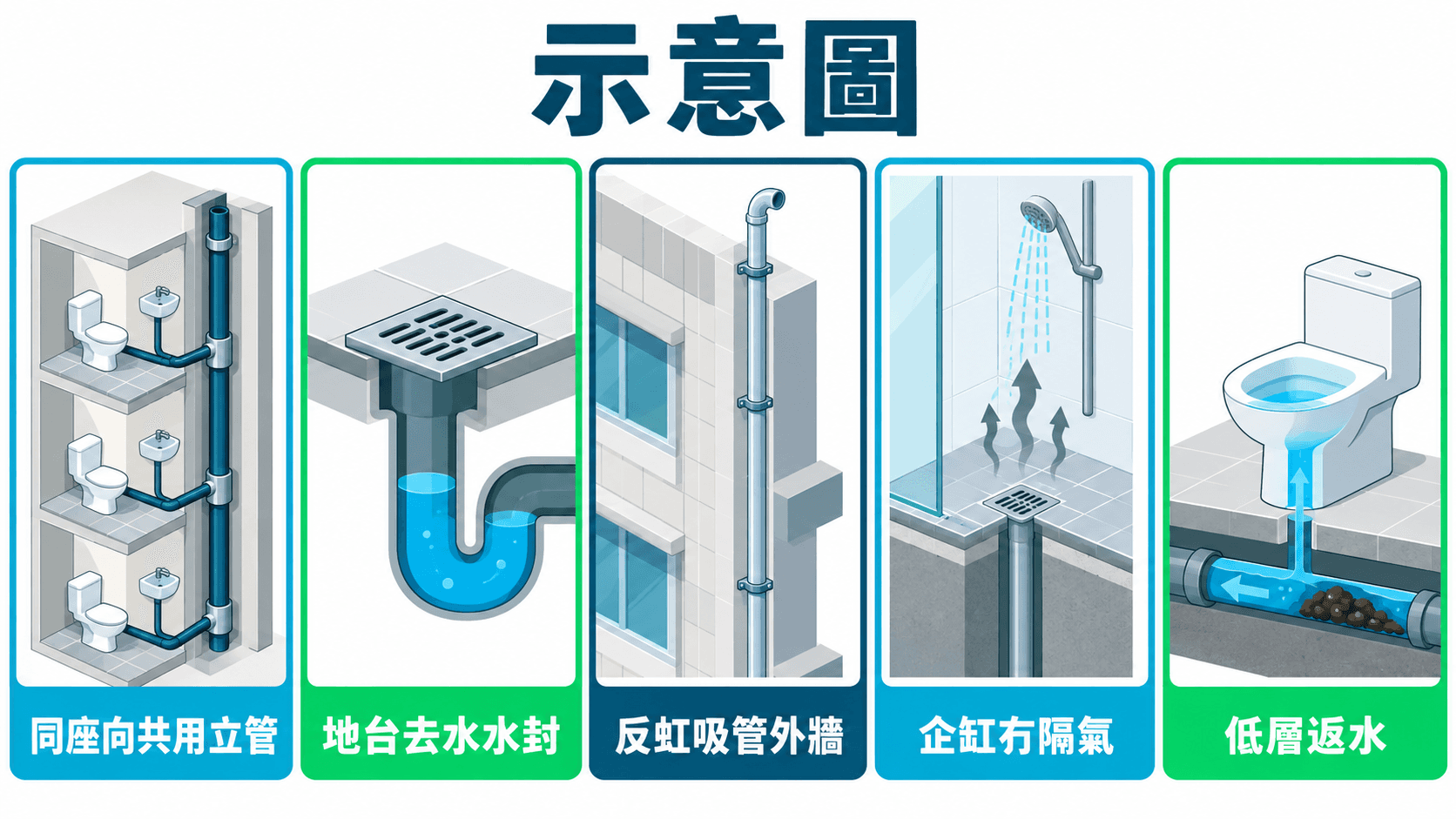
TVB News reported on 11 December 2020 that 8 of the 22 environmental samples the Centre for Health Protection collected in four Unit D flats tested positive, including samples from a kitchen floor and the surface of a toilet exhaust fan, though the viral load was low. For drainage, the point is that once a floor drain has no water seal, the negative pressure created when the bathroom door is closed and the exhaust fan is running can draw air from the stack into the room. The Buildings Department recommends pouring about half a litre of water into each floor drain at least once a week; if the smell remains after topping up, check whether the trap is damaged, has been removed or has been swapped for a shallower type.
On.cc reported on 10 December 2020 that when Ho Kui-yip, a spokesman for the Building Surveying Division of the Hong Kong Institute of Surveyors, examined the external walls of Block 6, he saw at least three flats whose WC anti-syphonage pipes ran out through the external wall before connecting, too far from the water seal to balance air pressure well; when a flat above flushes, the seal in the toilet below can be pulled out. TVB News quoted him the next day as saying that where a bathtub has been replaced by a shower tray without a trap, anything contaminating the building's main stack can easily get straight into the flat, especially with the windows shut and the exhaust fan running. The Buildings Department states that repairs to external drain pipes, or to main drain pipes inside a flat, must be carried out by a registered contractor under the Minor Works Control System. If the toilet's water level drops by itself, flushing makes a gurgling sound, or the shower drain smells persistently, these two points are worth checking.
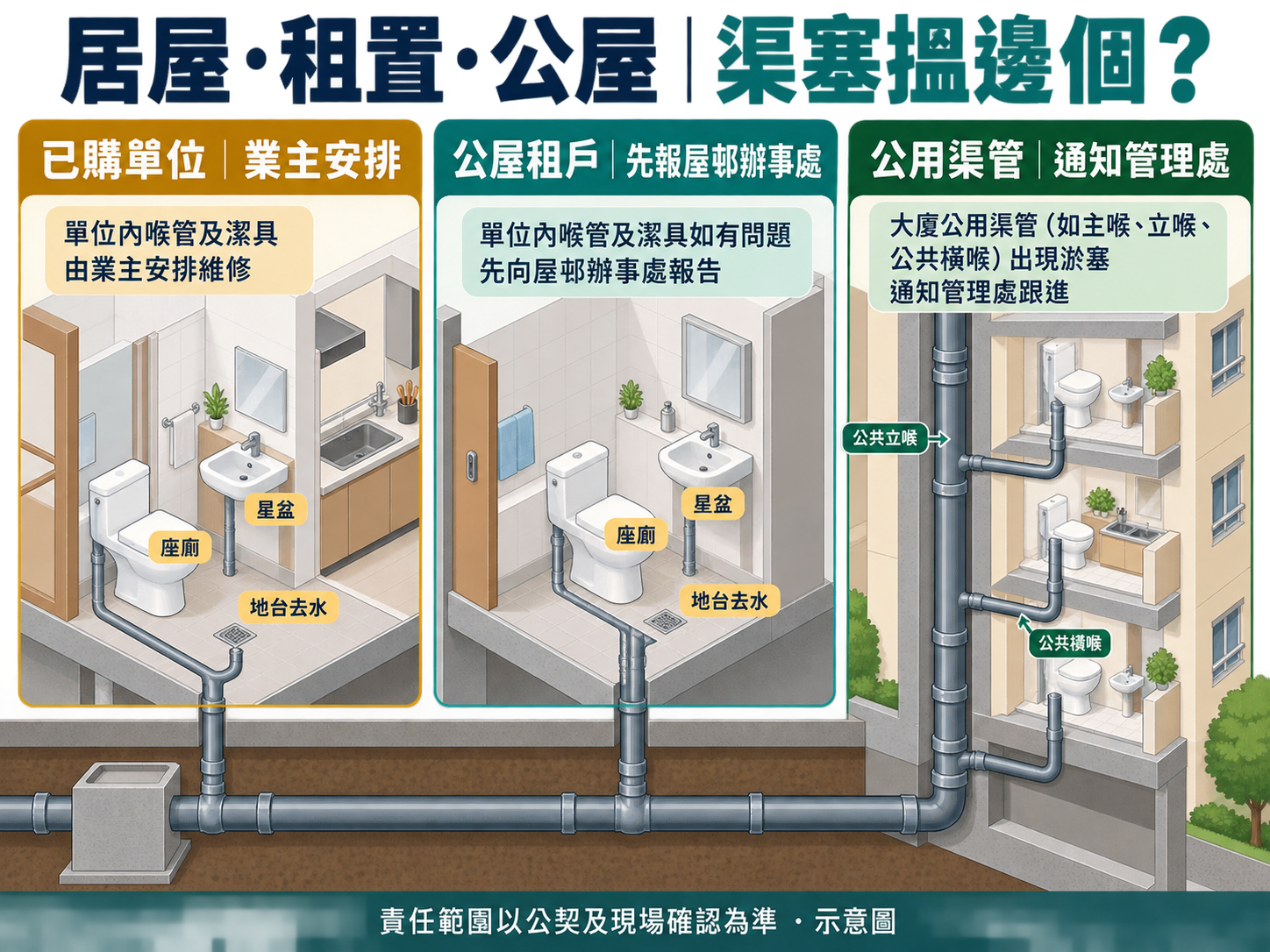
By design, the kitchen sinks, toilets, basins and floor drains of flats in one position all end up in the same stack, and each stack carries waste from thirty-odd storeys. If the base of the stack, a bend or the outlet is narrowed by grease, tissue or debris, low-floor flats are likely to notice first at the morning and evening peaks: water rising, bubbling or even backing up at the floor drain, shower tray or toilet. If only one outlet is slow, the cause is usually the flat's branch pipe or trap and a call-out can clear it; if several outlets back up together, report it to the management office first so the shared stack can be checked.
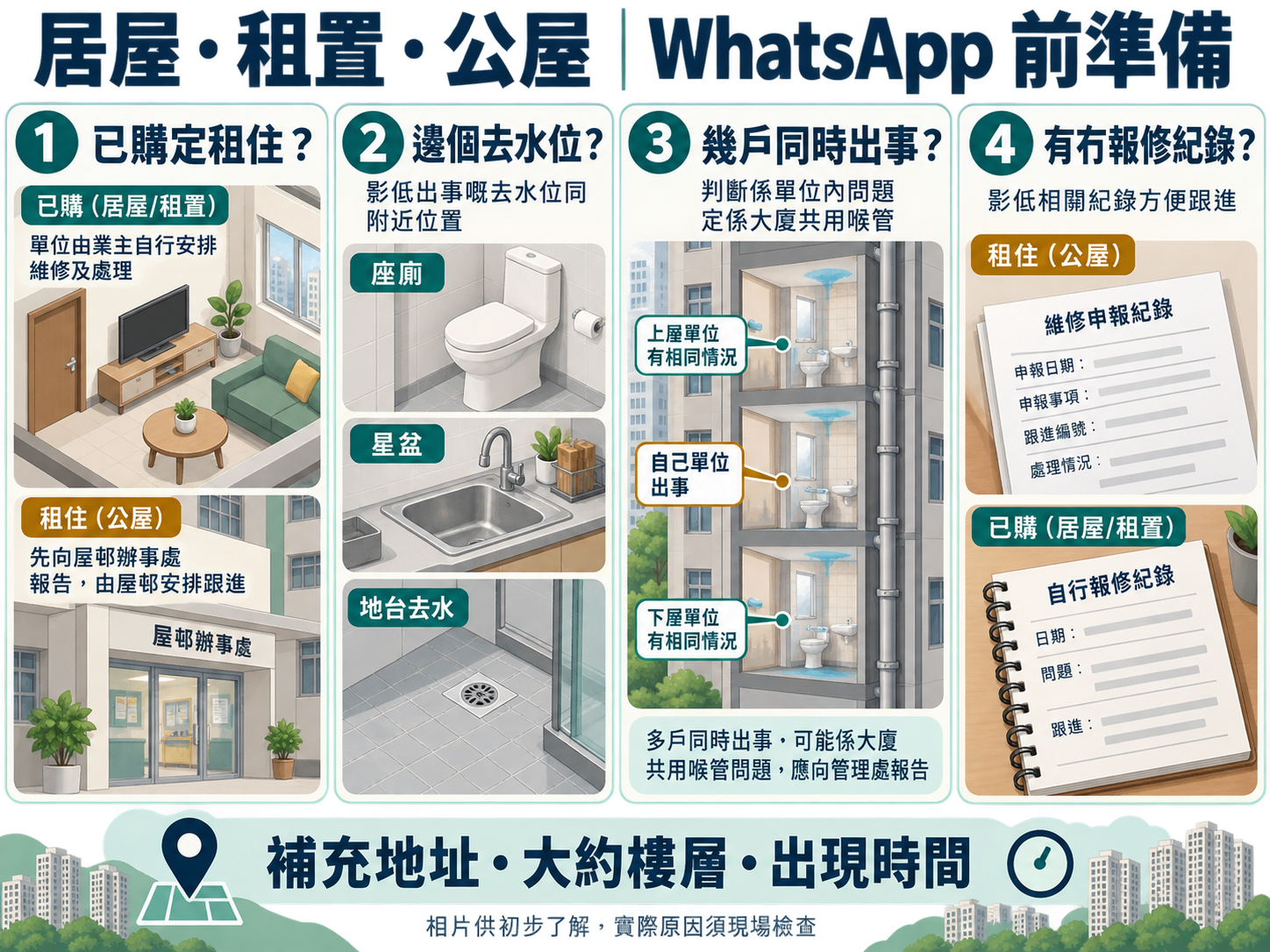
Photos or a short video on WhatsApp help us tell a single-fixture blockage from a shared-stack problem.
Richland Gardens, at 80 Wang Kwong Road in Kowloon Bay, is a Private Sector Participation Scheme (PSPS) estate occupied in 1985: 22 blocks with 5,904 flats, each block 33 or 34 storeys high with eight flats per floor. In December 2020 the Centre for Health Protection found confirmed cases in Unit D flats on four different floors of Block 6 and moved those residents into quarantine before the relevant departments had finished inspecting the toilet vent pipes, which put the single soil stack shared by flats in one position — and the condition of each flat's own traps and anti-syphonage pipes — in the news. If your flat smells of drains, the toilet drains slowly or a floor drain gives off odour, first work out whether the cause is your own trap, branch pipe or a past alteration, or the stack shared by the whole flat position, then decide between booking a call-out and reporting it to the management office.
The Richland Gardens site was originally zoned for industry and later switched to subsidised housing. Work began in August 1983 and flats were occupied from April 1985, with the developer designing and building the estate under Housing Authority supervision. All 22 residential blocks are cruciform towers with eight flats per floor and a light well. A surveyor who visited in 2020 described the light well as semi-open and said the kitchens and toilets of neighbouring Unit D and Unit E flats face each other. So a smell noticed at the window does not necessarily come from your own flat's drains.
Professor Yuen Kwok-yung and surveyors told the media in 2020 that the kitchen, toilet and bathroom outlets in Richland flats all connect to one soil pipe, shared by the same flat position from the top floor to the bottom. A spokesman for the Building Surveying Division of the Hong Kong Institute of Surveyors added that this WC drainage design is similar to that of most buildings over 30 years old and is common practice. An Environmental Protection Department officer who inspected Block 6 said the pipes showed no obvious deterioration. In other words, the thing to watch is not an unusual design but the fact that each household's trap seals, anti-syphonage pipes and alterations affect the neighbours on the same stack.
The estate is now more than 40 years old. As an inference from its age, most flats have been renovated at least once, and replacing a bathtub with a shower tray, moving the toilet or changing the basin or kitchen sink is common, so trap types and branch-pipe routes can differ even between flats in the same block and position. In 2020 a surveyor also said that the drains and bathrooms of several low-floor flats in Block 6 had been altered. Each flat has to be checked on its own; the estate name alone tells you little.
Note: statements based on building age and type are general inferences, not findings for any particular flat.
A clear process from enquiry and assessment to an agreed scope of work
Tell us the drain problem and district and ask about available timing.
Confirm timing based on the district and schedule, then inspect the blockage or odour issue.
Explain the proposed approach, scope and price before agreed work begins.
Use suitable tools for the site conditions and agreed scope of work.
After the agreed work, test drainage and explain the observed result and any next steps.
PipeButler is an independent drain-service provider with no affiliation to the developer, owners' corporation, management company or Housing Department of the places above. Facts come from public sources checked on the dates shown; work on common drains or common parts follows the management office's and deed of mutual covenant's arrangements.
WhatsApp with the problem and district, and we will confirm available timing.