
Loading page…
Loading page…
Sham Tseng & Tsing Lung Tau · Private estate · Village houses · Low-density houses · Commercial & restaurants
Waterfront estates from 1988 · village houses · a coastal low-lying area
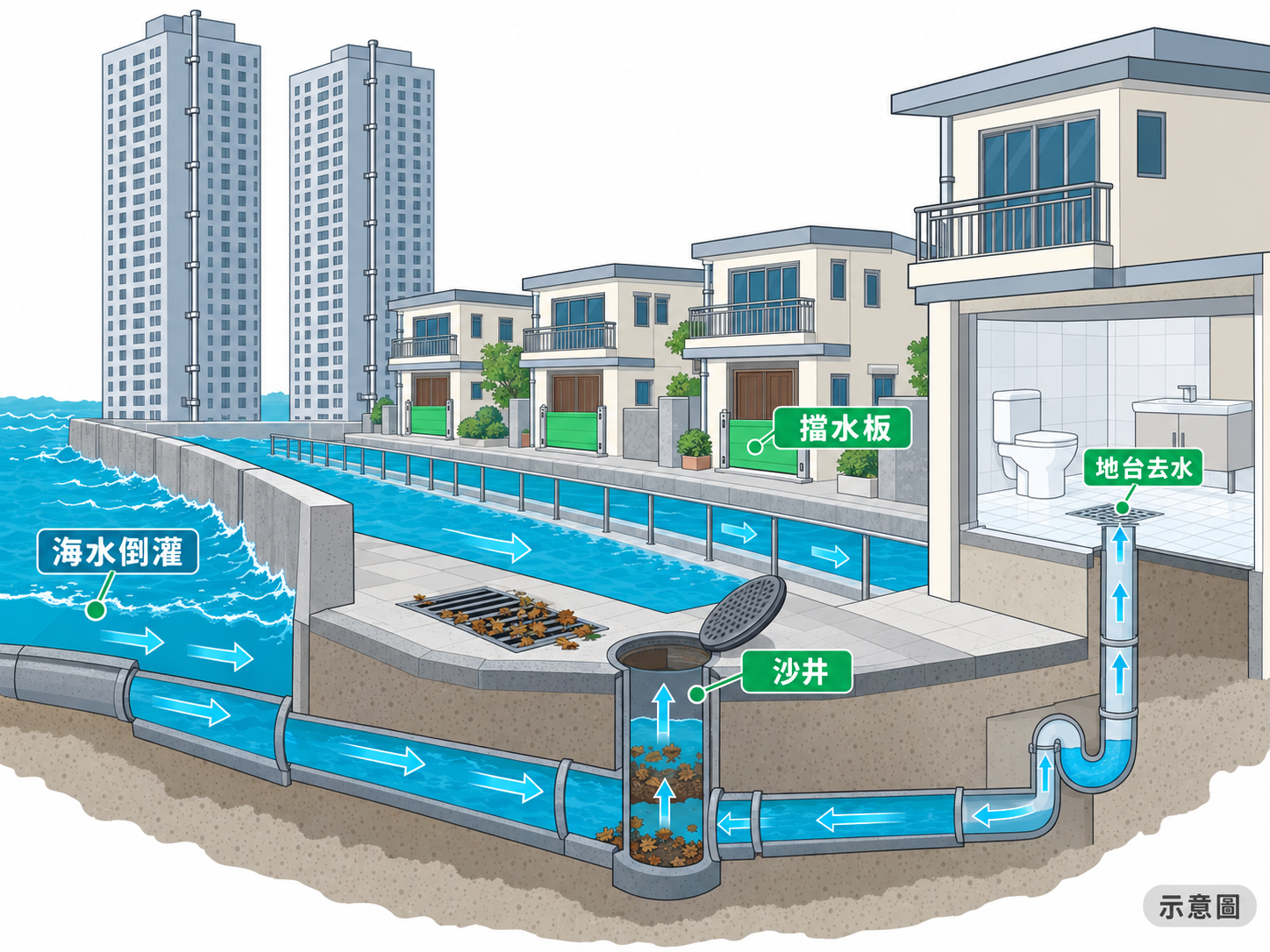
Sham Tseng, Tsing Lung Tau and Ting Kau form one coastal strip along Castle Peak Road with no rail service.
Last reviewed ·
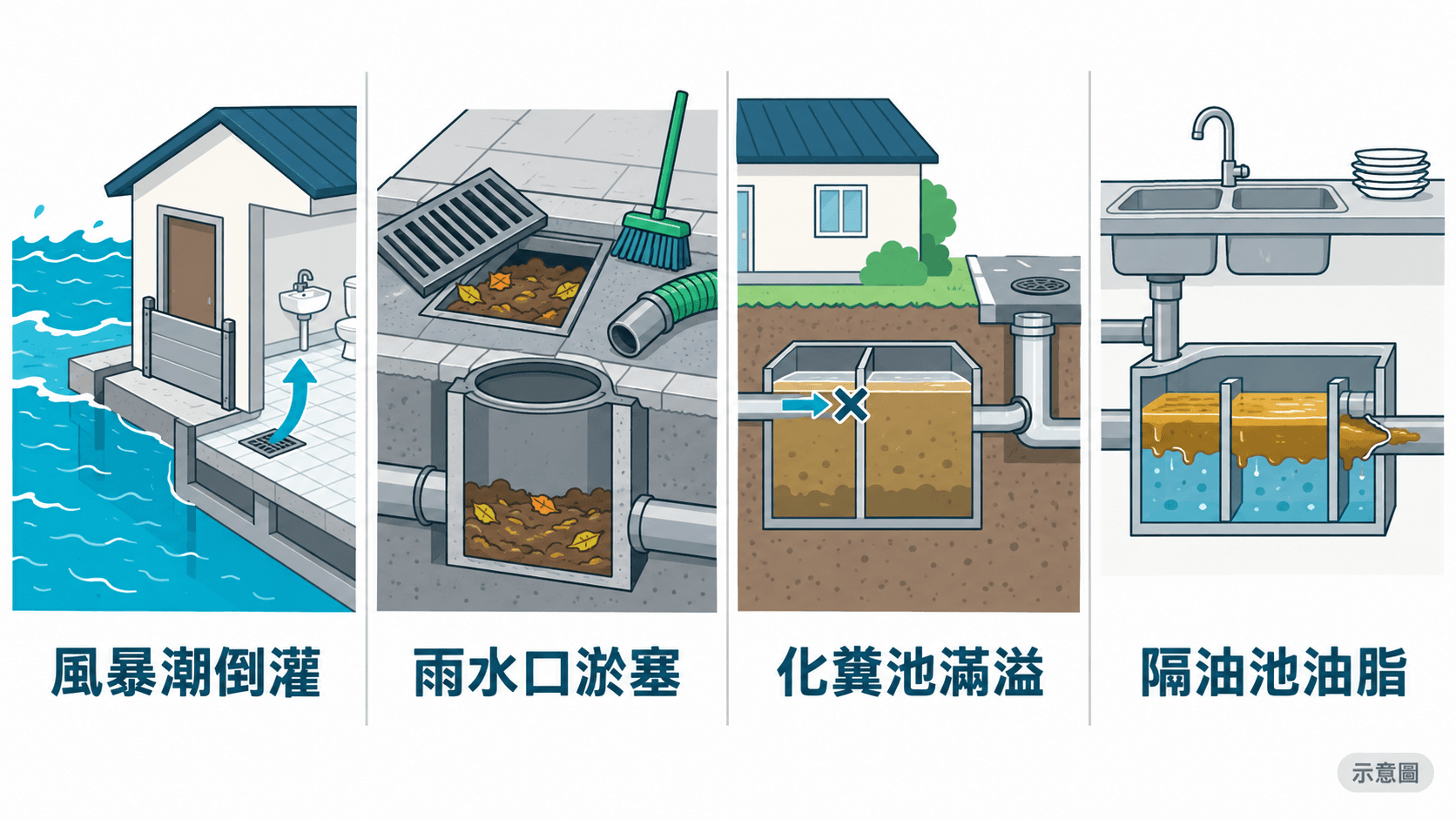
Choose the problem you are seeing to read the likely cause and next step.
Sham Tseng San Tsuen is one of the 26 coastal low-lying or windy residential areas identified by the government, and the only one in Tsuen Wan District. The Civil Engineering and Development Department's coastal hazards study recommends demountable flood boards in front of the buildings here, together with management measures such as an early-warning system and emergency response arrangements; it does not recommend a wave wall at this location. By inference from design, flood boards stop water coming in at the door, but floor drains, manholes and the lowest outlets remain an open water path: when the water outside rises above the outlet, it comes back up through the drain. So before a typhoon, check that the ground drains and manholes outside are clear as well as fitting the boards; once the water drops, clear the silt and dirty water quickly and disinfect.
The Tsuen Wan section of the Drainage Services Department's list of locations prone to blockage has six entries, one of which is "Sham Tseng Old Village near the nullah". The department also says that most recent flooding is not caused by a lack of drainage capacity but by other factors, including inlets or local stormwater systems being obstructed during a rainstorm, and abnormally high tides in coastal low-lying or windy areas. For village houses beside a nullah, the gullies, channels and manholes outside are the first things that leaves, silt and rubbish seal up; in heavy rain the water cannot get away, comes back in across the ground, and leaves silt and odour behind. Public nullahs and street gullies are cleared by government departments and can be reported to the Drainage Services Department, but the ground drains, manholes and connecting pipes on private land around the house are for the owner to open up and clean regularly.
Sham Tseng Tsuen, Sham Tseng San Tsuen and the Tsing Lung Tau villages still contain many village houses. EPD's village-connection statistics, as at the end of December 2024, show all 40 houses suitable for connection at Sham Tseng Village, Sham Tseng East Village and Sham Tseng West Village already on the public sewer, together with all 49 at Ting Kau Village and all 43 at Tsing Lung Tau Village and Tsing Lung Tau New Village; at Sham Tseng Kau Tsuen 15 houses out of 17 and at Sham Tseng San Tsuen and Sham Tseng Commercial New Village 19 out of 21 are connected. The Environmental Protection Department also explains that a domestic septic-tank discharge licence normally runs for the tank's useful life, or until the premises are connected to communal sewers provided in the vicinity, and that once a communal sewer is available the department can require the owner to build a terminal manhole and connecting pipework — which the owner then has to maintain. So sewage welling up from a manhole outside, a toilet that will not flush away or a smell that never clears usually means looking first at the private run of drain before the terminal manhole; for a house not yet connected, the question is whether the septic tank is full or the soakaway has failed. Either way, only opening up the manhole will tell you which.
Roast goose is Sham Tseng's calling card, and the Sham Tseng section of Castle Peak Road, together with the podium shops of several estates, is lined with roast-meat shops, cafés and fast food. The Environmental Protection Department requires every restaurant and food-processing factory to install a grease trap, and notes that grease deposits reduce the capacity of sewer pipes and cause sewage overflows and offensive odour. Its guidance on grease-trap maintenance advises inspecting the trap at least every three days, cleaning it promptly once greasy waste occupies the top 30 per cent of the liquid depth, and entering every maintenance visit in a log book. Sinks and floor drains inside a shop are for the tenant or owner to arrange, the grease trap is maintained by the operator, and the building's main drains and shared manholes go to the management office.
Apart from Bellagio and Sea Crest Villa Phase 5, most blocks in the main estates here have passed 30 years of age. The Buildings Department's Mandatory Building Inspection Scheme applies to private buildings aged 30 or more, other than domestic buildings not exceeding three storeys, and its scope covers drainage on external walls, in common parts, inside common pipe ducts and underground, so the inspection report is the first place to look for the condition of shared pipes. The Urban Renewal Authority's Building Drainage System Repair Subsidy Scheme covers private domestic or composite buildings aged 40 or more within the rateable-value limits, but Category 1 — the route owners applied through themselves — closed after 31 May 2024. What remains is Category 2, where the Buildings Department selects, on a risk basis, buildings whose common drainage is under a drainage repair order or MBIS notice and whose owners cannot organise the works, and arranges them on the owners' behalf. By inference from design and location, external pipes, brackets and joints on seafront blocks are exposed to salt-laden wind, so rust stains and loose fixings appear earlier. Note too that each block of Hong Kong Garden keeps separate accounts; by inference from that arrangement, repairs to shared pipes and major works may have to be discussed and funded block by block, and the block's management office can confirm the actual procedure.
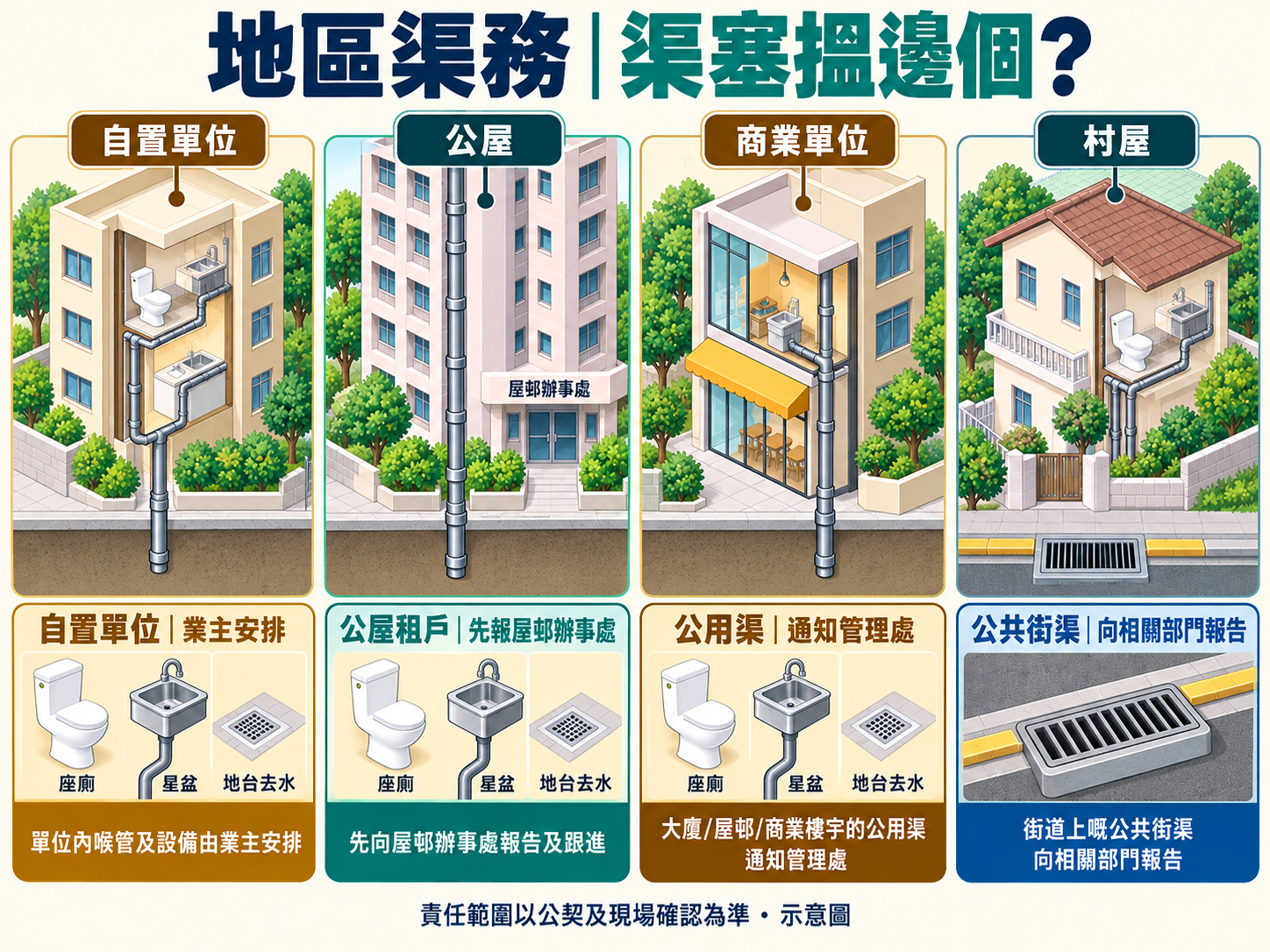
Photos or a short video on WhatsApp help us tell a single-fixture blockage from a shared-stack problem.
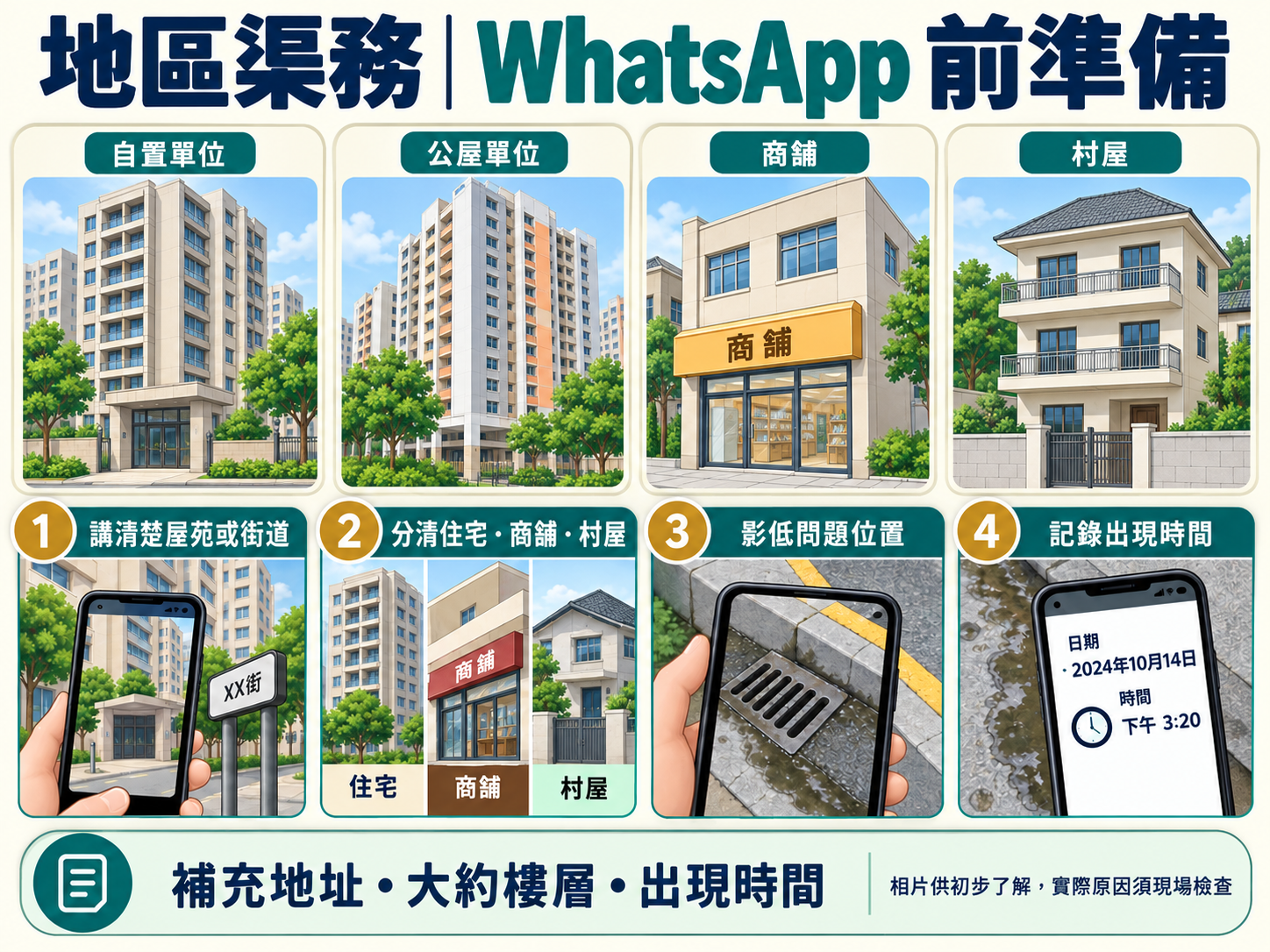
Sham Tseng, Tsing Lung Tau and Ting Kau form one coastal strip along Castle Peak Road with no rail service. Along the Sham Tseng section the estates run from Lido Garden, occupied in 1988, through to Bellagio, occupied between 2003 and 2006; on the Tsing Lung Tau side, besides Hong Kong Garden, built in phases from 1986, there are several smaller private developments, with the village houses of Sham Tseng Tsuen, Sham Tseng San Tsuen and the Tsing Lung Tau villages in between. Everything here is privately owned, so who you call about a blockage or a smell depends on whether the fault lies inside the flat, in the building's shared pipes, or outside in the ground-level drains, manholes and septic tanks. Sham Tseng San Tsuen is also on the Drainage Services Department's list of coastal low-lying or windy residential areas, so backflow deserves extra attention in typhoon and rainstorm season.
Sham Tseng lies west of Ting Kau and east of Tsing Lung Tau, centred on Sham Tseng Tsuen, and the three places sit in a line along Castle Peak Road with no railway. From the 1960s to the 1980s Sham Tseng was an industrial area; after the factories moved north in the 1980s, the sites were redeveloped for housing one by one — Lido Garden stands on a former cotton mill, Rhine Garden on former mill and brewery staff quarters, and Bellagio on the site of the first San Miguel brewery. Most buildings here therefore came from industrial land rather than from new-town estate planning.
Today the area is made up of private estates and village houses. Along the Sham Tseng section are Lido Garden, occupied in 1988 (5 blocks, 1,392 flats); Rhine Garden, occupied in December 1992 (5 blocks, 1,068 flats, and the only estate in Sham Tseng not on the waterfront); and Bellagio, occupied between 2003 and 2006 (8 blocks, 3,345 flats). Sea Crest Villa was built in five phases from November 1992 to 1997, spans Sham Tseng to Tsing Lung Tau, and totals 15 blocks and 2,409 flats. On the Tsing Lung Tau side, Hong Kong Garden, built between 1986 and 1994, dominates with 28 blocks and 2,830 flats; several smaller private developments stand nearby, among them Lung Tang Court at 88-90 Castle Peak Road, which was completed as early as 1982. The village housing includes Sham Tseng Tsuen, the old village and Sham Tseng San Tsuen, plus Tsing Lung Tau Tsuen, Yuen Tun Tsuen and Ka Lung Tsuen. From the estates to the village houses, everything is in private ownership, so responsibility for drainage sits with owners, owners' corporations and village-house owners.
On the public side, the Drainage Services Department's Sham Tseng Sewage Treatment Works stands on Sham Tsz Street, occupies 1.1 hectares, uses chemically enhanced primary treatment and can handle 17,000 cubic metres of sewage a day. Construction started in December 2000 and the works opened in September 2004; the same funding built a four-kilometre sewer along the coast from Ting Kau to Lido Beach. The beaches around Ting Kau were closed in the 1990s because of sewage and pollution from the Airport Core Programme works, and reopened in stages between 2011 and 2014 once water quality improved. In short, the public sewerage here was completed comparatively late, and estates and village houses were connected at different times and in different ways.
As a general inference from building age, every block in the main estates here except Bellagio and Sea Crest Villa Phase 5 (1997) is now over 30 years old, and Lido Garden and the first phase of Hong Kong Garden are close to 40. The Buildings Department's Mandatory Building Inspection Scheme applies to private buildings aged 30 or more, other than domestic buildings not exceeding three storeys, so ordinary village houses fall outside it; its scope expressly covers drainage on external walls, in common parts, inside common pipe ducts and underground — so for these estates the inspection report is itself a drainage health check. By inference from design and location, external pipes, brackets and joints on seafront blocks are exposed to salt-laden wind, so rust stains, seepage and loose brackets tend to appear earlier. Even so, the real condition of any block depends on its own inspection and repair record, and cannot be judged from the estate name alone.
Note: statements based on building age and type are general inferences, not findings for any particular flat.
Choose an enquiry route for your premises and work scope.
Pantry, washroom and shared-drain enquiries, with scope agreed before work
Scope and booking detailsUnit outlets, shared pipes and chamber enquiries assessed with site access
Scope and booking detailsDiscuss a defined maintenance scope using assets, usage and incident records
Scope and booking detailsA clear process from enquiry and assessment to an agreed scope of work
Tell us the drain problem and district and ask about available timing.
Confirm timing based on the district and schedule, then inspect the blockage or odour issue.
Explain the proposed approach, scope and price before agreed work begins.
Use suitable tools for the site conditions and agreed scope of work.
After the agreed work, test drainage and explain the observed result and any next steps.
PipeButler is an independent drain-service provider with no affiliation to the developer, owners' corporation, management company or Housing Department of the places above. Facts come from public sources checked on the dates shown; work on common drains or common parts follows the management office's and deed of mutual covenant's arrangements.
WhatsApp with the problem and district, and we will confirm available timing.