
Loading page…
Loading page…
Tsuen Wan waterfront · Private estate
Two phases 1988–1989 · 20 towers, 5,600+ flats · five podiums over car parks
Riviera Gardens stands on Yi Hong Street and Yi Lok Street in Tsuen Wan, facing the Rambler Channel.
Last reviewed ·
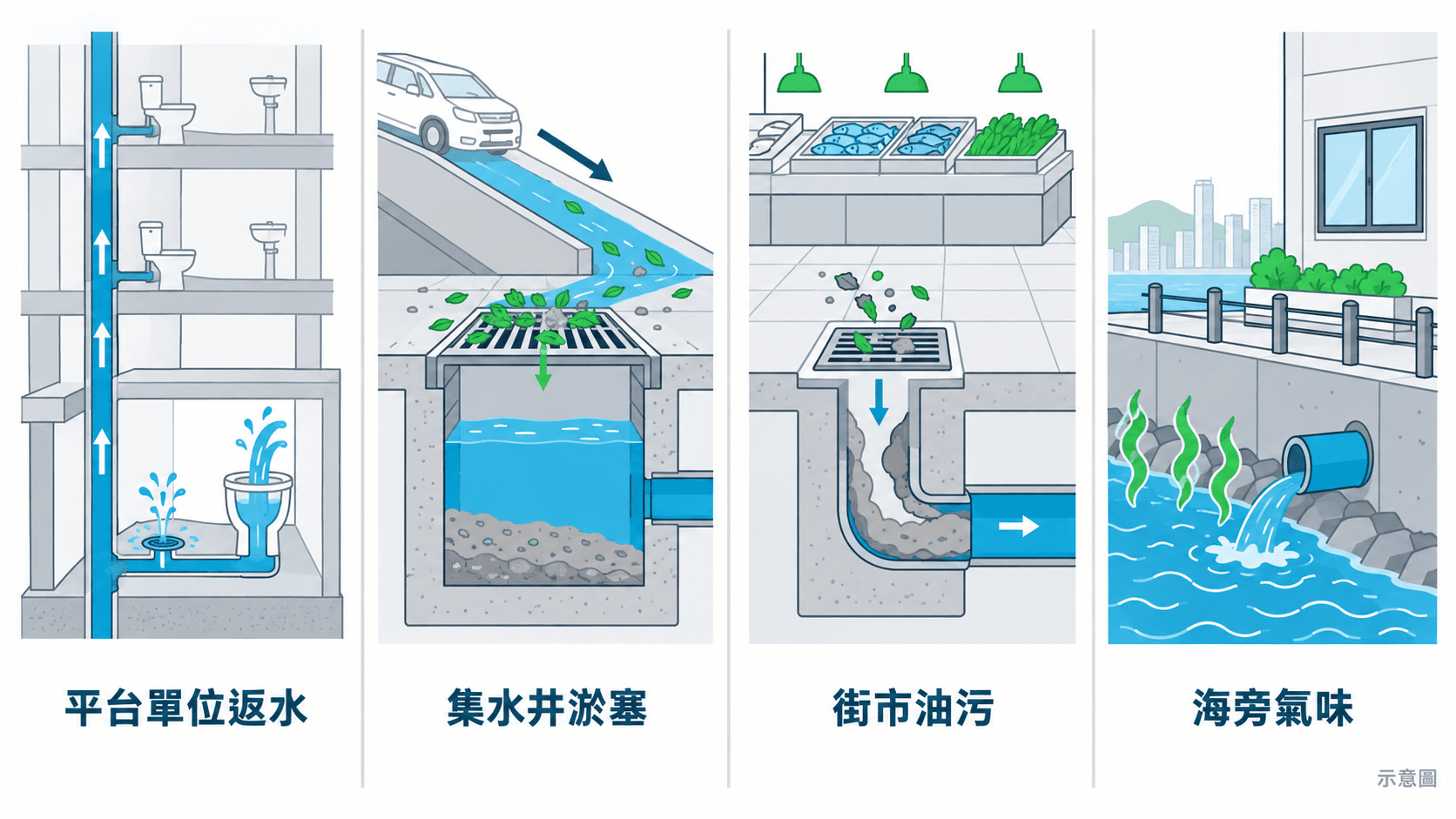
Choose the problem you are seeing to read the likely cause and next step.
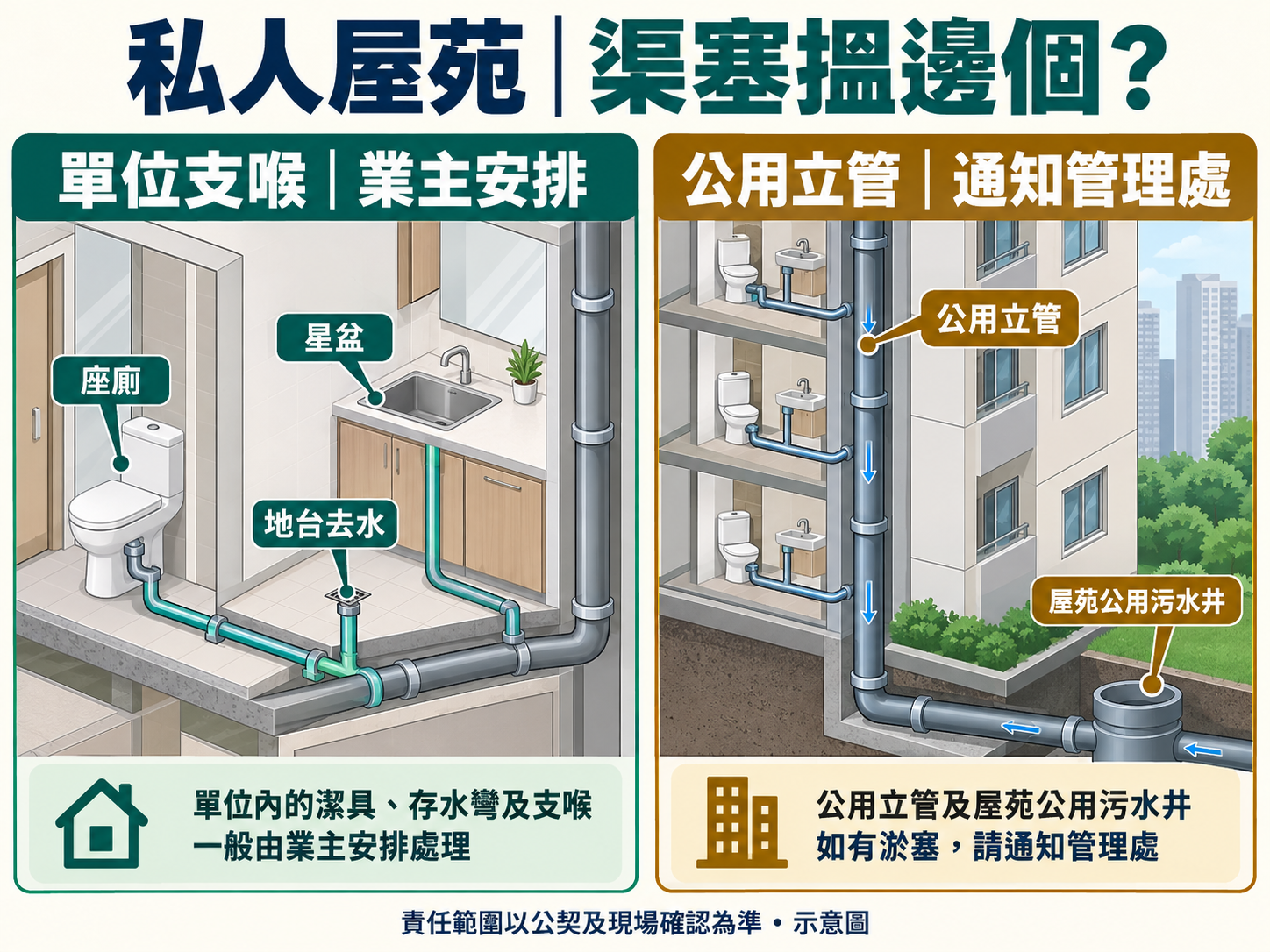
Every Phase 1 tower has flats at podium level, and Blocks 5–10 and 12 rise 41 storeys, so by design one vertical soil stack serves the same flat position from the 40th floor down to the podium, and the flow has to turn horizontal at podium or base level before joining the pipework below. That is why the lowest floors and the podium flats are the first to notice a rising toilet level or a gurgling floor drain during the evening peak of showers and laundry upstairs. Judge it by scope and timing: one slow fixture of your own usually means a branch pipe or trap, while several flats in the same vertical line failing together, or a reaction every time the floors above discharge, should be treated as the shared stack and reported to the management office at once.
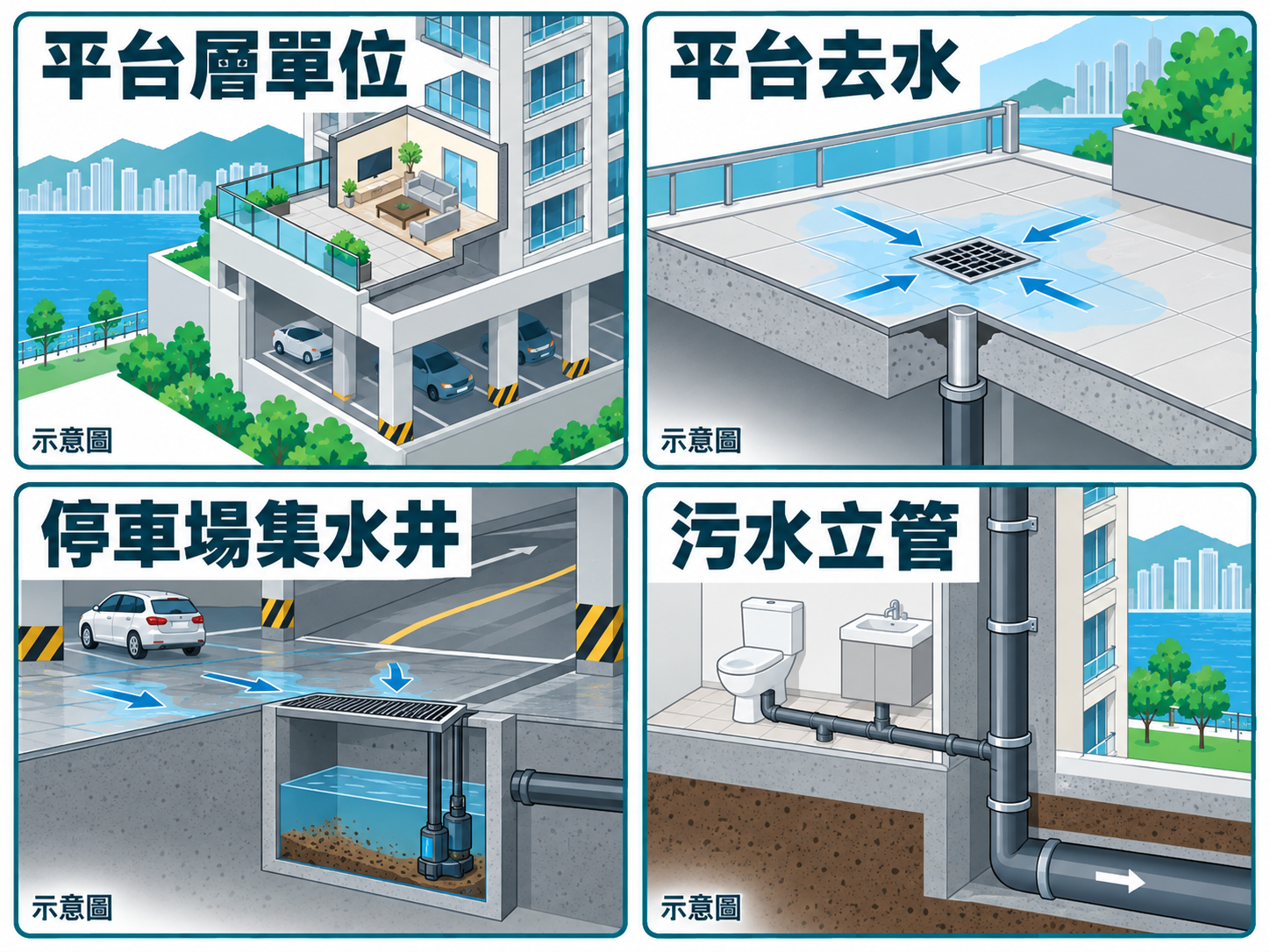
The five podiums from A to E are linked by footbridges, and their surfaces have to take rainwater, planter runoff and wash-down water, while most of the levels underneath are car parks, where, by inference from the layout, ramps bring in grit, leaves and tyre debris that all end up in the channels and catchpits. Blockages here are seldom noticed at the time; they usually surface when heavy rain or a podium wash leaves water standing or backing up. The fix is to remove the silt from the bottom of the pit and then flush the pipe, not merely to scoop the litter off the grating — and one check before the wet season beats pumping water out afterwards.
Two market levels were planned into the base of Podium D; the lower wet-goods level became a supermarket in the early 1990s, the stretch near the public toilet later became a restaurant, and the remaining corridor still has snack, vegetable, meat and flower stalls. By design, the floor drains and base-level pipes here take far more grease, leaf waste and fish scales than a purely residential spot, and in cooler weather grease congeals on the pipe wall and narrows it. If a sour food smell is concentrated on the podium or in the corridor rather than in your own bathroom, treat it as a shop or common-drain matter and raise it through the management office; regular cleaning of the shops' grease separators is what keeps that grease out of the building drains.
Tsuen Wan Riviera Park lies on the waterfront to the west of the estate. A Public Works Subcommittee paper of 9 November 2022 states that part of the open space beside the park's children's playground would be used from 2024 as a supporting works area for building a new-type dry-weather flow interceptor, and the Drainage Services Department's project 4450DS, “Construction of Dry Weather Flow Interceptor at Tsuen Wan”, gives its benefit as improving the pollution and odour nuisance at urban coastal waters (the Chinese page words it as improving water quality and odour in Victoria Harbour); the project was still listed as “Under planning & design” when checked on 19 September 2026. It is the same line of work as project 4438DS, under which eight interceptors were built in Tsuen Wan and Kwai Chung. For a resident the test is simple: a smell you meet on the promenade or when the window is open to the wind is usually an outdoor one, whereas a smell that stays in the bathroom or kitchen with the windows shut, and gets worse with the extractor fan on, points to your own water seals and branch pipes.
Being on the water, standing water here is easily read as the sea coming in, but of the 26 “coastal low-lying or windy residential areas” identified by the government's study of coastal hazards under climate change and extreme weather, the only one in Tsuen Wan is Sham Tseng San Tsuen and Riviera Gardens is not on the list. None of the six Tsuen Wan entries on the Drainage Services Department's list of locations prone to blockage falls inside the estate either: the nearest, the Tsing Tsuen Road interchange, is on a road that Wikipedia lists as bounding the estate, and that is public road drainage and the department's responsibility. So ponding on the podium, at a footbridge landing or at a car-park entrance after heavy rain is, by inference from the design, far more likely to be leaf litter and silt over the inlets, a silted catchpit or a narrowed pipe — all of which can be cleared. Rather than wait for the next black rainstorm, lift each inlet grating on a dry day, photograph what you find and pass it to the management office.
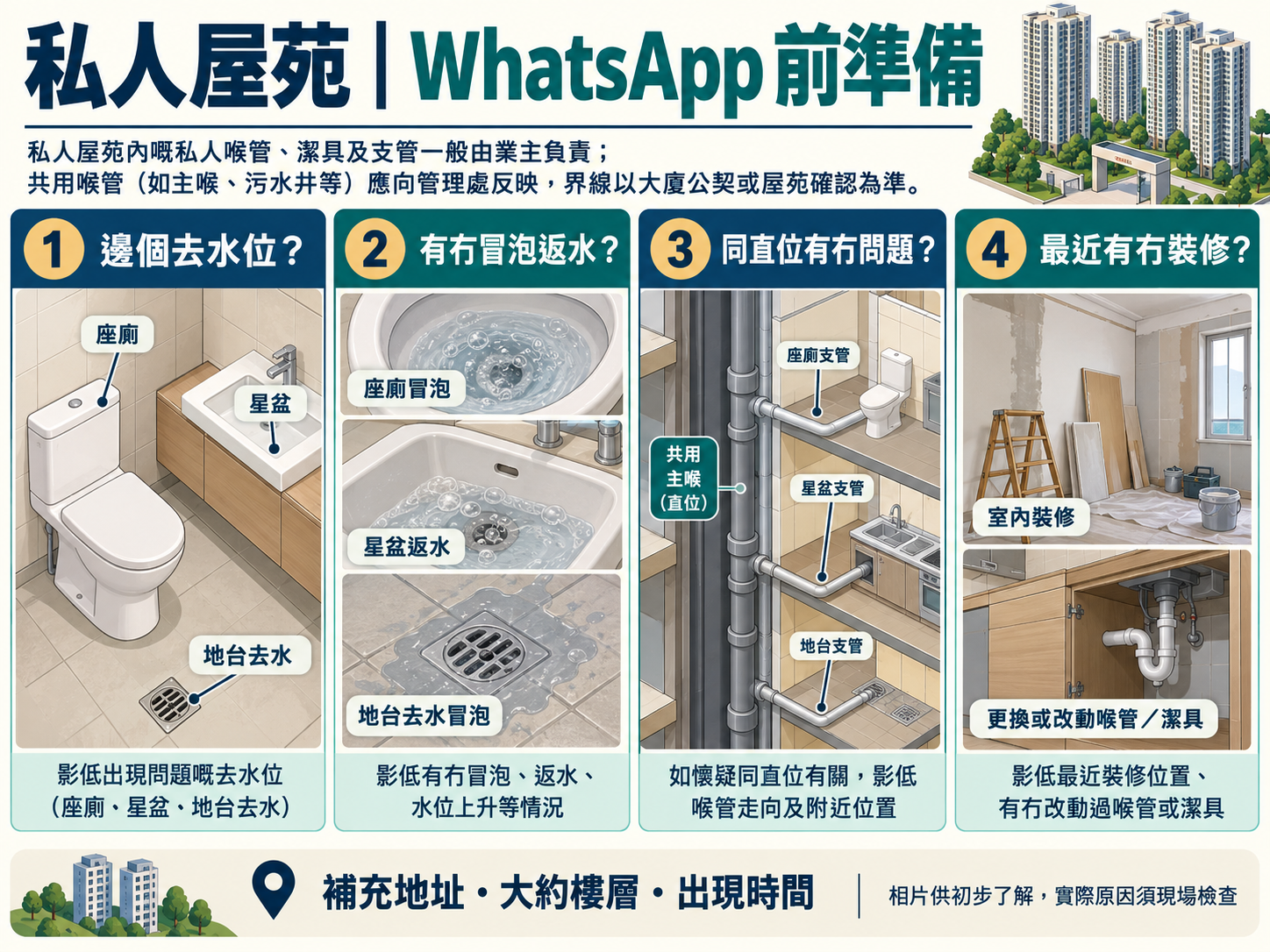
Photos or a short video on WhatsApp help us tell a single-fixture blockage from a shared-stack problem.
Riviera Gardens stands on Yi Hong Street and Yi Lok Street in Tsuen Wan, facing the Rambler Channel. The site was the Texaco oil depot; only after the depot moved to Tsing Yi in 1983 was the land rezoned for housing. Phase 1 was occupied in batches from August 1988 and Phase 2 finished in December 1989, giving 20 towers and more than 5,600 flats. What sets the estate apart from one built on flat ground is its five podiums, linked by footbridges, with car parks on most of the levels beneath them — and, in Phase 1, flats built at podium level itself. So when a toilet backs up, a bathroom smells of drains or water stands on the podium, the first step is not to pour in drain cleaner but to work out whether the fault lies in the flat's branch pipe, in the stack shared by the whole block, or in the podium and car-park drains.
The estate was developed by Tsuen Wan Land Company — a joint venture of Caltex, Tokyu Land of Japan and New World Development — designed by Wong Tung & Partners and built by Hsin Chong and Gammon. All 20 towers are named “Hoi X Mansion”, and because the numbering skips 13 and 14 the last one is Block 22. The addresses are spread over two streets: Blocks 1–4 at 1–7 Yi Hong Street, Blocks 5–10 at 2–12 Yi Hong Street, Blocks 11–12 at 7–9 Yi Lok Street, Blocks 15–19 at 2–12 Yi Lok Street and Blocks 20–22 at 1–5 Yi Lok Street. Quoting the block number — Block 7, say — is usually clearer than the tower's name, Hoi Wan Mansion, because the management office and the technician both navigate by block and podium.
The five podiums run from A to E and are joined by footbridges, each sitting on a base of a different height, mostly car-park levels; beneath Podium E there are three car-park floors and one commercial floor. Two market levels were planned into the base of Podium D: the lower wet-goods level became a supermarket in the early 1990s, the upper level's entrance area near the staircase was converted to other uses in the mid-2000s, the stretch near the public toilet became a restaurant around 2008, and the market today is down to a single corridor. The estate's Riviera Plaza opened in November 1990, and since the end of 2013 everything except the ground-floor bus terminus and the basement car park has stayed closed. In short, this base carries drainage from flats, car parks, a market, a supermarket and food shops all at once, which makes it more complicated than a purely residential podium.
In Phase 1 each tower has flats at podium level, entered from a three-step stair beside the podium lift lobby — at most four and at least one per tower. As an inference from age, Phase 1 is about 38 years old and Phase 2 about 37; private estates of this generation were typically piped in uPVC with cast-iron fittings, and after three decades most flats have been renovated, so trap types and branch-pipe routes now differ from flat to flat. Being well over 30 years old, the buildings can be selected under the Buildings Department's Mandatory Building Inspection Scheme, whose prescribed inspection already covers common pipe ducts and the shared drainage above and below ground, so the condition of the shared pipes is usually on record while the inside of a flat depends on the owner's own repair and renovation history. The 2016 by-census recorded 17,278 residents with an average household size of 3.2; from that household profile one would expect water use and discharge to concentrate in the morning and evening peaks.
Note: statements based on building age and type are general inferences, not findings for any particular flat.
A clear process from enquiry and assessment to an agreed scope of work
Tell us the drain problem and district and ask about available timing.
Confirm timing based on the district and schedule, then inspect the blockage or odour issue.
Explain the proposed approach, scope and price before agreed work begins.
Use suitable tools for the site conditions and agreed scope of work.
After the agreed work, test drainage and explain the observed result and any next steps.
PipeButler is an independent drain-service provider with no affiliation to the developer, owners' corporation, management company or Housing Department of the places above. Facts come from public sources checked on the dates shown; work on common drains or common parts follows the management office's and deed of mutual covenant's arrangements.
WhatsApp with the problem and district, and we will confirm available timing.