
Loading page…
Loading page…
Tseung Kwan O South · Private estate
Occupied in phases from 2009 to 2026 · over an MTR depot · balcony drains & light-well pipes
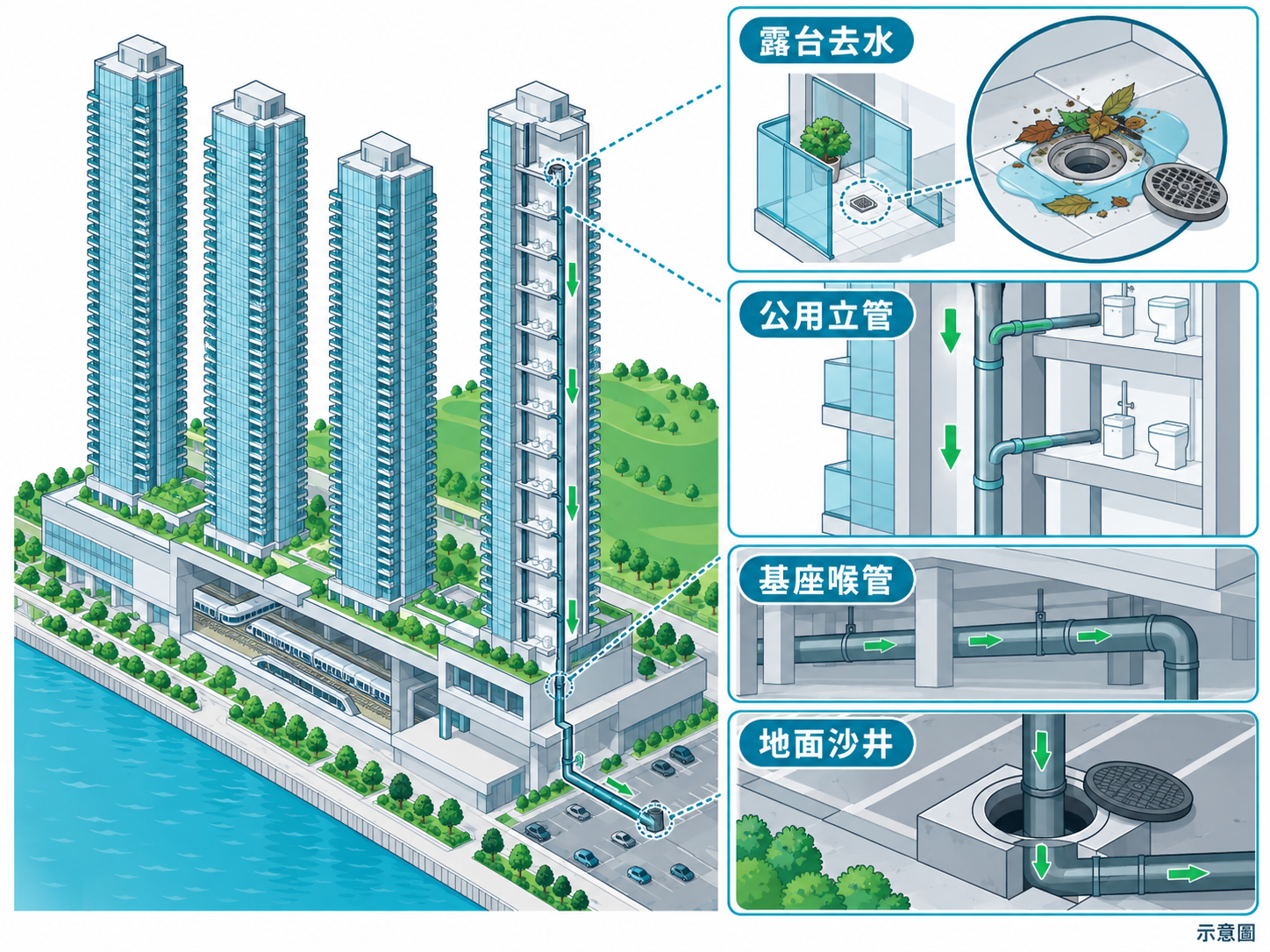
LOHAS Park stands at 1 LOHAS Park Road in Area 86, Siu Chik Sha, Tseung Kwan O, built over MTR LOHAS Park station and the Tseung Kwan O depot.
Last reviewed ·
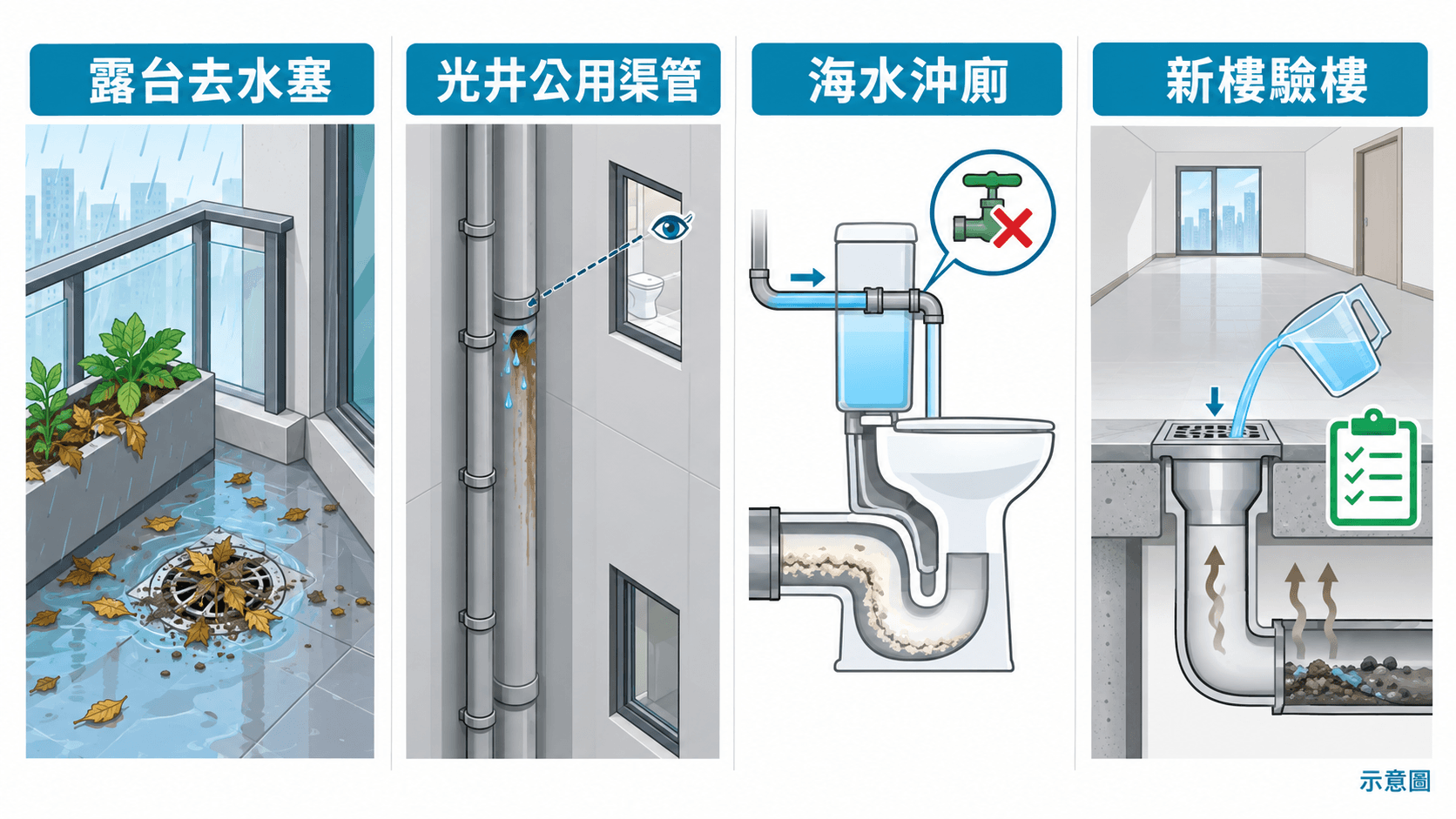
Choose the problem you are seeing to read the likely cause and next step.
Sky Post reported on 9 October 2023 that during the rainstorms of Typhoon Koinu a LOHAS Park household's balcony was apparently flooded and the resident was bailing water out with plastic buckets. The report quoted Simon Tang, principal of a renovation academy, saying that balcony flooding generally has two causes: a drain pipe too narrow to carry the rainwater away in time, and a blocked drain. He added that in typhoons and heavy rain, leaves and other debris are blown onto balconies and wash into the drain, and that balcony drains fitted with a trap are relatively more prone to blockage. Most flats here have a view balcony, wind is strong at height, and leaves, silt and soil from planters easily reach the outlet. The suggested order is to clear debris at the outlet first and, where there is a trap cover, unscrew it and remove the obstruction; if the trap sits on the external wall, tools or a pump are needed.
On 8 September 2018, HK01 reported that a residents' association convenor at Le Prestige told the media he had found exposed reinforcement, spalled concrete, rusty pipes and leaks inside the light well, and held up two pieces of concrete he said had fallen from it. The same report quoted the MTR Corporation saying the developer had awarded two contracts in July that year, one of them for light-well rectification, and that a light-well survey was being arranged. Note that the report's wording mixes supply pipes and drains: a leaking fresh-water or flushing-water pipe is not the same as a drainage fault, and the two are followed up by different parties in different ways. Common drainage pipes inside a light well cannot be seen from your own flat at all; they usually have to be looked at from the flat opposite, or by the management office or a consultant working off scaffolding. The design has also been discussed at district level: at the Sai Kung District Council meeting of 3 May 2022 a member raised the point that new estates built in Tseung Kwan O over the previous decade commonly use an enclosed light well, and the Director of Buildings replied that the law currently permits the design, and that without it bathrooms might have no window at all. At the same meeting, answering another member on external-wall pipe seepage, the Director said residents who find a damaged common drainage pipe can report it to the Buildings Department, that where the location of the damage cannot be established the department can only inspect or test floor by floor, and that visual observation remains the most direct way to spot a leaking pipe.
On 16 July 2026 the Water Supplies Department told the Sai Kung District Council's Food and Environmental Hygiene Committee that the Tseung Kwan O seawater pumping station supplies flushing water to LOHAS Park and the Shek Kok Road area. On the burst main at Wan Po Road, it said it was laying a temporary main on Chiu Shun Road near the Wan Po Road roundabout, with the connection due to be completed within 2026, to cut the risk of having to suspend that pumping station for emergency repair and so reduce the impact on the flushing-water supply to LOHAS Park and the Shek Kok Road area, and that it was studying separating the supply systems. (Separately, the District Council record of 6 November 2018 notes the Civil Engineering and Development Department saying the main function of the LOHAS Park Road seawater pumping station is to draw seawater for flushing.) That is a supply matter, not a blockage, but it has two practical consequences. While flushing water is off, do not try to force tissue or wet wipes down with a small amount of fresh water, because that readily blocks the branch pipe. And as a general inference from experience, a WC and branch pipe flushed with seawater for years tend to collect salt and urine scale on the inner wall, so a high water level on the first flush after a long holiday or an empty spell does not necessarily mean the building's stack is blocked.
Phase 12 (SEASONS) is still being handed over in batches, the final phase, LA MIRABELLE, is due in 2027, Phase 11 (Villa Garda) has been occupied since 2025 and is still within its rectification period, and flats in the older phases are refitted all the time. The Buildings Department points out that traps on the toilet, basin and bathtub rarely dry out because those fixtures are used daily, but that a floor drain left unused and not topped up loses its water seal to evaporation and stops holding back sewer air, which is why it advises pouring about half a litre of water into every floor drain at least once a week. An empty flat, one not yet moved into, or one where nobody runs water during a fit-out is exactly that situation, and the bathroom smells as soon as the extractor fan is switched on. The other common case is cement, render or marble dust washed into a drain outlet during renovation: once set, neither a rodding machine nor jetting will always shift it, and in bad cases a section of pipe has to be opened up and replaced. At handover it is worth pouring water into every outlet to test the flow and listen for gurgling, and noting where the access points are. Buildings Department practice note APP-164 applies to drainage plans submitted after 31 August 2021 and requires used water to refill floor-drain traps in kitchens, toilets and pantries, with separate discharge for the lowest floors. Note that APP-164 keys on the date the drainage plans were submitted, not on completion: Wikipedia records that development rights for Phases 11 to 13 were awarded between 2019 and 2020, so their plans almost certainly pre-date 31 August 2021 and the requirement may not reach any phase here. Unless your building documents say a self-replenishing design was installed, assume every phase still relies on someone topping up the traps by hand each week.
In the rainstorms of May 2024 the open-air car park outside LOHAS Park was badly flooded. At the Sai Kung District Council meeting of 7 May 2024, a member said the catchpits and drains around that car park should be cleared regularly, and that refuse and debris were still accumulating around LOHAS Park Road. The Environmental Protection Department later explained to the District Council on 6 January 2026 that the main cause was the natural hillside outside the landfill being washed out by extremely heavy rain: the landslide blocked the drainage channel, so a large volume of rainwater surged towards the car park beside the landfill and flooded it. A concrete bund wall was later built around the landfill and water-level monitors were installed in the main drains. These are public storm drains outside the estate, not flat or estate pipework; but when the same rain falls on the estate, it is worth checking whether floor drains on the podium, in the landscaped areas and in the car park have been blocked by leaves and silt, and reporting those to the management office.
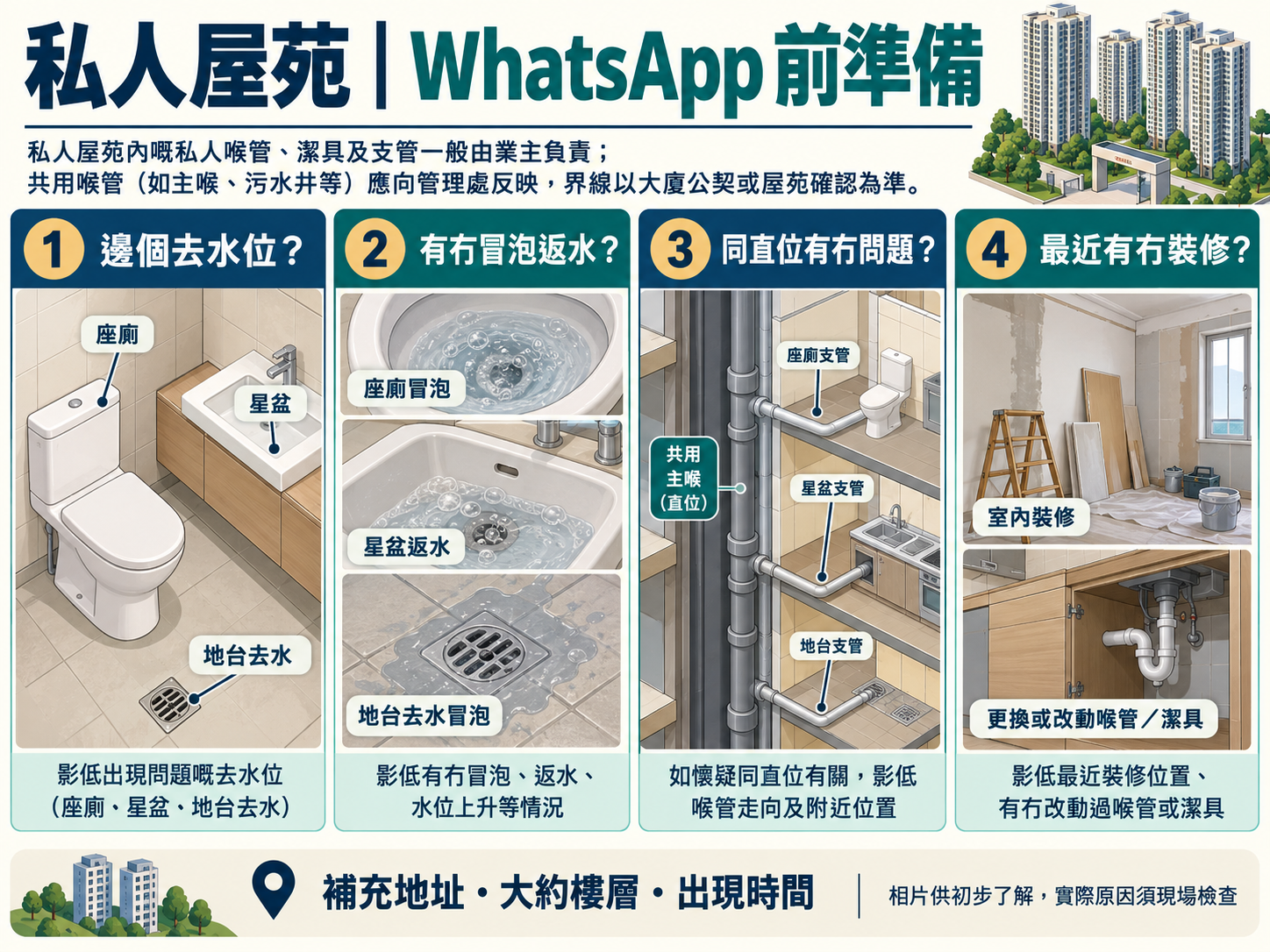
Photos or a short video on WhatsApp help us tell a single-fixture blockage from a shared-stack problem.
LOHAS Park stands at 1 LOHAS Park Road in Area 86, Siu Chik Sha, Tseung Kwan O, built over MTR LOHAS Park station and the Tseung Kwan O depot. Phase 1, The Capitol, was occupied in 2009 and the development continued phase by phase to Phase 10, LP10, in 2022, with Phase 11 (Villa Garda) occupied in 2025, Phase 12 (SEASONS) in 2025–2026, and the last phase, LA MIRABELLE, due in 2027. Under one estate name, the earliest and latest flats are more than a decade apart, and their pipework, balcony drainage and rectification arrangements differ accordingly. So when you meet drain odour, a slow drain or standing water on the balcony here, the first step is not to start rodding but to work out whether the problem lies in the flat's own traps and branch pipes, in the common pipes inside the light well or on the podium, or in the public storm drains outside the estate.
LOHAS Park was not built in one go; it has been added to phase by phase for more than a decade. Wikipedia records a 33.625-hectare site planned in 13 phases, with 50 towers of 46 to 76 storeys, 25,500 flats and unit sizes from about 280 to 3,928 sq ft. Phase 1, The Capitol, was occupied in 2009; Phase 2 followed as Le Prestige in 2010, Le Prime in 2011 and La Splendeur in 2013; Phase 3, Hemera, came in 2015 and Phase 4, Wings at Sea, in 2019; Phases 5 to 10 arrived between 2020 and 2022, Phase 11 (Villa Garda) in 2025 and Phase 12 (SEASONS) across 2025–2026, with the final phase, LA MIRABELLE, due in 2027. In other words, of two people who both say they live at LOHAS Park, one may be living in a flat seventeen years old while the other only took handover this year, and their pipe conditions, warranty periods and rectification arrangements are quite different. When you report a fault, naming your phase and rough floor level is far more useful than naming the estate.
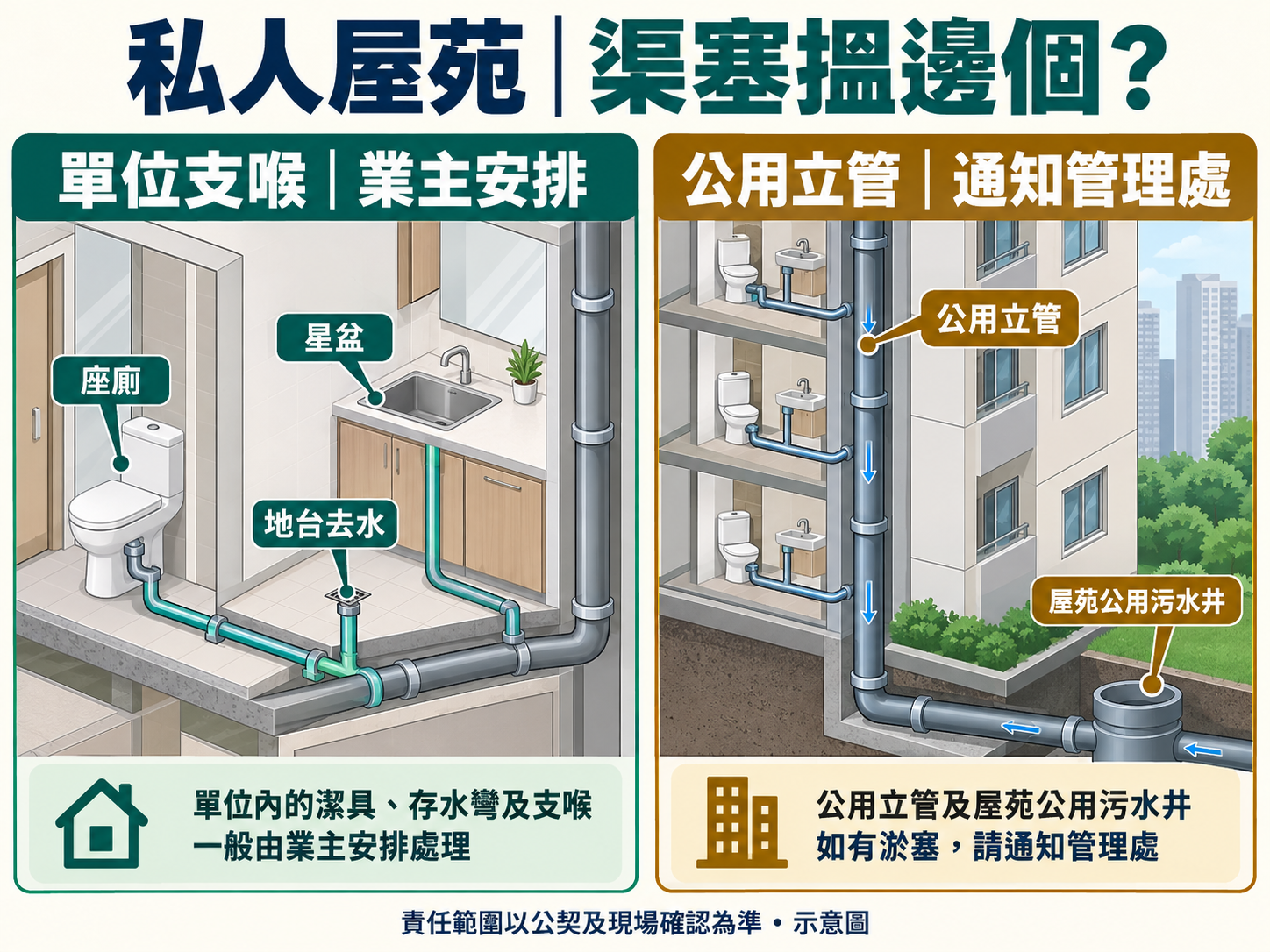
By design, the phases are built on a large podium over the MTR depot and station, so waste water from the flats passes through podium pipework before it reaches the ground drains and manholes. A resident cannot easily trace an odour or a pool of standing water at podium or ground level, and those are normally handled by the management office under the deed of mutual covenant. Buildings Department practice note APP-93 requires common soil and waste stacks in new domestic buildings to sit in common parts or in accessible pipe ducts and wells, and forbids a flat's pipework from protruding into the separately occupied flat on the floor below. On that basis it can be inferred that an owner's responsibility here usually ends at the branch pipe before the stack, and the stack itself is a common part. As an inference from how buildings of this era were built, some bathrooms and kitchens here may use a sunken slab: APP-93 says the void between the floor finish and the sunken slab must not be backfilled with concrete, and that where backfilling is unavoidable, access points or cleaning eyes must be provided so the pipework can later be inspected with a portable camera or CCTV imaging device. By design, then, a slow drain or a leak here whose source cannot be found is often traced through those access points rather than by breaking open the floor.
Location shapes how residents experience the estate too. Wikipedia records that it stands on reclaimed land between the restored Tseung Kwan O Stage I landfill (Area 77) and the Stage II/III landfill (Area 103). On flushing water, the Water Supplies Department told a District Council committee on 16 July 2026 that the Tseung Kwan O seawater pumping station supplies flushing water to LOHAS Park and the Shek Kok Road area. On 5 September 2017 the District Council passed a motion calling for a full investigation into the sources of odour around Tseung Kwan O South, LOHAS Park, Alto Residences and the Tseung Kwan O Industrial Estate; the Environmental Protection Department's reply listed locations including drainage maintenance works in Chun Wang Street and Chun Yat Street, one member described several distinct smells in the area including a sewage smell from drainage works, and while one member read the EPD reply as showing the odour did not appear to come from the landfill, another questioned that conclusion as guesswork. So a smell at LOHAS Park needs sorting into two layers: an outdoor smell that comes and goes and is only noticeable with a window open, and a persistent bathroom or kitchen drain smell that is still there with the windows shut. The causes and the fixes are different.
Note: statements based on building age and type are general inferences, not findings for any particular flat.
A clear process from enquiry and assessment to an agreed scope of work
Tell us the drain problem and district and ask about available timing.
Confirm timing based on the district and schedule, then inspect the blockage or odour issue.
Explain the proposed approach, scope and price before agreed work begins.
Use suitable tools for the site conditions and agreed scope of work.
After the agreed work, test drainage and explain the observed result and any next steps.
PipeButler is an independent drain-service provider with no affiliation to the developer, owners' corporation, management company or Housing Department of the places above. Facts come from public sources checked on the dates shown; work on common drains or common parts follows the management office's and deed of mutual covenant's arrangements.
WhatsApp with the problem and district, and we will confirm available timing.