
Loading page…
Loading page…
TKO South · Private estate
Five separate projects occupied 2012–2018 · about 3,729 flats · coastal backflow & new-build blockages
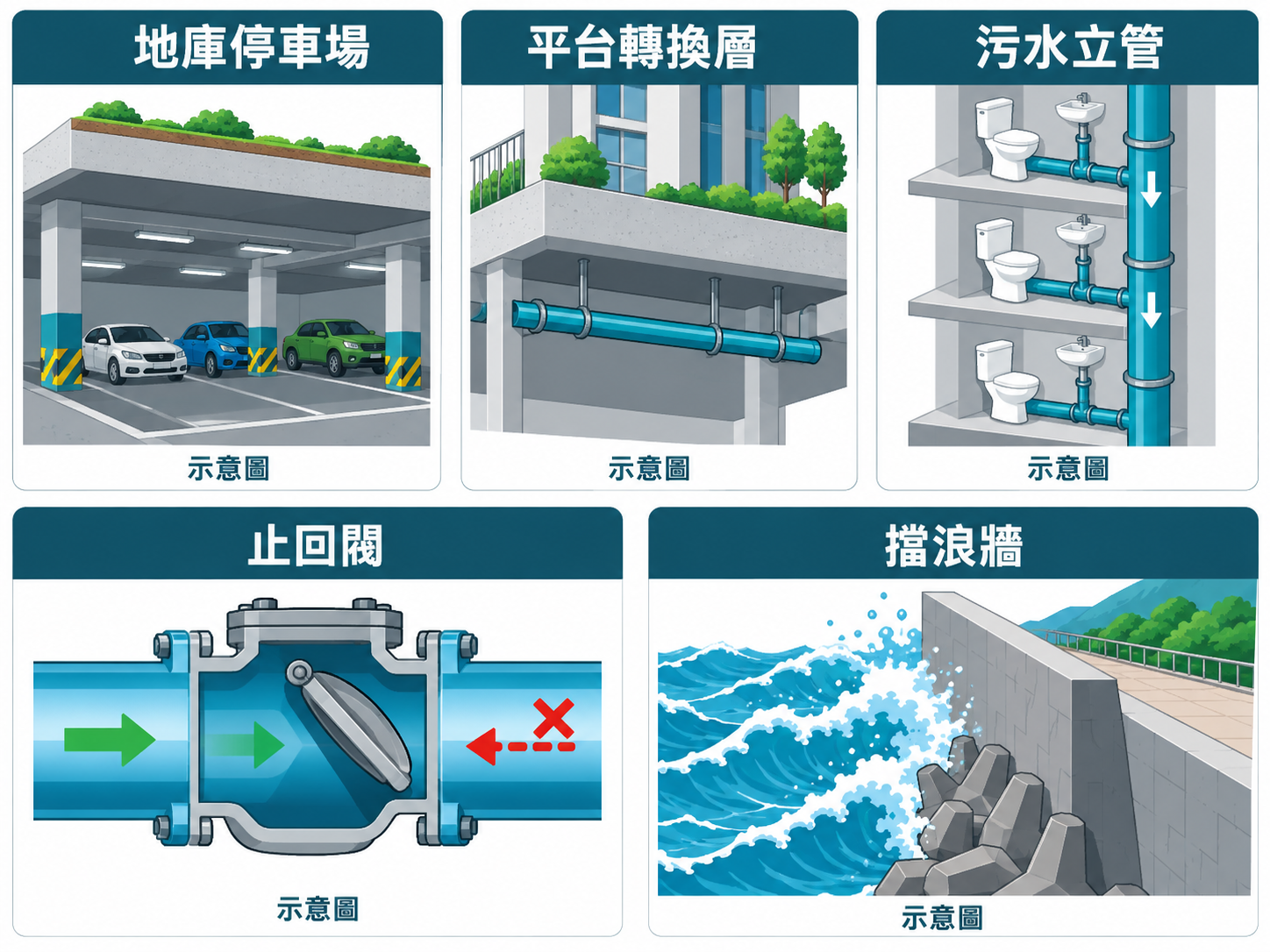
The Wings, The Wings II, The Wings IIIA, The Wings IIIB and Ocean Wings are five separate developments, occupied one after another between 2012 and 2018, running from the podium above MTR Tseung Kwan O station out towards the sea along Tong Chun Street and Chi Shin Street — about 3,729 flats in all.
Last reviewed ·
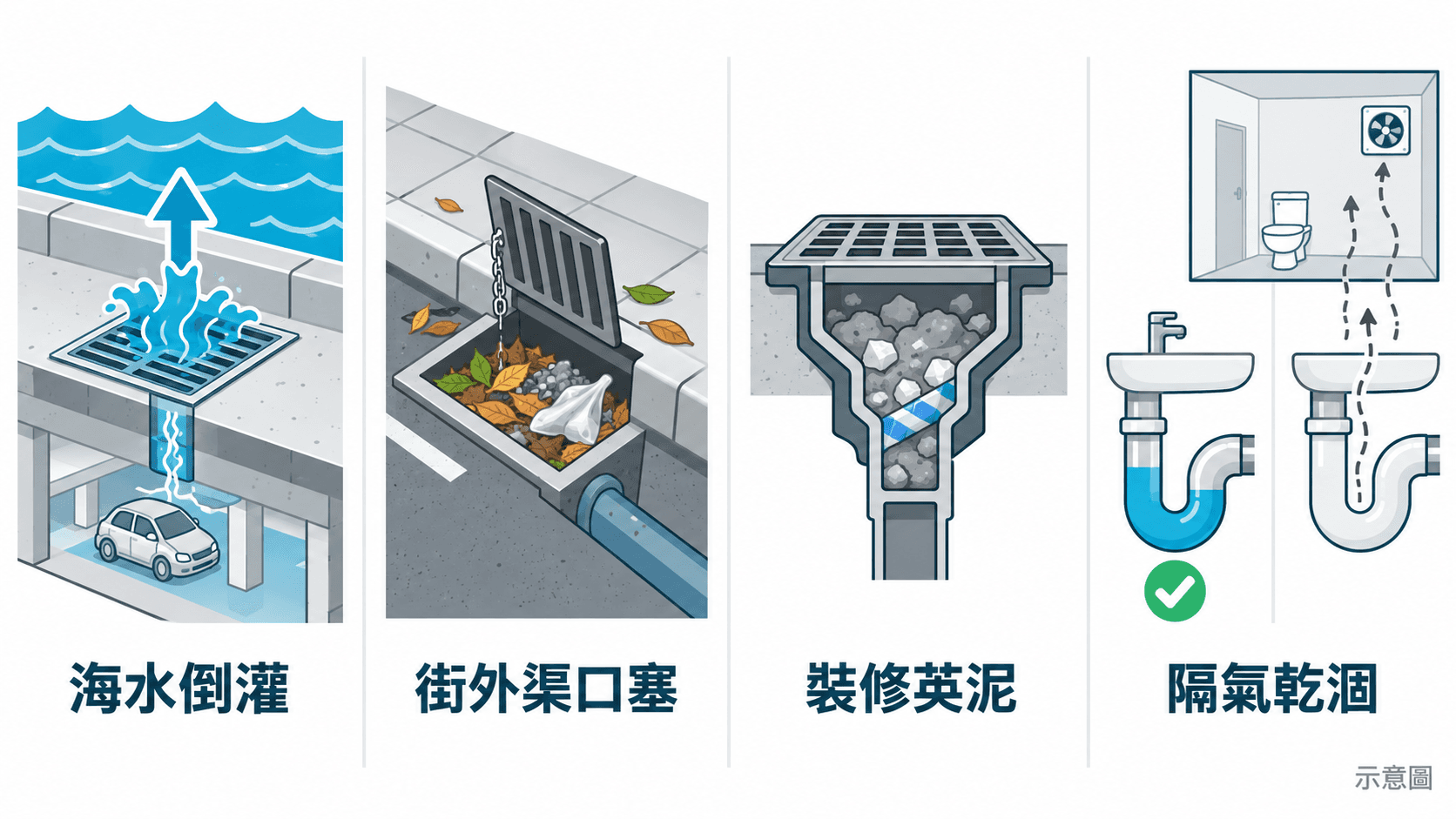
Choose the problem you are seeing to read the likely cause and next step.
At the Sai Kung District Council's special meeting on the typhoon on 15 October 2018, a member said seawater backflow had affected some TKO South estates; another member said the backflow in TKO South was serious, that flooding reached Chi Shin Street and that the car park of one private estate was affected (the minutes do not name it). At the council meeting of 6 November 2018 the Drainage Services Department said that, because seawater had flooded some coastal estates after the typhoon, it had visited coastal estates including Ocean Wings, The Wings 3A and The Wings 3B to review their drainage design. The 2021 coastal hazard study by the Civil Engineering and Development Department also suggests stakeholders consider drainage improvements site by site, "such as pumping facilities and fitting non-return valves on drains". If a basement or ground-level floor drain backs up, holds water, carries silt or smells salty after a typhoon, ask the management office to check the sump, pumps and non-return devices; the branch pipes inside your flat can be checked and cleared separately.
At the Sai Kung District Council meeting of 6 March 2018 a member reported that every typhoon season the drain covers on the promenade and on Tong Yin Street and Tong Chun Street get lifted, and that the Drainage Services Department had added chains, rubber edging and barriers around them. In November that year the department said it had completed the redesign of five sets of storm-damaged covers on the TKO South promenade, with the repair works then due for December. These are public stormwater drains, not estate pipework, but when a street gully is choked with grit, leaves or plastic bags, the drains at estate entrances, on podiums and on ramps also run slowly. Before and after the typhoon season it is worth glancing at the outlets inside the estate for leaf build-up, and reporting a blocked street gully to the management office or straight to the department.
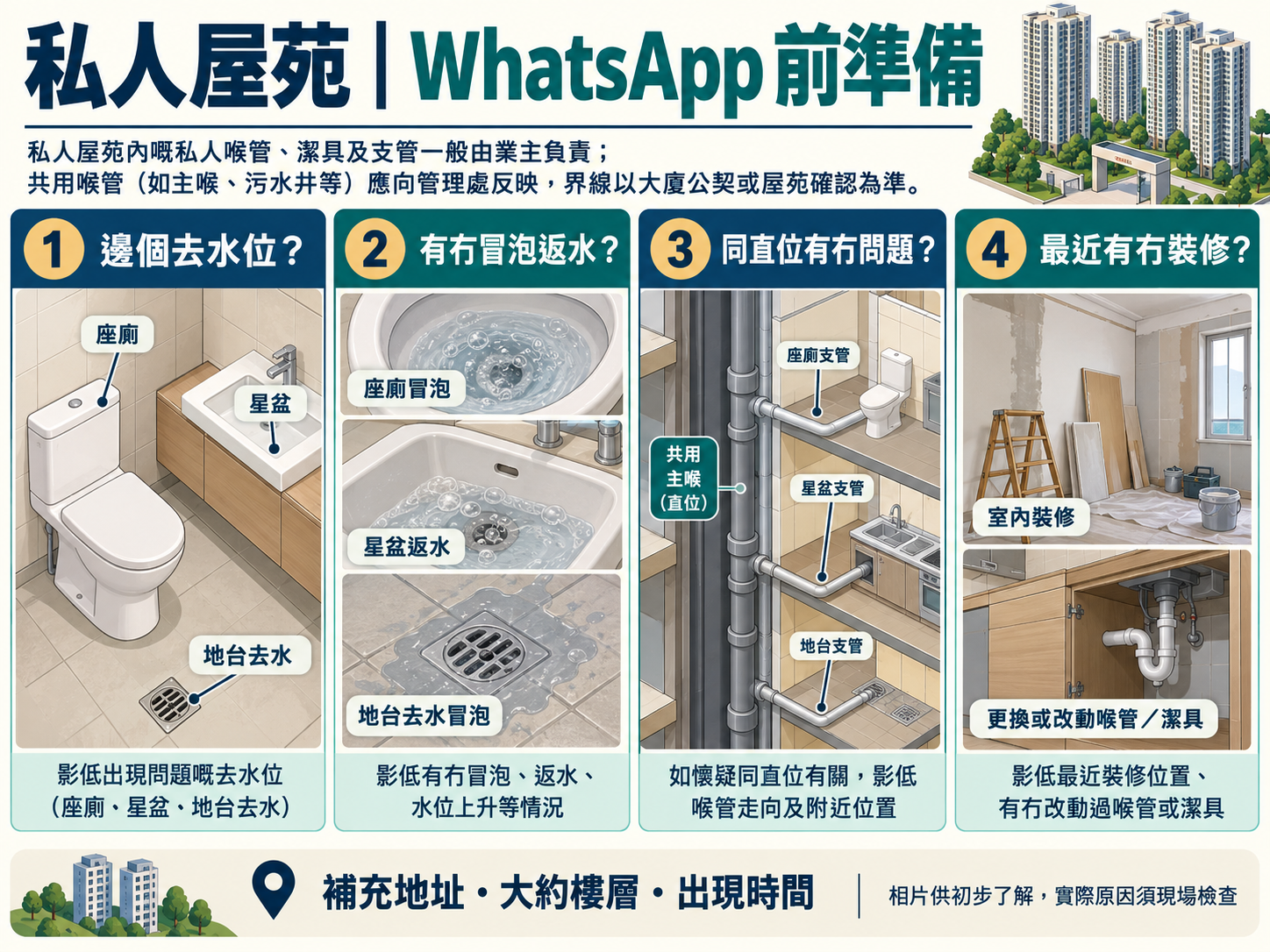
The five phases were occupied between 2012 and 2018, so as an inference from building age the pipes themselves are unlikely to be corroded or scaled. What turns up far more often is material left behind at handover and during fitting-out: a floor-drain outlet narrowed by cement, marble chips or plaster crumbs, renovation debris sitting in a sink trap, or protective tape over an outlet that was never fully removed. The tell-tale sign is a single fixture that is permanently slow — the water goes, but never briskly, and swirls when you run a lot of it. Opening the trap to clean it, or rodding the branch with a flexible cable, usually settles it; replacing pipework is rarely the first answer.
Standard flats at The Wings run from 692 to 1,668 sq ft gross, and the larger layouts have two en-suites plus a utility room with its own WC. Judging from those layouts, homes of that kind have a guest bathroom and a utility floor drain on top of the main bathroom, and neither gets daily use. As an inference from the design, a U-trap relies on a short column of water to block sewer air; with nothing to top it up the seal evaporates, and the smell is usually strongest when the door is shut and the extractor fan creates negative pressure. Ventilation is the other factor: answering a question on enclosed light wells at the Sai Kung District Council on 3 May 2022, the Buildings Department said the law currently permits the design, that it had studied how a ventilation opening at the bottom of a light well helps airflow, and that without the design toilets might have no window at all. Either way — a window onto an enclosed shaft, or no window — air moves little and odour lingers, which makes topping up the seals more important, not less: about half a litre of water into each drain once a week is enough.
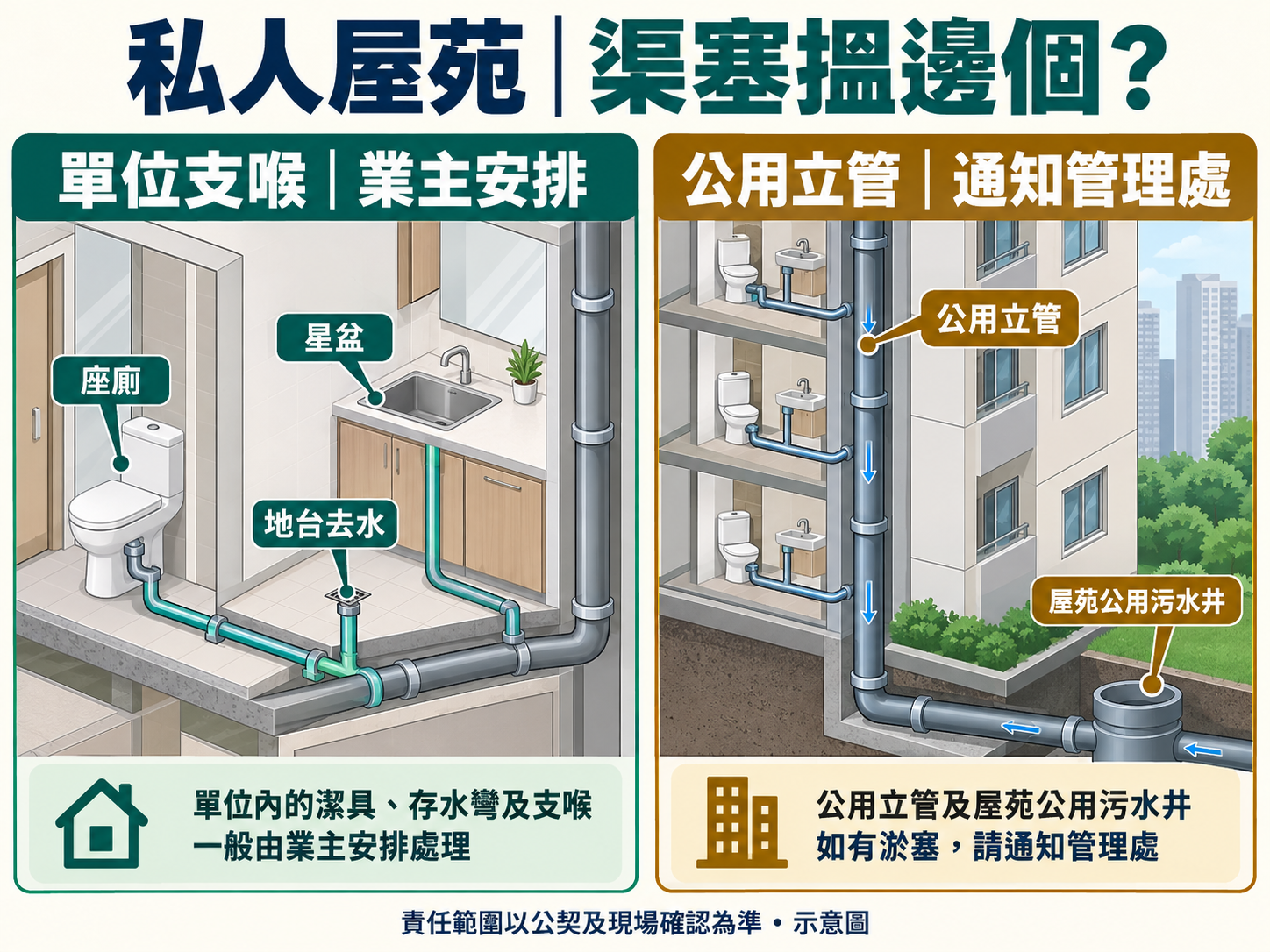
Ocean Wings has flats at ground level and three houses running from ground to 1/F, while the other phases start above a podium. As an inference from the design, the lowest fixture on a soil stack is the one that shows a rising water level, bubbling, gurgling or slow draining when the floors above discharge together, and ground and basement drains are the first to feel the water level outside the estate. The test is simple: if the toilet and the floor drain back up at the same time, especially while flats above are running water or a washing machine, the problem is usually not your own branch pipe. Tell the management office straight away so the stack, the estate manholes and the basement sump can be checked, and do not pour drain cleaner down it.
Photos or a short video on WhatsApp help us tell a single-fixture blockage from a shared-stack problem.
The Wings, The Wings II, The Wings IIIA, The Wings IIIB and Ocean Wings are five separate developments, occupied one after another between 2012 and 2018, running from the podium above MTR Tseung Kwan O station out towards the sea along Tong Chun Street and Chi Shin Street — about 3,729 flats in all. Because the buildings are young, drainage here behaves differently from an older district — judging from their age and location, one common cause is cement and debris left in the pipes at handover and during renovation; the other is seawater backing up at a low-lying coastal site during a storm surge. After Super Typhoon Mangkhut in 2018 the Drainage Services Department visited Ocean Wings, The Wings 3A and The Wings 3B to review the estates' drainage design and give advice.
Many people assume "The Wings" is one estate built in phases. In fact these are five separate developments with their own lots, land grants and deeds of mutual covenant: The Wings (9 Tong Yin Street, 6 blocks, 1,028 flats, occupied December 2012, built above MTR Tseung Kwan O station and the PopCorn mall), The Wings II (12 Tong Chun Street, 4 blocks, 784 flats, completed September 2014), The Wings IIIA (19 Tong Yin Street, 960 flats) and The Wings IIIB (19 Chi Shin Street, 1 block, 329 flats, both completed January 2017), and Ocean Wings (28 Tong Chun Street, 7 blocks of 7–18 storeys plus 3 houses, 628 flats, occupied January 2018). So the first step in "who do I call about a blocked drain here" is to say which of the five you live in.
All five share the same section: basement car park, then a mall or clubhouse podium, then the flats. The Wings has parking on B2–B1, The Wings II on B3–B1 including loading, and The Wings IIIA and IIIB on B2–B1; homes start at 5/F or 2/F depending on the phase. Ocean Wings adds flats at ground level and three houses on G–1/F above its basement car park. Every phase has a transfer plate between podium and tower. Judging from the layout, a soil stack usually has to offset sideways around that transfer level, and a horizontal run drains slowly, so it is where grease and debris tend to settle — while the drains nearest ground and basement level are the first to show water in heavy rain or a storm surge.
Geographically, the first phase sits on the station podium and the later phases run towards Tong Chun Street, Chi Shin Street and the promenade, in the TKO South coastal strip. At the Sai Kung District Council meeting of 4 November 2025 the Civil Engineering and Development Department said the TKO South coastal formation level is about 5.5 m above Hong Kong Principal Datum, that a wave wall about 600 m long and 1.1 m high was built along the promenade in 2019, and that a second wall about 1.3 m high is expected to be complete by the end of 2026 — and that damage to promenade facilities during Super Typhoon Ragasa in 2025 was clearly less than during Mangkhut in 2018. The department's coastal hazard study, completed in 2021, also lists "TKO South (Tseung Kwan O Waterfront Park)" among 26 identified residential areas and notes that wave overtopping is the main coastal risk on Hong Kong's southern and south-eastern shores.
Note: statements based on building age and type are general inferences, not findings for any particular flat.
A clear process from enquiry and assessment to an agreed scope of work
Tell us the drain problem and district and ask about available timing.
Confirm timing based on the district and schedule, then inspect the blockage or odour issue.
Explain the proposed approach, scope and price before agreed work begins.
Use suitable tools for the site conditions and agreed scope of work.
After the agreed work, test drainage and explain the observed result and any next steps.
PipeButler is an independent drain-service provider with no affiliation to the developer, owners' corporation, management company or Housing Department of the places above. Facts come from public sources checked on the dates shown; work on common drains or common parts follows the management office's and deed of mutual covenant's arrangements.
WhatsApp with the problem and district, and we will confirm available timing.