
Loading page…
Loading page…
Hang Hau · HOS / PSPS
Completed 1990 · 6 blocks, 2,450 flats · flats from G/F in Blocks 5 and 6
Fu Ning Garden stands at 25 Po Ning Road in Hang Hau and was the first estate completed in the area.
Last reviewed ·
Choose the problem you are seeing to read the likely cause and next step.
The adopted minutes of the first 2021 meeting of the Sai Kung District Council's Housing, Planning and Environment Committee (21 September 2021) list a carried-forward item: a request that the Buildings Department give technical support to residents of Fu Ning Garden and On Ning Garden whose drainage traps were alleged not to meet the legal requirements, so that the problem could be corrected, and give financial help to households in difficulty so that residents would not continue to bear a health risk. The department's written reply of 20 August 2021 (paper SKDC(HPEC) No. 15/21) made three points: that since the Minor Works Control System began in 2010 an owner wishing to erect, alter or remove a flat's drainage system, including an anti-syphonage pipe or a trap, may appoint a registered contractor under simplified requirements; that certifying or carrying out minor works without reasonable excuse by someone not qualified is an offence; and that staff had been sent on 11 May to give the estate's management company a set of guidelines. The committee noted the reply and the chair proposed deleting the item at the next meeting. Note what the reply does not say: it does not confirm that any flat's trap or anti-syphonage pipe breaches the regulations, and mentions no order or investigation finding. For a household, the practical step is to look at the hardware flat by flat — is the trap still there, has it been swapped for one without an anti-syphonage function, and was the anti-syphonage pipe sealed off or removed during a refit?
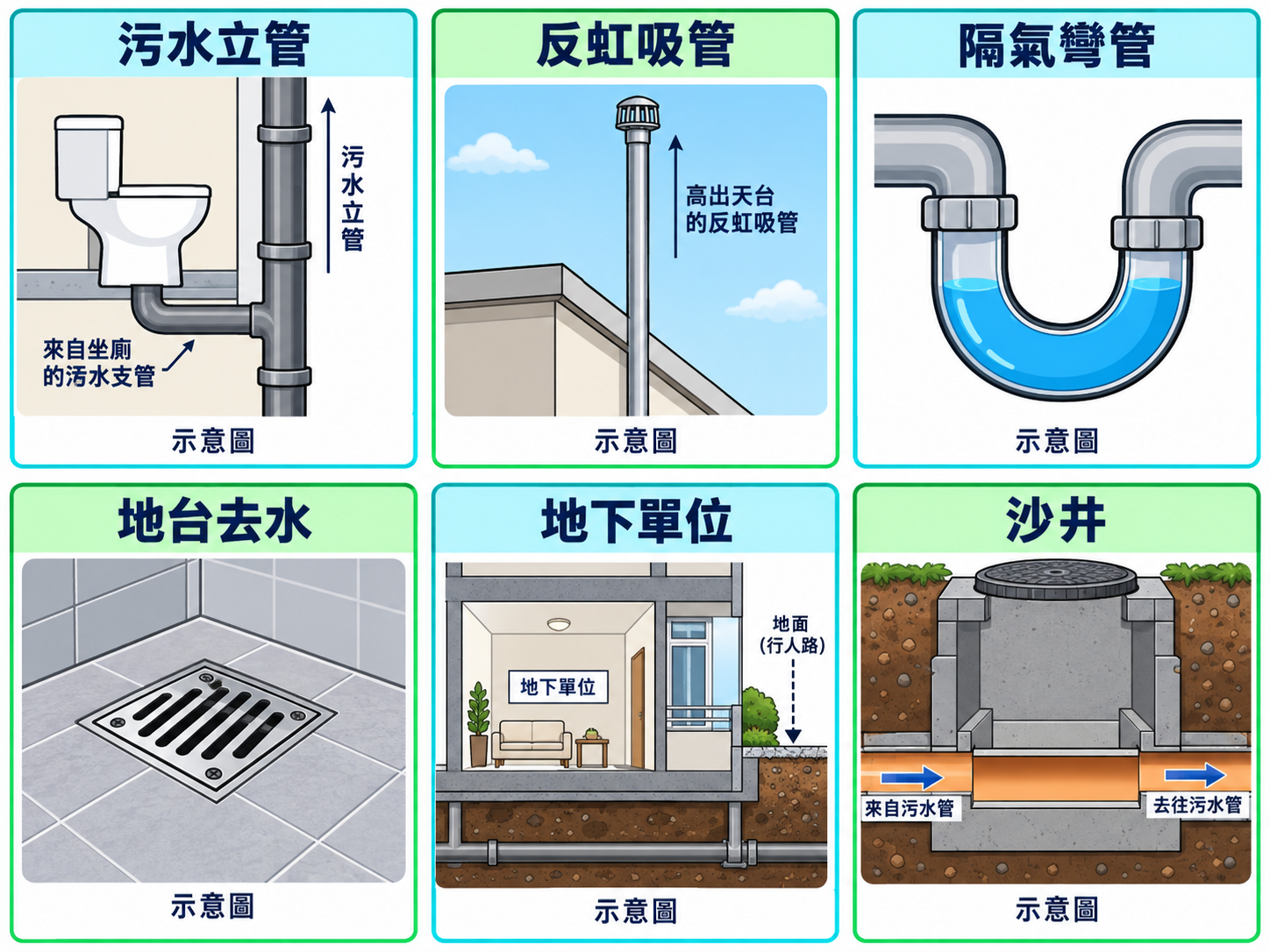
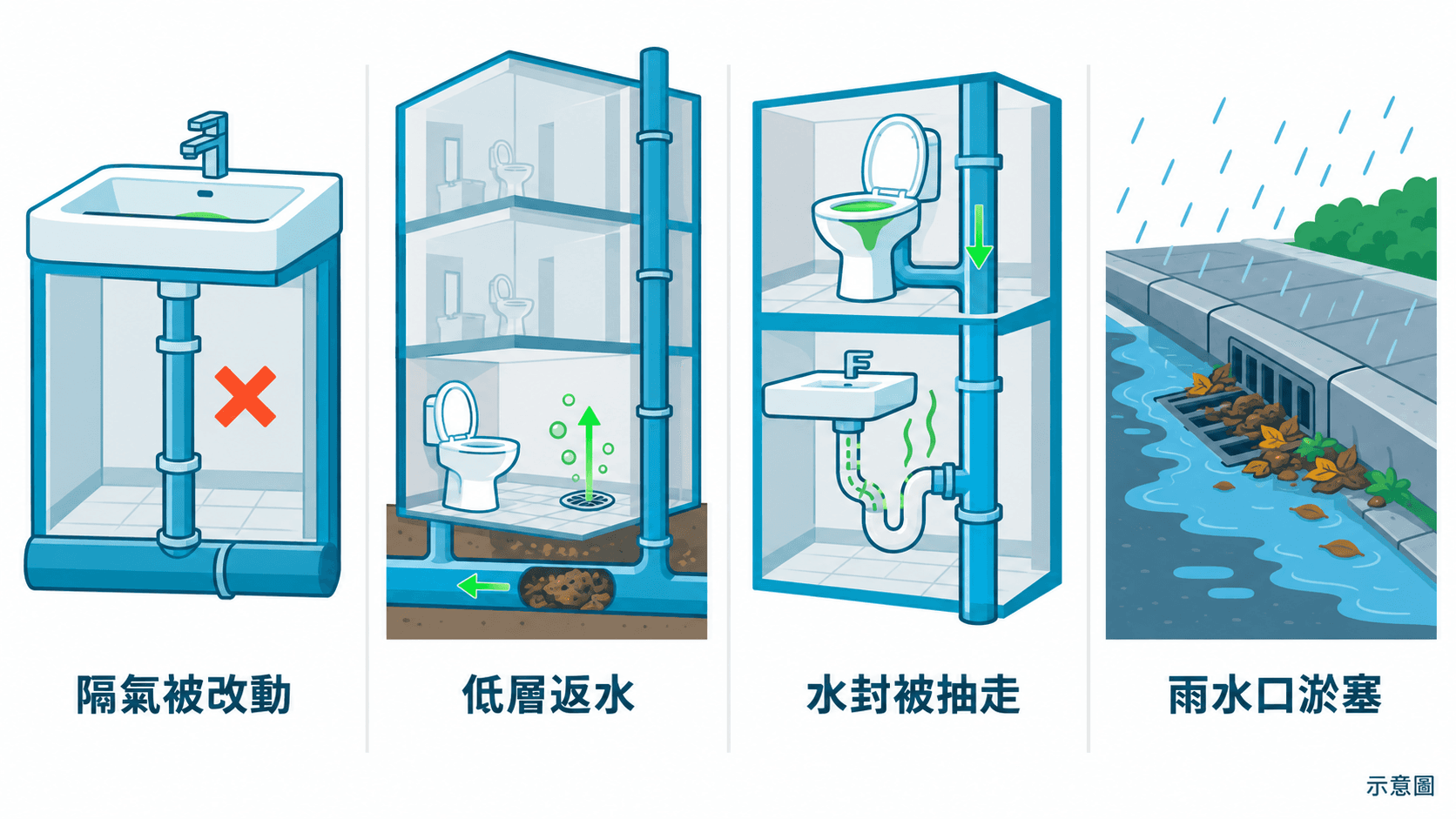
Buildings Department practice note APP-164 requires fitments on the lowest floor — and, in buildings over 20 storeys, the floor above it — to discharge through separate pipework straight to a manhole, and restricts branch connections near offsets in the stack; APP-93 of 1997 already required separate pipework for fitments at the foot of the stack in buildings over three storeys. Fu Ning Garden was completed in 1990, before both notes, and Blocks 5 and 6 have flats from the ground floor up. Inferring from that design, toilets and floor drains on the ground and lowest floors may connect close to the base of the stack, so once the lower part of the stack is narrowed by grease, tissue or debris, the bottom few floors are the first to bubble, rise or back up when the flats above are all running water. How to tell them apart: if only one fitment in your flat is slow, the branch pipe inside the flat is the likely cause; if the toilet and floor drain react together and the timing matches use upstairs, tell the management office at once so the shared stack and manholes can be checked.
The Buildings Department's Healthy Drains page explains the mechanism plainly: a trap holds water to form a seal against sewer air, and when an upper flat discharges enough sewage the siphon effect creates negative pressure in the branch pipes of the flat below, enough to suck the water seal out of a fitment's trap. The anti-syphonage pipe must run at least one metre above the roof and stay unsealed so air can flow in and balance the pressure. Wikipedia, citing Centadata, records 35 storeys per block and the Housing Authority record 12 flats per floor, so a great many flats share each vertical line and the mechanism shows up readily. The symptom is familiar: after a flush or a washing-machine discharge upstairs, your bathroom gurgles and then smells, though nothing is actually blocked. When that happens, do not simply change the extractor fan or add fragrance; check that fitment's trap and its anti-syphonage connection. The March 2021 guidance delivered to this estate also warns against installing an over-powered exhaust fan in a bathroom.
The guidance mentioned in the Buildings Department's reply is its March 2021 booklet on inspecting and maintaining the drainage pipes and sanitary fitments of a residential unit, delivered to Fu Ning Garden's management company on 11 May 2021. Its advice is concrete: pour about half a litre of clean water into every floor drain each week; make sure every sanitary fitment has a suitable trap; when a bathtub is replaced by a shower tray, a suitable trap must be installed; a washing-machine outlet should have a suitable trap and connect to a waste pipe; and never remove or alter anti-syphonage pipes or traps fitted with anti-syphonage air valves, nor replace a trap that has an anti-syphonage function with one that does not. It also lists the signs to report immediately to the management office or a qualified professional or contractor: foul smells or odd sounds from pipes or fitments, cracks or rust stains, loosened pipe brackets, leaks or blockages, and bubbles coming out of the toilet from time to time. Those are the first things we look at on a call-out as well.
At the Sai Kung District Council on 6 May 2025, a member reported that the Po Ning Road and Ying Yip Road area floods easily in heavy rain, noted the several large excavation sites and roundabout improvement works nearby, and asked the Drainage Services Department to step up inspection and clearing of silt and soil before the wet season so that flooding would not affect the nearby Po Leung Kuk Ho Yuk Ching Secondary School. The department's Tseung Kwan O engineer replied that extra staff are deployed in the wet season to inspect channels prone to blockage by refuse or fallen leaves, and that with a number of construction sites active around Po Ning Road and Ying Yip Road the department inspects and clears its own facilities there regularly. Po Ning Road is the estate's own address. To be clear: street stormwater drains and your flat's foul drainage are separate paths, and flooding outside will not block your toilet directly. But if a low-floor flat sees the floor drain bubbling or the toilet level rising and falling during a rainstorm, tell the management office straight away and record the time and what you saw.
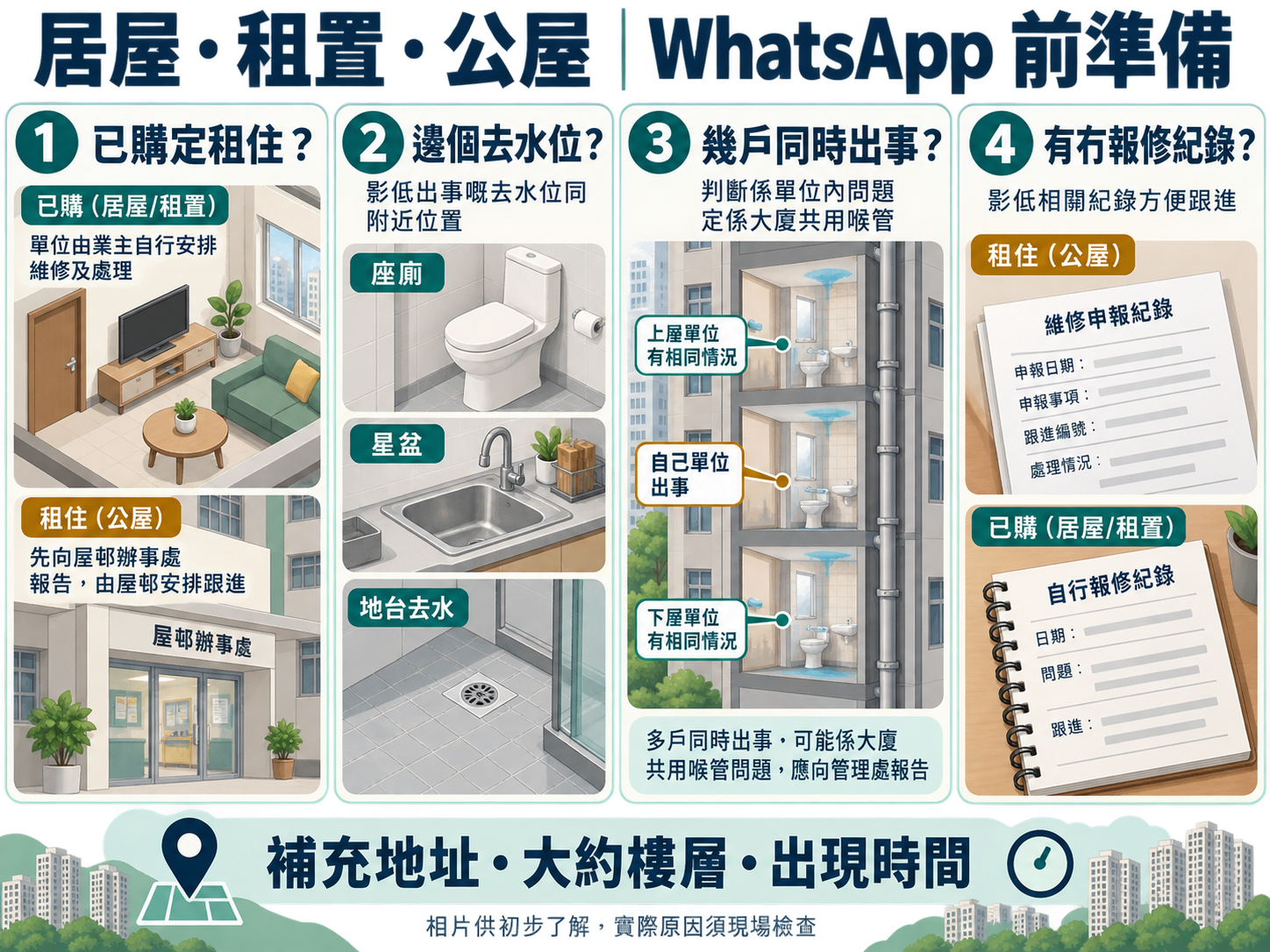
Photos or a short video on WhatsApp help us tell a single-fixture blockage from a shared-stack problem.
Fu Ning Garden stands at 25 Po Ning Road in Hang Hau and was the first estate completed in the area. The Housing Authority's estate record for the sale of surplus subsidised flats gives the building completion date as 4 June 1990 under the Private Sector Participation Scheme, with six blocks in all. In 2021 the Sai Kung District Council took up an item asking the Buildings Department to help residents of Fu Ning Garden and On Ning Garden whose drainage traps were alleged not to meet the regulations; the department's written reply set out the rules for altering a drainage system and recorded the guidance it had distributed, but did not confirm a breach in any flat. So here, a bathroom smell, a slow toilet or backflow on a low floor starts with one question: is the fault in the flat's own traps and branch pipes, or in the shared stack, external pipes and estate drains?
The Housing Authority's estate record in the third sale of surplus subsidised flats gives Fu Ning Garden's address as 25 Po Ning Road, its design as the Private Sector Participation Scheme, its building completion date as 4 June 1990 and its total as six residential blocks, with a government lease running from 18 January 1988 to 30 June 2047 and an owners' corporation already formed. The same record carries a sample floor plan: Blocks 5 and 6 have 12 flats on each floor from 1/F to 34/F, lettered A to M with no I, arranged around the central lift lobby, staircase and a light well, with no A, F, G or M flats on 33/F and 34/F; the floor-area table begins at G/F, so there are flats on the ground floor too. Wikipedia, citing Centadata and the Housing Authority sales brochure, records 2,450 flats, 35 storeys per block and flats of 504 to 661 sq ft at a 90% efficiency ratio; the Housing Authority's own floor-area table in the same record is set out in square metres instead (Block 4: 51.2 gross, 46.0 saleable; Blocks 5 and 6: 61.3 gross, 55.0 saleable), and the Wikipedia entry's infobox gives 495 to 656 sq ft, so the three records are not measured the same way — your own deed is what counts. Reading the plan, the kitchens and bathrooms of flats in the same wing sit one above another, so a whole vertical line of flats shares one set of stacks; neighbours above and below affecting each other is normal here and does not mean any one household is at fault.
Completed in 1990, the estate is now 36 years old. Inferring from that year, its drainage was designed before two important Buildings Department practice notes: APP-93 of 1997, which requires common soil and waste stacks to sit in common parts or accessible pipe ducts and requires buildings over three storeys to give fitments at the foot of the stack separate pipework straight to a manhole, and APP-164 of 2021, which requires used water to refill the traps of kitchen and bathroom floor drains, cross-venting to the main anti-syphonage pipe at least every three storeys in buildings over 20 storeys, and separate discharge to a manhole for fitments on the lowest floor. Ground-floor and low-floor fitments in a block of this generation may therefore connect close to the base of the stack, and when the lower part of a stack or its outlet narrows, bubbling and rising water usually show up in the bottom few floors first. That is an inference from the dates of the regulations, not a statement that anything is wrong at the estate today.
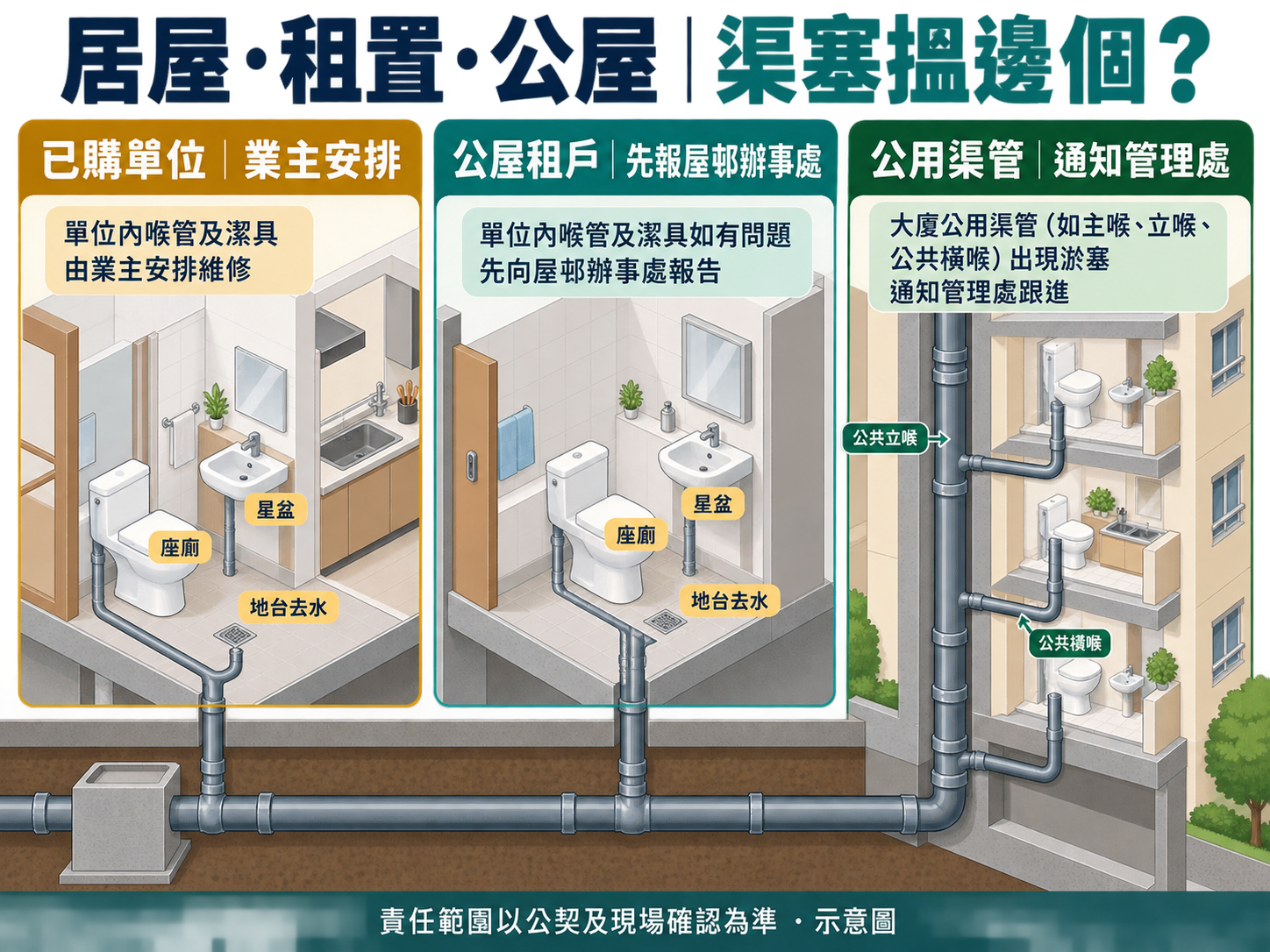
The other thing to watch is thirty-odd years of refurbishment. Inferring from age, most flats have been renovated at least once or twice, and converting a bathtub to a shower tray, adding a washing-machine outlet or changing a kitchen layout all disturb traps, branch pipes and anti-syphonage connections. The Buildings Department's Healthy Drains page draws the line clearly: ordinary repair or replacement of an internal branch pipe or sanitary fitment is exempted building works, but repairing external pipes or an internal main pipe — and erecting, altering or removing a flat's drainage system, including the anti-syphonage pipe — must go through the Minor Works Control System with a registered contractor. The estate also has a small shopping centre and market, whose floor drains and grease traps belong to a different management scope; if you smell cooking grease at ground level, letting the management office identify the source under the deed of mutual covenant is faster than guessing. What any particular flat is like today depends on its own and its block's repair history, not on the estate name.
Note: statements based on building age and type are general inferences, not findings for any particular flat.
A clear process from enquiry and assessment to an agreed scope of work
Tell us the drain problem and district and ask about available timing.
Confirm timing based on the district and schedule, then inspect the blockage or odour issue.
Explain the proposed approach, scope and price before agreed work begins.
Use suitable tools for the site conditions and agreed scope of work.
After the agreed work, test drainage and explain the observed result and any next steps.
PipeButler is an independent drain-service provider with no affiliation to the developer, owners' corporation, management company or Housing Department of the places above. Facts come from public sources checked on the dates shown; work on common drains or common parts follows the management office's and deed of mutual covenant's arrangements.
WhatsApp with the problem and district, and we will confirm available timing.