
Loading page…
Loading page…
Hang Hau · HOS / PSPS · Private estate · Public rental housing · Village houses
Town area built on reclaimed land from 1990 · subsidised courts, MTR-podium towers and Clear Water Bay Road village houses
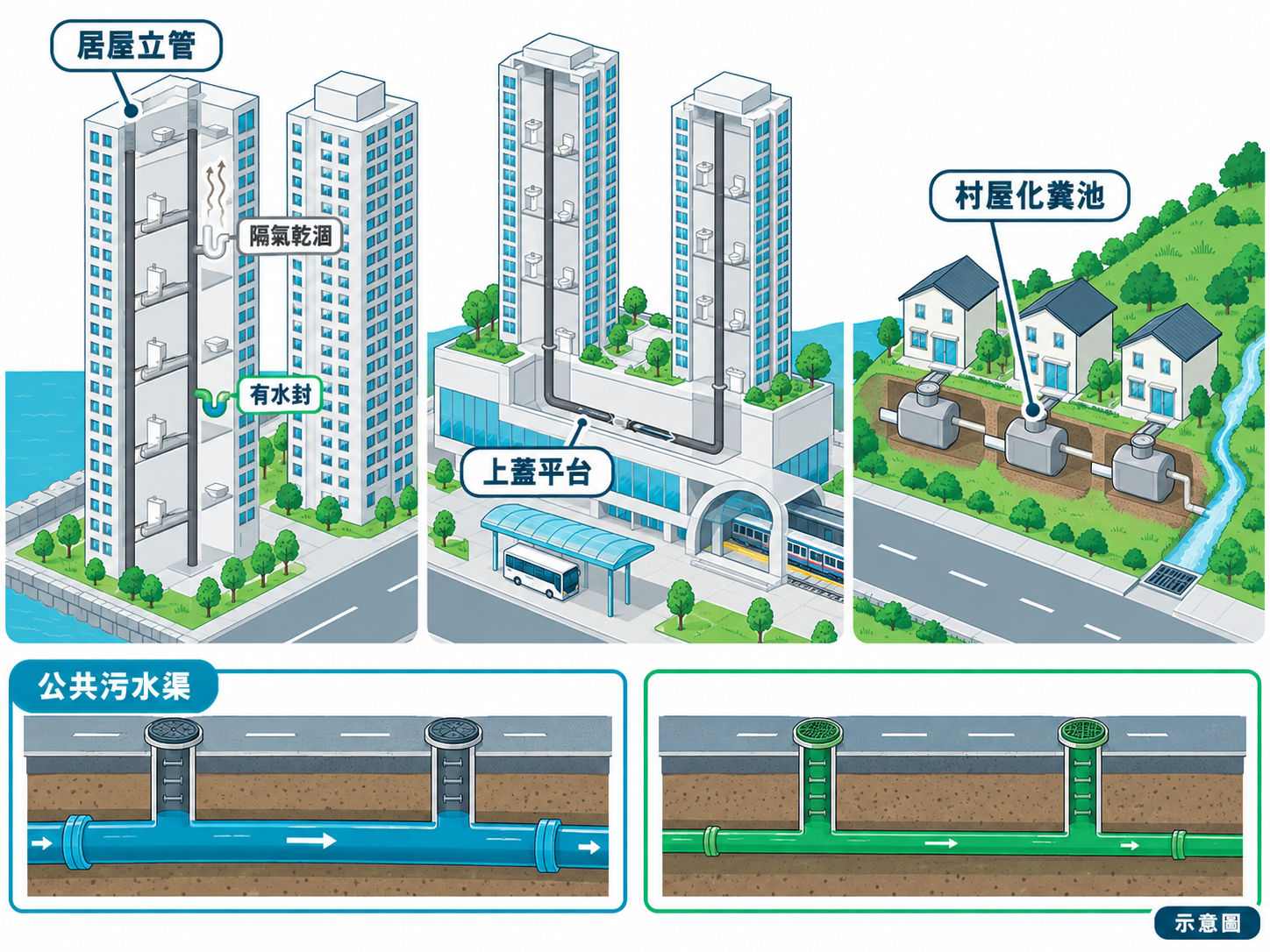
Hang Hau sits on the eastern side of Tseung Kwan O New Town, on land largely reclaimed around the old Hang Hau bay.
Last reviewed ·
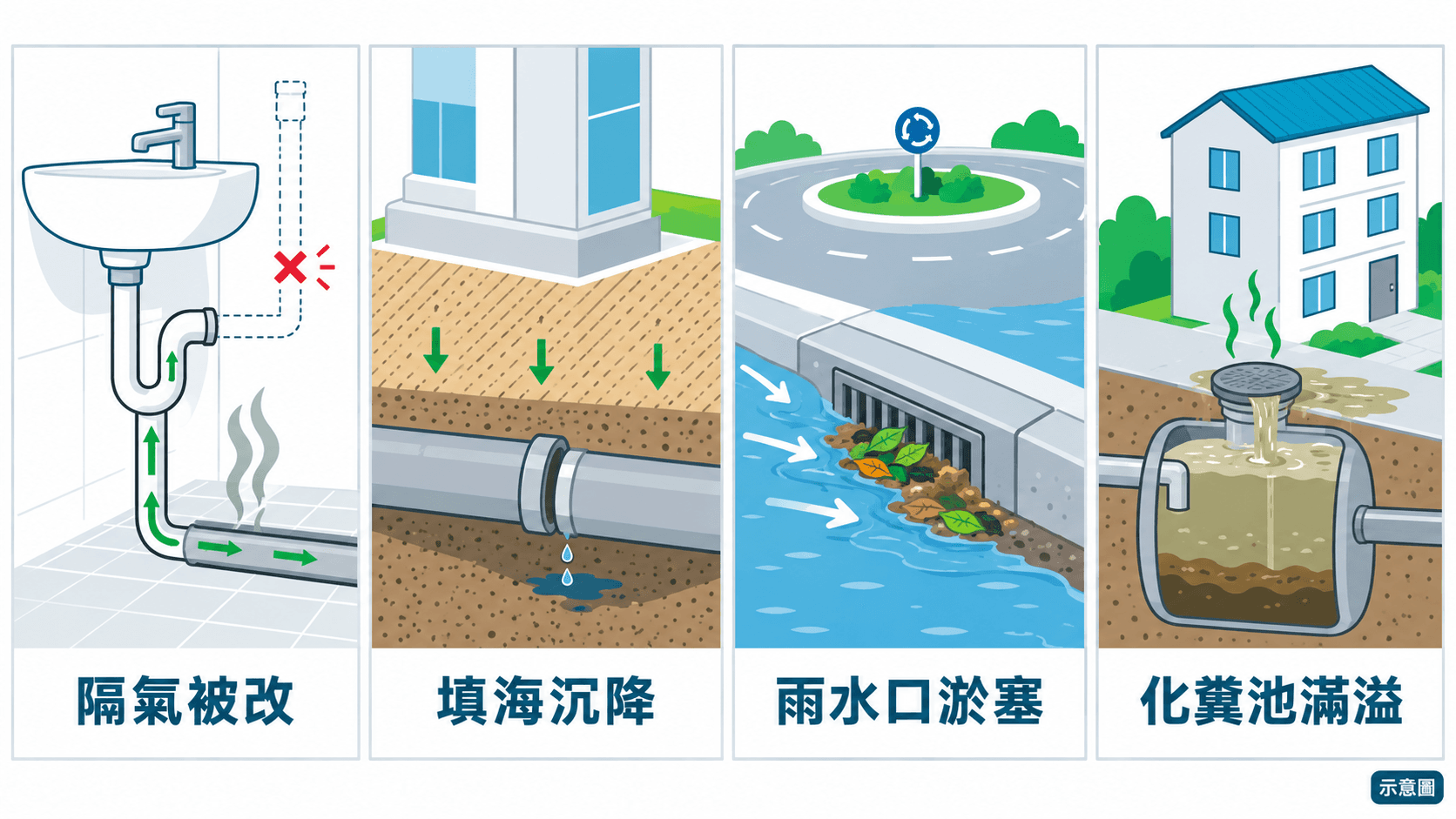
Choose the problem you are seeing to read the likely cause and next step.
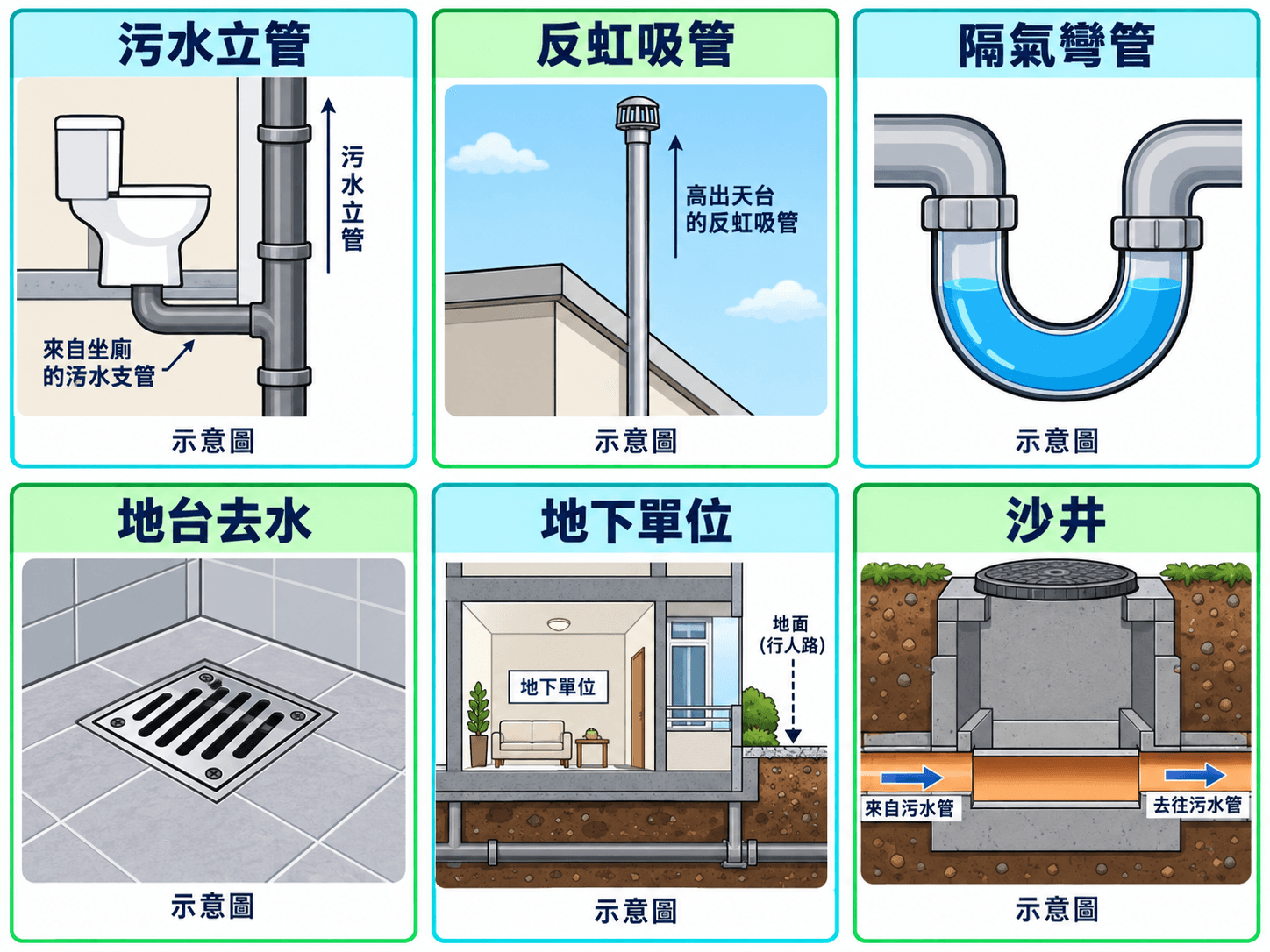
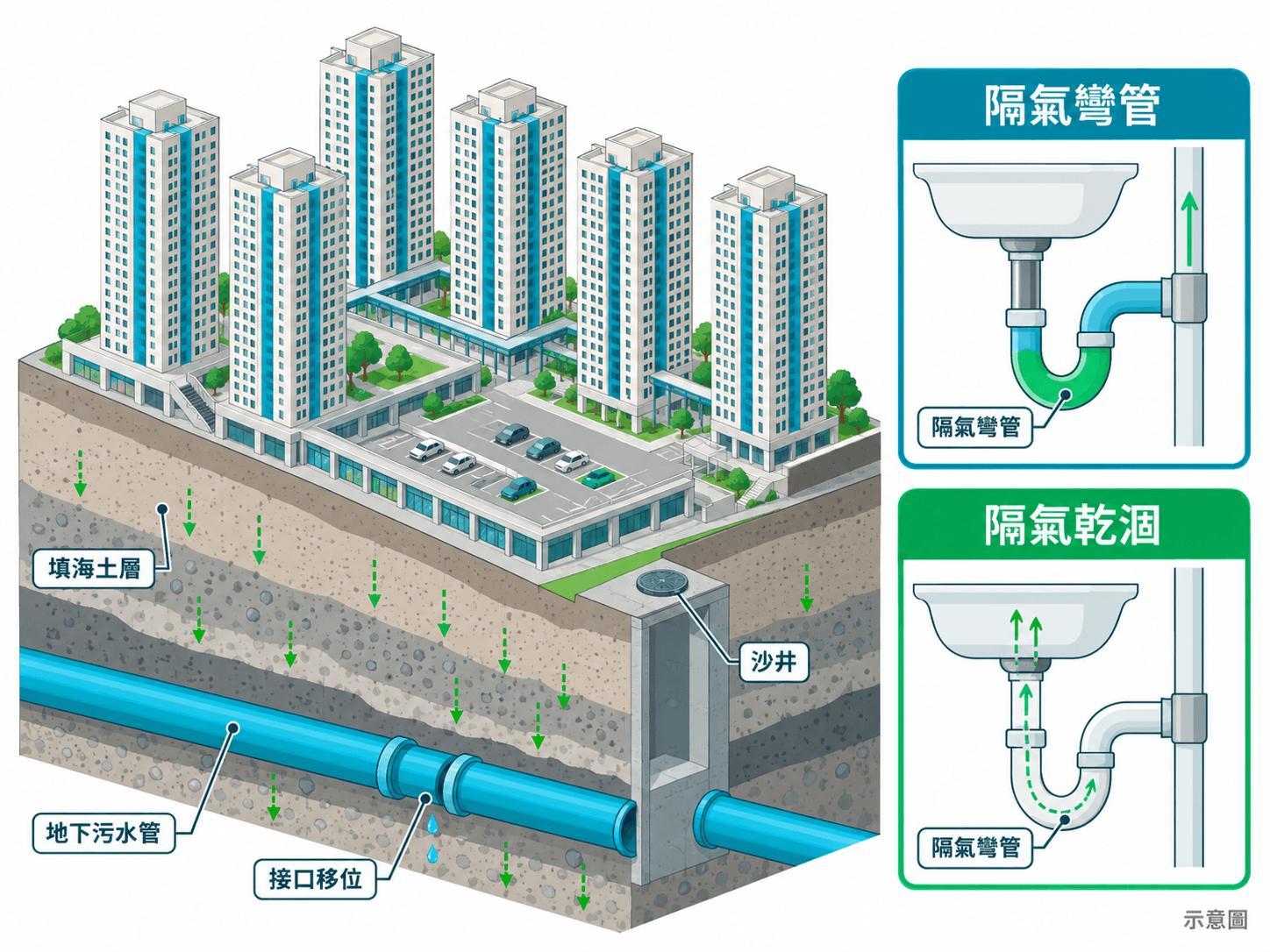
On 20 July 2021 the Sai Kung District Council's Housing and Planning Development Committee took up an item asking the Buildings Department to give technical support on drainage pipes to residents of Fu Ning Garden and On Ning Garden. The department's written reply of 20 August (paper SKDC(HPEC) No. 15/21) stated that an owner wishing to erect, alter or remove the drainage system of a flat, including an anti-syphonage pipe or a trap, may appoint a registered contractor under the Minor Works Control System, and that staff had distributed a set of guidelines to the management company of Fu Ning Garden on 11 May and planned to do the same at On Ning Garden on 24 and 25 August, reminding owners to maintain and repair drainage pipes properly. The reply did not confirm that any flat breaches the regulations. In practice this means that in flats of this generation, a persistent bathroom smell is worth tracing first to whether the trap is still there, whether it has been swapped for a shallower type, and whether an anti-syphonage pipe was removed during a fit-out.
Most of Hang Hau stands on reclaimed land. When the Director of Drainage Services attended the Sai Kung District Council on 6 March 2018, a member said that the area around Sheung Ning Road in Tseung Kwan O South had previously experienced abnormal settlement and asked whether the department would inspect the condition of drains there. At the same meeting the department replied that, after the abnormal settlement in Tseung Kwan O more than a decade earlier, it had paid particular attention to whether pipe joints in the Tseung Kwan O Industrial Estate were fracturing abnormally, and that breakages found during monitoring had been repaired promptly. Sheung Ning Road is the street of On Ning Garden, Hau Tak Estate and Yu Ming Court. Inferring from ground conditions, consolidating fill can shift buried pipe joints slightly and cause leaks or a shortfall in fall, but that is a general inference and not a statement about any estate today. Where waste water keeps appearing at ground level, on a podium or around a car park, ask the management office to arrange an inspection.
The Drainage Services Department's current list of locations prone to blockage (checked 19 September 2026) includes, under Sai Kung, Ying Yip Road near Chap Fuk Road at lamp post BE0877 and Clear Water Bay Road near Pan Long Wan Village at lamp post VE5177. At the District Council meeting of 7 May 2024, held after the exceptional rainstorm of 4 May, one member described Hang Hau in Sai Kung as terraced ground with many low-lying pockets whose existing drains might not take that volume of rain, and another said a great deal of silt washes into the Hang Hau roundabout and asked the department to clear the main channels more often. At the meeting of 6 May 2025 a member reported that the Po Ning Road and Ying Yip Road area floods easily in heavy rain, and the department replied that a number of construction sites are active nearby and that it inspects and clears its facilities there regularly. All of this is the public stormwater system, which is a separate path from your flat's foul drains. Low-floor flats are the exception worth watching: if the water in the toilet rises and falls repeatedly during a rainstorm, tell the management office or estate office straight away.
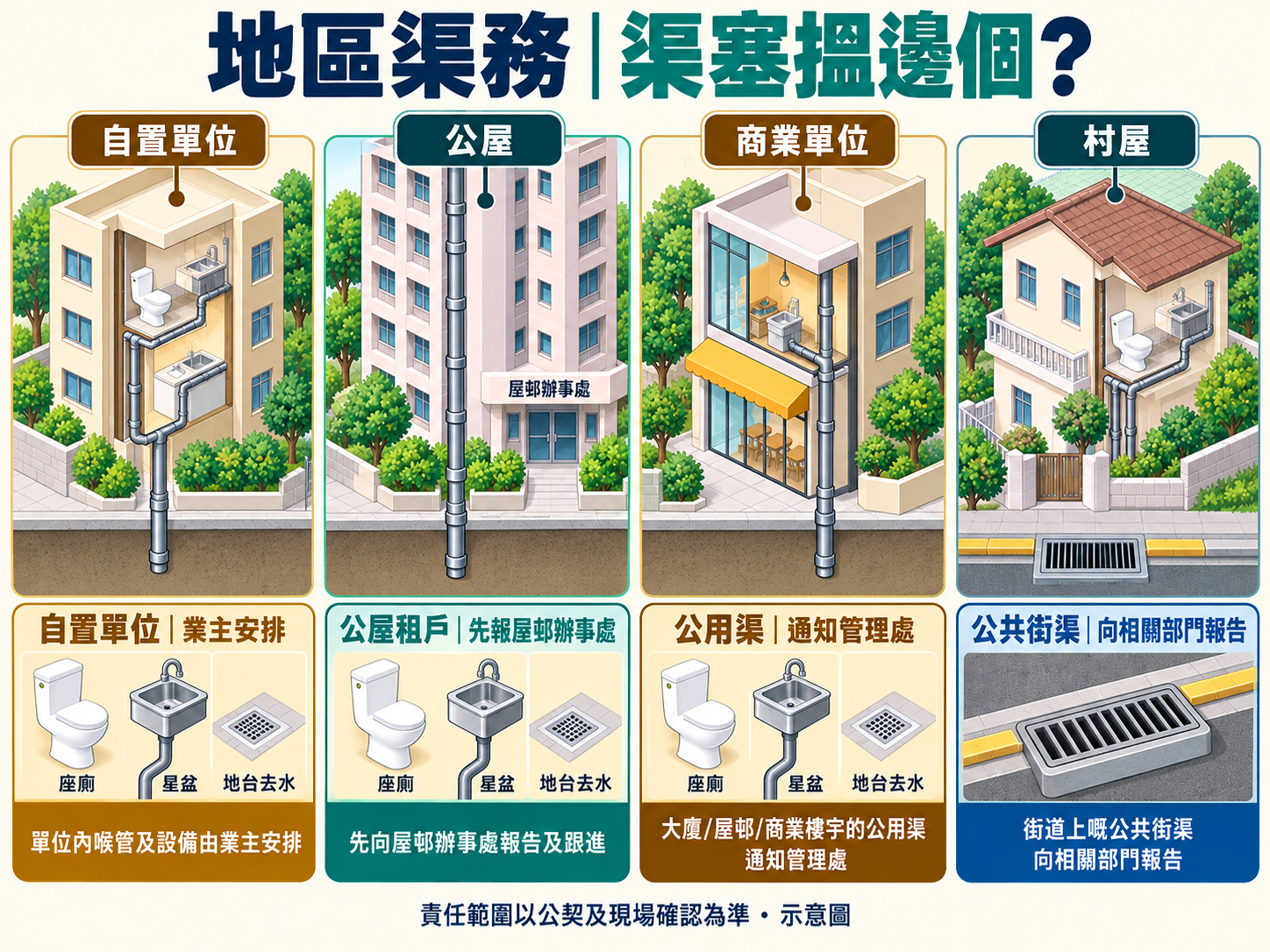
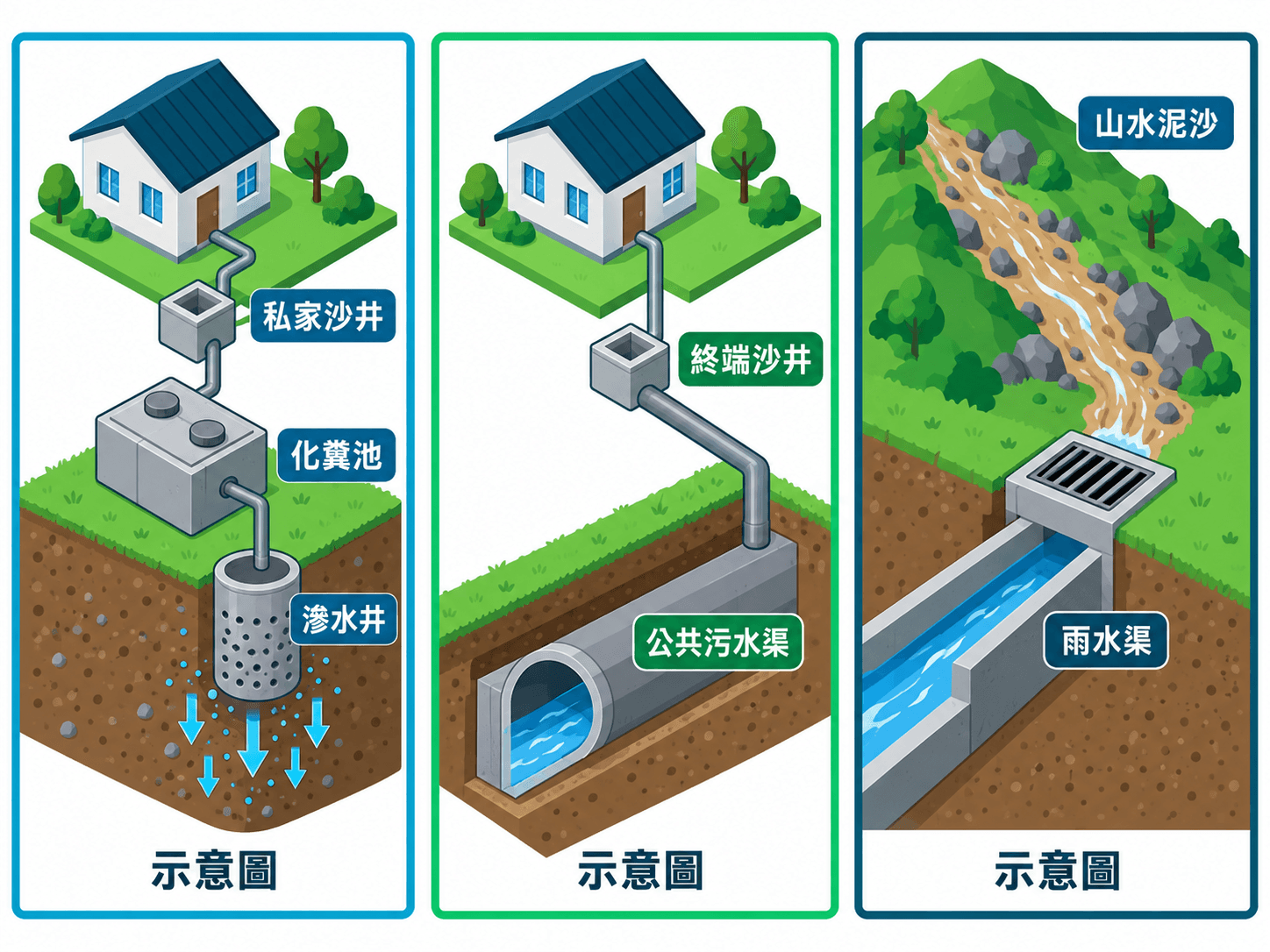
At the Sai Kung District Council's Housing, Planning and Environment Committee on 15 November 2022, a member said that septic tanks in some villages had gone unmaintained for years and seeped sewage from time to time, and that waste pipework at some village houses was connected in a tangle that produced a great deal of odour (the member was describing Sai Kung's villages generally and did not name any Hang Hau village). The Drainage Services Department replied at the same meeting that, on receiving a complaint or a referral, even though the septic tank and terminal manhole are privately managed and maintained, it first deals with the overflow and disinfects the spot, then asks the relevant departments to help refer the case to the owner. The chair also noted that a three-storey village house may have several owners but only one septic tank, so when sewage overflows every owner has a duty to follow it up. At the District Facilities and Works Committee on 12 November 2024, members reported that septic-tank sewage was backing up in some villages. Village houses have no management office, so emptying the tank, clearing the pipework and disinfecting afterwards are usually the owner's own arrangements.
At the Sai Kung District Council on 6 March 2018, a member reported that whenever the Ngau Mei Hoi pumping station was running, the underground sewer outside the Hang Hau Rural Committee gave off a smell, and said that although the Drainage Services Department had fitted rubber strips around the manhole cover the problem had not been solved; the department said it would send staff to check whether the odour came from the pumping station or from nearby drains. At the same meeting another member said residents had reported toilet drains smelling inside their flats, with the building's management company unable to find the source. Telling the two apart is fairly direct: if the smell sharpens as soon as you shut the bathroom door and switch on the exhaust fan, the water seal at a floor drain or another fixture is usually inadequate; if it is strongest outdoors, near a manhole cover or in a back lane, and varies with weather and wind, raise it with the management office or the department concerned. The two need different work, and masking the smell with bleach is not a fix.
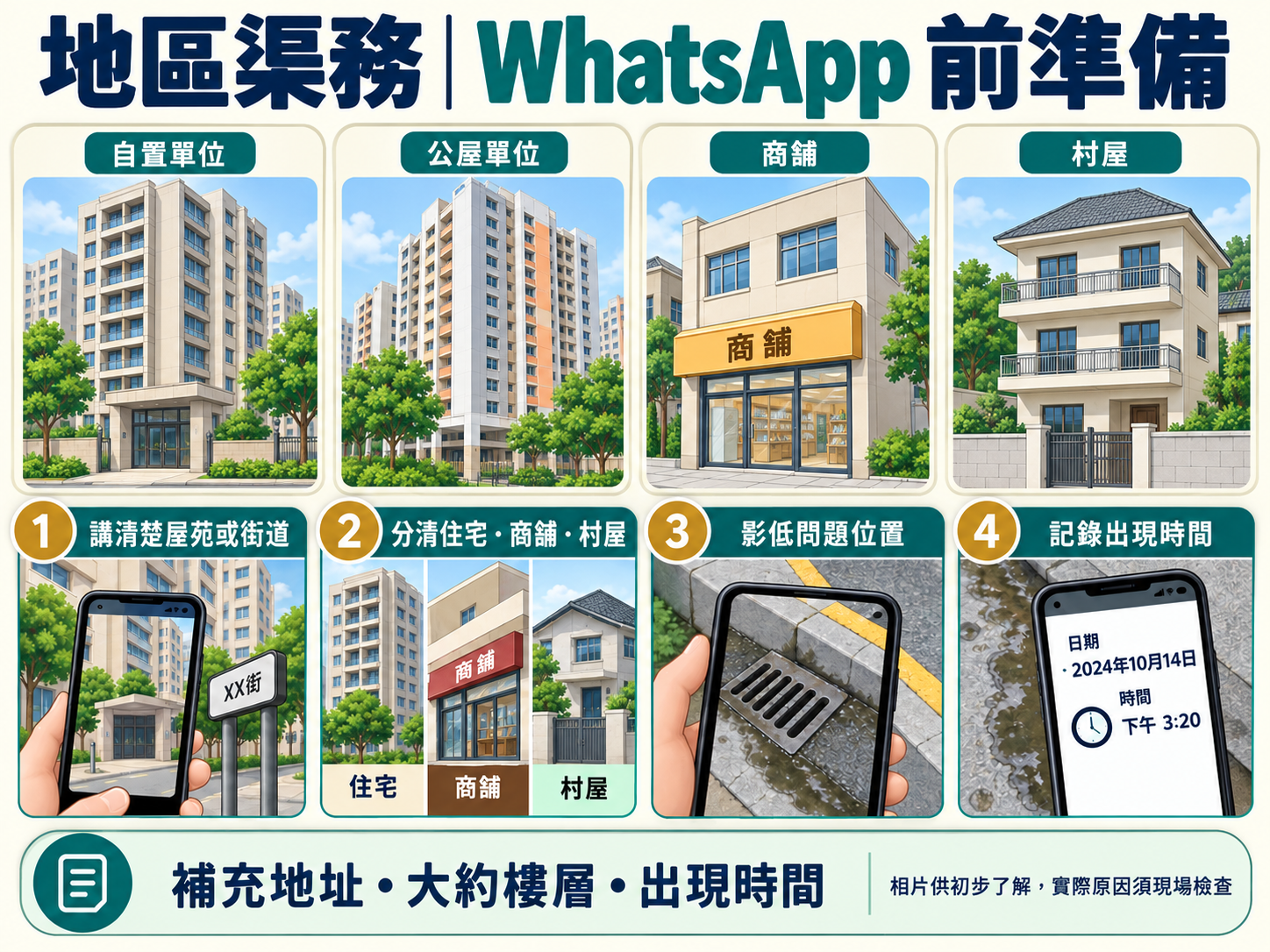
Photos or a short video on WhatsApp help us tell a single-fixture blockage from a shared-stack problem.
Hang Hau sits on the eastern side of Tseung Kwan O New Town, on land largely reclaimed around the old Hang Hau bay. Within a few years from 1990 it gained Fu Ning Garden, On Ning Garden, Hau Tak Estate, Chung Ming Court and Yu Ming Court all at once; East Point City, La Cité Noble and Residence Oasis over Hang Hau Station followed between 1997 and 2005; and to the east, along Clear Water Bay Road, there are still three-storey village houses, some of them not yet connected to a public sewer and relying on septic tanks. So in Hang Hau, deciding whether a blockage, a smell or an overflowing manhole belongs to the management office, the estate office, the Drainage Services Department or a contractor of your own starts not with the symptom but with which kind of home you live in.
What makes Hang Hau unusual is that most of the community went up within about five years. Wikipedia records that the first estate completed here was Fu Ning Garden in 1990 (25 Po Ning Road, 6 blocks, 2,450 flats), followed the same year by On Ning Garden (10 Sheung Ning Road, 6 blocks, 2,300 flats), both Private Sector Participation Scheme courts. Hau Tak Estate was first occupied in early 1993 as one of Hong Kong's first Harmony 1 public rental estates, with six blocks holding 4,236 flats, and the same scheme's Chung Ming Court (five blocks, 1,750 flats) and Yu Ming Court (two blocks, 1,216 flats) were completed in 1993 and 1994. In other words, those five estates alone account for more than eleven thousand flats (per-block figures on Wikipedia) inside a 32-to-36-year age band. A few years later Ming Tak Estate on Pui Shing Lane was occupied in 1996, with Hin Ming, Yuk Ming and Wo Ming Courts in the same scheme completed between 1996 and 1999. Inferring from building age, most of these flats are still on the pipework they were handed over with: after three decades the inside of a stack carries layer on layer of grease and soap scale, and every refit that swaps a toilet or turns a bathtub into a shower cubicle moves a trap and a connection point, so within one block the arrangement upstairs and downstairs can be nothing alike.
The second wave is a step younger. East Point City was completed in October 1997 (8 Chung Wa Road, 7 blocks, 2,184 flats), La Cité Noble in May 1999 (1 Ngan O Road, 6 blocks, 2,184 flats), and Residence Oasis was occupied in 2005 (15 Pui Shing Road, 6 towers, 2,130 flats) with a podium holding a shopping centre, a bus terminus and Hang Hau Station. Inferring from that design, in estates built over a railway and a mall the flats drain through podium pipework before reaching ground-level drains, and residents cannot easily trace the outlets in the podium area, so a smell or standing water out there is normally checked by the management office under the deed of mutual covenant. Inferring from building age, the pipework in this group is a decade or so younger than the 1990 batch and the usual trouble is renovation debris and evaporated water seals; but at twenty to thirty years old, leaking joints on external pipes start to appear as well, and the group should not be treated as too new to have drainage problems.
East of the town centre it changes again. Along Clear Water Bay Road and Tai Au Mun Road — Pan Long Wan, Tai Hang Hau, Siu Hang Hau, Sheung Sze Wan and Tai Wan Tau — three-storey village houses remain, some of them not yet connected to a public sewer and relying on septic tanks. The Environmental Protection Department's village sewerage statistics as at the end of December 2024 show neighbouring Silverstrand at 412 houses and Mang Kung Uk at 153 houses in phase one and 76 in phase two, all at a 100% connection rate, while those villages do not appear in that statistical table at all. The Drainage Services Department also told a committee meeting on 12 November 2024 that once connection works are done the septic tank is no longer used and must be filled in or demolished by the owner. These three groups — subsidised and public flats in their thirties, railway-corridor private estates between twenty and thirty years old, and village houses still on septic tanks — sit inside one small district, and who to call and who pays differ completely. The responsibility section below takes them one at a time. Fu Ning Garden, On Ning Garden and the Hang Hau rural village houses have pages of their own, listed below.
Note: statements based on building age and type are general inferences, not findings for any particular flat.
 HOS / PSPSFu Ning GardenCompleted 1990 · 6 blocks, 2,450 flats · flats from G/F in Blocks 5 and 6
 Village housesHang Hau Rural Village HousesRecognised villages off Clear Water Bay Road · septic tanks moving to public sewers
 HOS / PSPSOn Ning GardenCompleted 1990 · 6 blocks, 2,300 flats · a PSPS court on reclaimed land
A clear process from enquiry and assessment to an agreed scope of work
Tell us the drain problem and district and ask about available timing.
Confirm timing based on the district and schedule, then inspect the blockage or odour issue.
Explain the proposed approach, scope and price before agreed work begins.
Use suitable tools for the site conditions and agreed scope of work.
After the agreed work, test drainage and explain the observed result and any next steps.
PipeButler is an independent drain-service provider with no affiliation to the developer, owners' corporation, management company or Housing Department of the places above. Facts come from public sources checked on the dates shown; work on common drains or common parts follows the management office's and deed of mutual covenant's arrangements.
WhatsApp with the problem and district, and we will confirm available timing.