
Loading page…
Loading page…
Po Lam & Tsui Lam · Tenants Purchase Scheme estate · Public rental housing
Intake 1988–89 · 8 blocks · Trident 2 and New Slab · hillside estate
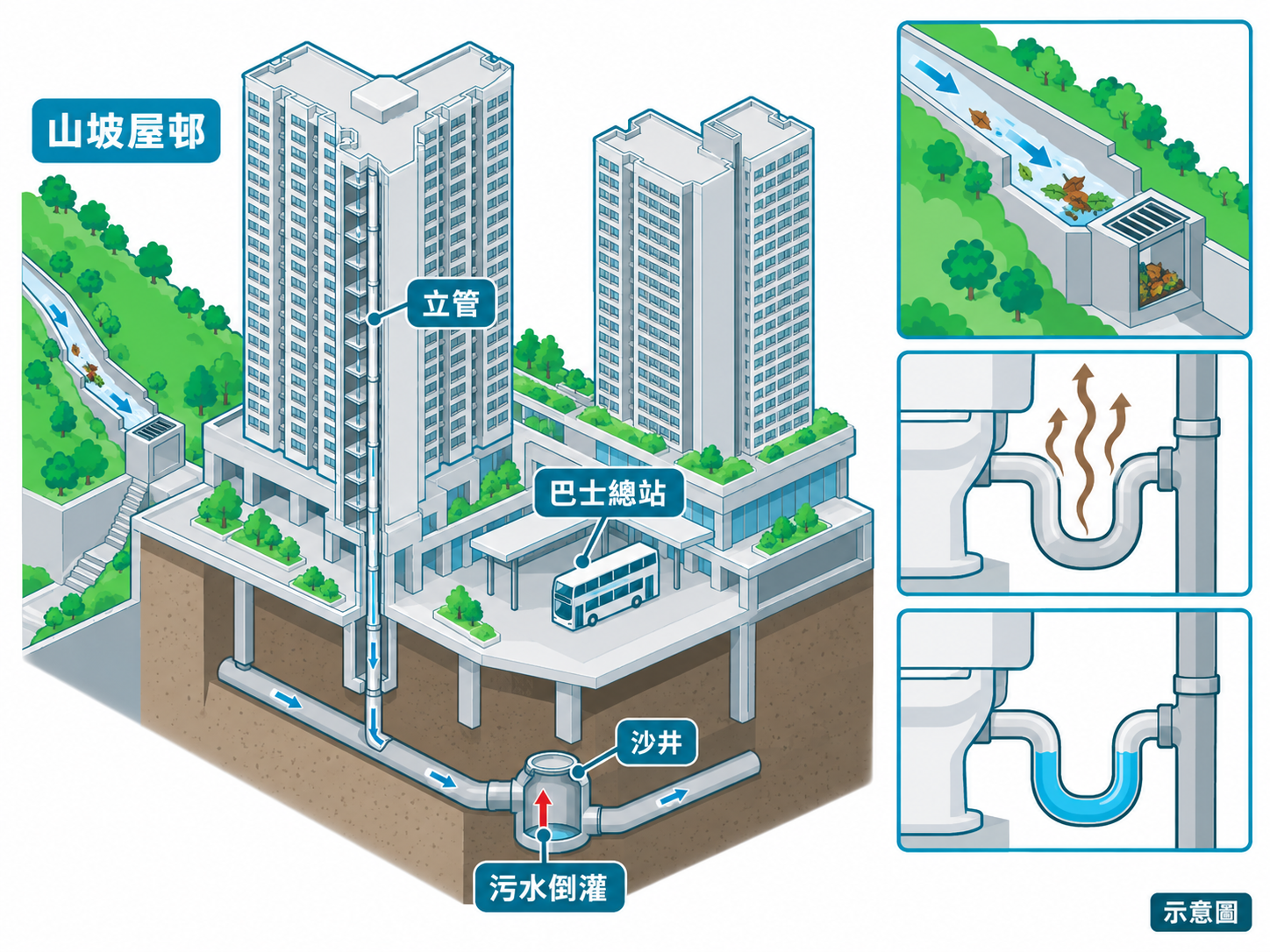
Tsui Lam Estate stands at 11 Tsui Lam Road, Tseung Kwan O; Wikipedia records that Tsui Lam and King Ming Court both sit on the hill west of the Po Lam area, at the junction of Tsui Lam Road and Po Lam Road North, one road apart from each other.
Last reviewed ·
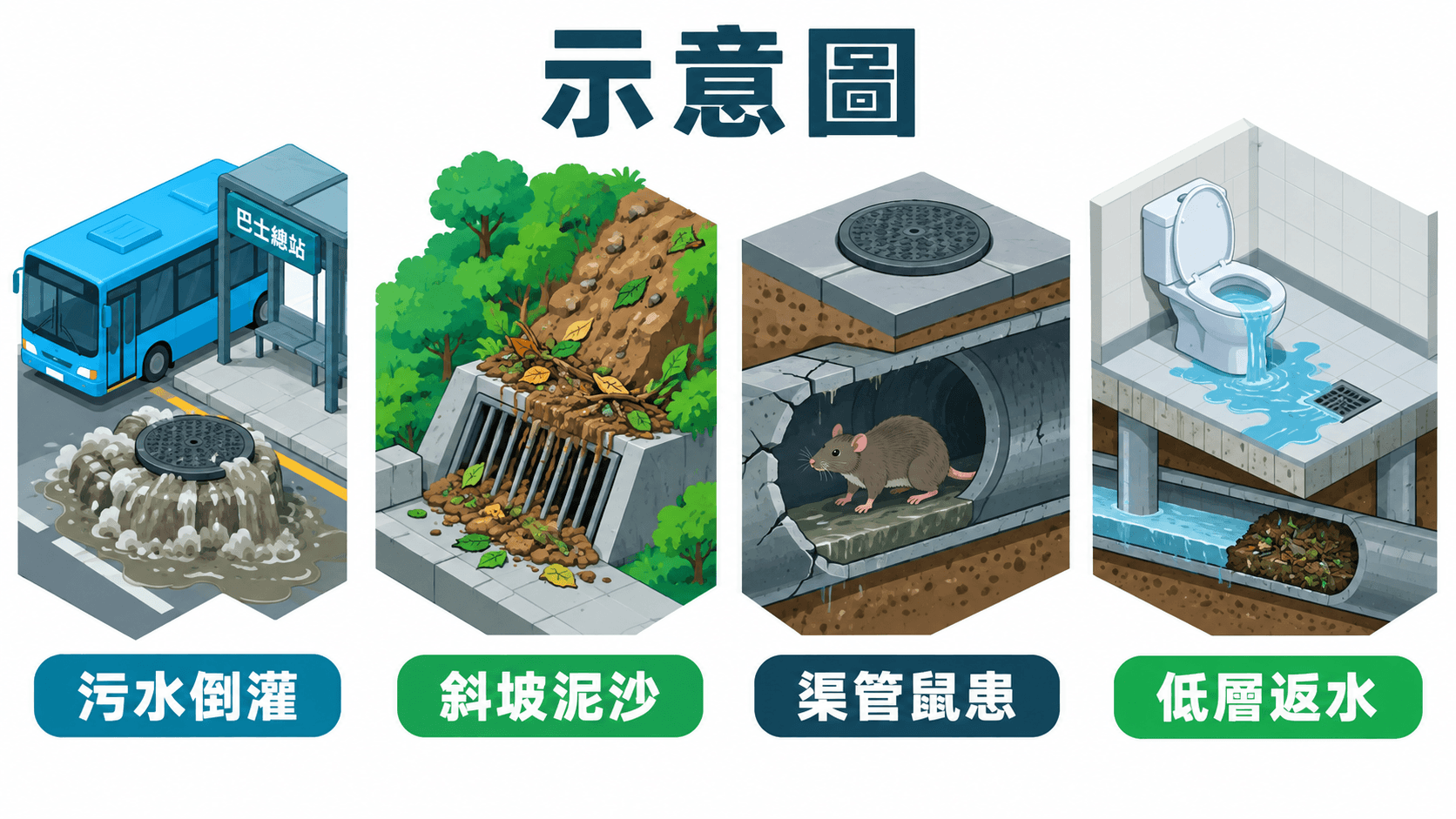
Choose the problem you are seeing to read the likely cause and next step.
The minutes of the Sai Kung District Council's second meeting of 2018 (6 March 2018) record a councillor reporting that the Tsui Lam Estate bus terminus “sees sewage seepage and odour problems every year around the middle or second half of the year”, while another said the underground foul drains in the terminus are managed by the Housing Department, with sold private premises — the mall and the market — above them, and that backflow had recurred there for years; the Drainage Services Department replied that it would study improvements together with the Housing Department. The council returned to it by motion on 3 November 2020: a councillor quoted the DSD's written reply (SKDC(M) Paper No. 318/20), in which the department said it believed the seepage and smell originated from silted drains within the estate; the Housing Department's representative told the meeting that “the drainage system in the bus terminus is connected to that of the mall, and drainage from the mall may silt up the terminus system and cause backflow”, adding that the mall side had sent drain tankers to clear blockages in the past. After the meeting, on 11 November, the Housing Department, the councillor, the mall's management and the management company engaged by the owners' corporation inspected the area together and found no blockage or smell at the time. If you smell drains or see wastewater at the terminus, the mall entrances or the footpaths nearby, the practical step is to note the date and time, take photos and pass them to the management office or the relevant department; a drainage problem inside your own flat is handled separately.
Tsui Lam sits on a hill. At the Sai Kung District Council meeting of 5 September 2017 a councillor referred to the estate's “dozen or so slopes”, said some of them are government-maintained and badly affected by illegal cultivation, and worried that in the wet season or after a landslip this “could affect the slopes the estate maintains and cause the channels to silt up”. Inferring from the terrain, heavy rain washes leaves and silt off the slopes into the U-channels, gullies and manholes; once they choke, water runs across podiums, footpaths and ramps to the lowest point, so low-floor corridors and back lanes are hit first. In practice, the channels, gullies and manholes inside the estate are cleared by the owners' corporation and the management company it engages, and the period around a rainstorm is the time to check them. The stretch of Po Lam Road outside the estate — the section between Mau Wu Tsai and Ma Yau Tong on the DSD's Locations Prone to Blockage list — is different: it is a public road drain, so a street inlet buried under leaves can be reported to the DSD directly.
At the Housing and Environmental Hygiene Committee meeting of the Sai Kung District Council on 11 January 2018, a member reported “rats in the drain pipes at On Lam House, Tsui Lam Estate” and asked the Food and Environmental Hygiene Department to raise it with the estate's owners' corporation; the department replied that its staff had inspected Tsui Lam with estate management staff in December 2017 and on 2 January 2018 and found fewer traces of rats. In general, rats get in along damaged pipes, disused outlets that were never sealed, and traps that have dried out or been removed, so baiting alone rarely settles it. If you hear noises in the wall or at a drain, or see stains or smell something around a floor-drain outlet, first check whether the trap still holds water, whether disused outlets are properly sealed and whether exposed pipe joints are cracked, then report it through the management office so the estate can follow up the common parts.
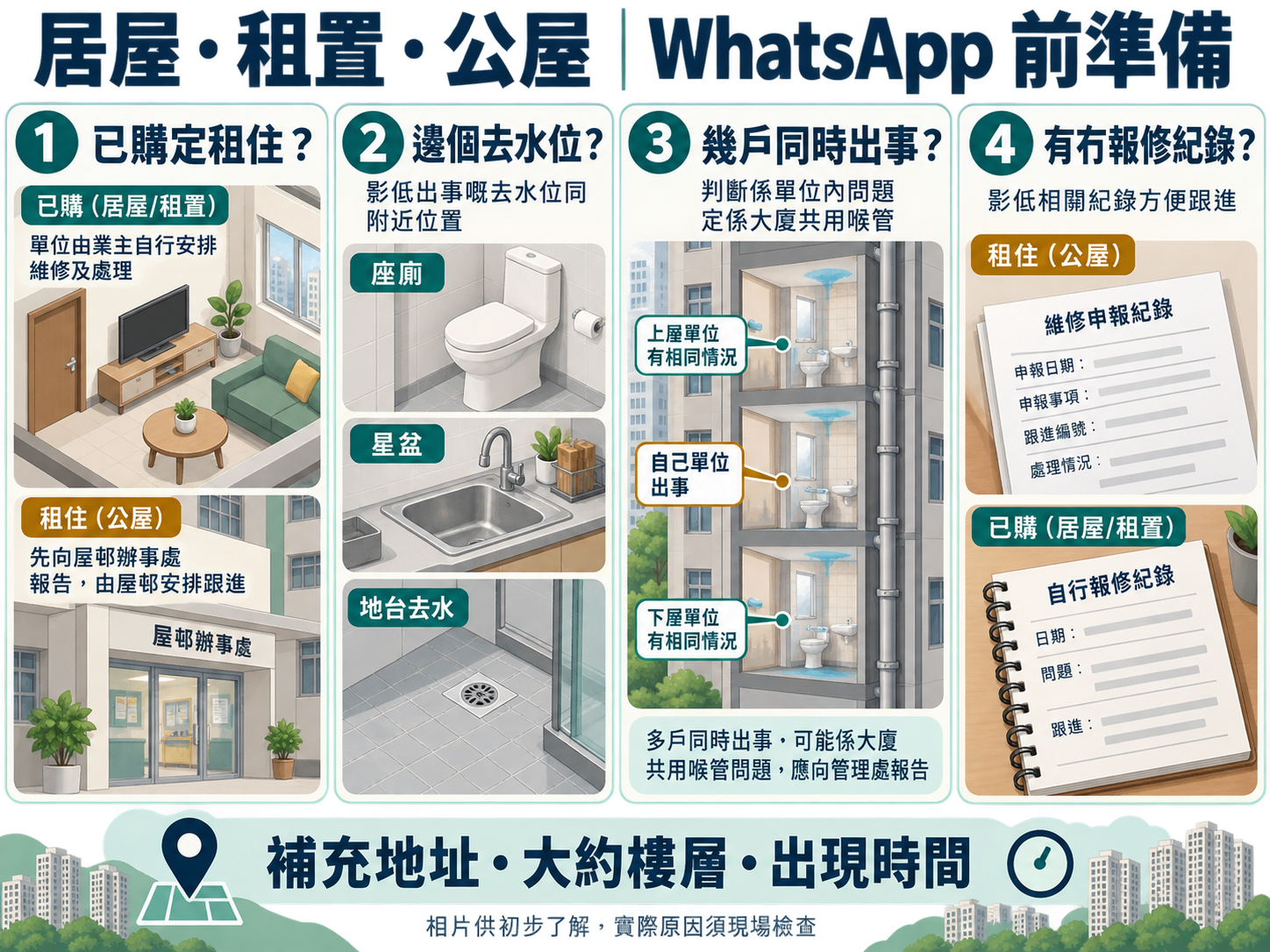
By design, a Trident 2 block puts three wings around a central core, 35 storeys high with 24 flats per floor, and the toilet, basin and bathroom floor drain of flats in the same vertical line discharge into one stack all the way down; the New Slab blocks are only 22 storeys, but their corridor layout puts many flats on each floor, joining a shared horizontal run before the stack. In both designs the low-floor flats take the flow from everything above. If the base of the stack, the horizontal run or a manhole outside is narrowed by grease, tissue and debris, then during the morning and evening peaks or in heavy rain the water level in a low-floor toilet rises first and the floor drain bubbles or backs up. Telling them apart is straightforward: one slow fitment on its own usually means the flat's own branch pipe or trap, while a toilet and floor drain misbehaving together, in time with water use upstairs, means the shared stack belongs in the check and the management office should be told at once.
At the Sai Kung District Council meeting of 1 November 2022, a councillor reported that “part of Tsui Lam Estate consists of sold flats, and seepage cases involving two owners arise from time to time”, adding that affected owners may have little recourse beyond civil proceedings. Seepage and blockage are different problems: a blockage usually shows itself at once as slow draining, backflow or odour, while seepage may come from a waterproofing layer, a pipe joint or an outlet in the flat above, and has to be eliminated item by item. Start with what you can do yourself: stop using the suspect fitment for a day or two and watch whether the damp patch changes, and photograph the marks, their extent and the date. If you suspect a bathroom or kitchen outlet upstairs, have the traps, branch pipes and floor-drain connections in your own flat checked first, then ask the management office to help contact the owner above. Altering a trap, an anti-syphonage pipe or a drain position is minor works under the Buildings Department and must be done by a registered minor works contractor.
Photos or a short video on WhatsApp help us tell a single-fixture blockage from a shared-stack problem.
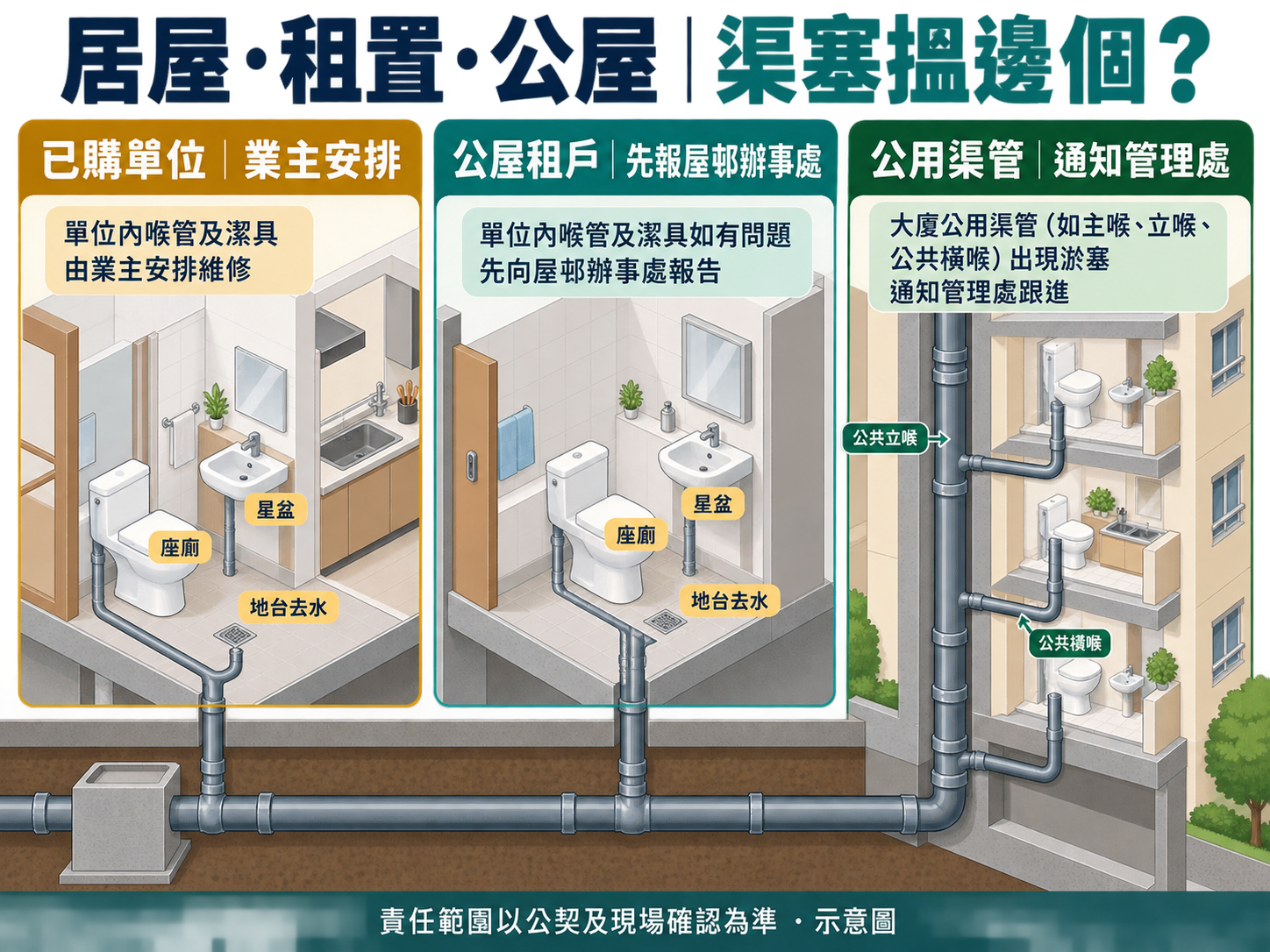
Tsui Lam Estate stands at 11 Tsui Lam Road, Tseung Kwan O; Wikipedia records that Tsui Lam and King Ming Court both sit on the hill west of the Po Lam area, at the junction of Tsui Lam Road and Po Lam Road North, one road apart from each other. Tsui Lam is also one of the few public housing estates in Tseung Kwan O that was not built on reclaimed land. The Housing Authority's list of Tenants Purchase Scheme (TPS) estates records 8 blocks and 4,932 saleable flats, with years of intake from 1988 to 1989, block types New Slab and Trident 2, and the sale launched under TPS Phase 6B in August 2005. The estate today holds both owners who bought their flats and households still renting from the Housing Authority. For floor-drain odour, a slow toilet or backflow in a low-floor flat, those two groups follow different routes — and the shared stacks, building drains and slope channels form a third route again.
The Housing Authority's list of TPS estates records 8 blocks and 4,932 saleable flats at Tsui Lam, block types New Slab and Trident 2, with years of intake from 1988 to 1989. The building table on Wikipedia separates the two designs further: Nga Lam, Yan Lam, Choi Lam and Fai Lam Houses are Trident 2 blocks of 35 storeys (floors 2 to 35) with 24 flats per floor and 816 flats each; Pik Lam and Sau Lam, and Hong Lam and On Lam, are twin-wing New Slab blocks of only 22 storeys, with 430 and 404 flats each respectively. One estate therefore holds both high towers of three wings around a central core and lower corridor-style blocks, and they differ in where the bathrooms sit, how many flats share a floor and how the pipes run. So the first step in answering what the drains here are like is to say which block you live in and roughly which floor.
Inferring from age, blocks taken into occupation in 1988 and 1989 are close to 38 years old today, and their original pipework was most likely cast iron or early plastic; after decades of separate renovations, trap patterns, branch-pipe routes and connection points now differ from flat to flat. On flushing water, the Water Supplies Department records that the seawater network extended in 2015 brought coverage to about 85% of the population, and Wikipedia records that a household in On Lam House once connected a fresh-water pipe to a flushing cistern, leaving the fresh water tasting salty, after which the estate management required the pipework to be reinstated. That was a water-supply matter rather than a drainage fault, but it suggests the estate flushes with seawater. If it does, a toilet and branch pipe fed with seawater for decades are more likely to build up scale on the inside wall, gradually narrowing the bore, so weak flushing or a rising water level tends to appear earlier.
Position and boundaries are what make this estate unusual. It sits on a hillside, and at the Sai Kung District Council meeting of 5 September 2017 a councillor said that among the estate's dozen or so slopes, some are government-maintained and suffer from illegal cultivation, and that in the wet season or after a landslip this could affect the slopes the estate maintains and silt up its channels. A public road outside the estate — the stretch of Po Lam Road between Mau Wu Tsai and Ma Yau Tong — also appears under Sai Kung on the Drainage Services Department's Locations Prone to Blockage list. At the other end, the bus terminus, shopping centre and market adjoin the residential part of the estate, and the District Council record of 3 November 2020 shows the Housing Department stating at the meeting that the drainage system in the bus terminus is connected to the mall's. On ownership, the Housing Authority's property information page (last revised 3 August 2026) shows that only 700 flats on the estate are still let by the Authority, with 700 households and an authorised population of 1,800 among them — the figures count rental flats only — while the rest are in owners' hands, and management is listed as “appointed by the owners' corporation”. In other words, whether something belongs to a flat, to the owners' corporation, to the mall side or to a government department depends on which length of drain it happens in — the phrase “the estate's drains” settles nothing on its own.
Note: statements based on building age and type are general inferences, not findings for any particular flat.
A clear process from enquiry and assessment to an agreed scope of work
Tell us the drain problem and district and ask about available timing.
Confirm timing based on the district and schedule, then inspect the blockage or odour issue.
Explain the proposed approach, scope and price before agreed work begins.
Use suitable tools for the site conditions and agreed scope of work.
After the agreed work, test drainage and explain the observed result and any next steps.
PipeButler is an independent drain-service provider with no affiliation to the developer, owners' corporation, management company or Housing Department of the places above. Facts come from public sources checked on the dates shown; work on common drains or common parts follows the management office's and deed of mutual covenant's arrangements.
WhatsApp with the problem and district, and we will confirm available timing.