
Loading page…
Loading page…
Po Lam · Tenants Purchase Scheme estate · Public rental housing
7 blocks, 5,276 flats · 6 sold under TPS Phase 6A · intake 1988–89
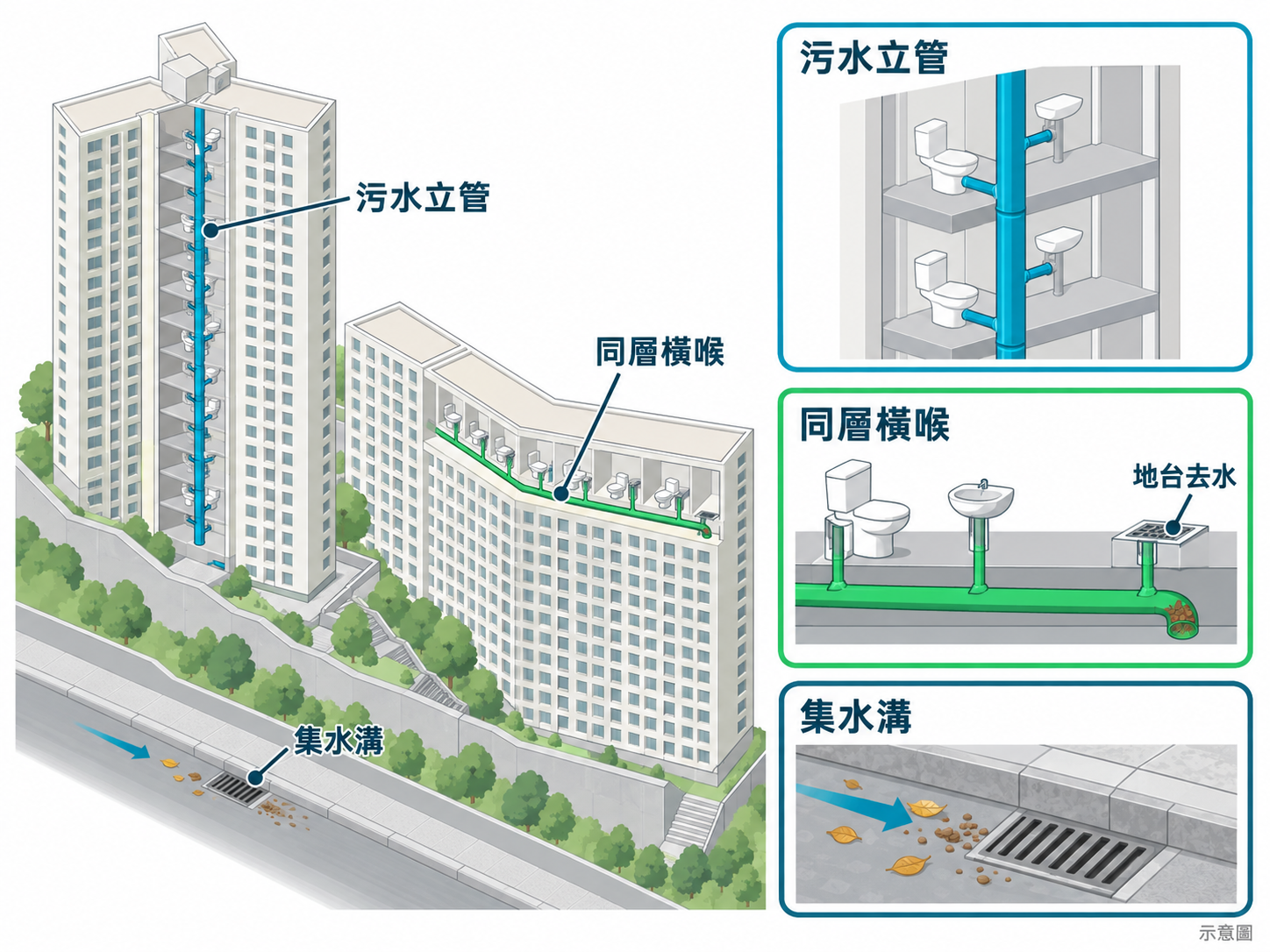
Po Lam Estate stands at 18 Po Lam Road North, Tseung Kwan O; Wikipedia records that Po Lam Road North climbs the hillside and meets Po Hong Road, which runs from Po Lam through to the town centre.
Last reviewed ·
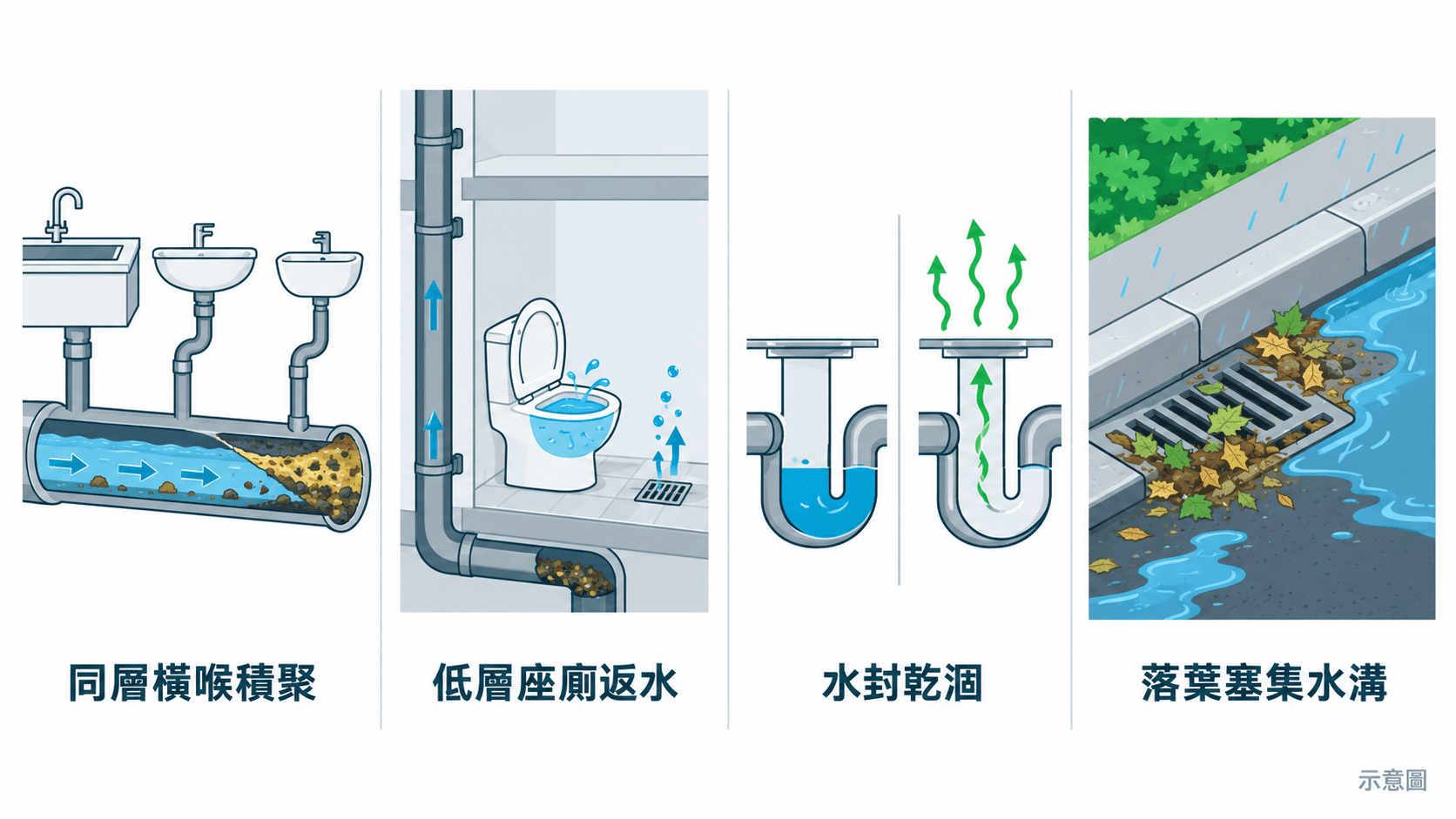
Choose the problem you are seeing to read the likely cause and next step.
Building data quoted on Wikipedia show that Po Ning and Po Kan Houses are only 22 storeys tall yet carry 52 flats on each floor, the densest blocks on the estate. By design, a twin-wing layout of that kind relies on one long horizontal waste pipe per floor, collecting from flats along its length before delivering everything to the stack; the further the run goes, the harder it is to keep fall and flow velocity, so grease, rice and hair settle at bends and junctions. The symptom is usually not a sudden blockage but a drain that slows again after every clearance: the sink empties sluggishly while you wash up, water pools around your feet in the shower, and the floor drain gurgles at night. If two or three flats on the same floor develop it together, calling separately only clears a short length each; report it to the management office so the whole horizontal run and the podium manholes can be inspected at estate level.
Po Yan, Po Tai, Po Tak and Po Chi Houses are 35-storey Trident 2 blocks with 24 flats per floor arranged along three wings. By design, flats in the same vertical line share one soil stack from top to bottom, and in a layout of the 1988–89 generation the fitments on the lowest few floors normally join that stack near its foot, without the separate discharge into a manhole that newer buildings provide. So if a low-floor flat sees the toilet level rise for no reason, the floor drain well up or the corner of the shower gurgle during the morning and evening peaks or in heavy rain, suspect a restriction in the lower stack or an outside manhole first, not the trap in your own bathroom. Note the time, how long it lasts and whether it was raining, then tell the management office: a shared stack is not something one household can put right alone.
The Buildings Department explains that a trap holds water to form a seal, keeping the foul air inside the drainage pipe out of the room. Bathrooms here are small, and the floor drain normally sees water only when the floor is washed or someone showers. Po Kim House, completed in 2001, has 14 flats per floor and consists largely of one-person units, so water use is lower still and the seal evaporates faster. A long trip away, or the empty spell between tenancies, does the same. The remedy is simple: pour clean water into every floor drain once a week to top the seal back up. If the smell is unchanged two or three days later, or sharpens the moment you close the bathroom door and switch on the extractor fan, look for a cracked trap, a shallower pattern fitted during a renovation, or a leaking branch-pipe joint — rather than masking it with bleach or fragrance.
At the Sai Kung District Council meeting of 6 March 2018, the Drainage Services Department explained that Po Lam Road and Po Hong Road flood because both have hillsides nearby, so rainstorm run-off carries dead leaves and soil down to the lower road and chokes some of the catch drains. The road side is for the Highways Department and the DSD; but the same rain falling inside the estate is taken by a different set of outlets. Wikipedia records that internal estate roads link the shopping centre, the car parks and the blocks and run north to Po Lam Road North, that the three car parks stand opposite Po Ning House, and that a footbridge built in 2001 connects Po Lam Shopping Centre, Metro City Phase 2 and Po Lam MTR station — and the gullies, gratings and manholes at all those places take the leaves and silt washed down from between the blocks, the landscaped areas and the planters. The signs are easy to read: rain starts and water immediately stands at a car-park entrance or a footbridge landing, still there an hour or two after it stops, with mud marks around the grating and leaves matted over it. In practice, clear them once in the leaf-fall season and once before the rains, and on the day of a downpour photograph where the water stands and note the time before passing it to the management office. Outlets inside the estate are the management office's to arrange; for a rainwater drain on the public road, call the DSD's 24-hour drainage hotline on 2300 1110.
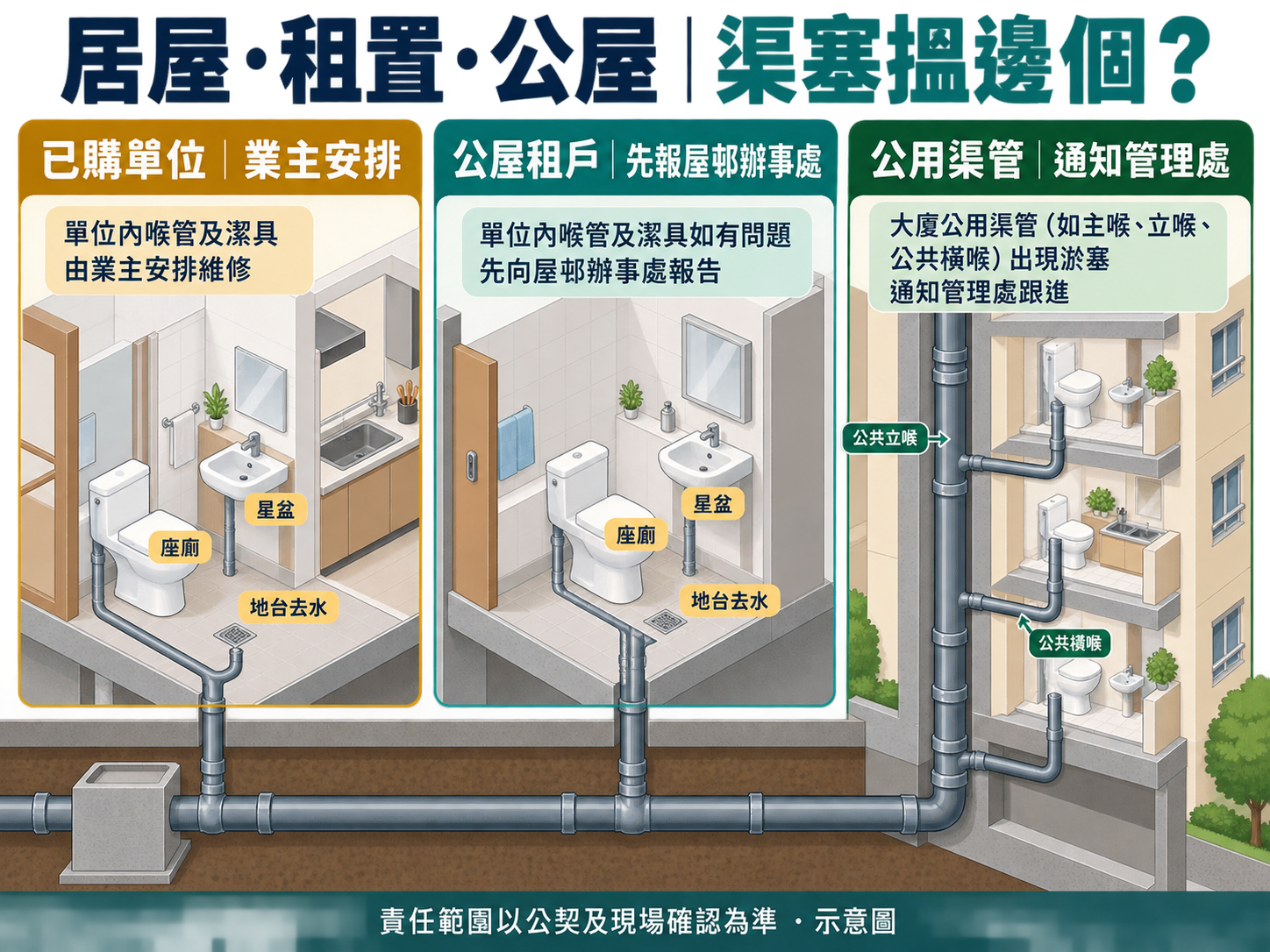
At the Sai Kung District Council meeting of 3 March 2026, a member whose office is in the estate said that, as she understood it, most flats at Po Lam had been sold and the small number still unsold were mainly flats with serious seepage, or flats the sitting tenants could not afford to buy; she proposed comprehensive repairs for flats with serious seepage or leakage. For a household, the practical question is which seepage route applies. Households still renting from the Housing Authority report seepage to the estate office first rather than going to the Joint Office themselves: the foreword published by the Joint Office of the Food and Environmental Hygiene Department and the Buildings Department states that it steps into seepage cases in private premises. Owners of purchased flats are in private premises, so if talking to the flats above and below and to the owners' corporation gets nowhere, the Joint Office can be asked to investigate; it brought in a new procedure in full on 16 July 2026, adding infrared thermography alongside the electronic moisture meter at the first stage to identify the likely source, and where there is reason to believe the seepage comes from the flat above it issues a Notification Letter requiring that owner to inspect and complete repairs within 28 calendar days. Owners next door at Ying Ming Court follow that court's own deed of mutual covenant and management arrangements.
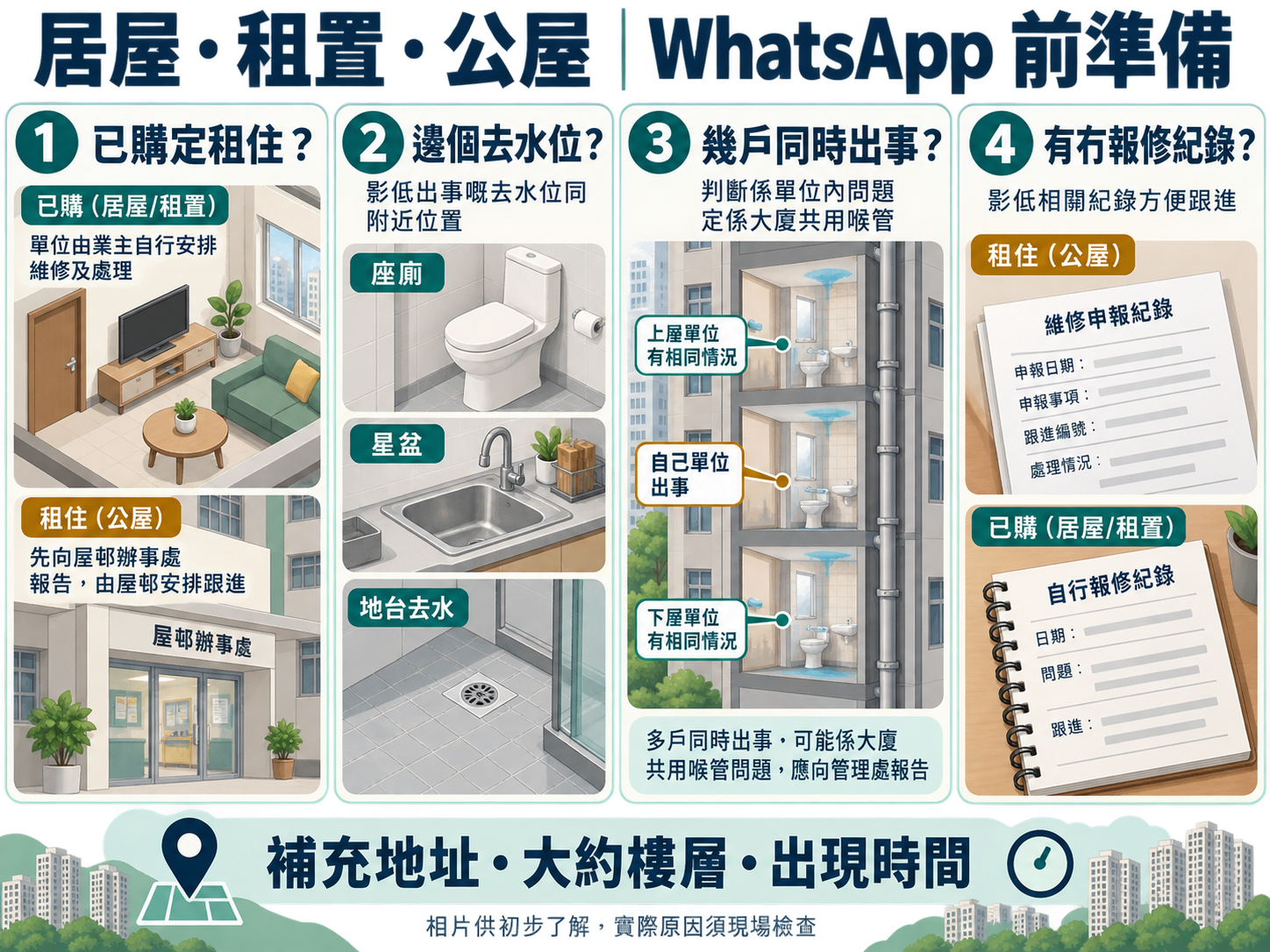
Photos or a short video on WhatsApp help us tell a single-fixture blockage from a shared-stack problem.
Po Lam Estate stands at 18 Po Lam Road North, Tseung Kwan O; Wikipedia records that Po Lam Road North climbs the hillside and meets Po Hong Road, which runs from Po Lam through to the town centre. The Housing Authority's list of Tenants Purchase Scheme (TPS) estates shows that the six blocks put up for sale have years of intake from 1988 to 1989, are of the New Slab and Trident 2 types, and hold 5,008 saleable flats; Po Kim House, added in 2001, was left out of the sale. The estate today houses both owners who bought their flats and households still renting from the Housing Authority, and next door at 20 Po Lam Road North sits Ying Ming Court, a separate Home Ownership Scheme court. For slow drains, odour or low-floor backflow, those three groups follow completely different routes. This page sorts out which route is yours, then explains what the two block designs, and the estate's own layer of ground, actually mean for the pipework.
The Housing Authority's list of TPS estates records that the six blocks put up for sale at Po Lam are of the New Slab and Trident 2 types, with years of intake from 1988 to 1989 and 5,008 saleable flats, and adds a footnote that Po Kim House, a small household block, is excluded. Building data quoted on Wikipedia breaks that down further: Po Yan, Po Tai, Po Tak and Po Chi Houses are Trident 2 blocks of 35 storeys with 24 flats per floor; Po Ning and Po Kan Houses are New Slab blocks with twin wings set at 135 degrees, only 22 storeys tall but with as many as 52 flats per floor; and Po Kim House, added in 2001, is a small household block of 21 storeys with 14 flats per floor and 268 flats. Twenty-four flats on a floor and fifty-two flats on a floor call for very different pipe runs, so there is no single answer to what the drains are like here — the first question is which block you live in.
Inferring from the years of intake, the six blocks put up for sale are now 37 to 38 years old. The Trident 2 blocks are shaped like a three-pointed star, with flats arranged along three wings off a central core; by design each wing forms its own group, so a flat's waste travels only a short way before reaching a stack. The New Slab blocks, with 52 flats on a floor, work the other way: a long horizontal run collects from flats along its length before everything drops into the stack together. The Housing Authority's current tenant-to-pay repair schedule prices the renewal of a plastic trap of 50 mm diameter or less and notes that the charges apply only to the repair of standard public-rental fittings; from that one would infer that the traps in unaltered flats here are still mostly plastic — and once a plastic trap cracks, or a renovation swaps it for a shallower pattern, the seal is no longer deep enough. As for flushing water, the Water Supplies Department reports that since the 2015 extension of the flushing-water network seawater has covered about 85 per cent of the population, and the Sai Kung District Council minutes of 8 July 2025 refer to salt-water mains in the Po Lam area (a supply matter, not a drainage fault in itself). From experience one would infer that decades of salt-water flushing leave scale in the toilet branch pipe, gradually narrowing it.
The setting matters just as much. Wikipedia records that Po Lam Road North climbs the hillside and that the estate's address is 18 Po Lam Road North; the same article notes that internal estate roads link the shopping centre, the car parks and the blocks and run north to join Po Lam Road North, that the three car parks stand opposite Po Ning House, and that when Po Kim House was added in 2001 a footbridge was built with it, connecting Po Lam Shopping Centre, Metro City Phase 2 and Po Lam MTR station. In other words, between the flats and the public road lies a whole layer of ground that belongs to the estate — roadways, walkways and car-park entrances — with its own set of gullies, looked after by people other than those who look after the road drains. The road side of that boundary is on the record: at the Sai Kung District Council meeting of 6 March 2018, one member said that the previous year's more serious flooding had included Po Lam Road and Po Hong Road, and another reported severe rainstorm flooding on Po Lam Road North; the Drainage Services Department replied that both places have hillsides nearby, so in a rainstorm the run-off carries dead leaves and soil from the slopes down to the lower road and blocks some of the catch drains. To this day, the Sai Kung entries on the DSD's Locations Prone to Blockage list still include two points on Po Hong Road and one on Po Lam Road.
On ownership, the estate's affairs are now run by an owners' corporation. At the District Council meeting of 3 November 2020, the Housing Department stated that every TPS estate in Tseung Kwan O has formed an owners' corporation which has taken over management, and that however much ownership the Housing Authority retains, the property management work is no different from that of an ordinary private estate, being governed alike by the Building Management Ordinance, the land lease and the deed of mutual covenant, with day-to-day matters carried out by the management company the corporation appoints. At the meeting of 3 March 2026, a member whose office is in the estate said that, as she understood it, most flats at Po Lam had been sold and the small number still unsold were mainly flats with serious seepage, or flats the sitting tenants could not afford to buy; she proposed comprehensive repairs for flats with serious seepage or leakage. Next door at 20 Po Lam Road North, Ying Ming Court was completed in 1989 with five New Cruciform blocks of 350 flats each, 1,750 in all. It is a separate Home Ownership Scheme court with its own deed of mutual covenant and management arrangements, so the Po Lam Estate route does not apply there.
Note: statements based on building age and type are general inferences, not findings for any particular flat.
A clear process from enquiry and assessment to an agreed scope of work
Tell us the drain problem and district and ask about available timing.
Confirm timing based on the district and schedule, then inspect the blockage or odour issue.
Explain the proposed approach, scope and price before agreed work begins.
Use suitable tools for the site conditions and agreed scope of work.
After the agreed work, test drainage and explain the observed result and any next steps.
PipeButler is an independent drain-service provider with no affiliation to the developer, owners' corporation, management company or Housing Department of the places above. Facts come from public sources checked on the dates shown; work on common drains or common parts follows the management office's and deed of mutual covenant's arrangements.
WhatsApp with the problem and district, and we will confirm available timing.