
Loading page…
Loading page…
Sha Tin town centre · Private estate
Occupied 1981–1988 · five estates above malls · about 5,000 flats
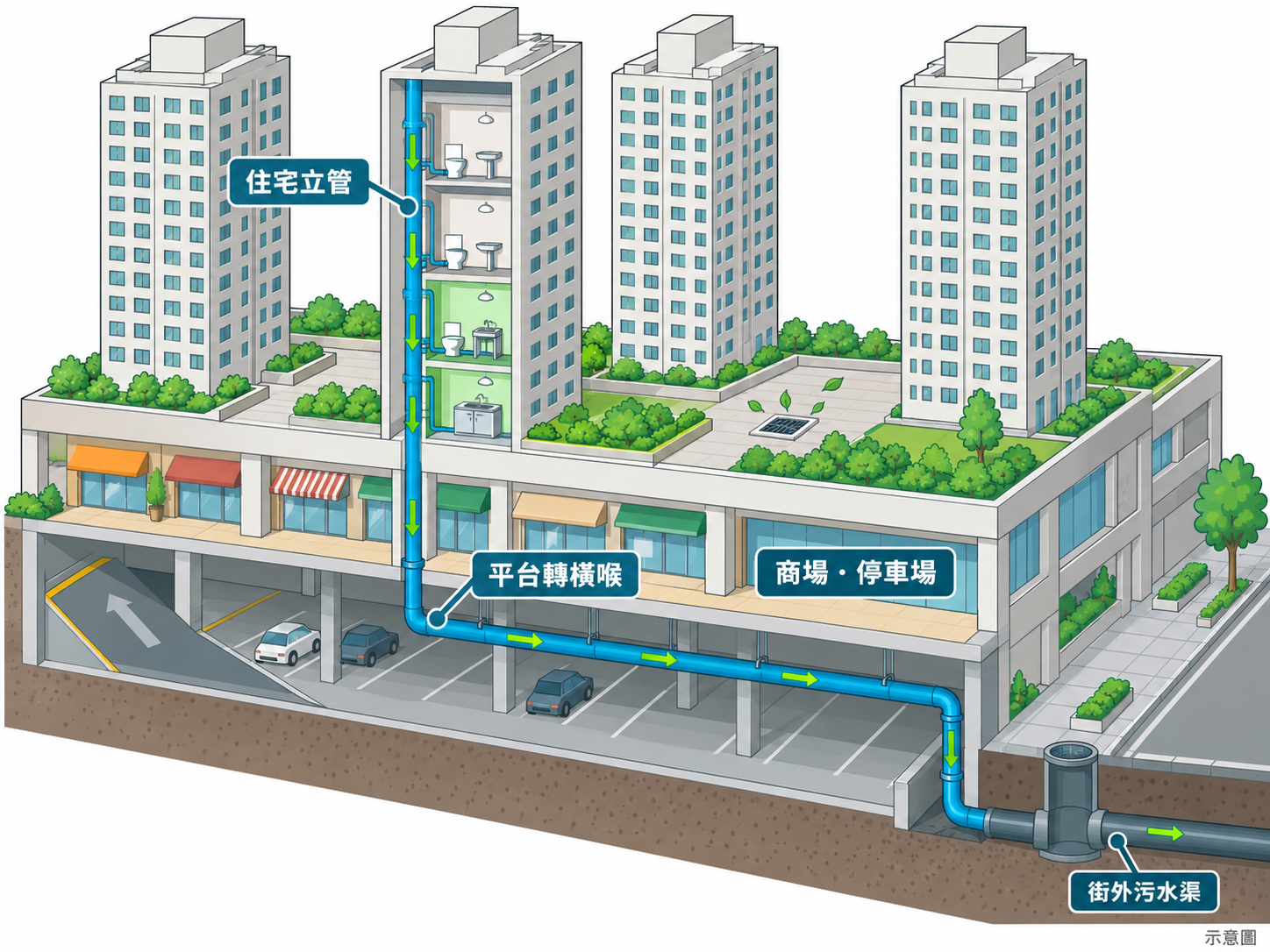
Along Sha Tin Centre Street and Wang Pok Street, five estates went up above their own shopping podiums in the seven years from 1981 to 1988 — Shatin Centre, Lucky Plaza, Hilton Plaza, Wai Wah Centre and Shatin Plaza — about 5,070 flats between them.
Last reviewed ·
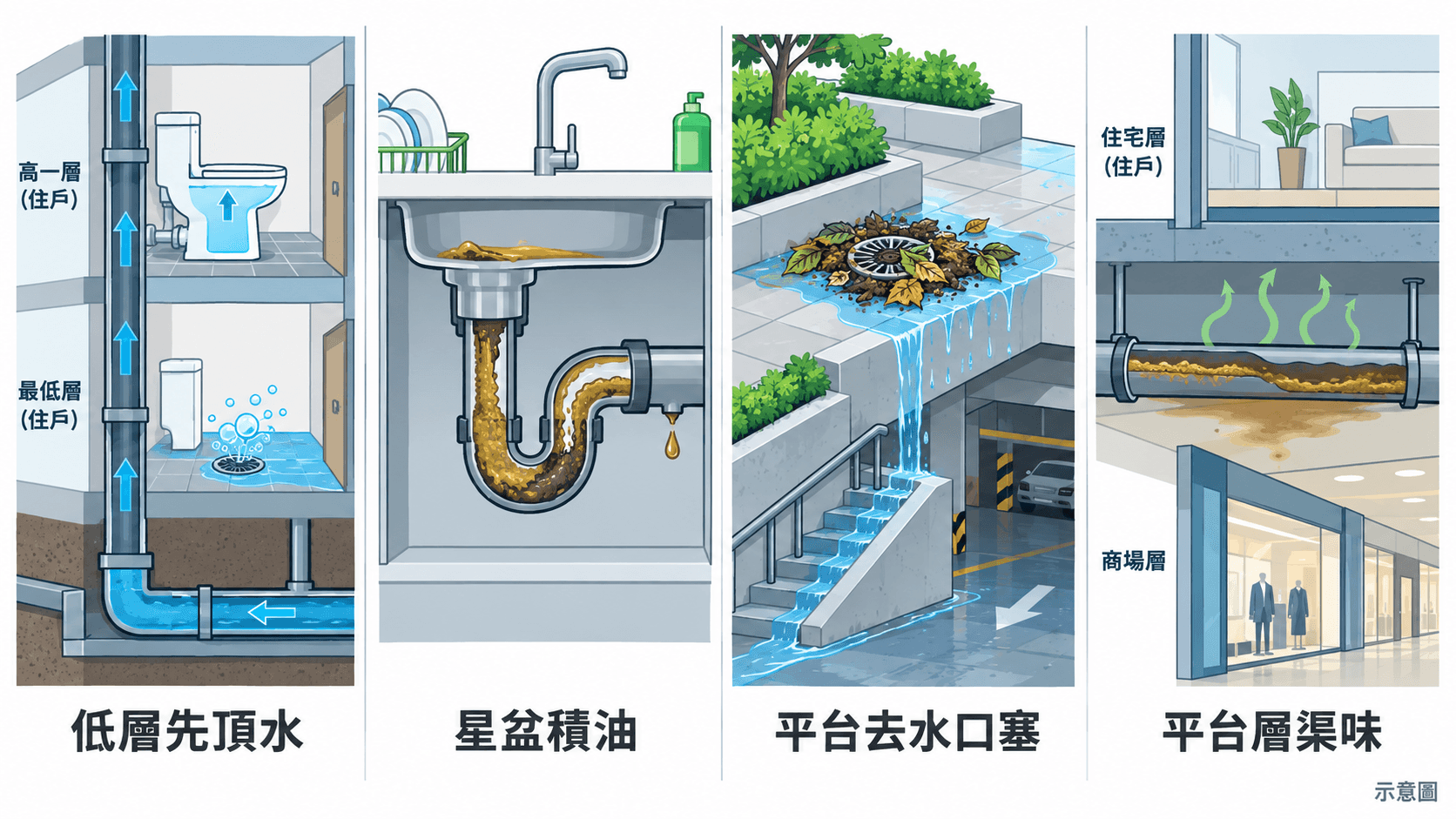
Choose the problem you are seeing to read the likely cause and next step.
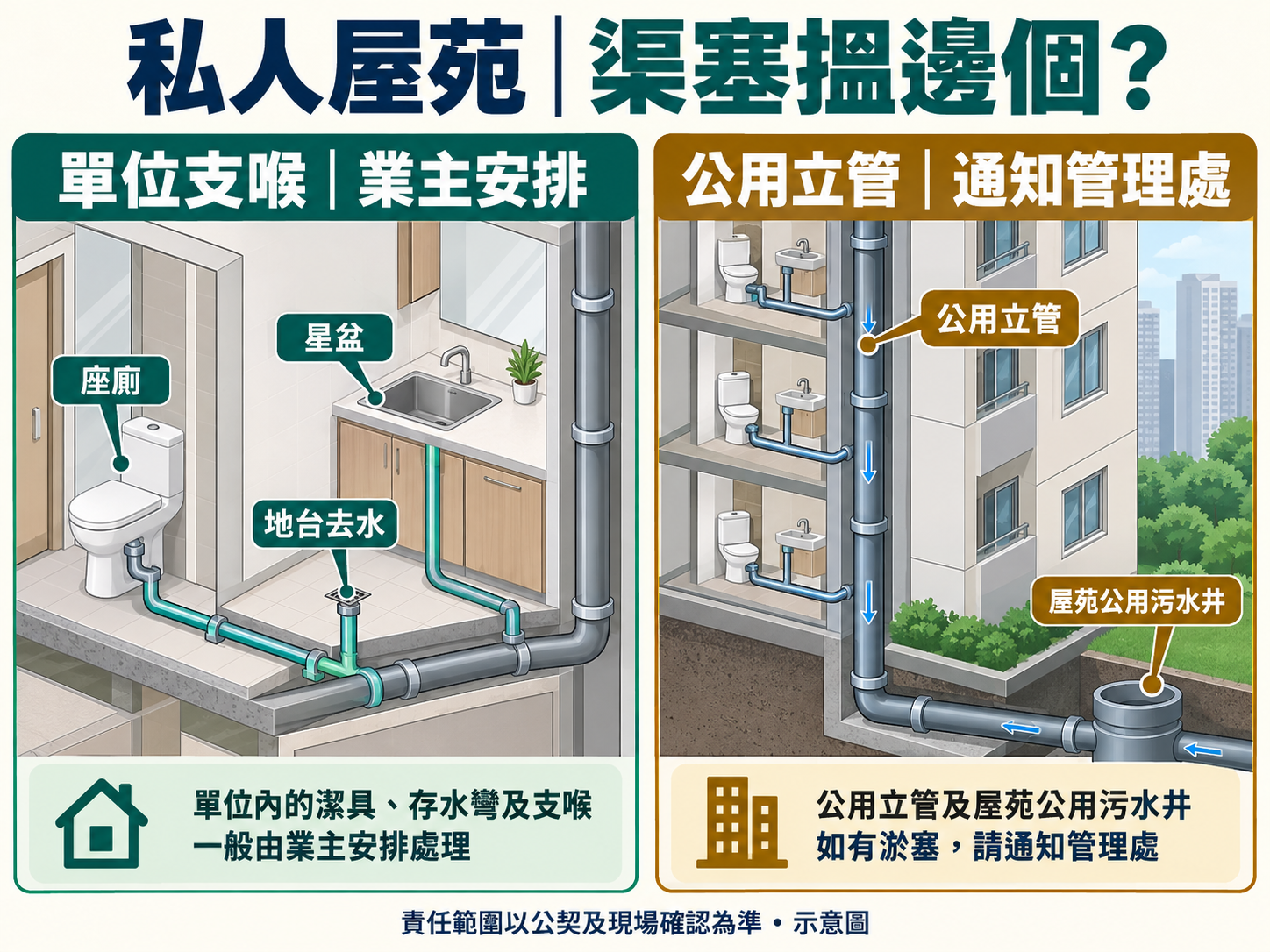
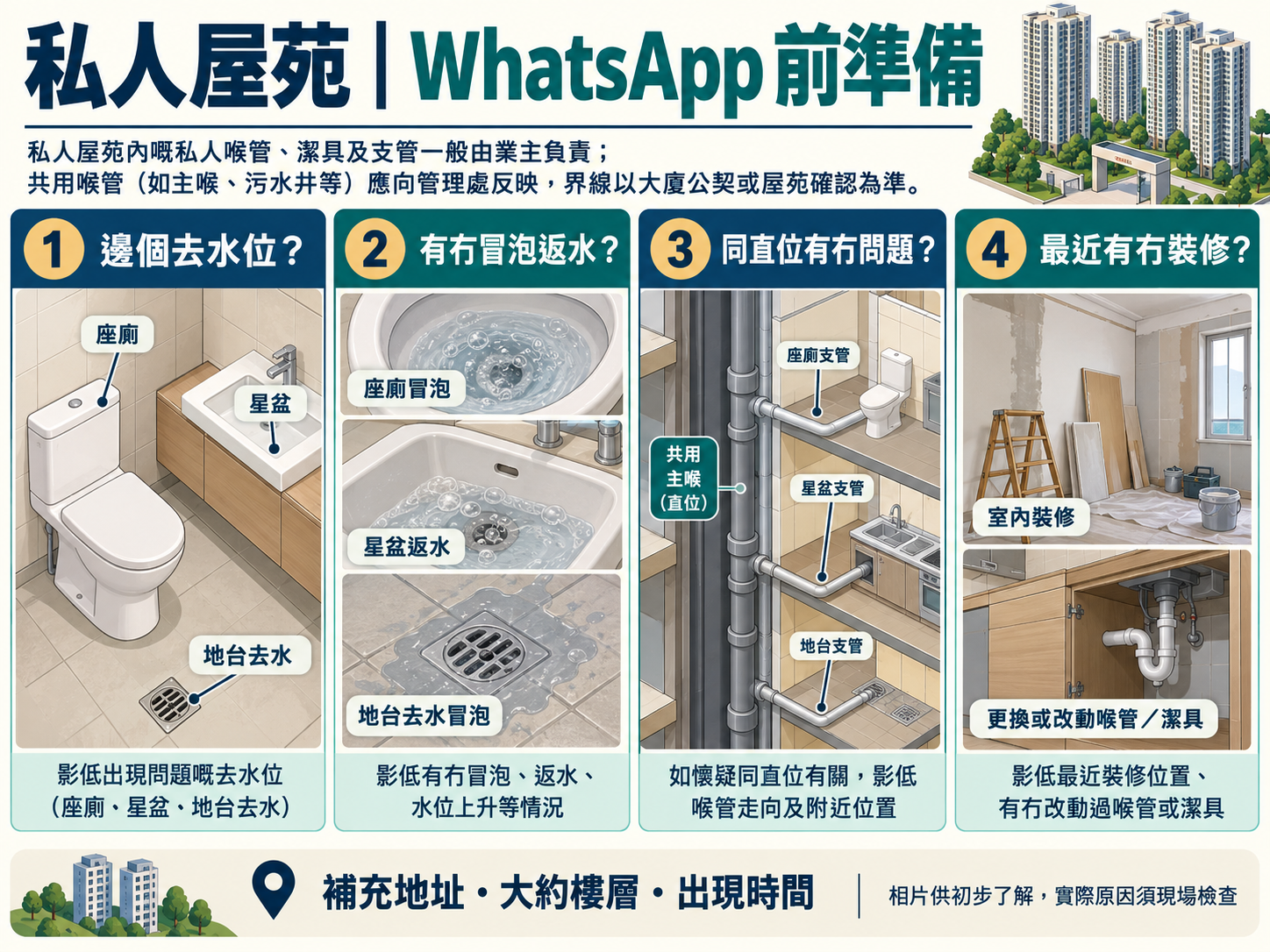
As set out above, the flats at Shatin Centre start on L5 and those at Wai Wah Centre and Shatin Plaza on L4, with the mall and car park below. By inference from that design, the soil stack has to turn into a horizontal run at about that level, and the lowest few residential storeys sit at the most downstream point of the whole line. Once grease, wet wipes and material that does not break up collect in that horizontal length or at a bend, the space left for water along the whole run narrows. When twenty-odd storeys discharge at once the water can only find a way out at the lowest connection, so the bottom few floors are where the toilet level rises, the floor drain pushes up bubbles and, at worst, water spills onto the bathroom floor. How do you tell which side is at fault? By timing and by spread: if a single fitting misbehaves, the problem is usually the branch pipe or trap inside your own flat; if several outlets in the bathroom and kitchen react at the same moment, and the pattern clusters around the morning and the hour either side of dinner, treat it as shared pipework, tell the management office the same day, and write down the date, time and duration of each episode.
All these podiums carry a fair number of food outlets. Per an am730 report of 16 September 2022, Chinachem Group spent HK$500 million from June 2021 refurbishing Lucky Plaza in four stages, which include the ground-floor main entrance, the second-floor car park and the third-floor mall; the report also said the scheme would bring a dining cluster of more than thirty speciality restaurants onto a single floor. Kitchen wastewater normally passes through a grease trap before it enters the building's drains, and whether the residential stacks and the mall's drains share any length, and where they meet, depends on each building's drawings. What this means in practice: if you smell stale cooking grease or see grease or water staining on a podium, a mall soffit, a rear lane or in the car park, do not assume the pipes in your own flat are at fault. Photograph it, note the exact spot and time, and pass it to the management office, which can refer it on according to who owns that part.
The flats at Lucky Plaza run from 416 to 655 sq ft and those at Wai Wah Centre from 403 to 483 sq ft, so kitchens here are generally small. By inference from that layout, a small kitchen has a short sink waste pipe with tightly spaced bends, and cooking oil and detergent gradually build a thick film on the pipe wall: at first the sink is merely slow and gurgles, and later it starts to smell. Day to day: do not pour cooking oil, soup solids or hotpot stock down the sink, empty the strainer every day, and flush the outlet with hot water once a week. If the sink slows again a few months after being cleared, the cause is usually not one point in the pipe but a film of grease lining a whole length of it, leaving less and less room for water. That normally calls for high-pressure washing along the whole branch length to take the film off the wall, rather than reopening a narrow channel through the middle. Strong acid and alkali drain cleaners, meanwhile, carry a corrosion risk in iron pipework and plastic traps of around forty years old, and do little to grease that is stuck to the pipe wall.
Per a Sing Tao Headline report of 30 May 2026, during the yellow rainstorm on the night of 29 May a gully cover at the New Town Plaza basement bus terminus surcharged badly, with water fountaining out of the opening; the report suggested the urban stormwater system had been overwhelmed and that rain-borne grit had blocked the gully, and noted severe ponding the same night on Lion Rock Tunnel Road near Tai Chung Kiu Road. That spot is directly opposite these estates. The distinction matters: gullies in the street belong to the stormwater system, while your toilet and sink connect to the foul system, so street flooding does not itself push water back into your flat. What does deserve attention is the estate's own drainage surfaces — the podium garden, the mall roof, the car-park ramps and the light wells. The Chinese Wikipedia entry records that Lucky Plaza's L4 podium was re-waterproofed in 2021–2022, and by inference these small-diameter outlets block easily with leaves, soil and moss, after which rainwater runs down stairwells and ramps into car parks and lobbies. Raising the state of the podium and ramp outlets with the management office before the wet season beats clearing up afterwards.
The Chinese Wikipedia entries record that Shatin Centre's major repair began in December 2006, with the external-wall works completed first in March 2008 and the lobbies and water features renovated from 2013, and that Lucky Plaza began its own major repair in 2007 — external-wall repairs, refurbishment of the ground-floor and fourth-floor lift lobbies, the lift cars and the electrical system — finishing in April 2008. Neither record mentions replacing the drainage pipes inside flats. The Mandatory Building Inspection Scheme does cover drainage, but the prescribed scope is spelled out as drainage on external walls, drainage in common parts, drainage in common pipe ducts and shared underground and above-ground drainage — not the branch pipe buried in your own wall. So when viewing, taking possession of or buying a second-hand flat here, treat "the major repair has been done" as no substitute for pouring water into every outlet yourself, watching how fast it goes and smelling what comes back.
Photos or a short video on WhatsApp help us tell a single-fixture blockage from a shared-stack problem.
Along Sha Tin Centre Street and Wang Pok Street, five estates went up above their own shopping podiums in the seven years from 1981 to 1988 — Shatin Centre, Lucky Plaza, Hilton Plaza, Wai Wah Centre and Shatin Plaza — about 5,070 flats between them. They share one trait: the flats do not stand on the ground but sit on top of malls and car parks. By inference from that design, waste leaving a flat generally has to reach podium level, turn, and travel horizontally before it can leave the building footprint. Working out who to call about a blockage, a smell or a dripping podium soffit therefore starts not with a phone call but with two questions: which of the five estates you live in, and whether the trouble is in your flat, in the building's shared pipes or in the mall — because even the management arrangements differ from estate to estate.
The five estates stand in a row beside Sha Tin MTR station and New Town Plaza, tied together by the footbridge network. Shatin Centre came first in December 1981, followed by Lucky Plaza in 1983–84, Hilton Plaza in 1985, Wai Wah Centre in 1986 and, last, Shatin Plaza in 1988 — seven years from first to last, making them roughly 38 to 45 years old today. They range from 430 to 1,480 flats and total about 5,070, and all five are private estates, with no public rental, Home Ownership Scheme or Tenants Purchase element.
Set their floor levels side by side and the five look almost identical: car parking at the lower levels, one or two mall floors above that, then a podium garden. Where the level is on record — L5 at Shatin Centre, L4 at Wai Wah Centre and Shatin Plaza — the flats begin above the podium, and at Lucky Plaza and Hilton Plaza the flats likewise sit above podium level. By inference from that design, the big difference between this kind of commercial-residential building and an ordinary block standing on the ground is that waste cannot drop from the stack straight into a manhole below. Near podium level the stack has to turn and continue as a horizontal run around the mall and car-park structure before it can reach the public sewer in the street. Horizontal runs are laid at a shallow fall and have many bends, so grease and sediment settle in them, and the first sign of trouble may be a stain or a drip on a mall or car-park soffit rather than anything in your own flat. The actual pipe routes for each block are shown on the drawings kept by its management office.
The podium deck is itself a drainage surface that needs maintenance. The Chinese Wikipedia entry records that the L4 podium at Lucky Plaza was re-waterproofed in 2021–2022 alongside the mall refurbishment, with all the planting replaced; that Shatin Centre's major repair began in December 2006, with external-wall works finished in March 2008 and the lobbies and water features renovated from 2013; and that Lucky Plaza began its own major repair in 2007, completing it in April 2008. Note what those records cover — external walls, lobbies, lifts and podium — and what they do not mention: replacing the drainage pipes inside flats. As a general inference from building age, the original stacks and branch pipes of 1980s blocks were usually cast iron or galvanised steel, and rust scale gradually narrows the effective bore; four decades of renovations of varying depth then mean trap types and branch routes can differ considerably between flats in the same block.
Note: statements based on building age and type are general inferences, not findings for any particular flat.
A clear process from enquiry and assessment to an agreed scope of work
Tell us the drain problem and district and ask about available timing.
Confirm timing based on the district and schedule, then inspect the blockage or odour issue.
Explain the proposed approach, scope and price before agreed work begins.
Use suitable tools for the site conditions and agreed scope of work.
After the agreed work, test drainage and explain the observed result and any next steps.
PipeButler is an independent drain-service provider with no affiliation to the developer, owners' corporation, management company or Housing Department of the places above. Facts come from public sources checked on the dates shown; work on common drains or common parts follows the management office's and deed of mutual covenant's arrangements.
WhatsApp with the problem and district, and we will confirm available timing.