
Loading page…
Loading page…
Fo Tan · Private estate
Occupied 1985–86 · 9 blocks on a depot podium · main drain across the 3/F podium
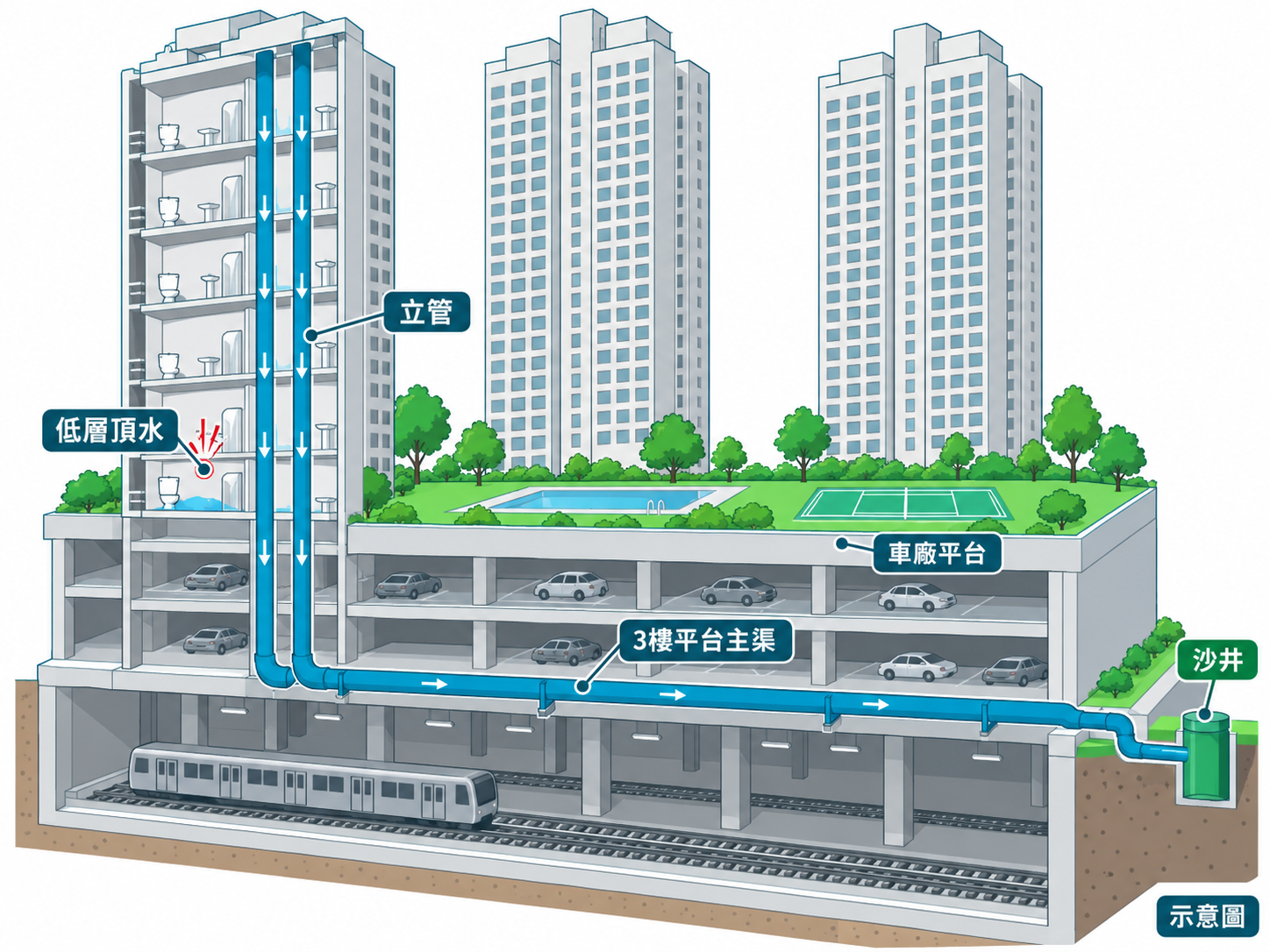
Jubilee Garden stands at 2-18 Lok King Street, Fo Tan, Sha Tin: eight residential towers plus the duplex block 銀禧閣, nine blocks in all, built on the podium above the MTR East Rail line's Ho Tung Lau depot.
Last reviewed ·
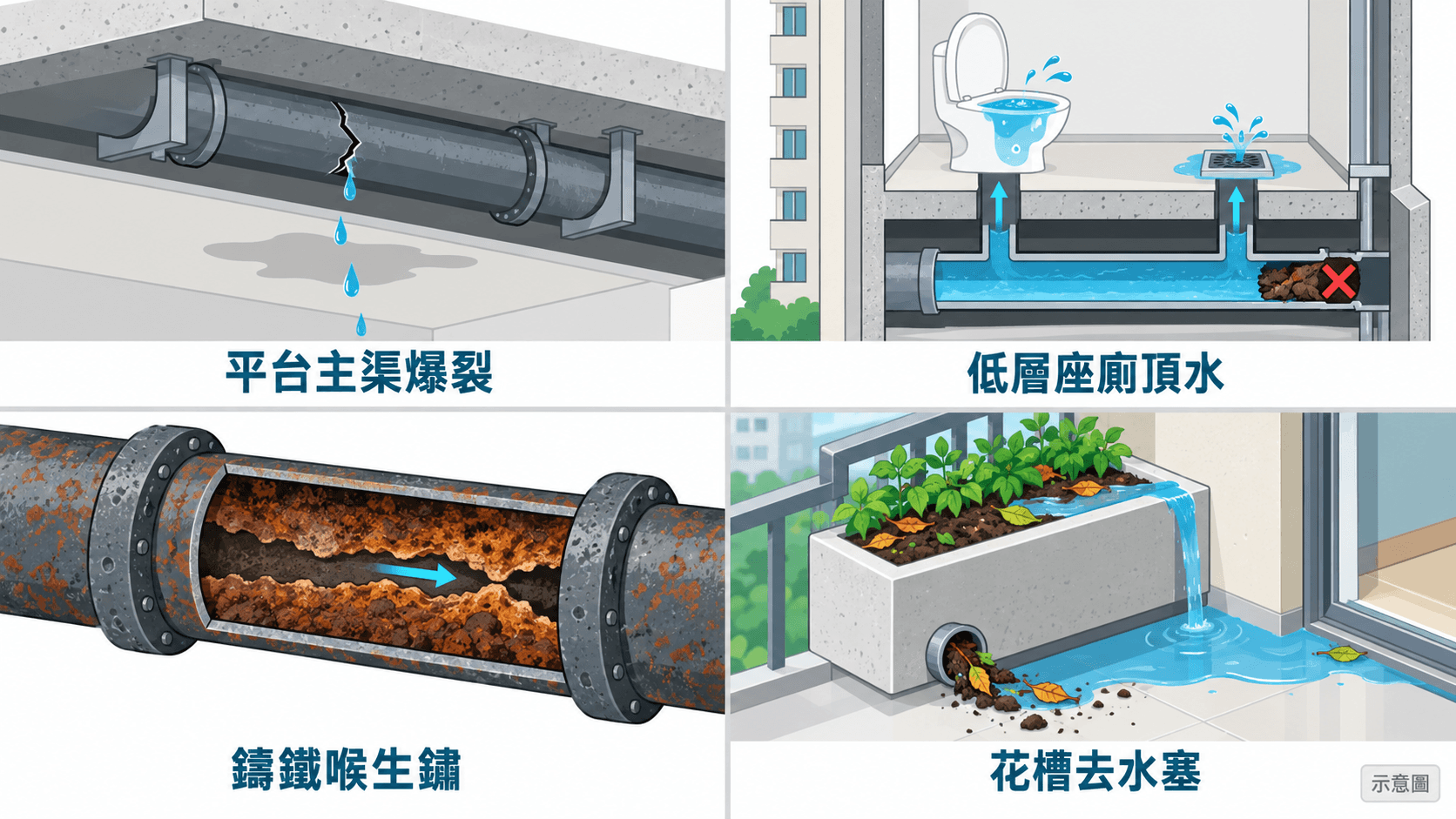
Choose the problem you are seeing to read the likely cause and next step.
The Chinese Wikipedia entry for Jubilee Garden records that a Tung Wah Group of Hospitals service unit originally on the third-floor podium suffered repeated wall leakage, a burst sewage pipe and foul-water backflow between 2008 and 2011, because the estate's main drain runs through the premises; the unit moved temporarily to the mall in June 2011 and only returned in July 2017. Two things follow. The main drain crosses the podium level rather than dropping straight to the ground, and when something goes wrong there, the premises on the podium are hit first. If you see staining, dripping or smell sewage on a podium, car-park or common-corridor ceiling today, photograph it, note the exact spot and time and pass it to the management office so the owners' corporation can follow up the shared length; do not open pipework yourself.
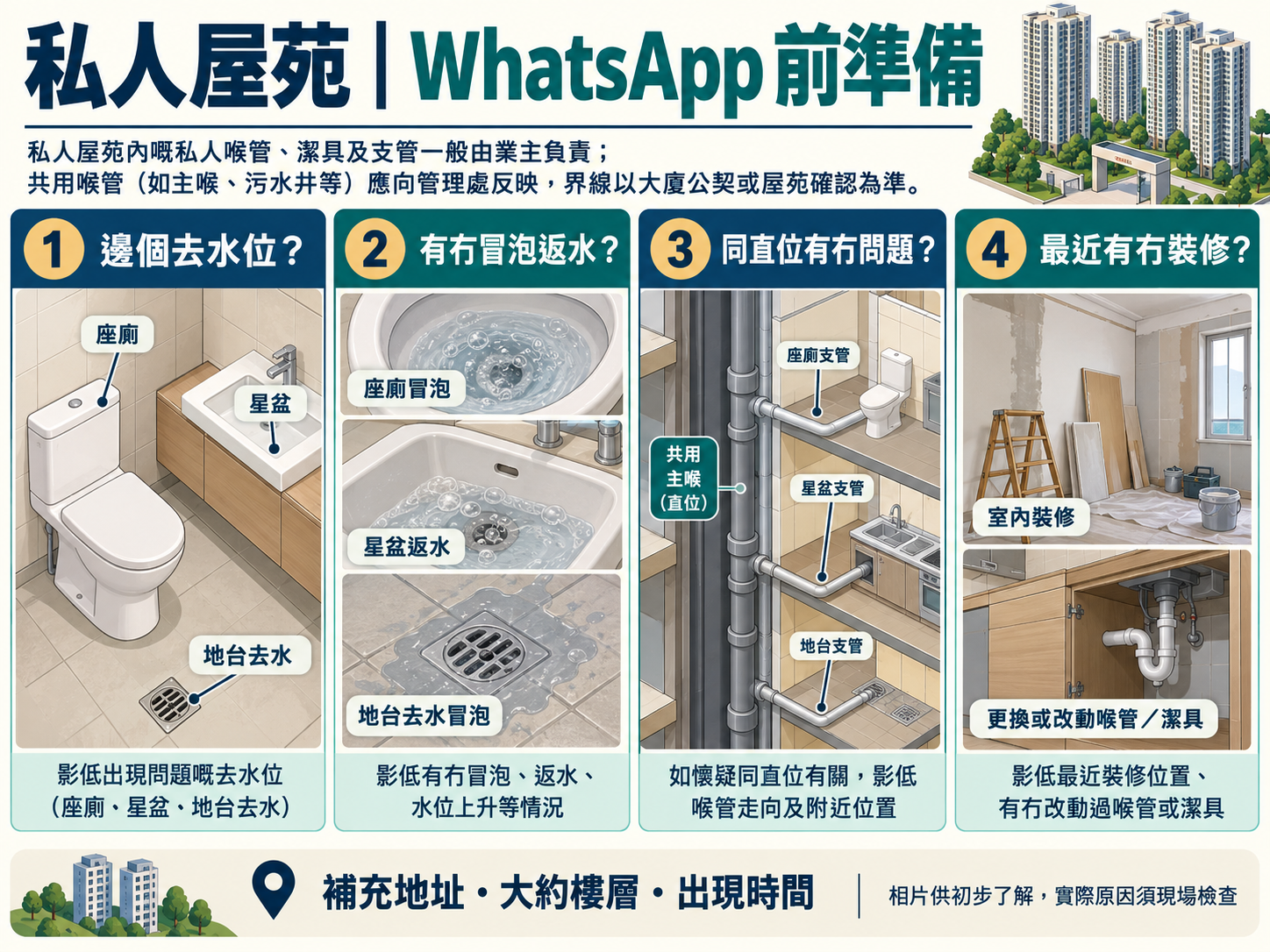
Flats begin on the fourth floor, with the garden podium on the third, the car parks on the first and second, and the depot structure below those. Inferring from that arrangement, the fittings on the 4th to 6th floors connect nearest the length where the stack turns into the podium's horizontal run — the slowest-moving and most deposit-prone part of the whole line. Blocks 1 to 8 carry eight flats a floor, lettered A to H, and discharge is concentrated at the morning and evening showering peaks, so once grease or wet wipes narrow that horizontal length, the pressure finds its way out through the toilets and floor drains of those bottom storeys. Three signals tell you which length is at fault: whether the floors above are discharging heavily at the time; whether the flats directly above and below you, in the same lettered position, behave the same way; and whether one outlet or several in your flat go slow together. Two out of the three point at the shared pipework — tell the management office and note the date and time.
Wikipedia states that the estate's flushing water is seawater supplied by the Water Supplies Department. As a general inference from building age, in an estate occupied in 1985–86 the original soil stacks and toilet discharge pipes were most likely cast iron, and Buildings Department practice note APP-133 notes premature rusting, leakage and corroded fixing brackets in cast-iron pipes in some existing buildings. Once rust flakes and scale build up on the pipe wall, the effective bore keeps shrinking, which is why some flats are cleared every year and slow down again a few months later. Chemical drain cleaner will usually only dissolve the surface film, leaving the rust and scale in place, and a caustic residue does no favours to old iron pipe or to whoever later opens it up for inspection; the wall itself has to be stripped with high-pressure water jetting. If a crack or a loose joint is suspected, a camera survey should decide whether a length needs replacing.
Wikipedia records that every flat has bay windows and planters, top-floor flats have an open terrace, and some layouts carry a balcony of 83 to 117 sq ft; the third-floor podium is also planted with flowers and trees and holds the pool and ball courts. Inferring from the design, these small-diameter outlets are the easiest to block with soil, fallen leaves and moss, and in a rainstorm water that cannot get away comes back over the planter edge or the threshold. Beyond the estate, the Drainage Services Department's list of locations prone to blockage (version dated 26 August 2026) keeps three Fo Tan spots under watch — Wo Liu Hang Village, Tat Yip Lane and Fo Tan Road — which shows how much outdoor clearing before the wet season matters around here. Clear the planter and balcony outlets inside your own flat one by one; the podium garden and common outlets are for the management office to arrange.
Blocks 1 to 8 each have 34 residential floors with eight flats on every one. Inferring from that layout, flats in the same lettered position share one soil stack from top to bottom, so when the floors above flush heavily the pressure inside the pipe swings sharply up and down. If the vent pipe is choked by debris or a bird's nest, or the anti-syphonage pipe was removed during a renovation, that negative pressure draws the water seal out of the basin and floor-drain traps and sewer air enters through the outlet. The classic signs are a gurgle when someone flushes and a smell that comes and goes, with nothing actually blocked in your flat. The Buildings Department's drainage-health guidance explains it plainly: the trap holds a body of water that seals sewer air out of the room, while the anti-syphonage pipe, carried at least a metre above roof level and left open, balances the negative pressure created when the upper floors discharge — alter either without approval and the seal is lost. Such alterations fall under the Minor Works Control System and must be carried out by a suitable contractor registered under the Buildings Ordinance.
Photos or a short video on WhatsApp help us tell a single-fixture blockage from a shared-stack problem.
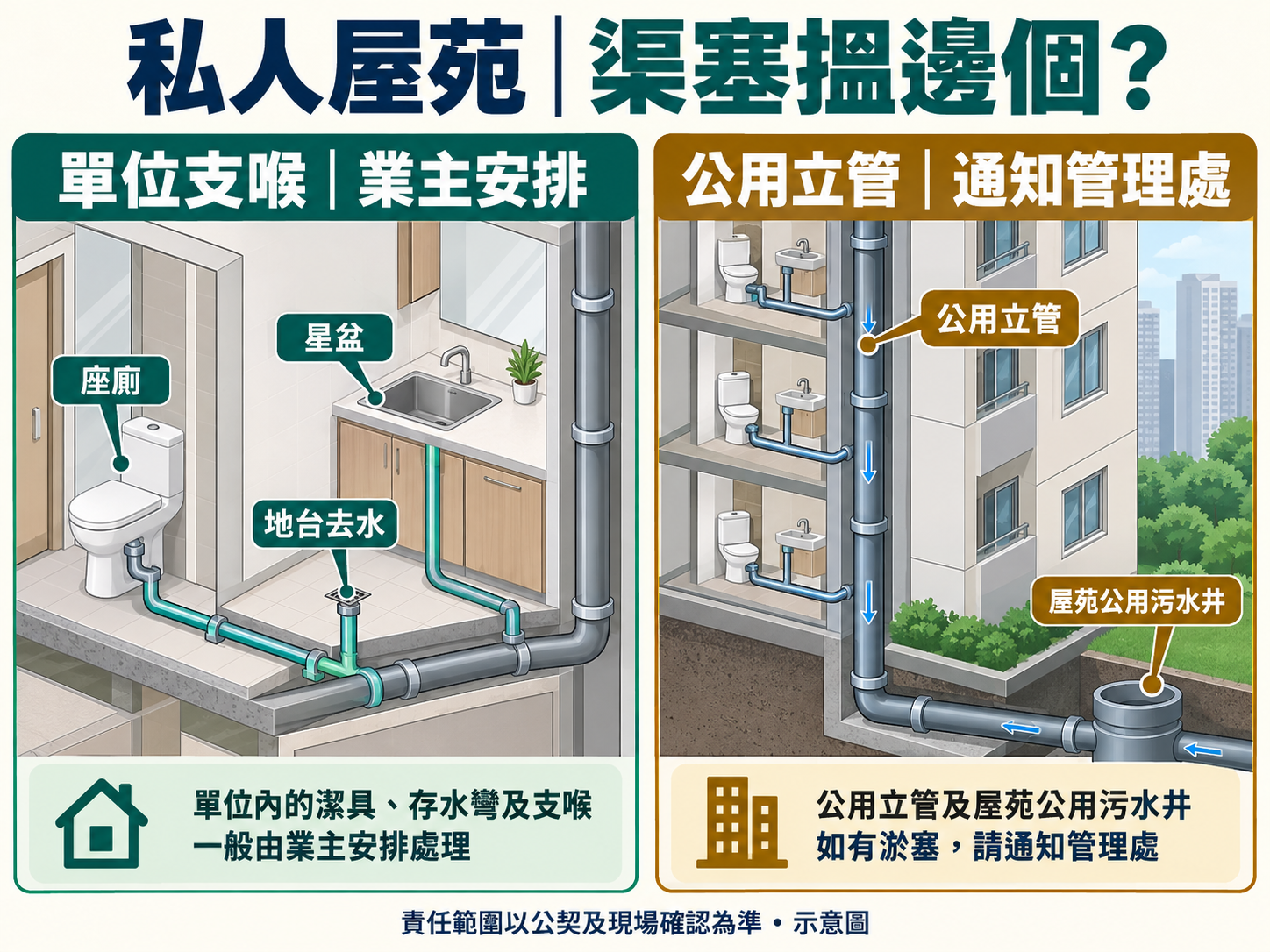
Jubilee Garden stands at 2-18 Lok King Street, Fo Tan, Sha Tin: eight residential towers plus the duplex block 銀禧閣, nine blocks in all, built on the podium above the MTR East Rail line's Ho Tung Lau depot. Phase one was occupied in October 1985 and phase two in May 1986, giving 2,260 flats. The first and second floors are car parks, the third floor is the garden podium, flats begin on the fourth floor, and the Chinese Wikipedia entry records that the estate's main drain crosses that third-floor podium. So when a drain blocks, smells or surcharges here, the first job is to separate a problem in the flat's own branch pipes and traps from one in the shared pipework below, where the stacks turn at podium level.
The site was put up for public tender by the government in April 1979 (Sha Tin Area 15B, Sha Tin Town Lot 87, about 2.66 hectares) and won in July that year by 宜賓地產發展有限公司, a joint venture of Cheung Kong, Federal Real Estate (聯邦地產) and Chiao Kuang Properties (僑光置業); the Chinese Wikipedia entry describes it as one of the few podium-over-depot projects in which the railway company took no part. Only after the Ho Tung Lau depot's extension was finished in 1982 was the podium handed over to the developer, on 21 May that year, for the blocks to be built. Blocks 1 to 8 each rise 38 storeys, with flats on floors 4–19 and 21–38, eight flats per floor lettered A to H and 272 flats per block; the 20th floor is a refuge floor, making this one of the first residential developments in Hong Kong to have one. Together with 銀禧閣, a six-storey block of 84 duplex flats, the estate has 2,260 flats.
By inference from the structure, the big difference between an estate on a depot podium and an ordinary block standing on the ground is that the sewage cannot drop straight into a manhole below. The stacks have to turn at around podium level and continue as horizontal pipes until they can leave the depot footprint and reach the public sewer. The Chinese Wikipedia entry records that the estate's main drain passes through the premises of a service unit on the third-floor podium, which fits that reading. Horizontal runs are laid at a shallow fall and have many bends, so grease and sediment settle in them, and if such a length blocks or leaks, the first sign may be a stain on a podium or car-park ceiling rather than anything in your own flat. The actual pipe routes are shown on the drawings kept by the management office.
The estate is now about 40 to 41 years old. Wikipedia states that both the drinking water and the seawater used for flushing come from the Water Supplies Department. As a general inference from building age, soil stacks of this generation were usually cast iron, and Buildings Department practice note APP-133 says cast-iron pipes in some existing buildings have shown premature rusting, leakage and corroded fixing brackets. Every flat also has bay windows and planters, and some layouts have a balcony, so there are many small-diameter outlets; four decades of renovations of varying depth mean trap types and branch-pipe routes can differ considerably between flats in the same block. The owners' corporation was registered under the Building Management Ordinance on 25 February 1995, and 198 flats are held by the Financial Secretary Incorporated and administered by the Government Property Agency as police quarters.
Note: statements based on building age and type are general inferences, not findings for any particular flat.
A clear process from enquiry and assessment to an agreed scope of work
Tell us the drain problem and district and ask about available timing.
Confirm timing based on the district and schedule, then inspect the blockage or odour issue.
Explain the proposed approach, scope and price before agreed work begins.
Use suitable tools for the site conditions and agreed scope of work.
After the agreed work, test drainage and explain the observed result and any next steps.
PipeButler is an independent drain-service provider with no affiliation to the developer, owners' corporation, management company or Housing Department of the places above. Facts come from public sources checked on the dates shown; work on common drains or common parts follows the management office's and deed of mutual covenant's arrangements.
WhatsApp with the problem and district, and we will confirm available timing.