
Loading page…
Loading page…
Tai Kok Tsui · Private estate · Commercial & restaurants
Built 1974–1976 · 15 blocks of 13 storeys · compact 200–400-odd sq ft flats
Cosmopolitan Estates in Tai Kok Tsui is made up of 15 residential blocks of 13 storeys, built between 1974 and 1976, with more than 2,000 flats, most of them only 200 to 400-odd sq ft.
Last reviewed ·
Choose the problem you are seeing to read the likely cause and next step.
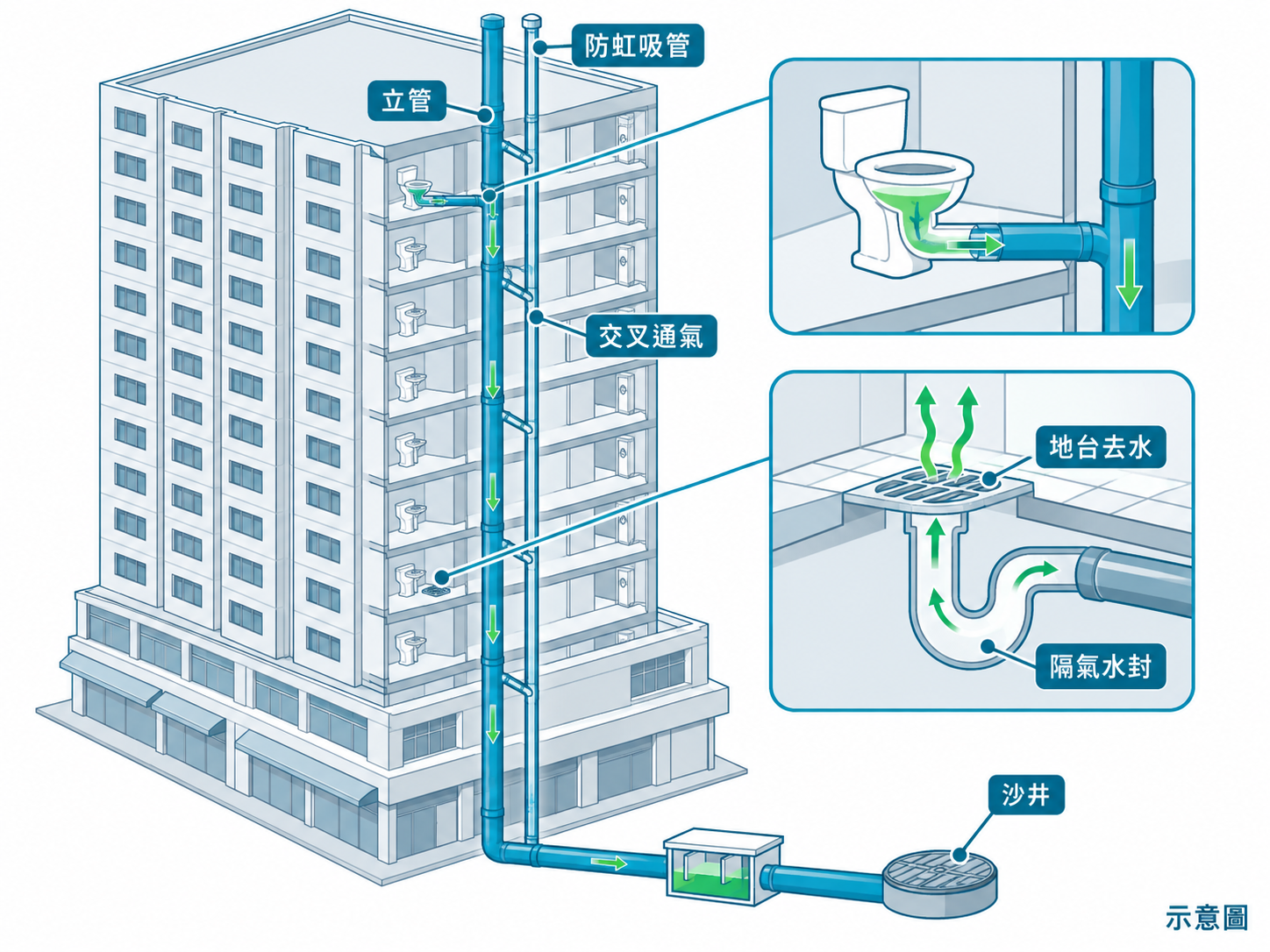
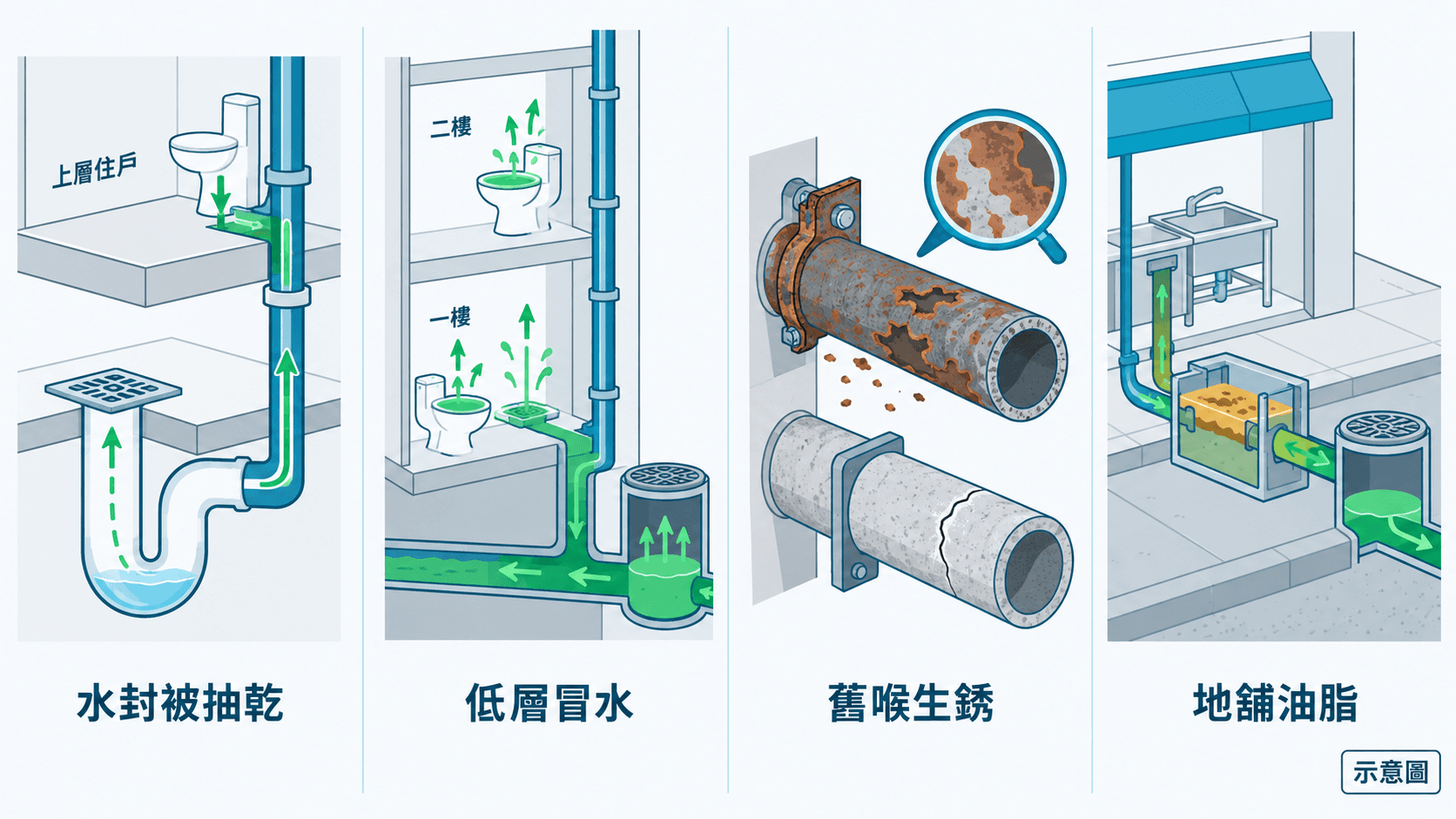
The Buildings Department's drainage-health pages explain that once a flat above discharges sewage beyond a certain volume, siphonage creates negative pressure in the branch pipes of the flat below, enough to pull the water seal out of the trap; the main anti-syphonage pipe and its cross-vents exist to balance that pressure. By inference from the design of the period, a 13-storey block completed in the 1970s may not meet the current APP-164 requirement for buildings of more than 5 and not more than 20 storeys, which asks for a cross-vent at intervals of no more than 5 storeys. If the odour comes in waves, usually a few minutes after someone upstairs runs water, and there is clearly still water in the floor drain, do not treat it as a blockage: check that each fitment still has its trap and what type it is, whether the branch pipe weeps, and whether the anti-syphonage pipe on the external wall has been sealed, cut through or removed during a renovation.
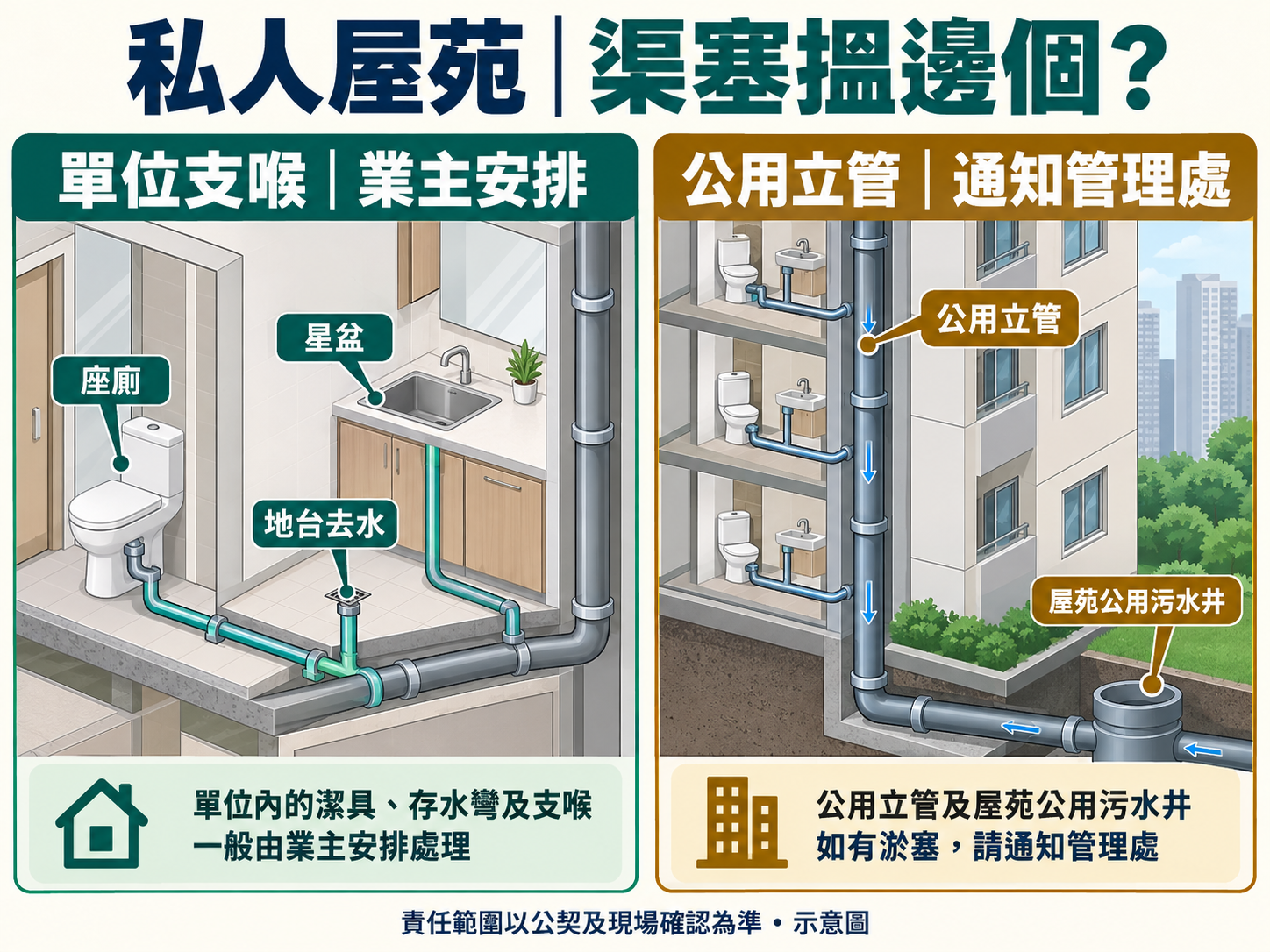
For buildings of more than 3 and not more than 20 storeys, APP-164 requires that the fitments on the floor where the stack discharges into a manhole must not be connected to the stack, but must have separate pipework running straight to the manhole. That requirement only appeared in 2021, so by inference the low-floor fitments here may still tee into the stack. Where the stack reaches the bottom and turns into the manhole, that bend is the easiest place for grease and debris to settle; once it narrows, flow from the upper floors backs up at that point, and the floor or two closest to the manhole are the first to suffer. Telling them apart is simple: if several outlets on a low floor well up together and the timing matches water use upstairs, tell the management office or owners' corporation at once so the shared stack and manhole can be checked. If only one fitment is slow, it is usually the flat's own branch pipe.
Sections of pipe buried in a wall, a light well or above a false ceiling cannot be judged by eye. Buildings Department practice note APP-133 records premature rusting, leakage and corroded metal fixing supports in cast iron pipes in some existing buildings, and finding out the real condition usually means a CCTV survey or opening up. For cement soil pipe, the Environmental Protection Department states that buildings completed before the mid-1980s may contain asbestos-containing materials and lists cement soil stacks among the examples, so the material should be established before anything is struck, cut or replaced, and qualified people brought in where the law requires. Routine clearing of a blockage does not normally disturb the pipe itself; but if the same spot blocks year after year, a survey first is worth it, to see whether it is a build-up, a narrowing or a break before choosing between clearing and replacing a short length.
Flats here are mostly 200 to 400-odd sq ft at close to 80% efficiency, so kitchens and bathrooms are tight. As a general inference from building age, most flats have been refitted at least once over fifty years: walls opened up for a kitchen, the bathtub replaced with a shower tray, the washing machine teed into the sink trap or the floor drain. Three consequences recur. The outlet is raised to suit a new floor build-up and no longer has enough fall, so it drains slowly. The original trap is swapped for a shallow-seal type, so the smell arrives as soon as the extractor fan runs. And the washing machine discharges faster than the old branch pipe can take, so the sink or floor drain wells up on every wash. The Buildings Department points out that ordinary repair or replacement of an indoor branch pipe or a sanitary fitment — a toilet, basin or bath — is exempted building works; but erecting, altering or removing the flat's drainage system, traps, anti-syphonage pipes and drain positions included, falls under the Minor Works Control System and must be entrusted to a contractor registered under the Buildings Ordinance, such as a registered minor works contractor. Pouring water down every outlet when you move in or out is the quickest way to find what the previous refit left behind.
Ivy Street, where the estate stands, is the local food street, thick with eateries and chain shops at ground level, and the estate mall sits right against the residential blocks. The grease-and-oil section of the Environmental Protection Department's guide for restaurants and food processors states that all restaurants and food processing factories are required to install grease traps; the maintenance section of the same guide advises inspecting the trap at least every three days, cleaning it once greasy waste fills the top 30 per cent of the liquid depth, and recording the work in a log book. By inference from the layout, the shops and mall drain through horizontal runs and manholes at ground level; that pipework is not necessarily the same as the residential stack, but the two often share a manhole. So when a rancid-oil smell is concentrated on the low floors, in the back lane or around the mall, and is worst after the shops close, the place to work is the ground-level horizontal runs and the grease traps, not the branch pipe inside a flat.
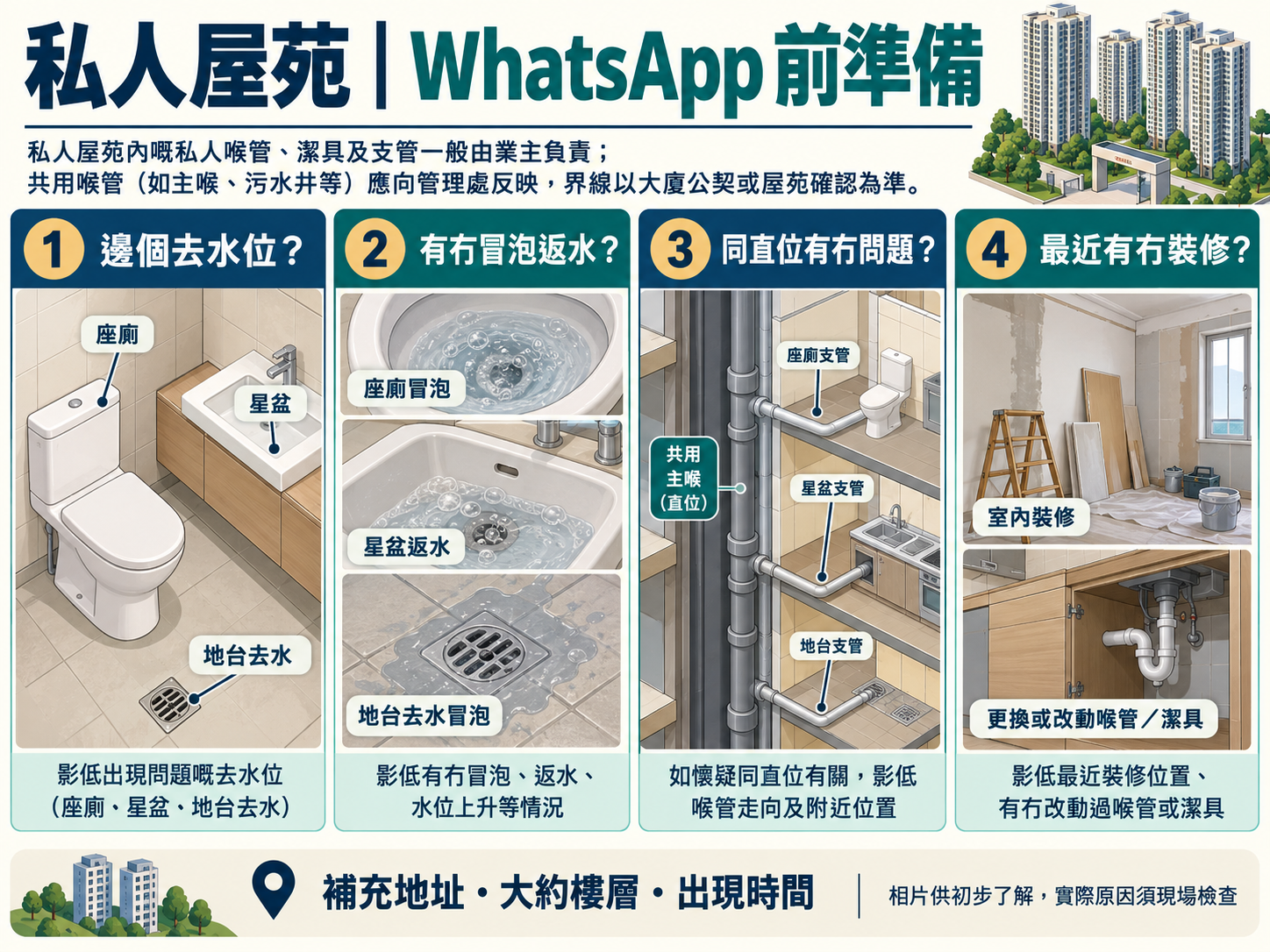
Photos or a short video on WhatsApp help us tell a single-fixture blockage from a shared-stack problem.
Cosmopolitan Estates in Tai Kok Tsui is made up of 15 residential blocks of 13 storeys, built between 1974 and 1976, with more than 2,000 flats, most of them only 200 to 400-odd sq ft. The Urban Renewal Authority's social impact assessment for the Oak Street/Ivy Street project records that the Cosmopolitan Dock closed in 1972 and the site was redeveloped into the estate standing there today. Half a century of age, small flats, refits that by inference most flats will have had at least once, and a street full of ground-floor eateries make drainage here behave quite differently from a new building: an odour does not necessarily mean a blockage, and water welling up on a low floor is not necessarily in your own section of pipe.
The fifteen blocks run from Block A, Tai Fu Building (大富樓), to Block Q, Tai Wah Building (大華樓), with no I or O block in between, spread across five streets — Tai Tsun Street, 117 Tai Kok Tsui Road, 12 Tai Ching Street, Ivy Street and Wong Tai Street — with Tai Shing Arcade (大成商場) adjoining Block H, Tai Shing Building (大成樓), and the Tai Ching car park alongside. The practical consequence for residents is that each of the fifteen blocks has its own street address: give the block name and number when you report a fault, or nobody knows which stack to look at. Renovation and repair histories also vary widely from block to block, so nothing useful follows from the estate name alone.
Thirteen storeys places these blocks in the "more than 5 and not more than 20 storeys" band of the Buildings Department's current standard. Practice note APP-164 asks that stacks in that band be cross-vented into the main anti-syphonage pipe at intervals of not more than 5 storeys, starting from the lowest storey with a branch pipe connected to the stack. It also says that on the floor where the stack discharges into a manhole, the sanitary fitments must not be connected to the stack but must have separate pipework running straight to the manhole. That practice note was first issued in April 2021 and applies to drainage plans submitted after 31 August 2021, and also to the erection or alteration of any aboveground drainage system commenced under the Minor Works Control System after that date — so blocks designed in the 1970s were not built to it, but pipework altered today has to follow it. By inference from the design of the period, cross-vents may be sparser here, and low-floor fitments may still tee straight into the stack.
On materials, as a general inference from building age, the original stacks are most likely cast iron or cement soil pipe. Buildings Department practice note APP-133, first issued in November 2003, records that cast iron pipes in some existing buildings have shown premature rusting, leakage and corroded metal fixing supports. The Environmental Protection Department also warns that buildings completed before the mid-1980s may contain asbestos-containing materials, and the examples it lists include cement soil stacks and cement pipes; all forms of asbestos have been banned from import, supply and use in Hong Kong since 4 April 2014. Neither point says anything is wrong at this estate — they say that the material has to be established before anyone cuts, chases or replaces old pipework. At fifty years old, what any one flat is actually like depends on the renovation and repair history of that flat and that block.
Note: statements based on building age and type are general inferences, not findings for any particular flat.
Choose an enquiry route for your premises and work scope.
Pantry, washroom and shared-drain enquiries, with scope agreed before work
Scope and booking detailsUnit outlets, shared pipes and chamber enquiries assessed with site access
Scope and booking detailsDiscuss a defined maintenance scope using assets, usage and incident records
Scope and booking detailsA clear process from enquiry and assessment to an agreed scope of work
Tell us the drain problem and district and ask about available timing.
Confirm timing based on the district and schedule, then inspect the blockage or odour issue.
Explain the proposed approach, scope and price before agreed work begins.
Use suitable tools for the site conditions and agreed scope of work.
After the agreed work, test drainage and explain the observed result and any next steps.
PipeButler is an independent drain-service provider with no affiliation to the developer, owners' corporation, management company or Housing Department of the places above. Facts come from public sources checked on the dates shown; work on common drains or common parts follows the management office's and deed of mutual covenant's arrangements.
WhatsApp with the problem and district, and we will confirm available timing.