
Loading page…
Loading page…
Mong Kok West / Tai Kok Tsui · HOS / PSPS
HOS estate completed 1998 · 18 blocks, 3,908 flats · ceiling seepage and floor drains
Charming Garden stands on Hoi Ting Road in Mong Kok West and was completed in May 1998 as a Private Sector Participation Scheme estate: 18 blocks and 3,908 flats in two phases, straddling Hoi Wang Road.
Last reviewed ·
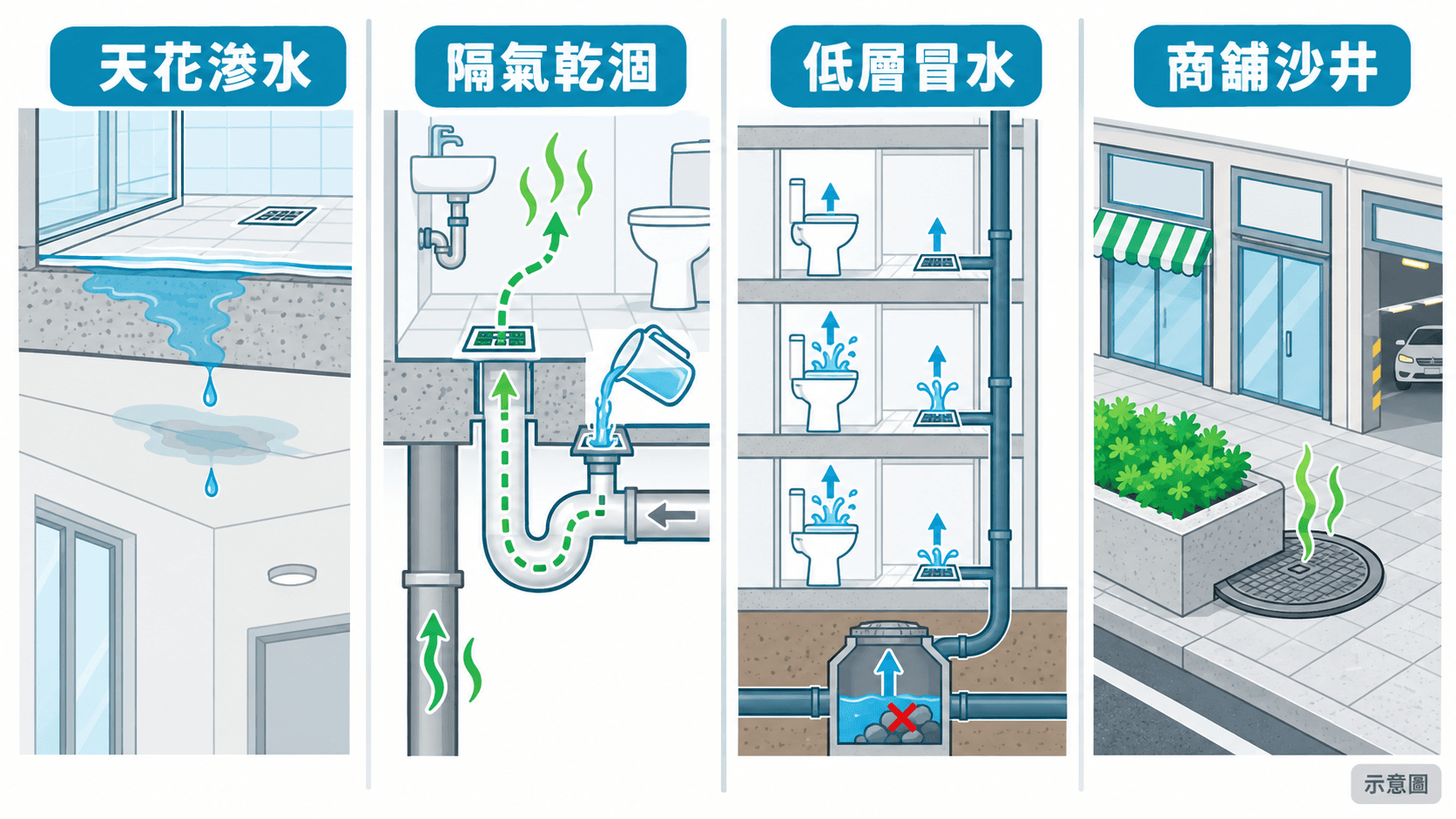
Choose the problem you are seeing to read the likely cause and next step.
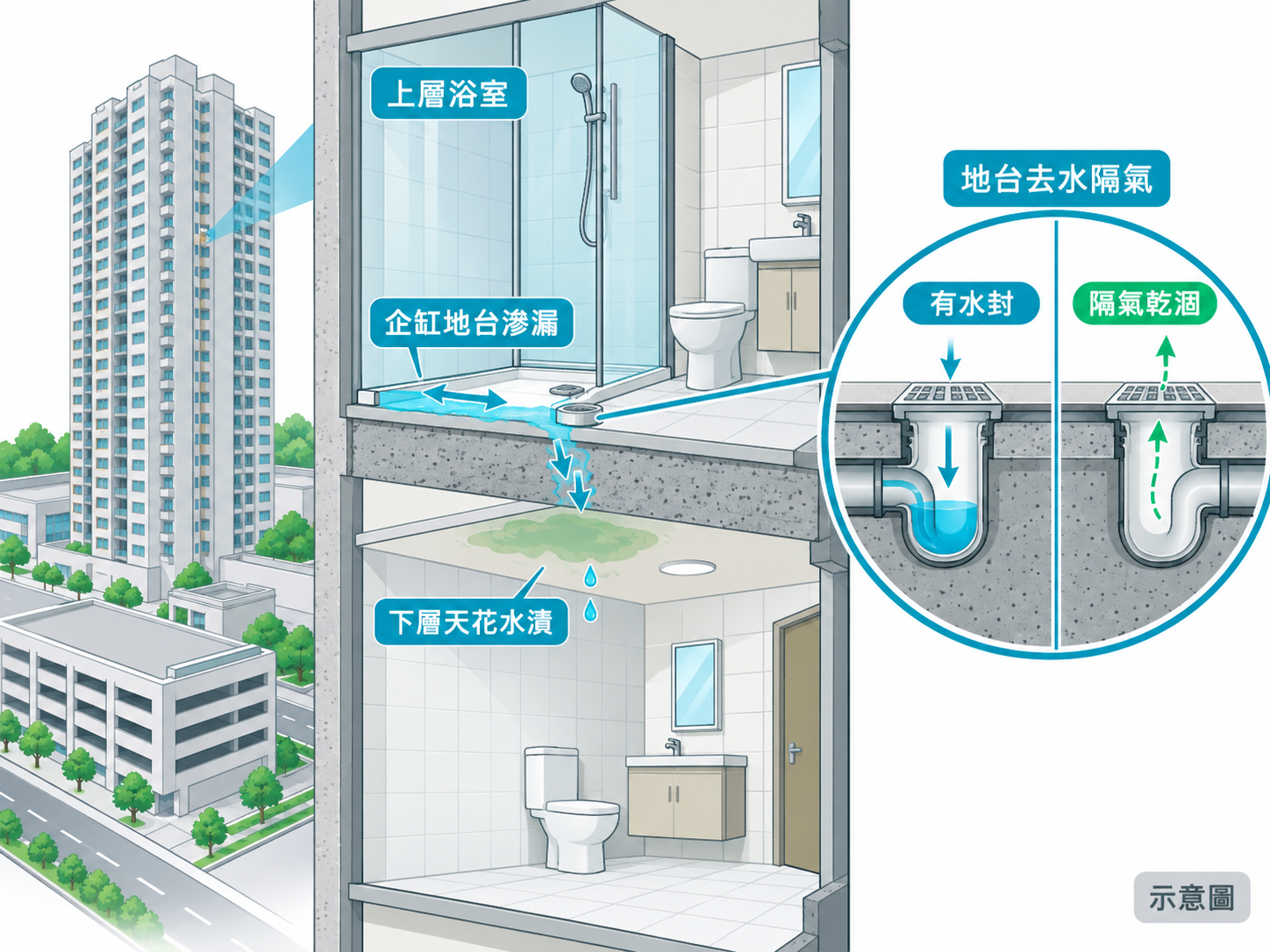
According to an on.cc report of 1 November 2015, a Charming Garden household's corridor and bathroom ceilings had been seeping since 2012. The Joint Office for Investigation of Water Seepage Complaints received the complaint in March 2012 and carried out dye tests, floor ponding tests and reverse-pressure tests without finding the source, suspended the investigation and replied to the complainant at the end of October 2014. A fresh complaint came in January 2015, a further ponding test was arranged in the flat above at the end of July, and the result found seepage at the floor beside the shower enclosure in the upper bathroom; the spokesperson said a Nuisance Notice was to be served on the owner above, requiring the repair to be completed within a specified period. That location is worth remembering: the junction and waterproofing at the edge of a shower tray is one of the hardest spots in a bathroom to judge by eye, and one of the spots a ponding test picks up most readily. If your stain is in the bathroom or the corridor outside it and is worse after the flat above showers, you can ask for a ponding test upstairs.
If you remember a neighbour here waiting three years without an answer, the procedure is no longer the same. Buildings Department information shows that from 16 July 2026 the Joint Office has run new procedures as a pilot scheme: Stage I now adds infrared thermography alongside the electronic moisture meter, so the source can be provisionally identified without entering the flat above; where there is reasonable belief the seepage comes from above, a Notification Letter goes to that owner requiring inspection and repair within 28 calendar days; if seepage persists after the deadline, Stage II and Stage III investigations run in parallel and a Nuisance Notice follows under the Public Health and Municipal Services Ordinance (Cap. 132). The Joint Office contacts the informant within 6 working days of a report and, for simple cases, issues the Notification Letter in about 14 working days. Mong Kok is handled by the Kowloon Regional Joint Office, reached through 1823.
Buildings Department practice note APP-164 requires that the floor drain of a domestic kitchen, toilet or pantry be fed with used water diverted from a basin, bath or shower, so evaporation does not destroy the water seal. That requirement only appeared in 2021, and by inference a flat completed in 1998 has no such arrangement: the seal in a bathroom floor drain depends entirely on water happening to run across it. A shower enclosure that keeps the floor dry, a second bathroom that is rarely used, or a flat let out or left empty for a while will all let the seal evaporate, and sewer air then comes straight back into the room — more noticeably when the exhaust fan is on. The remedy is to pour water into every floor drain regularly; if the smell is still there a few days after doing so, the trap needs checking for damage, for cement or debris sealing it up, or for having been removed in a past renovation.
For a building over 20 storeys, APP-164 provides that at the floor where the stack discharges to a manhole, the fitments on that floor and on the floor above should not be connected to the stack but should have separate pipework running directly to the manhole; for a building of more than 3 and not more than 20 storeys — which here means the 20-storey Blocks 4–6 — only that one floor is covered. Charming Garden's blocks are 20 to 23 storeys, so the fifteen blocks of 22 and 23 storeys fall in the "over 20 storeys" category, yet the requirement did not exist when they were designed in 1998. By inference, the toilet, basin or floor drain on the lowest floor or two may still tee straight into the stack, and once grease, tissue or debris narrows the lower stack or the manhole outlet, a heavy discharge from above shows up first as a rising level, or water welling out, on those low floors. The test is simple: one slow fitment usually means the flat's own branch pipe or trap, while a toilet and floor drain rising together in step with water use upstairs should be treated as the shared stack and reported to the management office immediately.
The estate has traded actively since 1998 — the Chinese Wikipedia article, citing Ming Pao, records a middle-floor flat changing hands for HK$10.65 million in July 2018 — and by inference from that age and turnover many flats have been renovated more than once, each time with a chance that a bathroom or kitchen outlet was moved. The Buildings Department states that APP-164 applies to drainage work started under the Minor Works Control System after 31 August 2021, and it names the alterations concerned: installing a new floor drain in a domestic kitchen, toilet or pantry; installing or altering a drainage stack; altering an offset in an existing stack; adding a pipe connection into the stack; adding a sanitary fitment at the lowest or second lowest floor of the stack; and altering a roof ventilating pipe. All of these must be carried out by a registered minor works contractor and to the current standard. In practice the commonest faults after a handover or a renovation are cement and debris dropped into an outlet, a floor drain made shallower or sealed over, and a washing machine discharging into the wrong place — running water through every outlet before you accept the flat costs far less than lifting a floor afterwards.
Besides the flats, the estate has 88 shops and two car parks. By inference from that composition, the floor drains, horizontal collector drains and manholes serving those areas — with grease separation where food businesses operate — are not the same run of pipework as the residential stacks, and day-to-day maintenance there is mostly about grease, silt and debris. The Buildings Department's guidelines note that manholes should be readily accessible for regular maintenance, that access should not be obstructed by floor finishes, planters or furniture items, and that foul air escaping from a manhole can be dealt with by using double-seal covers or repairing cracks in the cover and the edges of the opening. So if you meet drain odour, standing water or a dripping ceiling in a podium area, a shop corridor or a car park, note the spot and the time and tell the management office rather than assuming your own flat is at fault; owners can also keep an eye out for manhole covers left permanently under planters or clutter.
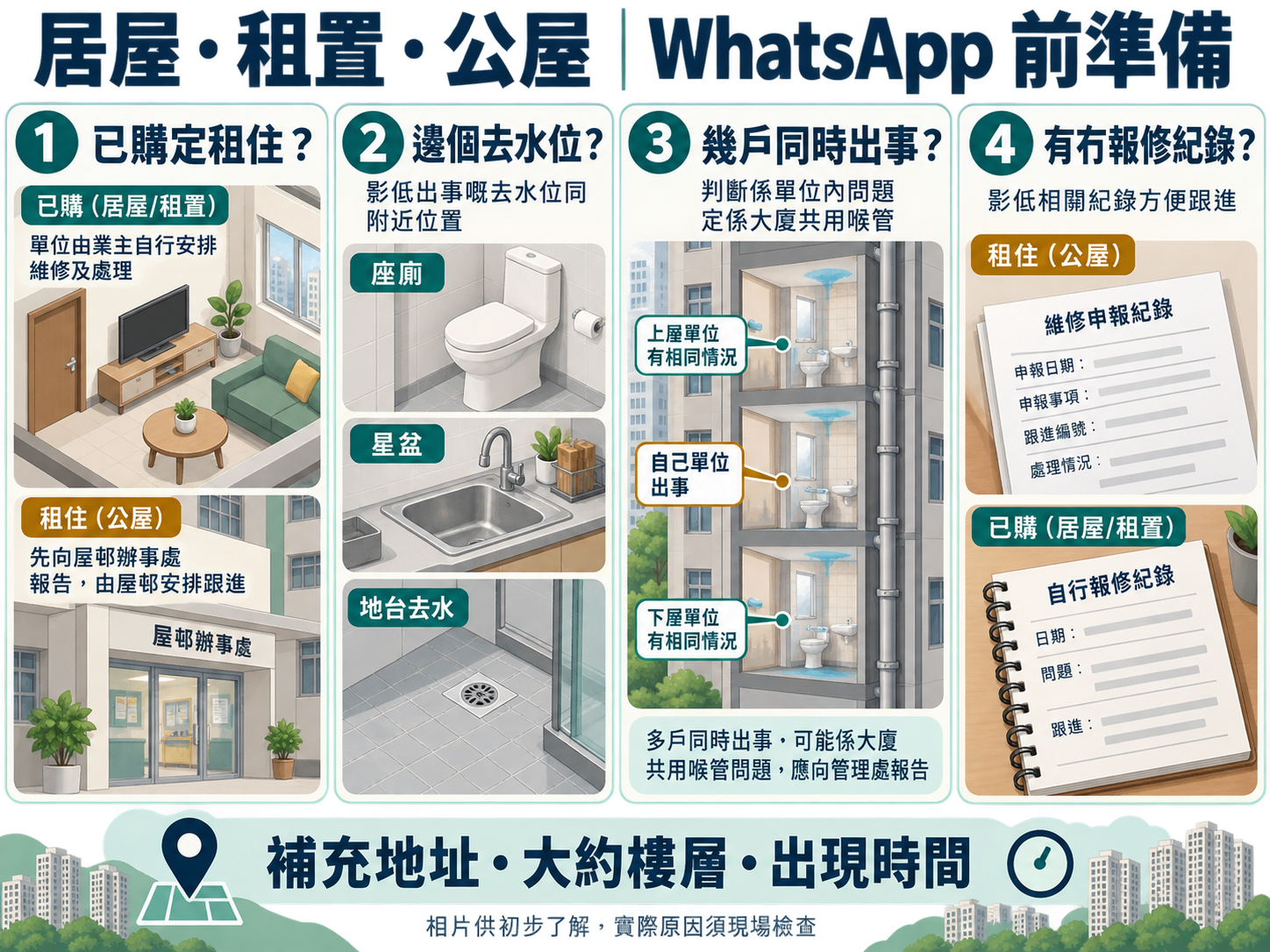
Photos or a short video on WhatsApp help us tell a single-fixture blockage from a shared-stack problem.
Charming Garden stands on Hoi Ting Road in Mong Kok West and was completed in May 1998 as a Private Sector Participation Scheme estate: 18 blocks and 3,908 flats in two phases, straddling Hoi Wang Road. Calls from here fall into two families. One is seepage — water stains on a ceiling, plaster coming away, steady dripping — where the whole job is finding the source. The other is drainage — slow outlets, odour from a floor drain, water rising at a low-floor fitment — where a blockage or a lost water seal is at fault. The checks, the responsible party and the legal route all differ between the two, so the first step is not to book an unblocking call but to work out which of the two you have.
The estate was completed in May 1998, with the Housing Authority overseeing the development and the sale and, as developer, a wholly owned subsidiary of Chevalier Development (其士發展) named 銳中有限公司, for which no English name appears in the source. Before reclamation the site was the Yau Ma Tei Typhoon Shelter; the land only appeared after the West Kowloon Reclamation began in 1995, so the estate and the streets around it — Hoi Ting Road and Hoi Wang Road — were laid out in one piece in the mid-to-late 1990s. The 18 blocks are 20 to 23 storeys with 10 flats per floor, listed as standard-design Private Sector Participation Scheme buildings, and the estate also holds 88 shops and two car parks (nine storeys and 513 spaces in Phase 1, two storeys and 168 spaces in Phase 2) on a site of about 38,100 m². By inference from that composition, besides the residential stacks there is a large shared drainage system serving the shops and the parking floors.
As a general inference from building age, flats occupied in 1998 are now about 28 years old, and the original waste pipes, traps, shower and bath edge seals and bathroom waterproofing have all reached the age where they deserve to be checked item by item. The Buildings Department's Guidelines on Maintenance and Repair of Drainage System and Sanitary Fitments advise that water closets, bathtubs, basins, shower trays, sinks and floor drains should be inspected regularly, preferably once every three months, to confirm they work properly and do not leak — an interval that is genuinely practical at this age. Bear in mind that two flats in the same estate can be in very different condition depending on their own renovation and repair history; the estate name tells you nothing on its own.
On design standards, Buildings Department practice note APP-164 was first issued in 2021 and applies only to new drainage plans and alteration and addition works submitted after 31 August 2021, and to drainage work started under the Minor Works Control System after that date. It is not retrospective. By inference, a 1998 flat has none of the arrangement APP-164 now calls for, in which used water from a basin, bath or shower is diverted to keep a floor-drain trap topped up. The blocks are 20 to 23 storeys, and those of 22 and 23 storeys fall into APP-164's "over 20 storeys" category, for which the current standard asks for anti-syphonage connections at intervals of not more than three storeys, and requires that at the floor where the stack discharges to a manhole the fitments on that floor and the floor above are not connected to the stack but run in separate pipework straight to the manhole. Neither requirement existed in 1998, so fitments on the lowest two floors may still tee straight into the stack. For completeness, the Mandatory Building Inspection Scheme covers private buildings aged 30 or more; on a 1998 completion the estate does not reach that threshold until 2028.
Note: statements based on building age and type are general inferences, not findings for any particular flat.
A clear process from enquiry and assessment to an agreed scope of work
Tell us the drain problem and district and ask about available timing.
Confirm timing based on the district and schedule, then inspect the blockage or odour issue.
Explain the proposed approach, scope and price before agreed work begins.
Use suitable tools for the site conditions and agreed scope of work.
After the agreed work, test drainage and explain the observed result and any next steps.
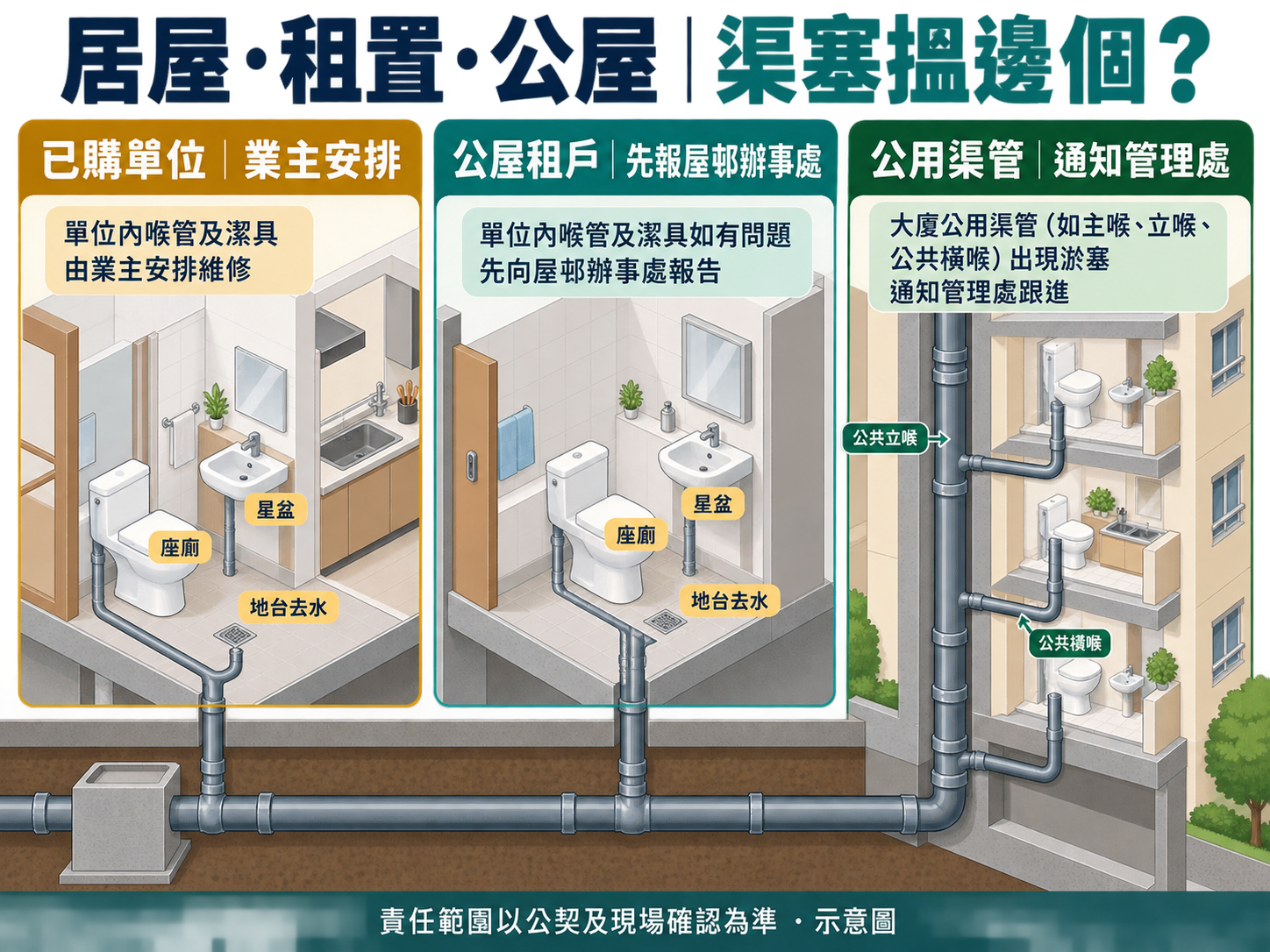
PipeButler is an independent drain-service provider with no affiliation to the developer, owners' corporation, management company or Housing Department of the places above. Facts come from public sources checked on the dates shown; work on common drains or common parts follows the management office's and deed of mutual covenant's arrangements.
WhatsApp with the problem and district, and we will confirm available timing.