
Loading page…
Loading page…
Tai Kok Tsui · Private estate
Completed 1980–81 · 7 blocks of about 14 storeys · two-storey mall podium
Choose the problem you are seeing to read the likely cause and next step.
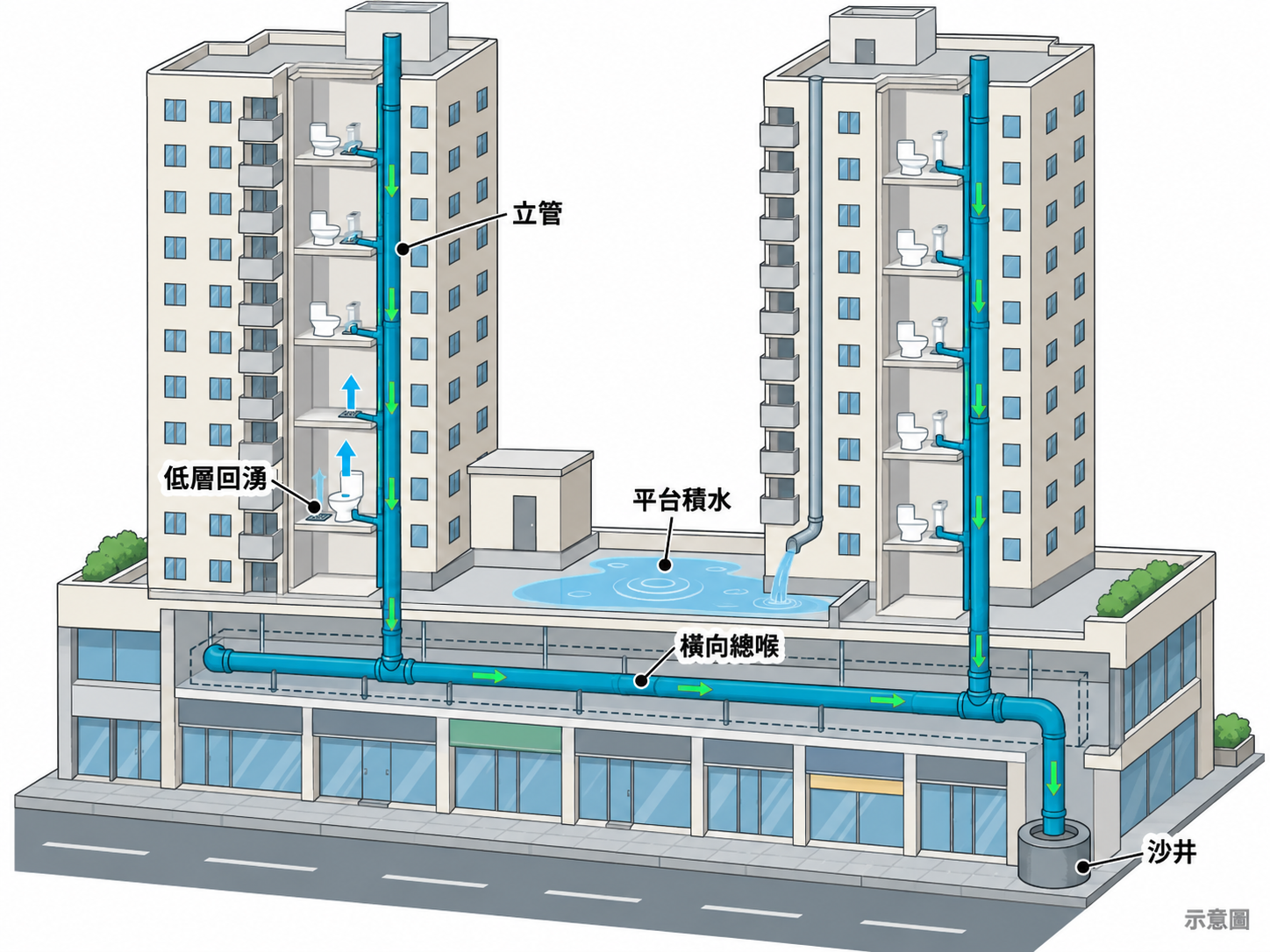
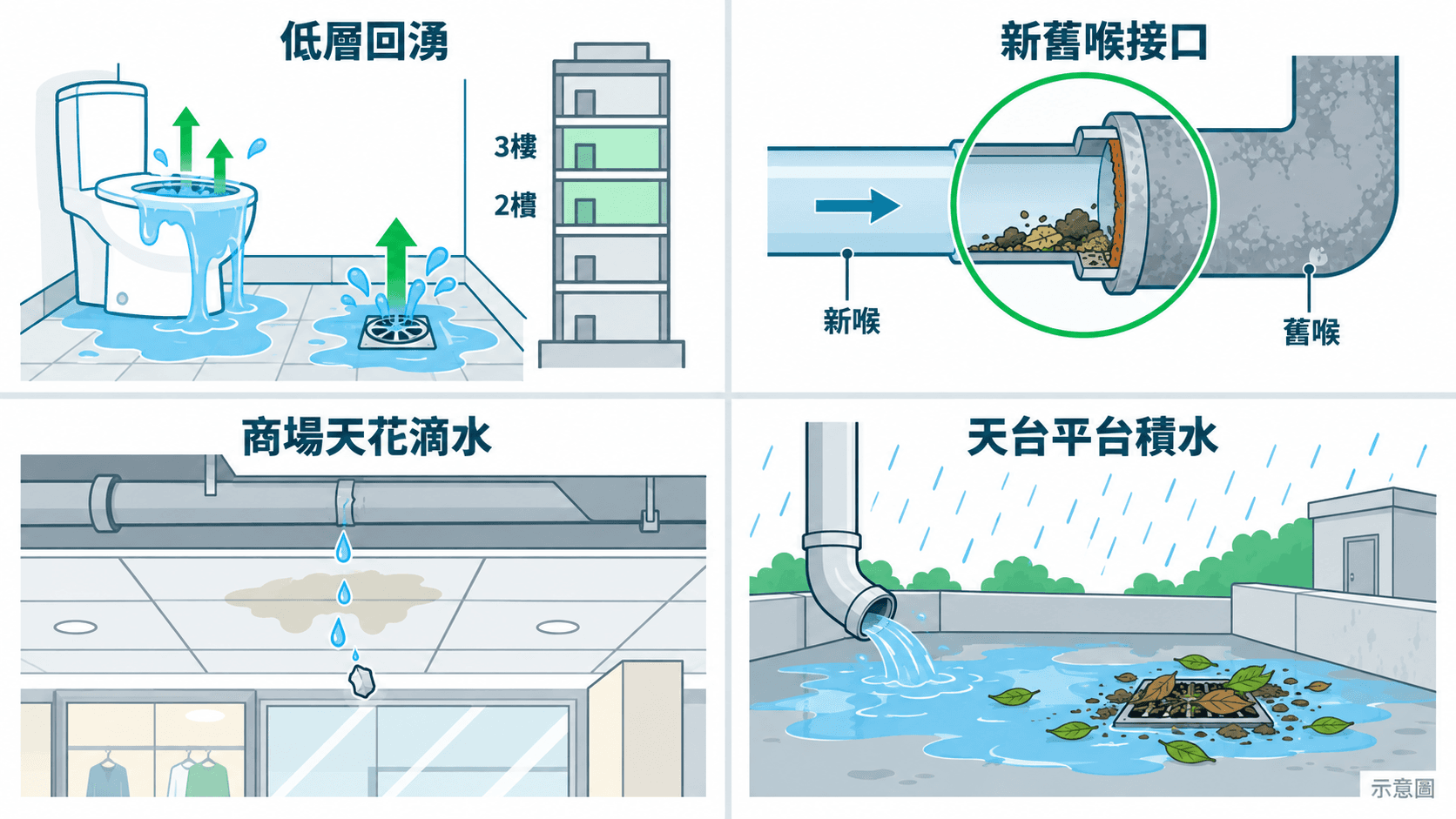
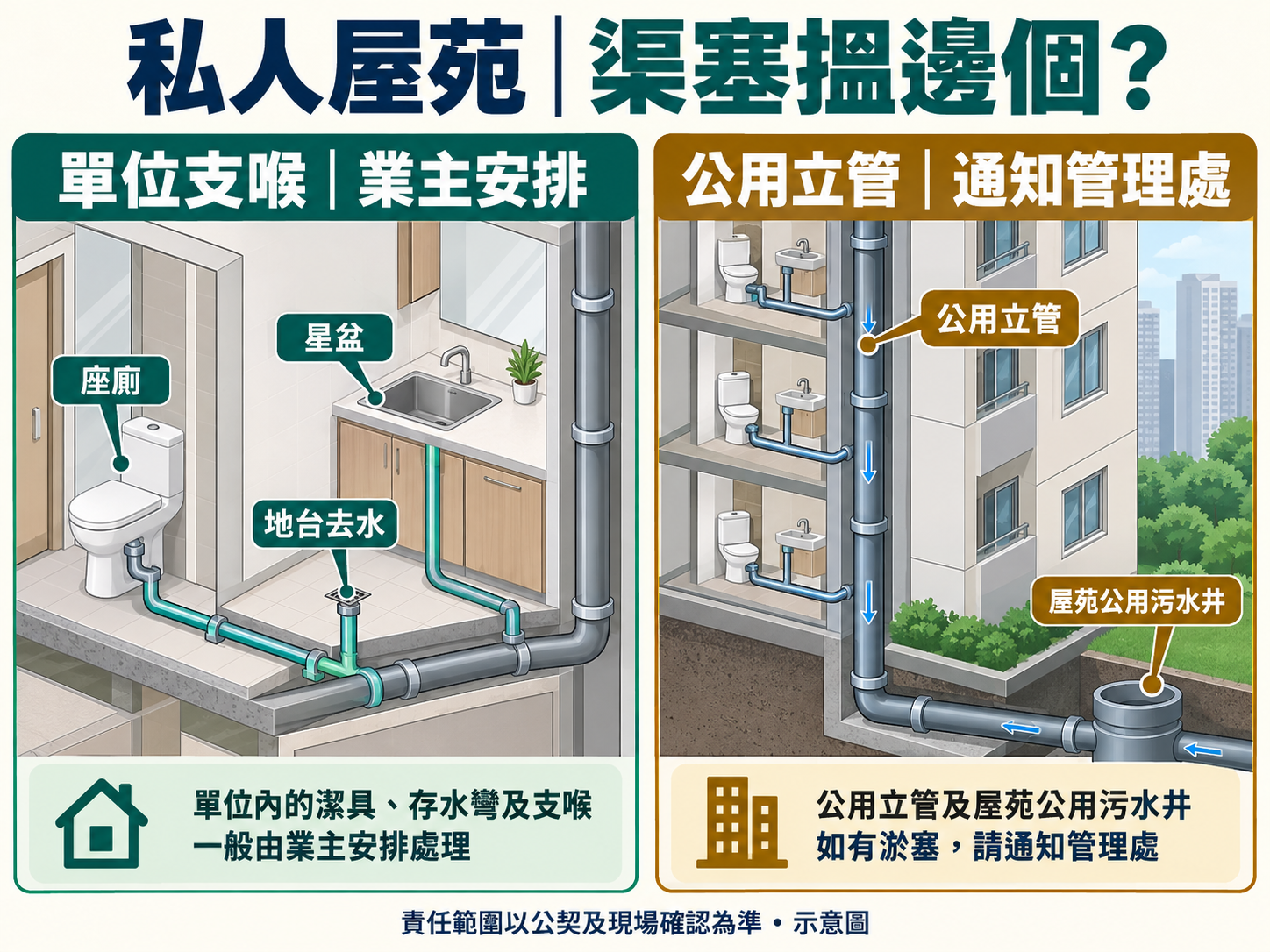
According to an HK01 report of 17 July 2017, during Phase 2's major repairs the estate's management supervisor said that after the soil pipes were replaced the office received a dozen or so complaints a month, and that owners on the second and third floors complained of backflow regularly, with one flat's floor drain, basin, sink and toilet all discharging sewage at once. There is a structural reason why low floors go first: the estate was completed in 1980–81 and, by inference from the design of that period, predates the separate low-floor pipework that APP-164 later required, so fitments on those floors may tee straight into the stack, and once the lower stack or its outlet narrows, water coming down from above looks for a way out at the bottom. Telling the two apart is simple — if only one fitment is slow it is usually the flat's branch pipe, while several outlets welling up together, especially when flats above flush, should be treated as the shared stack: tell the management office or owners' corporation at once and cover the outlets not in use to limit the spill.
The same report recorded what the journalist saw on site: only a few sections of the podium soil pipe had been replaced with new pipe, the old pipe inside the wall was left as it was, and the joint between them was covered in rust stains. A building surveyor who inspected it explained that where a section of pipe narrows, or takes a winding route, blockages become likely. The contractor told the press that it had not replaced the whole soil pipe under the contract because part of the pipework was covered by unauthorised structures and could not be removed. Setting aside the dispute of the time, the useful point for residents today is that partial renewal leaves a change of bore and one or two extra joints and bends in the same pipe, and tissue, grease and flakes of rust catch exactly there. Where one vertical line blocks again and again, a CCTV survey is worth doing to see which floor the joint is on and whether a proud plastic edge or a rust nodule is sitting in the bore, so the right access point can be chosen instead of rodding from the fitment every time.
The same report also recorded a shop whose ceiling had two patches of concrete spall away, exposing the reinforcement, after a soil pipe hidden above the false ceiling leaked over a long period. This is typical of an older podium estate: by inference from the design, once the stacks of the blocks over the podium turn horizontal at that level, long runs hang above the mall ceiling, and escaping sewage soaks the concrete and reinforcement before it ever drips into the shop. So when a shop tenant sees yellow staining, damp patches or drips that continue whether or not it is raining, it should not be written off as a leak from upstairs: note the spot, the time and the colour and smell of the water, and ask the owner and the management side to check the horizontal run above. Residents can help too — if your flat is a few floors above the podium and everything drains normally indoors, a drip below is more likely to involve the shared horizontal pipe than your own branch.
In the same report the management supervisor said the roof had flooded badly during a black rainstorm, while the surveyor who inspected it said the roof surface did not fall enough to carry standing water to the outlets, and found that the roof rainwater pipe had not been connected out to the street but instead discharged onto the podium, which in his view did not have enough drainage points. The contractor replied that taking roof water to the podium was the estate's original design. The accounts differ, but the lesson for residents is the same: before the rainy season, check the outlets on both the roof and the podium for leaves, silt, renovation debris or weeds, because once water on the podium rises above a threshold or an outlet it runs back in along low-floor corridors, mall entrances and drains. If Cherry Street outside is flooding at the same time, record the two separately — street stormwater drains belong to the Drainage Services Department, while the roof, podium and rainwater pipes within the estate are common parts.
By inference from the design, the kitchens and bathrooms in flats of 300 to 400-odd sq ft are small, so the sink discharge turns almost immediately and cooking grease congeals from that bend outwards, narrowing the bore; the bathroom floor drain sits close to the shower, so hair and soap scum gather in the first half-metre of pipe. As a general inference from building age, a 45-year-old flat has usually been renovated more than once: a trap may have been swapped for a shallower type, an outlet moved, or a washing-machine hose pushed straight into the floor drain — and if it goes in too deep or seals the opening, the water seal stops working and sewer air comes back into the room. The Buildings Department advises pouring about half a litre of water into every floor drain at least once a week to keep the seal, which matters most for a guest or utility toilet that is rarely used. Altering a trap or an anti-syphonage pipe is minor works and must be carried out by a registered minor works contractor.
Photos or a short video on WhatsApp help us tell a single-fixture blockage from a shared-stack problem.

Fu Tor Loy Sun Chuen stands on Pok Hok Lane in Tai Kok Tsui. It was built in two phases, the first completed in 1980 and the second in 1981, and its seven residential blocks hold 700 flats in total, with a two-storey shopping centre at podium level. Drainage trouble here falls into three families: backflow at toilets or floor drains on low floors such as the second and third, slow sinks and basins inside a flat, and drips through the false ceilings of the shops below. Before anything is opened up, the question is whether the fault lies in the flat's own branch pipe, in the shared stack serving that vertical line, or in the horizontal collector pipe at podium level — the remedy and the person to report to differ in each case.
The estate was occupied in 1980 and 1981, which makes it about 45 years old today. As a general inference from building age, the original stacks and horizontal runs of this period were usually cast iron or early plastic, and the sections that give trouble are not the exposed pipes you can see but the ones buried in walls, false ceilings and ducts: corroded joints and scale narrowing the bore cannot be judged by eye, and are often noticed only when draining slows or a stain or drip appears. The flats are also small, roughly 300 to 400-odd sq ft, with six flats a floor in Phase 1 and eight in Phase 2, so kitchens and bathrooms are tight and the branch pipes from the sink and floor drain are short with sharp bends, where grease and hair settle at the first turn.
The blocks are about 14 storeys and the estate has a two-storey mall at podium level, which governs where some of the pipes run. By inference from the design, where a block stands over the podium its stack has to turn into a horizontal collector at that level and cross the mall area before discharging into a manhole at ground level, and those horizontal runs are generally hidden above the mall or podium false ceilings. The first sign of a leaking pipe is therefore often not in a flat at all but a stain, a drip or spalling concrete in a shop ceiling below. Separately, Buildings Department practice note APP-164, first issued in 2021, requires that in a building of more than three but not more than 20 storeys the fitments on the floor where the stack discharges to a manhole must not connect to that stack but need separate pipework running straight to the manhole. The estate was completed in 1980–81, long before that requirement existed, so by inference the low-floor fitments may still tee directly into the stack, which is why the lowest floors feel the pressure first.
Wikipedia records that Phase 2 underwent major repairs in 2016 and 2017, with drain replacement in the contract, and that the works were not finished after a dispute over fees between the owners' corporation and the contractor. That history is useful when diagnosing a problem today: where a stack was partly renewed there are extra joints and changes of bore between old and new pipe, while the untouched sections remain original. In other words, within one estate and even one block the condition of the pipes can differ a great deal from one vertical line to the next, and nothing can be concluded from the estate's age alone. A call-out here normally starts with the same questions: is this block in Phase 1 or Phase 2, was it part of the pipe renewal, and have the flat's own outlets been moved during renovation — and only then which cleaning eye or manhole to work from.
Note: statements based on building age and type are general inferences, not findings for any particular flat.
A clear process from enquiry and assessment to an agreed scope of work
Tell us the drain problem and district and ask about available timing.
Confirm timing based on the district and schedule, then inspect the blockage or odour issue.
Explain the proposed approach, scope and price before agreed work begins.
Use suitable tools for the site conditions and agreed scope of work.
After the agreed work, test drainage and explain the observed result and any next steps.
PipeButler is an independent drain-service provider with no affiliation to the developer, owners' corporation, management company or Housing Department of the places above. Facts come from public sources checked on the dates shown; work on common drains or common parts follows the management office's and deed of mutual covenant's arrangements.
WhatsApp with the problem and district, and we will confirm available timing.