
Loading page…
Loading page…
Ngau Tau Kok · Private estate · HOS / PSPS · Public rental housing · Older buildings · Commercial & restaurants
1980s private estates, HOS and public housing · Ngau Tau Kok Road on DSD's blockage-prone list
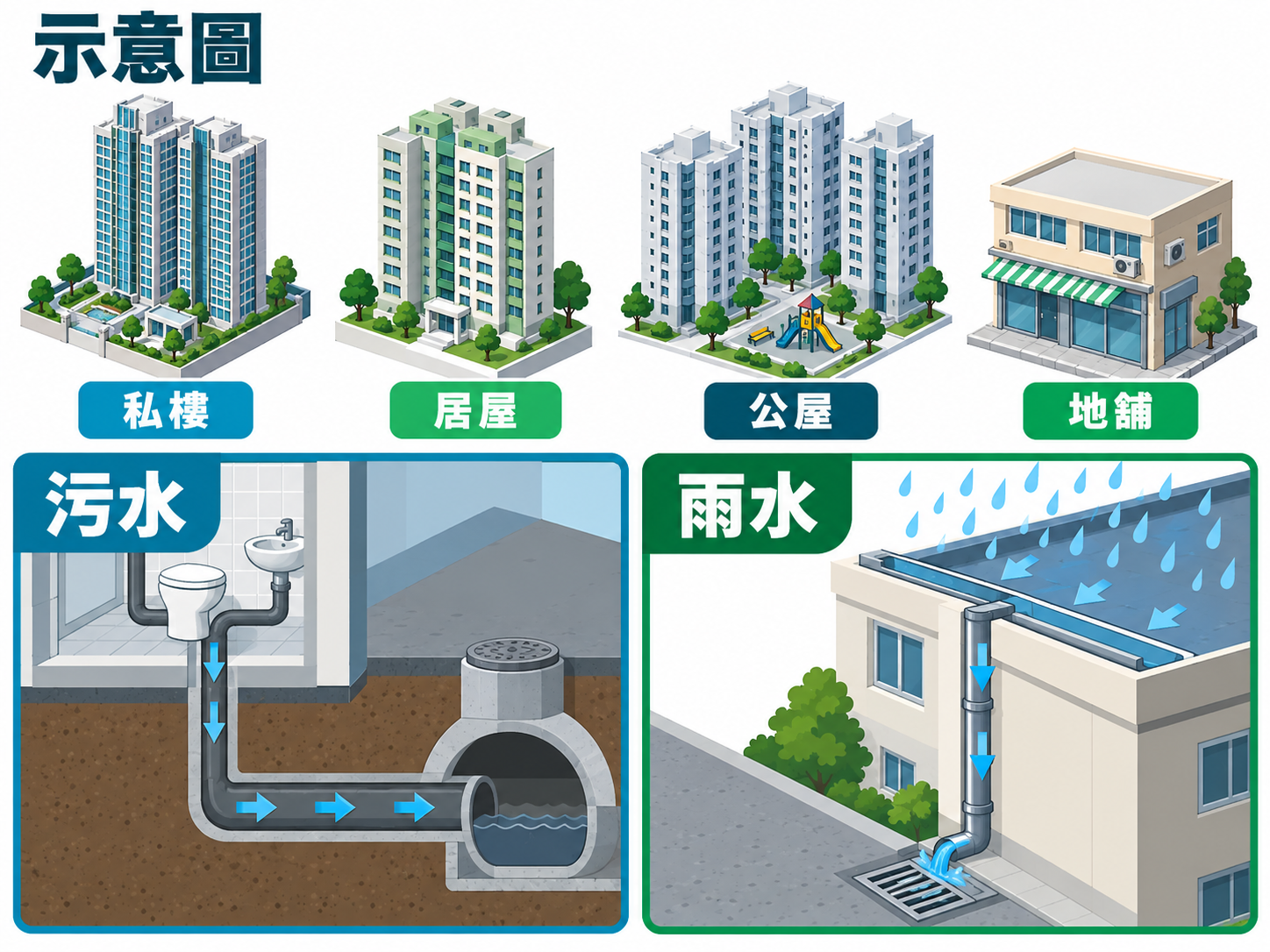
Ngau Tau Kok lies in the middle of Kwun Tong District, south of Jordan Valley, and is separated from Kowloon Bay by Kwun Tong Road.
Last reviewed ·
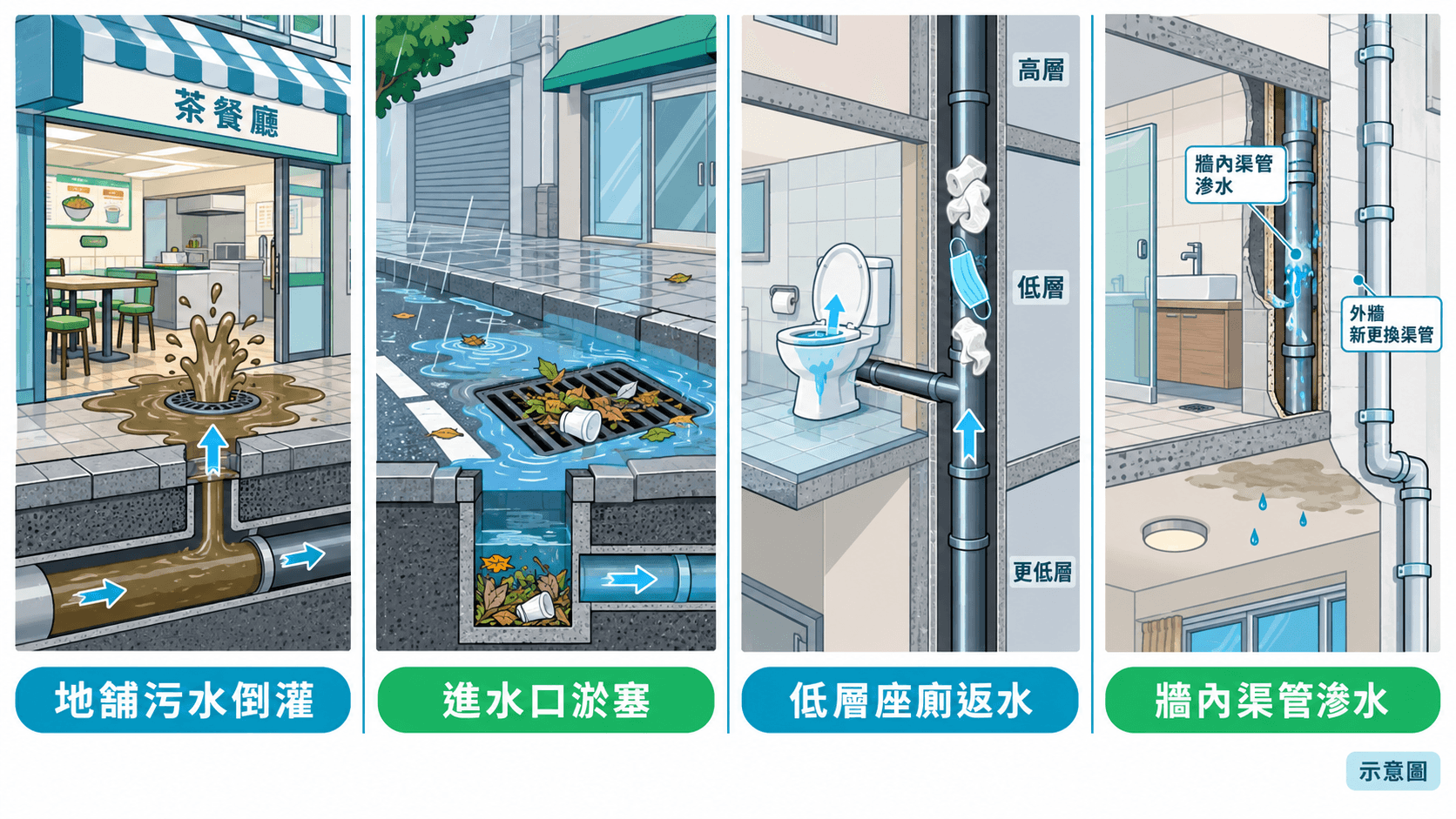
Choose the problem you are seeing to read the likely cause and next step.
On.cc reported on 5 January 2016 that the operator of a restaurant on Ngau Tau Kok Road said sewage had repeatedly come up through a manhole inside the shop since 29 December 2015. A Drainage Services Department spokesperson said both the public sewer managed by DSD and the private sewer inside the shop were blocked, and that staff had cleared both on the evening of 4 January; the next day, during an Amber Rainstorm Warning, two restaurants there flooded again when water came up through a new manhole that was still under construction and not yet connected, and DSD said it was investigating the cause. For a restaurant, the in-shop outlets, grease trap and the private drain up to the public sewer have to be cleaned regularly by the operator, while the public sewer and street manholes are DSD's.
The Drainage Services Department's current list of Locations Prone to Blockage includes Ngau Tau Kok Road between Ngau Tau Kok MTR Station Exit B1 and Leun On Street among its Kwun Tong entries. Inferring from the nature of the list, the roadside gullies on this stretch are more easily clogged by litter, leaves or silt, so the road floods readily in a rainstorm. Standing water on the road does not mean the shop's own drain is blocked, but the floor drain at the entrance and the back-lane manhole may slow down at the same time. Clearing debris from the outlet in front of the shop before a storm and checking the shop's outlets for silt afterwards is more practical than unblocking later; report a blocked road gully to DSD.
Sky Post reported on 3 January 2023, citing TVB's Scoop programme, that a second-floor flat at Upper Ngau Tau Kok Estate had sewage backing up through its drains twice within a few weeks from 4 December 2022; the resident said the sewage contained masks, sanitary pads and a large wad of used tissue, and a neighbour on the same floor had experienced something similar. Inferring from the design, flats in the same vertical line of a high-rise public housing block share one soil stack, and once debris narrows the lower part of the stack, the lowest floors back up first. Public housing tenants should report backflow to the estate office immediately, and masks, wet wipes and sanitary products should never go into the toilet.
Wen Wei Po reported on 30 December 2020 that, according to one of the contractors on the job, the drain pipes at Lok Nga Court — then occupied for 36 years — had been installed inside the walls, so when residents complained of seepage it was impossible to tell by eye which floor was leaking and the pipe ducts had to be opened floor by floor; the paper reported that most flats below 6/F had seepage and damaged plaster on their bathroom ceilings. With its building inspection falling due, the whole court's drainage was improved: work began in May 2020 and was completed in mid-November, moving the whole drainage system to the external walls and changing from a single-stack to a two-pipe design, with the soil pipes connected to vent pipes to keep the air pressure in them stable. As a general inference from building age, in other 1980s blocks in the area whose pipes are still concealed in walls or ducts, seepage and odour may not appear where the fault is, so the pipe routes need to be traced before deciding whether the flat's branch pipe or the shared stack is to blame.
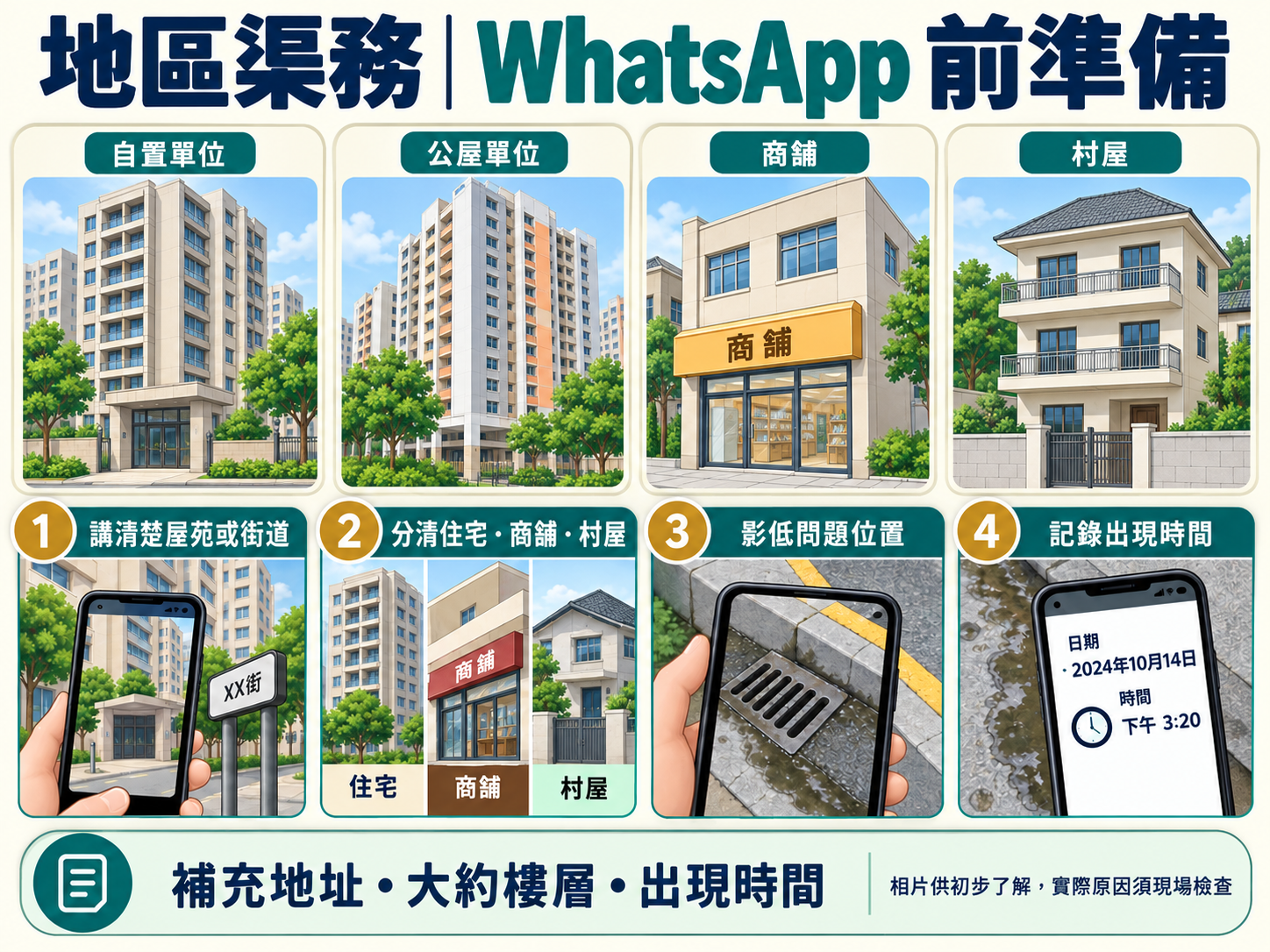
Photos or a short video on WhatsApp help us tell a single-fixture blockage from a shared-stack problem.
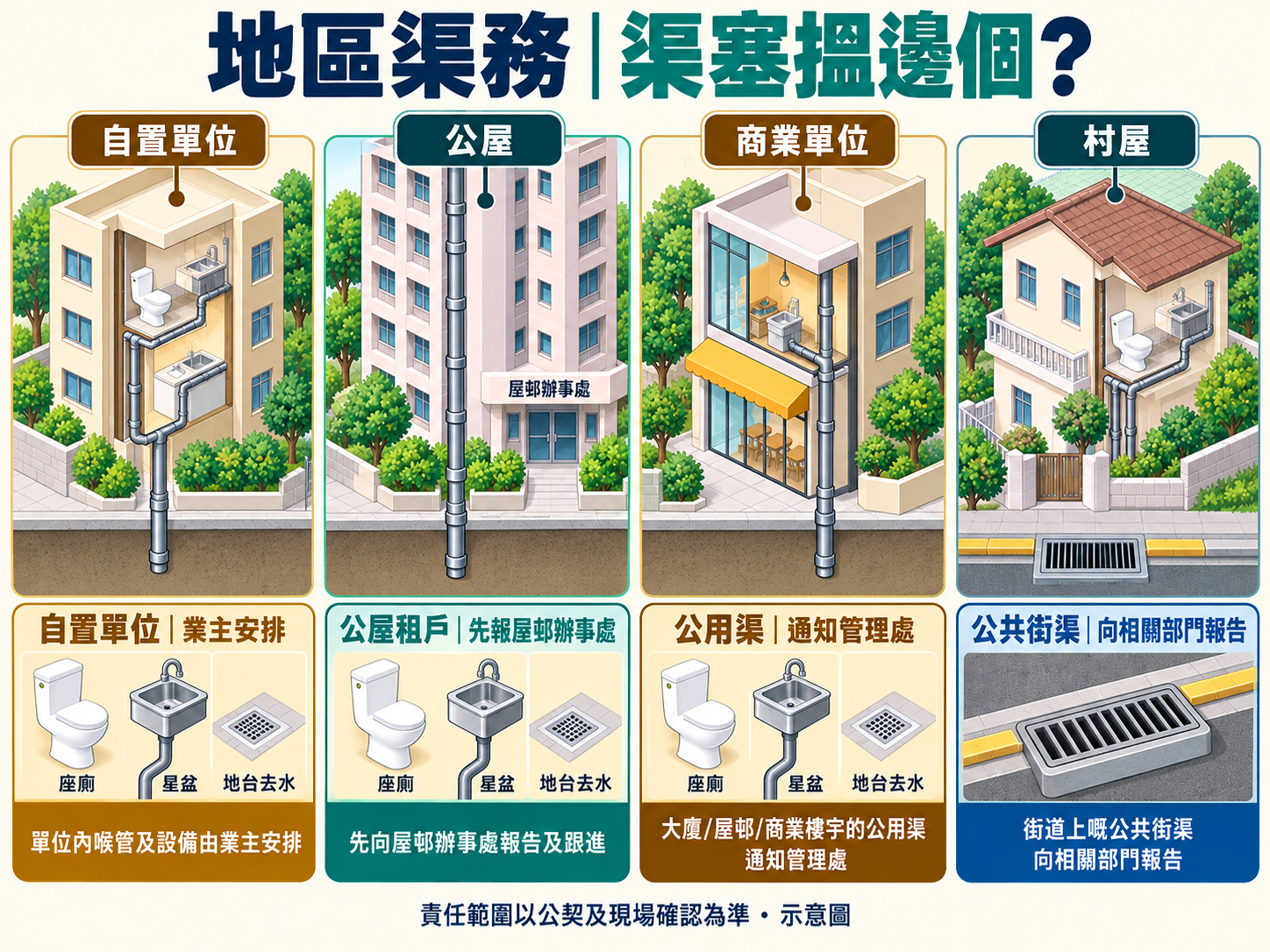
Ngau Tau Kok lies in the middle of Kwun Tong District, south of Jordan Valley, and is separated from Kowloon Bay by Kwun Tong Road. It is mainly residential. There are 1980s private estates such as Tak Bo Garden and Amoy Gardens, and HOS courts such as Lok Nga Court. The public estates include Upper Ngau Tau Kok, Lower Ngau Tau Kok and Lok Wah, and Ngau Tau Kok Road is lined with street-level shops and restaurants. When a drain blocks or smells, first work out which kind of housing you are in: public housing tenants go to the Housing Department through the estate office; in private and HOS flats the pipes inside the flat are the owner's to arrange and the shared pipes go to the management office or owners' corporation; and shops need to tell the private drain inside the shop from the public sewer outside.
Ngau Tau Kok was once on the waterfront and only became inland after the Kwun Tong and Kowloon Bay reclamations were completed in the 1970s. The old Ngau Tau Kok Village was cleared in the mid-1960s, and its site is now the tenement blocks around Ting On Street. The cottage area at the foot of Lung Shan was cleared and rebuilt as Lok Wah Estate and the Lok Nga Court HOS development, completed in stages between 1982 and 1985, and Lower Ngau Tau Kok Estate began redevelopment in 2003, its southern part becoming today's second-generation estate. Building ages therefore vary widely, from street-shop blocks built after the village was cleared and 1980s private and HOS estates to public housing first occupied in the 2000s.
Several kinds of housing now sit side by side. Private estates include Tak Bo Garden at 3 Ngau Tau Kok Road and Amoy Gardens in the Jordan Valley area; Amoy Gardens has its own page, listed below, covering floor-drain traps and shared stacks in detail. Lok Nga Court is the main HOS court. Public housing includes the Housing Authority's Upper Ngau Tau Kok, Lower Ngau Tau Kok and Lok Wah estates, while Kwun Tong Garden Estate and its Lotus Towers are managed by the Housing Society. On the same street, who you should call about a blocked drain can be completely different.
As a general inference from building age, Tak Bo Garden, Lok Nga Court and Lok Wah were completed in the early-to-mid 1980s and are now over 40 years old; most original pipes have been partly replaced, and flats in the same block can be in very different condition. Tak Bo Garden's flats sit above a shopping and car-park podium, so inferring from the design, sewage from the flats has to pass through horizontal runs and bends inside the podium before reaching the ground drains, and grease and debris collect more easily at those points. Upper Ngau Tau Kok (occupied 2002 and 2009) and the rebuilt Lower Ngau Tau Kok are much newer, so blockages there are more often down to use, such as tissue, wet wipes, masks or food waste going down the drain.
Note: statements based on building age and type are general inferences, not findings for any particular flat.
Choose an enquiry route for your premises and work scope.
Pantry, washroom and shared-drain enquiries, with scope agreed before work
Scope and booking detailsUnit outlets, shared pipes and chamber enquiries assessed with site access
Scope and booking detailsDiscuss a defined maintenance scope using assets, usage and incident records
Scope and booking detailsA clear process from enquiry and assessment to an agreed scope of work
Tell us the drain problem and district and ask about available timing.
Confirm timing based on the district and schedule, then inspect the blockage or odour issue.
Explain the proposed approach, scope and price before agreed work begins.
Use suitable tools for the site conditions and agreed scope of work.
After the agreed work, test drainage and explain the observed result and any next steps.
PipeButler is an independent drain-service provider with no affiliation to the developer, owners' corporation, management company or Housing Department of the places above. Facts come from public sources checked on the dates shown; work on common drains or common parts follows the management office's and deed of mutual covenant's arrangements.
WhatsApp with the problem and district, and we will confirm available timing.
