
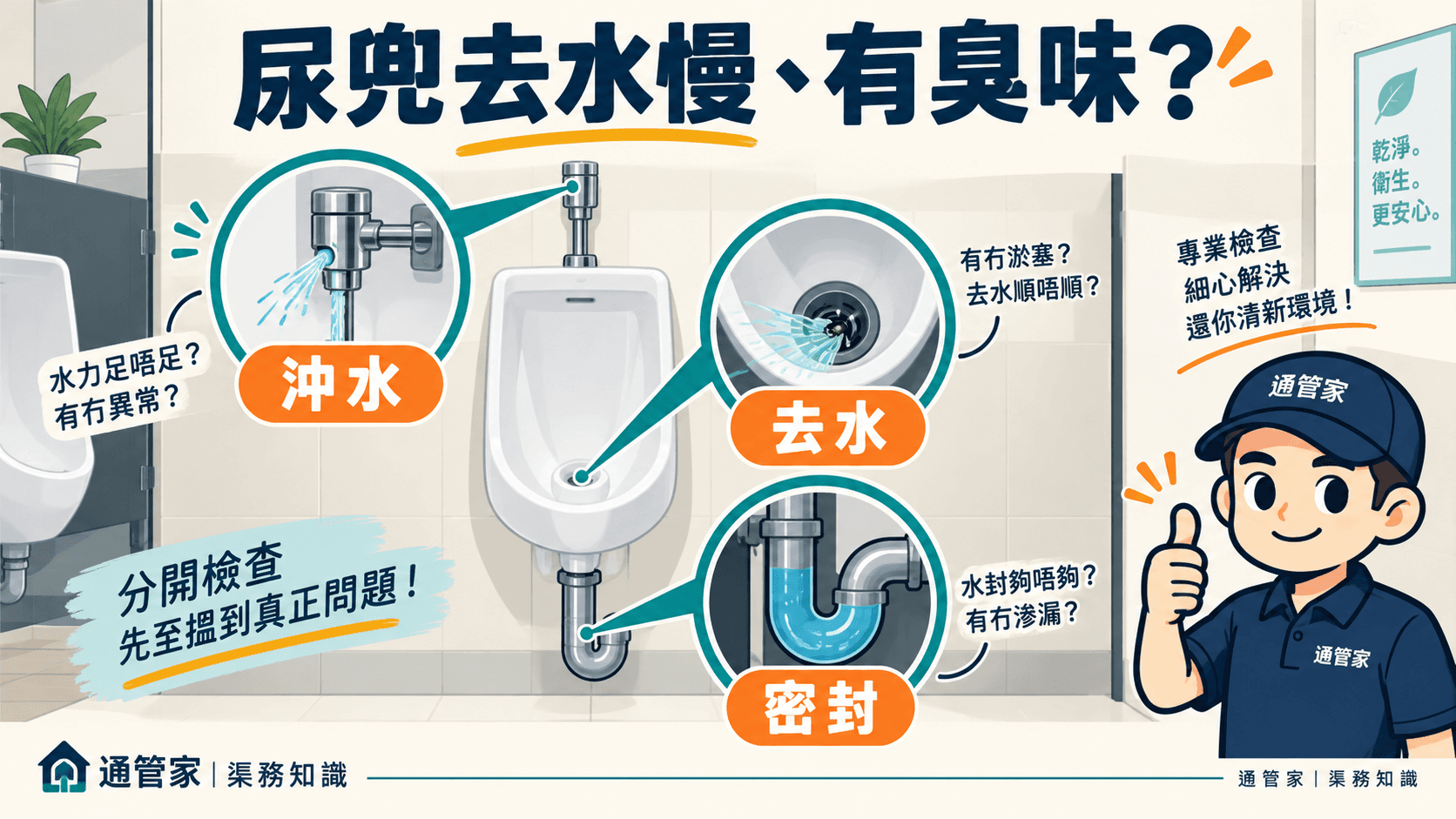
A smelly urinal does not automatically need descaler, and slow drainage is not always caused by urine scale. Flushing volume, controls, drainage restrictions, connection seals, ventilation and model-specific components deserve separate assessment. In malls, restaurants, offices and schools, first record whether one fixture or a whole row is affected, then arrange cleaning, equipment repair or drainage inspection.
If the bowl is full, overflowing, leaking at the wall or creating a slippery floor, close the affected position, notify management and stop use. Do not repeatedly flush to test whether it will clear.
Identify the urinal type first
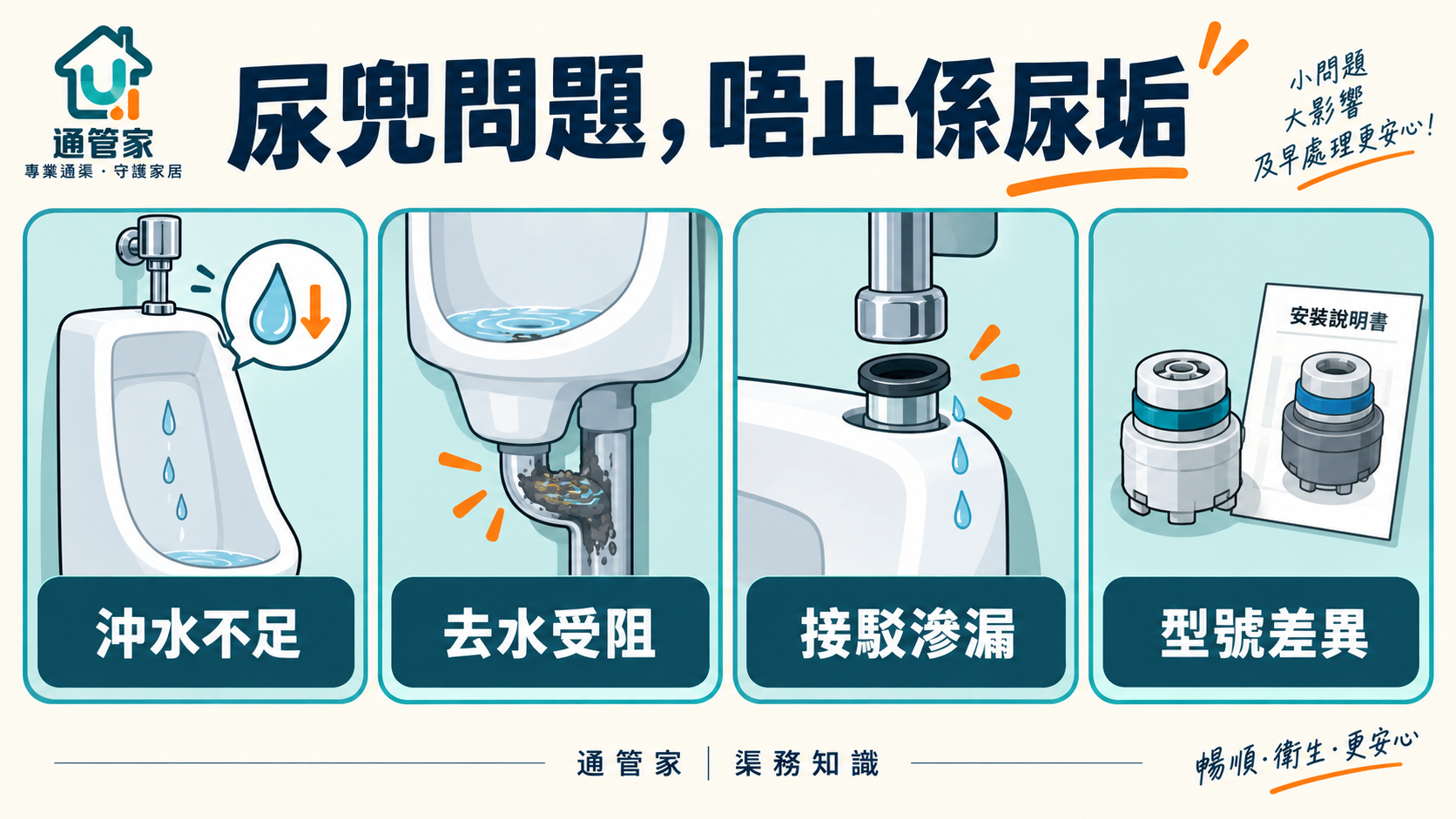
Conventional flush, sensor-operated, waterless and hybrid urinals differ in water supply, controls and maintenance parts. Waterless systems may use specific cartridges or gas-barrier components and cannot simply follow an ordinary flushing urinal's cleaning routine. Record the brand and model, locate the manual and identify the existing equipment-maintenance provider.
Sloan publishes separate guidance for standard urinals and waterless and hybrid models. These demonstrate why one procedure does not suit every system. Their pressure and component specifications are not universal standards for Hong Kong fixtures.
Record four different symptom types
Weak flushing, but water drains away
Consider flushing settings, sensor response, valves and supply. This differs from plenty of water that cannot escape, and unblocking may not correct inadequate flushing. Managers should record observations without opening controls or adjusting the supply.
Normal inflow, but the bowl level rises
Check visible objects, strainers, fixture passages and downstream branches. Tissues and cigarette ends may worsen a restriction. Surface cleanliness does not prove concealed passages are clear. Broaden the investigation if several urinals or floor drains react together.
Normal drainage with persistent odour
Possible sources include surface deposits, nearby flooring, seals, gas-barrier components and ventilation. Fragrance does not resolve these faults, and the place where smell is noticed is not necessarily the defective location.
Leakage at the wall or base
Installation joints, seals or the fixture may be involved. Stop use and arrange inspection. Do not loosen a wall-mounted urinal yourself; its weight, fixing and concealed connections need proper handling.
Confirm the deposit and treatment area
Appearance offers clues, but deeper deposits, material compatibility and pipe condition may need dismantling or further inspection. Ask whether the proposed treatment addresses the surface, fixture passage, trap or downstream drain, and which method will be used.
Claims of rapid deodorising or repair without dismantling do not replace diagnosis of leaks, damaged components or ventilation faults. Follow both chemical-product and fixture-manufacturer instructions. Never mix acidic descaler, bleach or drain cleaners.
What can cleaning staff do?
- Restrict use and display out-of-service and wet-floor signs according to site procedures.
- Clean accessible surfaces using the model-specific plan, approved products and required protection.
- Record objects, abnormal flushing, slow discharge, leaks and recurring incident times.
- Record chemical names and application times for the repair team.
- Do not dismantle electrical controls, prise the fixture loose, force tools into concealed pipes or alter supply settings.
A useful four-column maintenance record
Give each urinal a location reference and record date and peak use, flushing and discharge behaviour, cleaning or component work, and the follow-up person and review date. Repeated slow drainage at one position gives more useful direction than a general complaint that the washroom smells.
Adjust maintenance frequency to use, model and history rather than applying one interval to every commercial washroom. For wider arrangements, see building drainage maintenance contracts.
Confirm scope and completion checks
- Are fixture cleaning, parts, removal and reinstatement, downstream clearing and site cleanup included?
- Will additional fixture or connection defects be explained and approved before further work?
- Will completion checks observe a normal operating cycle, leaks and neighbouring drains?
- Are waterless or hybrid replacement parts suitable for the model and recorded?
- What follow-up applies if odour persists or returns?
Frequently asked questions
Does a urine smell prove the urinal drain is blocked?
No. Nearby surfaces, flooring, seals and gas-barrier parts may contribute. Locate and investigate the source.
Will strong acid clear it faster?
Do not use strong acid to clear a blockage yourself. Components have compatibility limits, and standing water increases contact and splash risks.
Does one slow urinal mean a main-drain problem?
Not necessarily. Start with local checks while considering the branch connection. Several affected fixtures provide stronger evidence of a downstream restriction.
Can waterless models be cleaned like ordinary urinals?
No. Follow the manufacturer's cartridge, gas-barrier and cleaning requirements.
Does immediate odour improvement prove a permanent repair?
No. Retain follow-up records and investigate seals, ventilation and downstream problems if symptoms recur.
Arrange an assessment
Provide the number of affected fixtures, models and previous work records to establish whether drainage inspection is appropriate. Send the district and photographs through the PipeButler contact page and confirm the available unblocking service scope. Electrical work, appliance internals, design and statutory procedures need the relevant professionals.
Sources
Sloan standard urinal guide; Sloan waterless and hybrid guide; Buildings Department: healthy drainage. Prepared in September 2026.
From one urinal to the wider washroom scope
Record a single urinal issue separately from symptoms across a row, toilets and floor outlets. For several affected points, ask the responsible person and management to check potentially shared routes rather than repeatedly cleaning each fixture.