
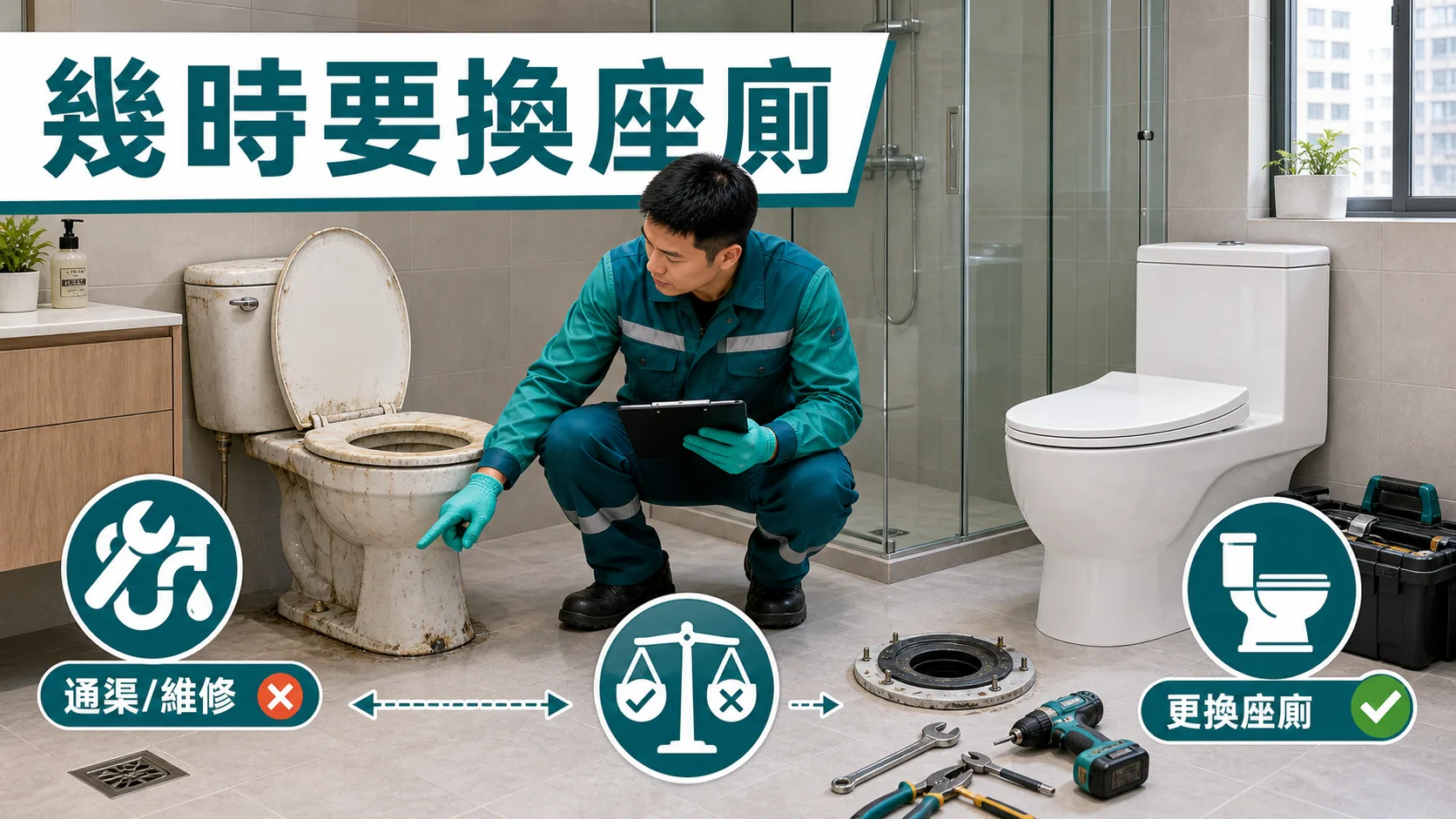
Repeated blockage, a leaking base, weak flushing or cracks often prompt the question: does the toilet need replacing? First establish whether the fault is in the toilet, its installation or downstream drainage. A toilet fault does not prove the drain is defective, and a blocked drain does not automatically require a new toilet.
Cracked ceramic, a loose leaking base, physical damage or repeated component failure may justify replacement or reinstallation. Rising bowl levels, slow recession and recurrence after clearance call for a drainage assessment first, so the same restriction is not left behind a new toilet.
This guide explains when to repair, clear the drain, reinstall or replace a toilet in a Hong Kong home.
Four situations that warrant assessment for replacement
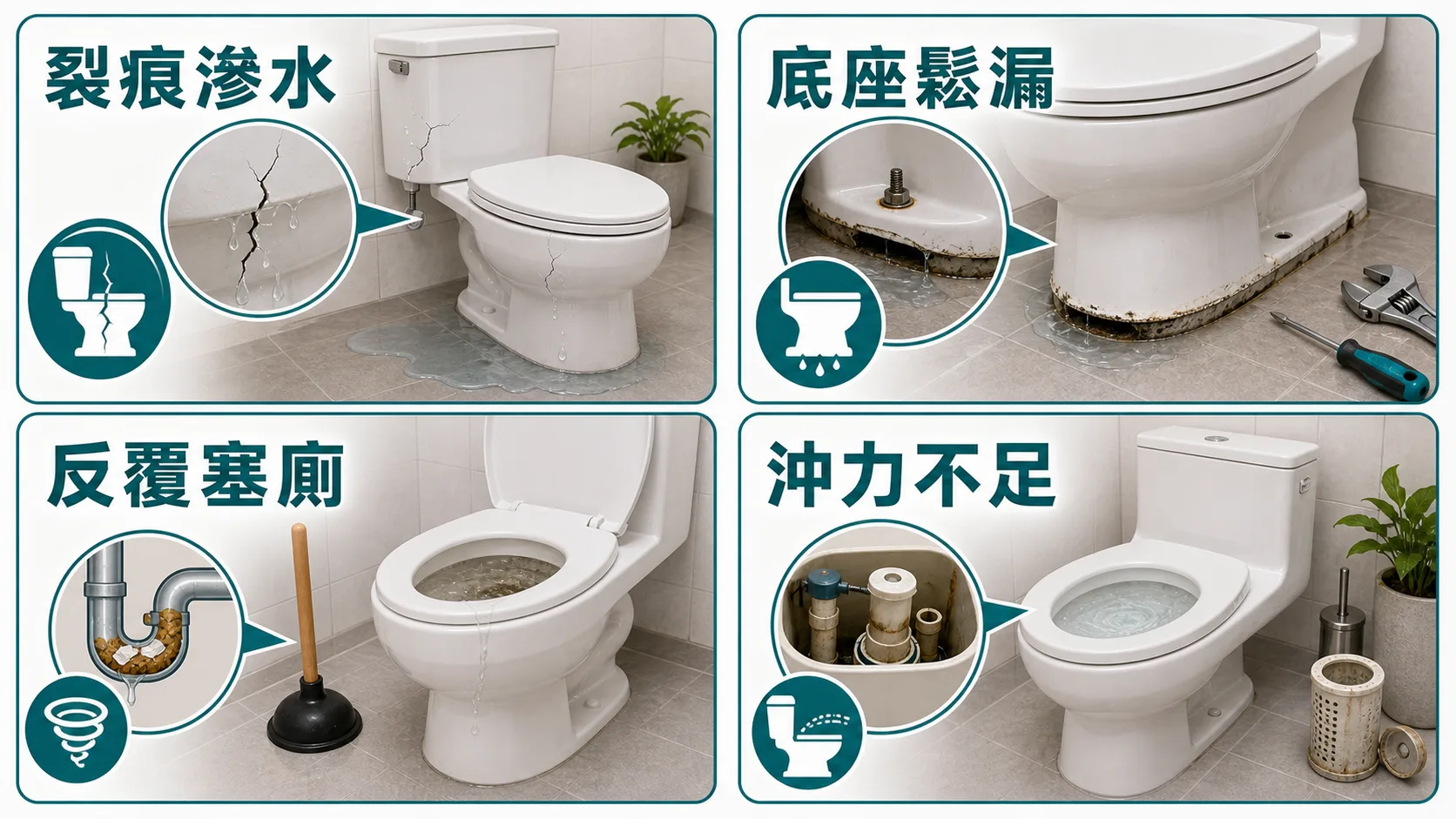
1. Cracks and leakage
Glue or silicone is not a suitable long-term solution for cracked toilet or cistern ceramic. Cracks can expand, leak, retain contamination or fail suddenly. Cracks in the cistern, bowl, base or load-bearing parts generally warrant replacement.
2. A loose, leaking base
Movement, water at the base or sewage odour may involve fixings, the flange or outlet connection, uneven flooring, aged seals or misalignment. Sound ceramic may be reinstalled; damaged or deteriorated ceramic may need replacement. Adding silicone alone does not establish the cause.
3. Repeated blockage
Assess the obstruction, drainage speed, possible hard objects, other affected outlets and recurrence interval. A branch, building main or chamber restriction remains after replacing the toilet. See rising toilet water and recurrent blockage causes.
4. Weak flushing or repeated component failure
The fill valve, flush valve, button, float or water adjustment may need repair. Where the design is obsolete, internal deposits are severe, flushing performance remains poor or parts are difficult to obtain, replacement may be more practical than repeated repairs.
When repair or clearance may be enough
- An isolated paper blockage: suitable clearance does not imply a broken toilet.
- Cistern component failure: slow filling, continuous leakage into the bowl or an ineffective button may need a replacement part.
- Minor base movement: intact ceramic, sound flooring and a suitable outlet may allow refixing and resealing.
- Several slow outlets: investigate downstream pipes, cleaning, CCTV or shared drainage.
- Smell beginning after renovation: consider seals, connections and anti-siphonage; see post-renovation odour checks.
Four checks before replacement
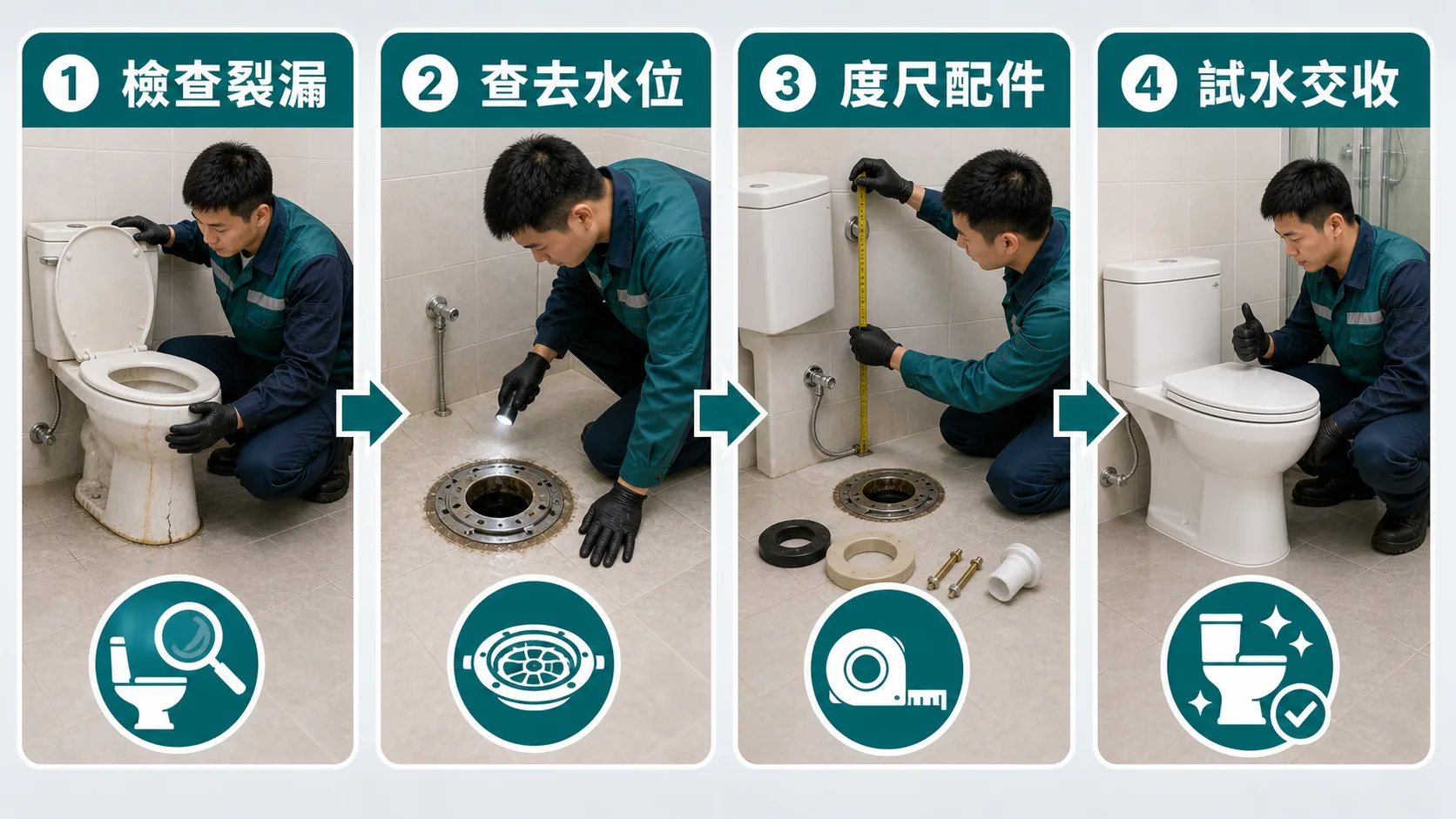
1. Document cracks and leaks
Photograph the cistern, bowl, base, rear wall, floor, supply hose and waste connection. Explain whether water appears continuously, during flushing or only after cleaning. This distinguishes ceramic, component, joint, floor and pipe problems.
2. Check the waste outlet
Establish the outlet position, set-out distance, floor condition and existing flange or connector. Older or altered bathrooms require particular attention to alignment, fall and any necessary drainage alterations.
3. Measure clearances and fittings
Measure wall-to-outlet distance, side clearance, door movement, distance to the basin or shower screen, supply-valve position and cistern height. Toilet projection and cistern size matter in compact Hong Kong bathrooms.
4. Test at handover
After installation, check repeated flushing, filling and shut-off, base leakage, movement, odour and nearby water marks. Appearance alone is insufficient: drainage, sealing and supply must all work correctly.
Does frequent blockage mean the toilet must be replaced?
Not necessarily. A few incidents involving excessive paper, wipes or objects usually call for clearance. Gurgling, smell or backflow at basins and floor drains points towards downstream or shared drainage. Poor toilet performance and heavy internal deposits can coexist with pipe resistance, in which case both may need attention.
Record existing flush behaviour and level changes without repeatedly flushing a blocked bowl. Clearance or CCTV assessment may help establish whether the downstream route is the problem before replacement is selected.
What work should be agreed before replacement?
Clarify the model, removal of the old fixture, access and disposal, installation space, supply connection, waste alignment, any pipe alterations, floor making-good, scheduling and whether leakage or blockage also needs treatment. A straightforward same-position replacement differs substantially from work involving concealed pipes, an old floor or new connections.
Provide photographs, measurements, the existing fault, whether you are supplying the new fixture, lift availability, removal requirements and any recurring blockage or odour. Use our contact page to discuss and approve the scope.
Why might a new toilet still block or smell?
- Remaining downstream restriction: a new flush cannot reliably overcome a partly blocked pipe.
- Misaligned waste connection: poor sealing can cause leakage and odour.
- Seal or ventilation problems: gurgling, smell or seal loss after flushing may involve anti-siphonage or venting.
- Floor or flange defects: uneven support, insecure fixing or an old damaged flange may require reinstallation.
- An object remains in the branch: replacing the toilet without examining the downstream section may leave the obstruction untouched.
WhatsApp PipeButler on 5340 0748 with fixture photographs, the leak location, existing flush video, base condition, bathroom dimensions and blockage history. We will assess replacement or reinstallation, clearance, pipe cleaning or CCTV and agree the scope before starting.
Frequently asked questions
Can cracked ceramic be patched?
A cracked ceramic toilet should not rely on a long-term patch. Cracks can leak, retain contamination and expand; cistern, bowl and base damage generally warrants replacement.
Does a base leak always require replacement?
No. Seals, flanges, fixings or uneven flooring may be responsible. Sound ceramic may allow reinstallation; damaged ceramic or a broken base is more likely to require replacement.
Will a new toilet stop recurring blockages?
It may help where the toilet itself has poor performance or heavy internal deposits. It cannot resolve a downstream object, branch, chamber or building-main restriction. Locate the cause first.
Will the drain need altering?
Not always for a same-position replacement. Outlet position, set-out, floor level, wall clearance and model compatibility determine whether alterations are needed. Relocation or mismatched dimensions can require new connections.
What should I provide before selecting a toilet?
Bathroom photographs, the old model or dimensions, wall-to-outlet distance, supply-valve position, side and door clearances, and any leakage, odour or blockage history help avoid an unsuitable choice.