
Loading page…
Loading page…
Kam Tin & Pat Heung · Village houses
Kam Tin village sewerage Stage 1 still in planning · septic tanks, soakaways & backflow after rain
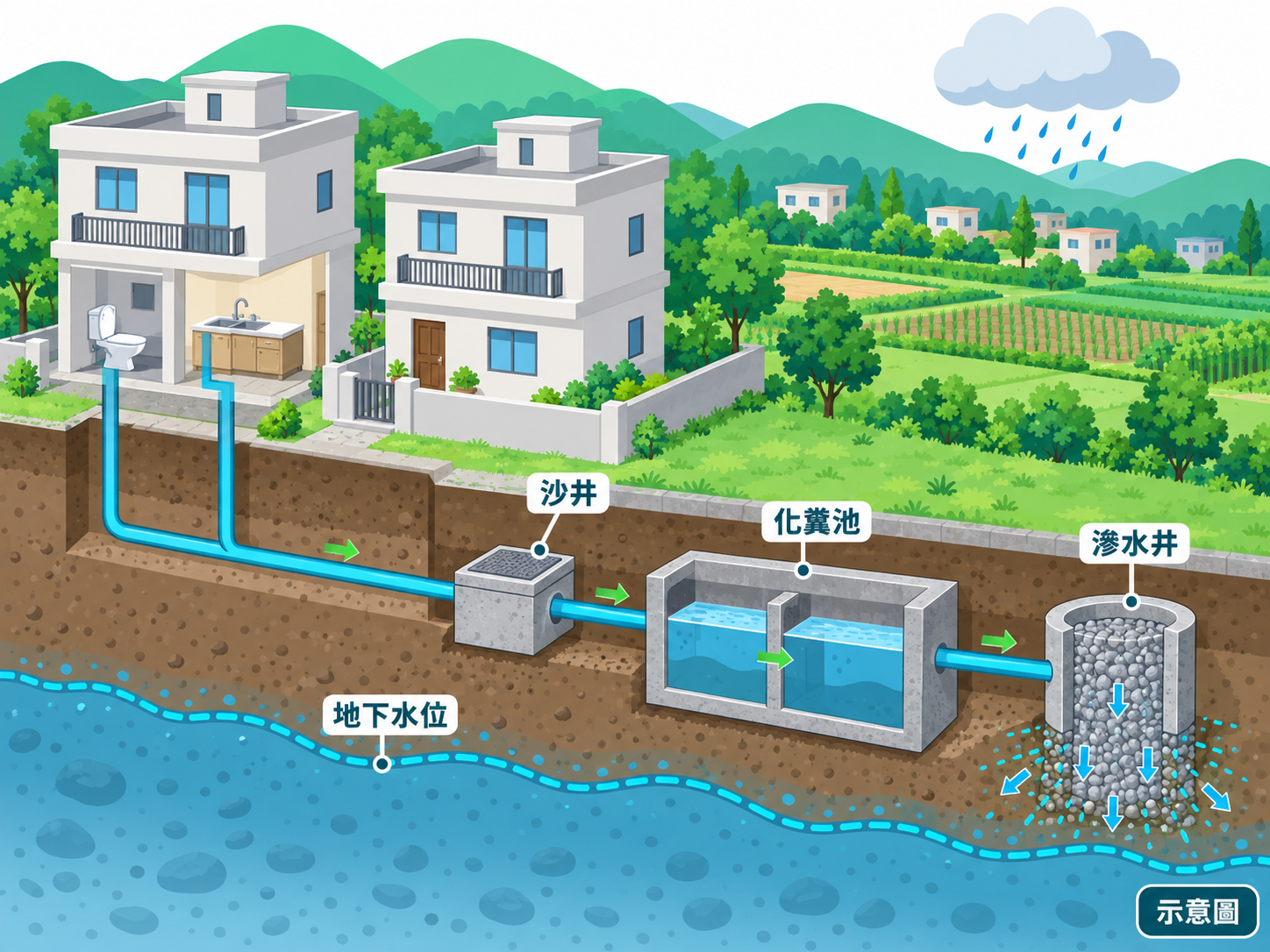
Kam Tin and Pat Heung lie in a basin between Tai Mo Shan, Kai Kung Leng and other hills, and the area is mostly walled villages and village houses.
Last reviewed ·
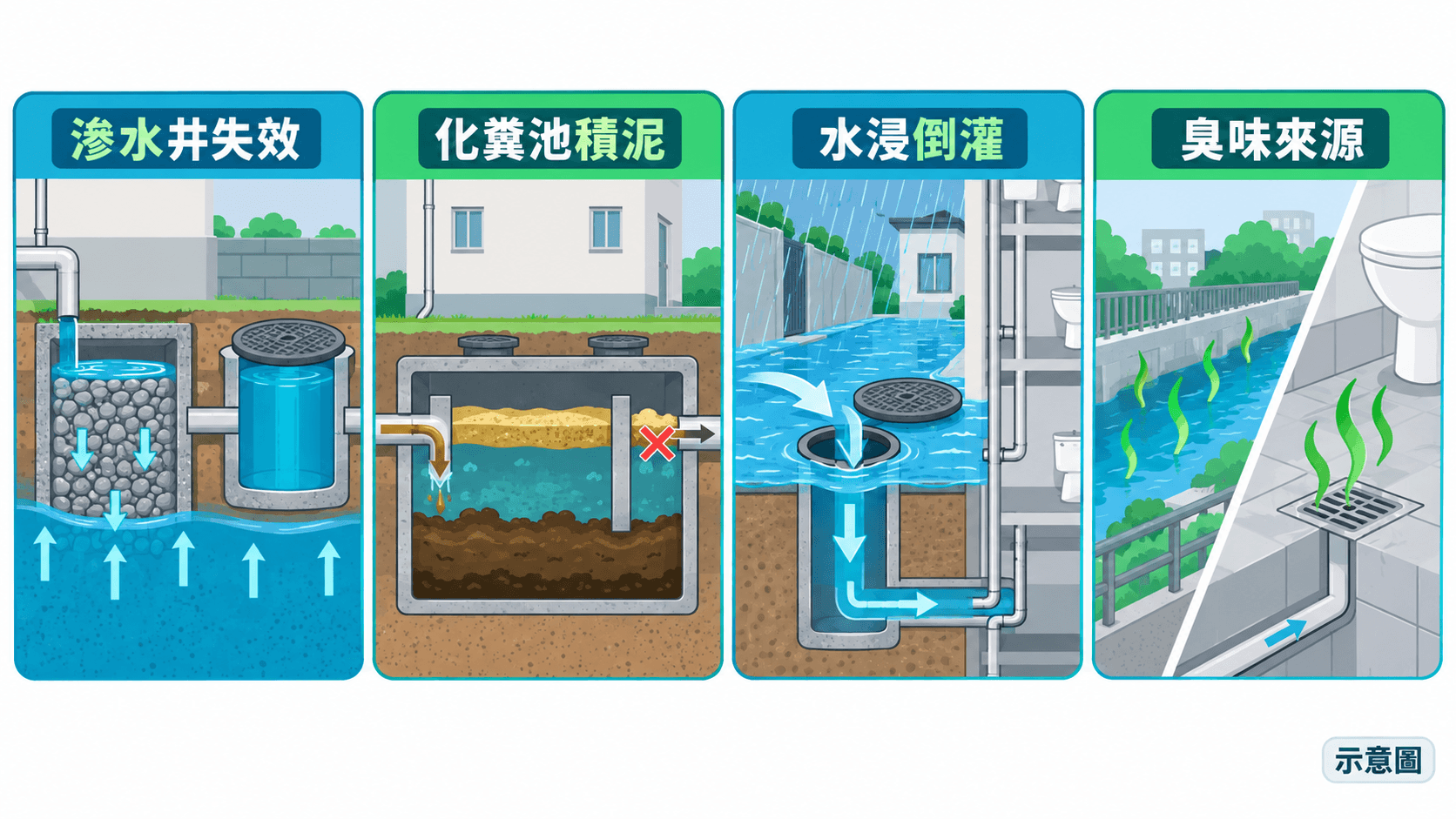
Choose the problem you are seeing to read the likely cause and next step.
The Audit report cites EPD's 2003 view that many village sites on flood plains such as Yuen Long and Kam Tin are unsuitable for septic systems, because soakaway pits cannot drain in soil with high groundwater or high clay content. A common pattern is that everything works in dry weather, but in the wet season or after days of rain the outdoor manhole level does not drop for days, and the ground-floor toilet and floor drains slow down first or even back up. Clearing the indoor branch pipe alone may not help; the manhole level, septic tank outlet and soakaway need checking together.
According to the EPD guidance cited in the Audit report, a septic tank should be desludged every six months, with the sludge taken by a desludging operator to a sewage treatment works; yet EPD also noted in 2003 that few owners maintained their tanks regularly. By design inference, once sludge builds up it is carried into the soakaway, which then clogs faster. A stronger smell around the tank cover, several outlets slowing at once or scum visible in the manhole all point to desilting and emptying the tank, not pouring in drain cleaner.
According to HK01, during the yellow rainstorm on 7 July 2026 the flooding cases confirmed by DSD included Kam Tin Road near Pat Heung Police Station and Lin Fa Tei. RTHK also reported that on 20 July the Observatory recorded more than 70 mm of rain in one hour around Pat Heung and Kam Tin. By design inference, most village manhole covers are not sealed, so when floodwater rises over a manhole, rainwater and silt pour into the septic tank and house drains; after the water recedes the toilet or floor drains may run slowly, carry mud or smell. DSD's drainage improvement works at Lin Fa Tei, Ha Che, Tai Wo and other sites are due for completion in mid-2027.
There are other sources of odour around the Kam Tin River. On 20 August 2026 the EPD announced that the operator of a pig farm at Sheung Che in Pat Heung, Yuen Long, had been convicted on 18 August at Fanling Magistrates' Courts of discharging improperly treated livestock waste into a nearby watercourse, and fined HK$8,000; the EPD says livestock waste discharged into rivers without proper treatment pollutes the water and also causes an odour nuisance. If the smell is strongest by the river, a watercourse or with a certain wind while the indoor outlets are odour-free, your own drains may not be the cause. If it concentrates in the bathroom, kitchen or around the septic tank cover, check the trap water seals, the manhole covers and the tank level.
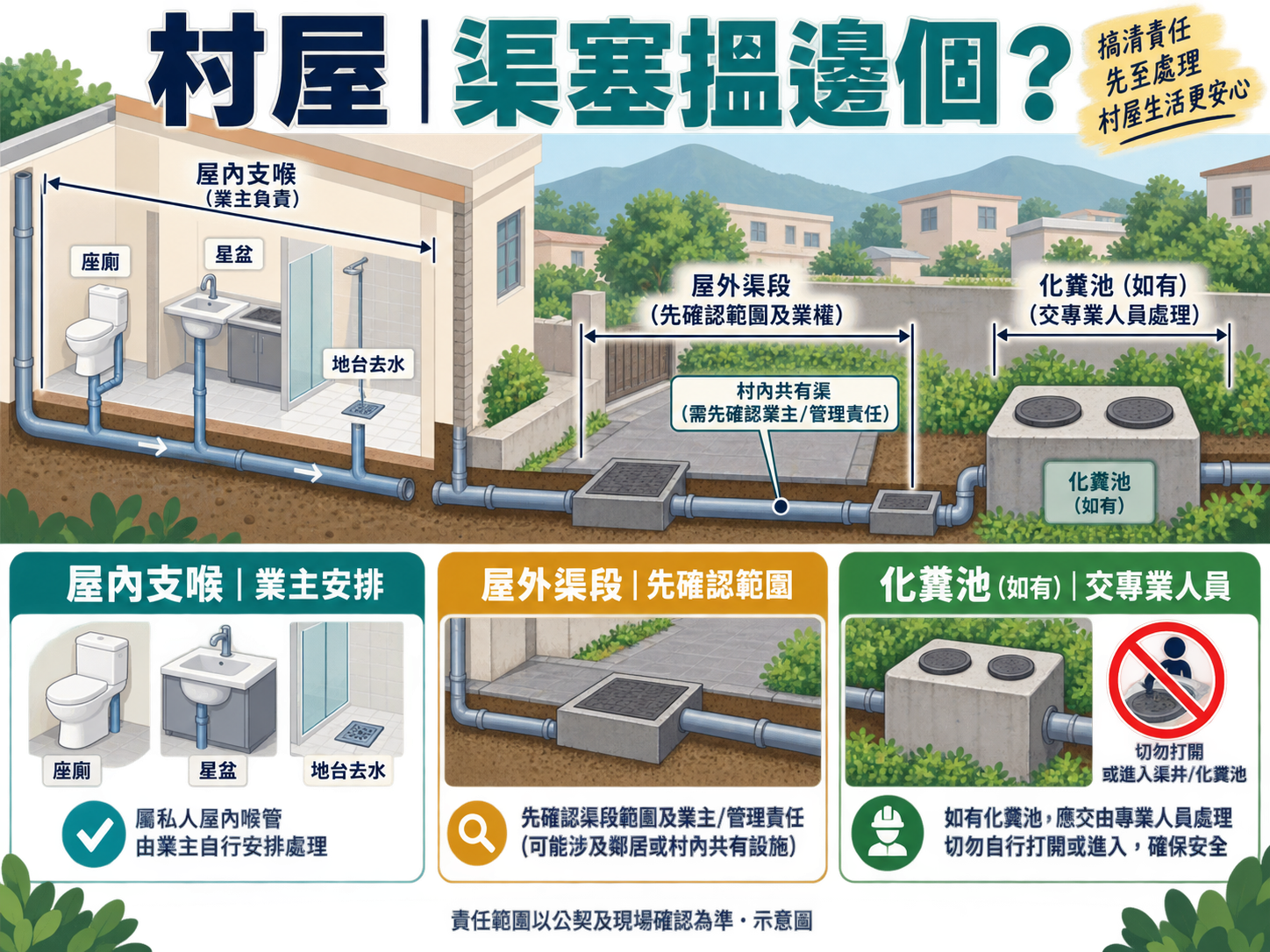
The Audit report explains that under Government policy public sewers are laid only up to the boundary of private land as far as practicable, and village house owners must build the terminal manhole and connecting sewers at their own cost. Once the sewers are ready, EPD can serve a notice requiring connection by a deadline, and a confirmation form is returned afterwards. When the Kam Tin village areas that have finished their investigation studies move to construction, owners will do well to know in advance how their indoor and outdoor pipes run, what will happen to the old septic tank, and whether existing pipes are damaged or silted.
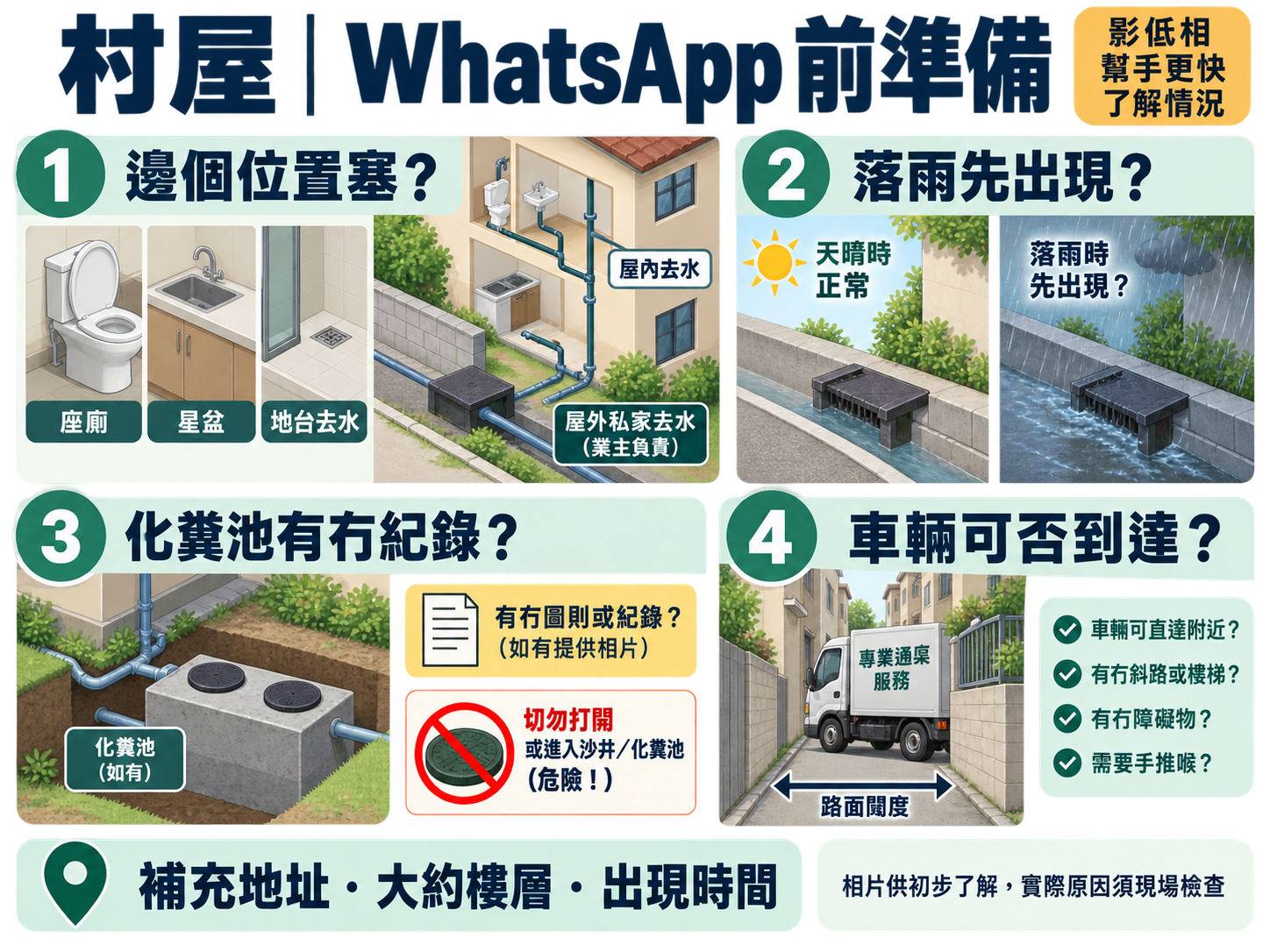
Photos or a short video on WhatsApp help us tell a single-fixture blockage from a shared-stack problem.
Kam Tin and Pat Heung lie in a basin between Tai Mo Shan, Kai Kung Leng and other hills, and the area is mostly walled villages and village houses. In a written reply to the Legislative Council in April 2025, the Government said that of the nine Kam Tin village areas covered by the village sewerage programme, only part of Kam Tin Shi had sewers completed (in 2024), and investigation studies for the other eight are done. DSD's project page for 4452DS (Village sewerage for Kam Tin, Yuen Long (stage 1)) still showed the status “Under planning & design” when checked in September 2026. Houses without public sewers continue to rely on septic tanks and soakaway systems. When a toilet drains slowly, a manhole stays full or water backs up after rain, first work out whether the problem lies in the branch pipe inside the house, the outdoor manhole, the septic tank or the soakaway, then decide between unblocking, desilting or having the septic tank emptied.
Kam Tin and Pat Heung are both basins ringed by hills. Kam Tin is known for walled villages built by the Tang clan, such as Kat Hing Wai, Tai Hong Wai and Wing Lung Wai, and Wikipedia records that Kam Tin was once “criss-crossed by waterways and often flooded”. Pat Heung has about 30 Punti and Hakka villages, and in recent years much of its farmland has become village houses, vehicle repair yards and scrapyards. As a terrain-based inference, more and more ground is paved, so in heavy rain water gathers in roadside drains and watercourses, and outdoor drains and manholes in low-lying spots are hit first.
New Territories village houses are generally no more than three storeys. The Audit Commission's 2016 report explains that for a new or rebuilt village house meeting specified criteria (for example a covered area of no more than 65.03 m² and a height of no more than 8.23 m), the Lands Department issues a certificate of exemption for the drainage works, setting the minimum distance between the septic tank and sensitive waters such as streams, and the tank's size and type. By design inference, in a house without public sewers the toilet, kitchen and bathroom outlets run through an outdoor manhole into the septic tank, where solids settle, and the outflow soaks into the ground through a soakaway pit; some houses share a septic tank or a length of outdoor drain with neighbours.
Work on the Kam Tin trunk sewers began in 2005, and the Audit report also records that a dry-weather-flow interceptor was installed in Kam Tin in 2016 to intercept surface sewage. Even so, when DSD's page for 4452DS (Kam Tin village sewerage, stage 1) was checked in September 2026 its status was still “Under planning & design”. A legislator's 2025 question noted that private estates completed nearby are already connected to the trunk sewer while many villages are not. There is no official list we can cite showing which individual Pat Heung villages have public sewers, so it has to be confirmed village by village and house by house.
Note: statements based on building age and type are general inferences, not findings for any particular flat.
A clear process from enquiry and assessment to an agreed scope of work
Tell us the drain problem and district and ask about available timing.
Confirm timing based on the district and schedule, then inspect the blockage or odour issue.
Explain the proposed approach, scope and price before agreed work begins.
Use suitable tools for the site conditions and agreed scope of work.
After the agreed work, test drainage and explain the observed result and any next steps.
PipeButler is an independent drain-service provider with no affiliation to the developer, owners' corporation, management company or Housing Department of the places above. Facts come from public sources checked on the dates shown; work on common drains or common parts follows the management office's and deed of mutual covenant's arrangements.
WhatsApp with the problem and district, and we will confirm available timing.