
Loading page…
Loading page…
Wo Shang Wai (Mai Po / San Tin) · Private estate · Low-density houses
Completed 1993–1996 · 980 + 424 three-storey houses · own sewage treatment plants
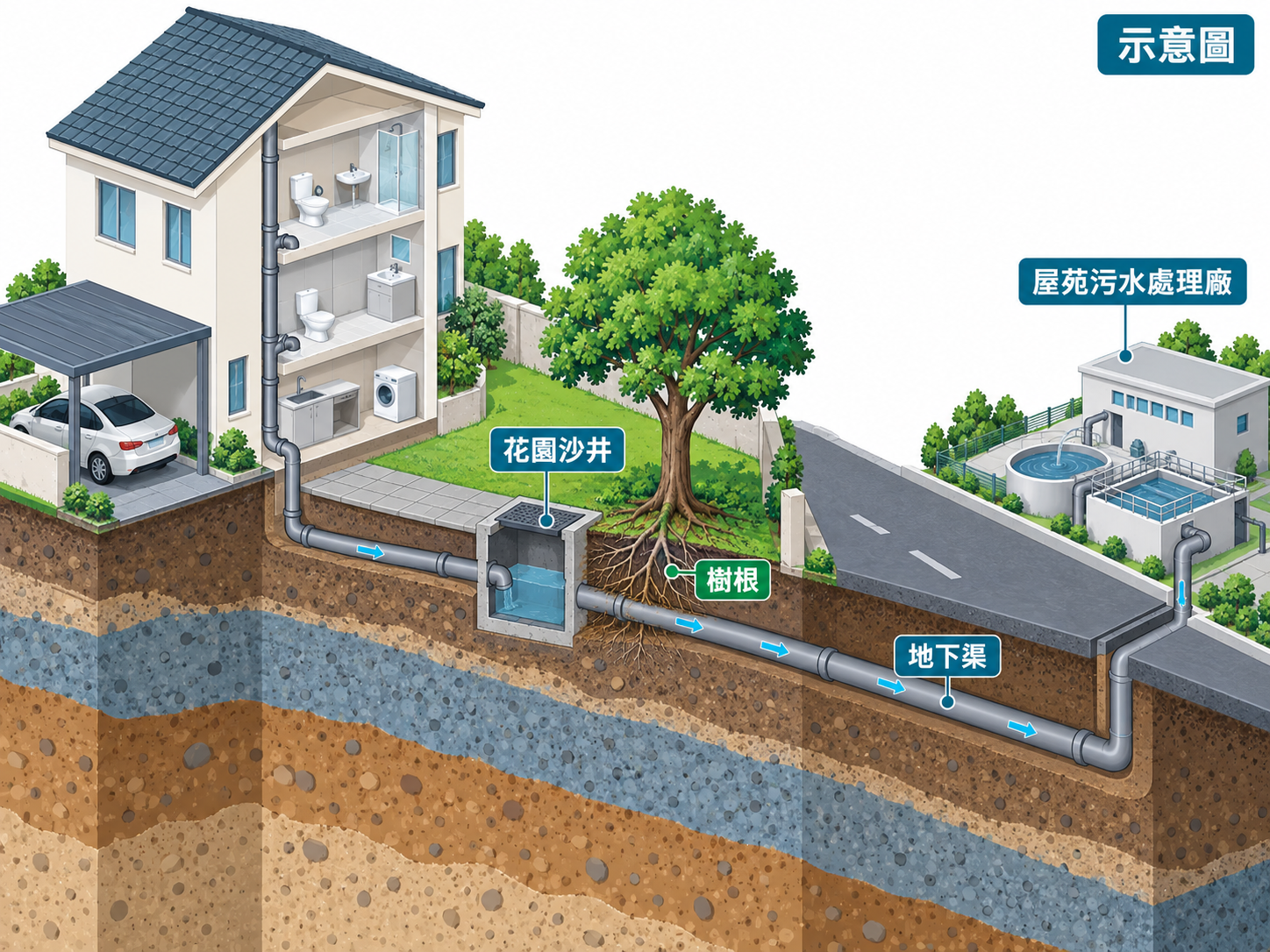
Palm Springs and Royal Palms are two neighbouring low-density estates developed by Sun Hung Kai Properties at Wo Shang Wai, Yuen Long, with 980 and 424 three-storey garden houses respectively.
Last reviewed ·
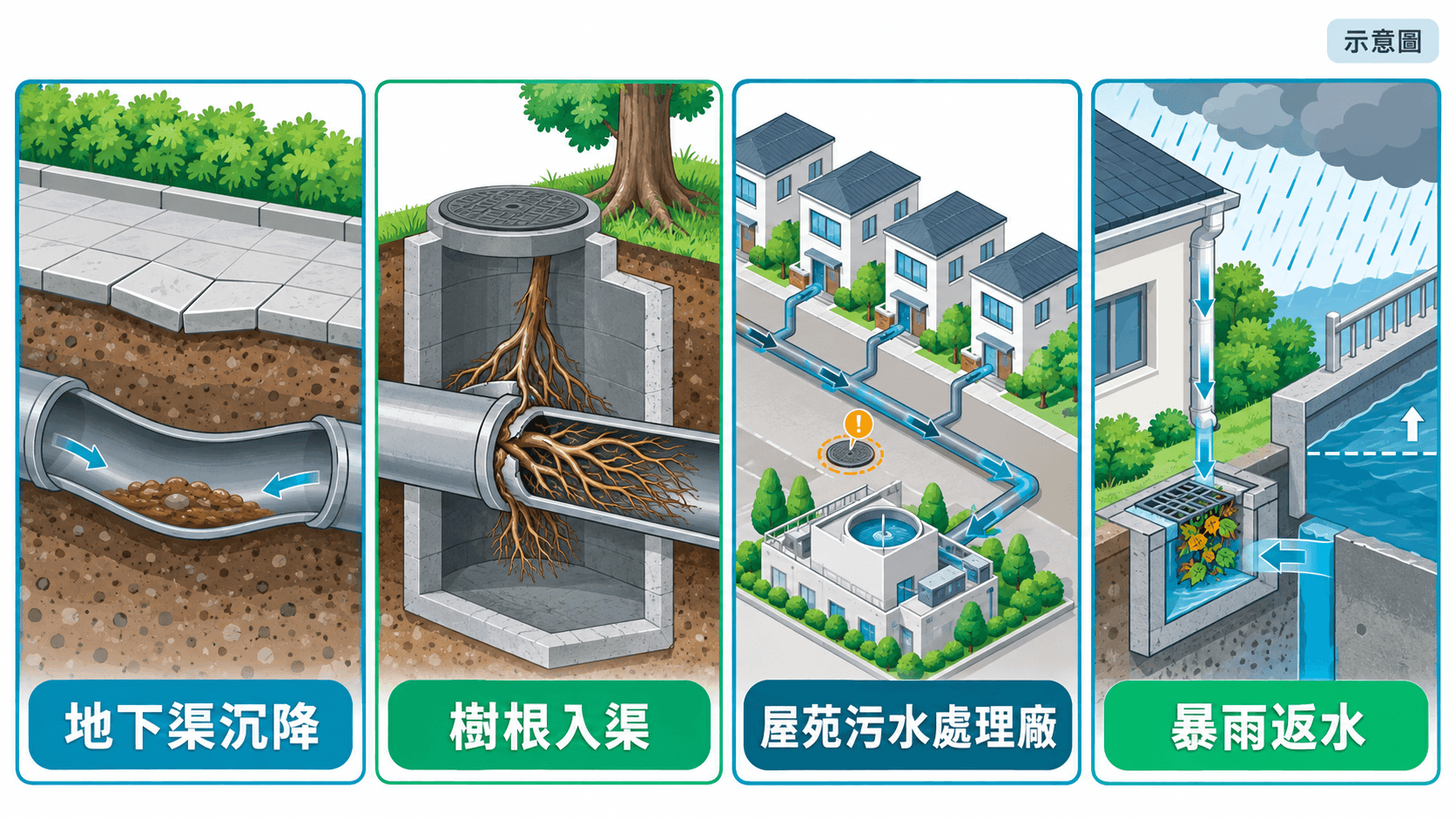
Choose the problem you are seeing to read the likely cause and next step.
The ground floor of a three-storey house is closest to the underground drain outside. If the toilet, kitchen sink and floor drain on that floor are all slow, or the garden manhole stays high, the cause is rarely a single fixture. As an inference from the ground conditions, underground drains laid on filled fishponds may have sunk in places over 30 years, creating low spots where water and silt collect, or joints may have shifted and started catching debris. Start by opening the manhole to check the flow direction and silt, then clear the line by high-pressure water jetting or rodding; if it keeps blocking, a CCTV pipe survey can show whether a section is displaced or cracked.
The 2018 EIA recorded that the estates' landscaping and private gardens are dominated by semi-mature trees 6 to 10 m tall, with trees of up to 15 m along the boundary walls. Roots seek moisture, so they work their way along pipe joints and hairline gaps in manhole walls; at first the drain is just slow, then the roots trap tissue and grease into a blockage. Buildings Department guidelines also say manholes should stay accessible and not be covered by floor finishes or planters. Where roots are found, they can be cut out and the line flushed, then the joint assessed for repair or the section for replacement.
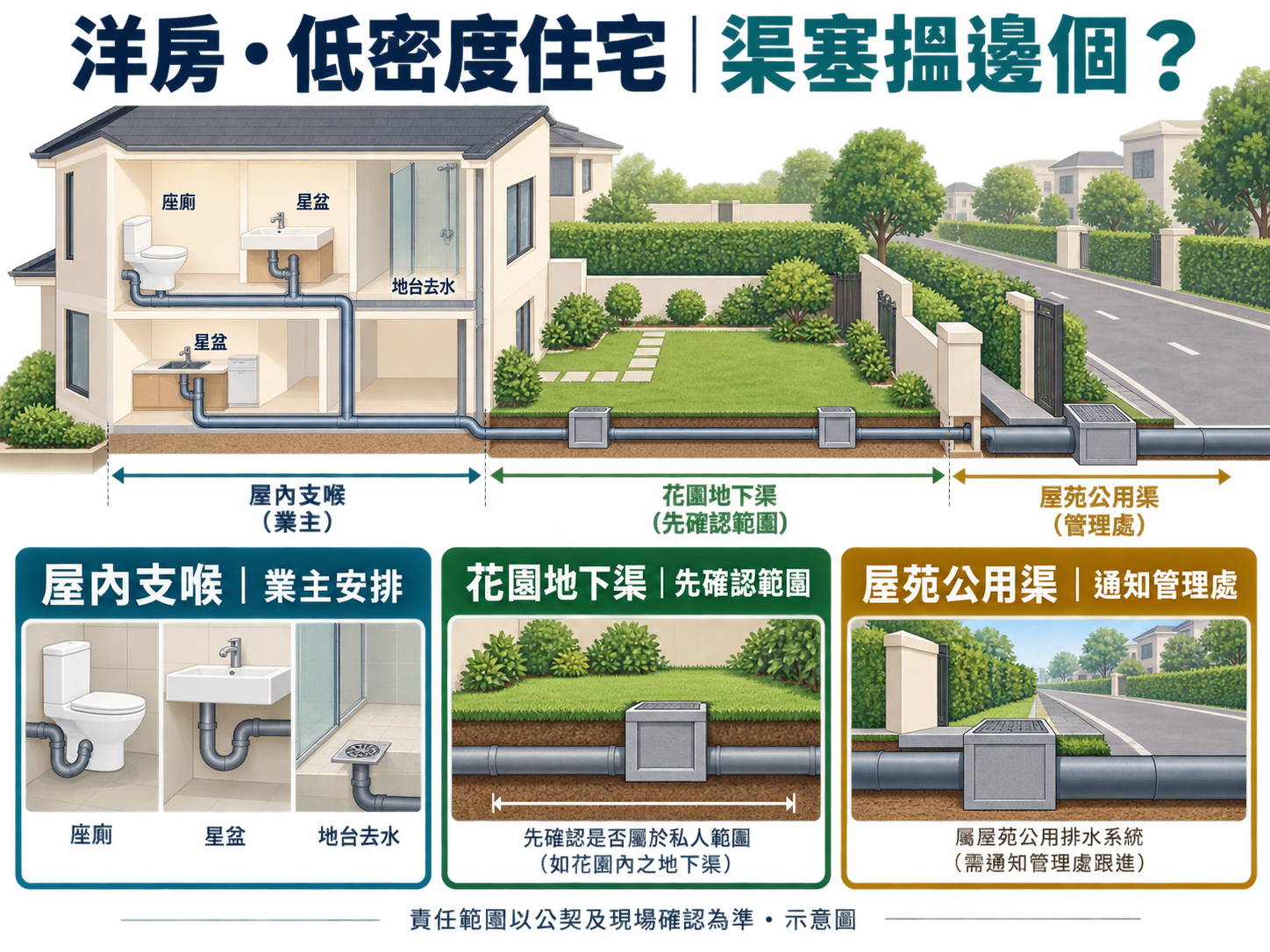
The EIA states that each estate has its own private sewage treatment plant, so house sewage is collected by the estate network and treated within the estate rather than discharged straight into a government sewer. Grease, wet wipes or large amounts of strong chemical drain cleaner poured down the drain therefore do more than block the house's branch pipes; they also add load to the estate's shared sewers and treatment facilities. If only your house drains slowly, the fault is usually inside the house or in your own garden section. If several houses on the same path back up together, or a manhole on the road overflows, tell the management office at once so the estate can check the shared drains.
The EIA describes Palm Springs and Royal Palms as low-lying, with nearby channels between fishponds draining to Deep Bay and some of them tidal in their lower reaches. As an inference from the terrain, rainwater may drain away more slowly when a rainstorm coincides with high tide; if garden gully gratings, car-port channels or roof and terrace outlets already hold leaves and silt, water is more likely to pond or even back up into the house. Clearing leaves and silt before the rainy season, and checking manholes for silt after heavy rain, is more practical than dealing with it afterwards.
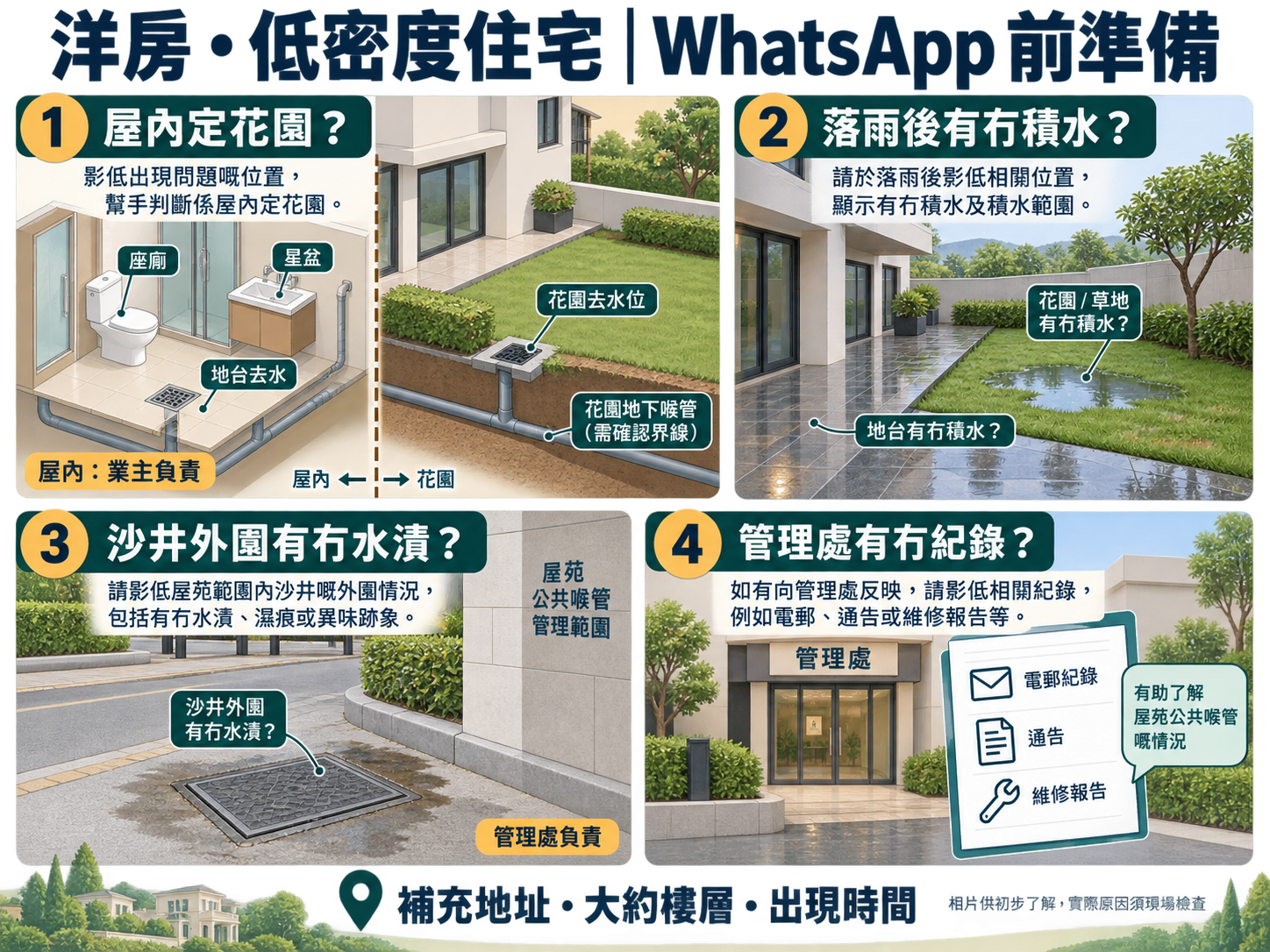
Photos or a short video on WhatsApp help us tell a single-fixture blockage from a shared-stack problem.
Palm Springs and Royal Palms are two neighbouring low-density estates developed by Sun Hung Kai Properties at Wo Shang Wai, Yuen Long, with 980 and 424 three-storey garden houses respectively. They were completed between 1993 and 1996 on land that was once fishponds. Unlike a high-rise estate, every house here has its own garden; in the usual house layout, waste water leaves the house through underground drains outside, joins the estate's drainage network and is taken to the estate's own sewage treatment plant rather than straight into a public sewer. When ground-floor fixtures drain slowly, a garden manhole fills up or water backs up after heavy rain, first work out whether the fault is in the house pipes, the underground drain in your own garden, or the estate's shared drains.
Wo Shang Wai was once salt-water paddy and fishponds. According to the Wikipedia entry on Wo Shang Wai, Sun Hung Kai Properties bought about 3 million sq ft of already-filled land in the late 1980s, had it rezoned for low-density housing in 1990, and developed it into Palm Springs in 1993; it bought a further 2 million sq ft in 1991, and Royal Palms was completed in 1996. The South China Morning Post reported in January 1994 that Palm Springs Phase 1C comprised 374 houses, all three storeys, from 1,719 to 2,427 sq ft.
Drainage here is largely self-contained. A public project record by the engineering consultant Ho Tin & Associates lists site formation, stormwater and sewerage networks and a sewage treatment plant in the scope for Palm Springs Phase 1. A 2018 report on EPD's environmental impact assessment register, prepared for a proposed interim sewage treatment plant at Wo Shang Wai, states that Palm Springs and Royal Palms each have a private sewage treatment plant, and that the planned public trunk sewer along Castle Peak Road was then still at the planning and design stage; it also notes that EPD received no odour complaints about the two plants from 2012 to 2016. A 2026 planning submission confirms again that sewage from Palm Springs Plaza runs through the estate's sewers to the on-site treatment plant.
The houses are about 30 years old. Inferring from their age and the ground conditions, their underground drains and manholes were laid on filled fishpond land, so slight settlement or displaced joints may have developed over the years; the same EIA records that the estates' landscaping and private gardens are dominated by semi-mature trees 6 to 10 m tall. And because the houses are domestic buildings of no more than three storeys, they fall outside the Buildings Department's Mandatory Building Inspection Scheme, so underground drains often go unnoticed until something goes wrong. Regular self-checks matter.
Note: statements based on building age and type are general inferences, not findings for any particular flat.
A clear process from enquiry and assessment to an agreed scope of work
Tell us the drain problem and district and ask about available timing.
Confirm timing based on the district and schedule, then inspect the blockage or odour issue.
Explain the proposed approach, scope and price before agreed work begins.
Use suitable tools for the site conditions and agreed scope of work.
After the agreed work, test drainage and explain the observed result and any next steps.
PipeButler is an independent drain-service provider with no affiliation to the developer, owners' corporation, management company or Housing Department of the places above. Facts come from public sources checked on the dates shown; work on common drains or common parts follows the management office's and deed of mutual covenant's arrangements.
WhatsApp with the problem and district, and we will confirm available timing.