
Loading page…
Loading page…
Hang Hau rural area · Village houses
Recognised villages off Clear Water Bay Road · septic tanks moving to public sewers
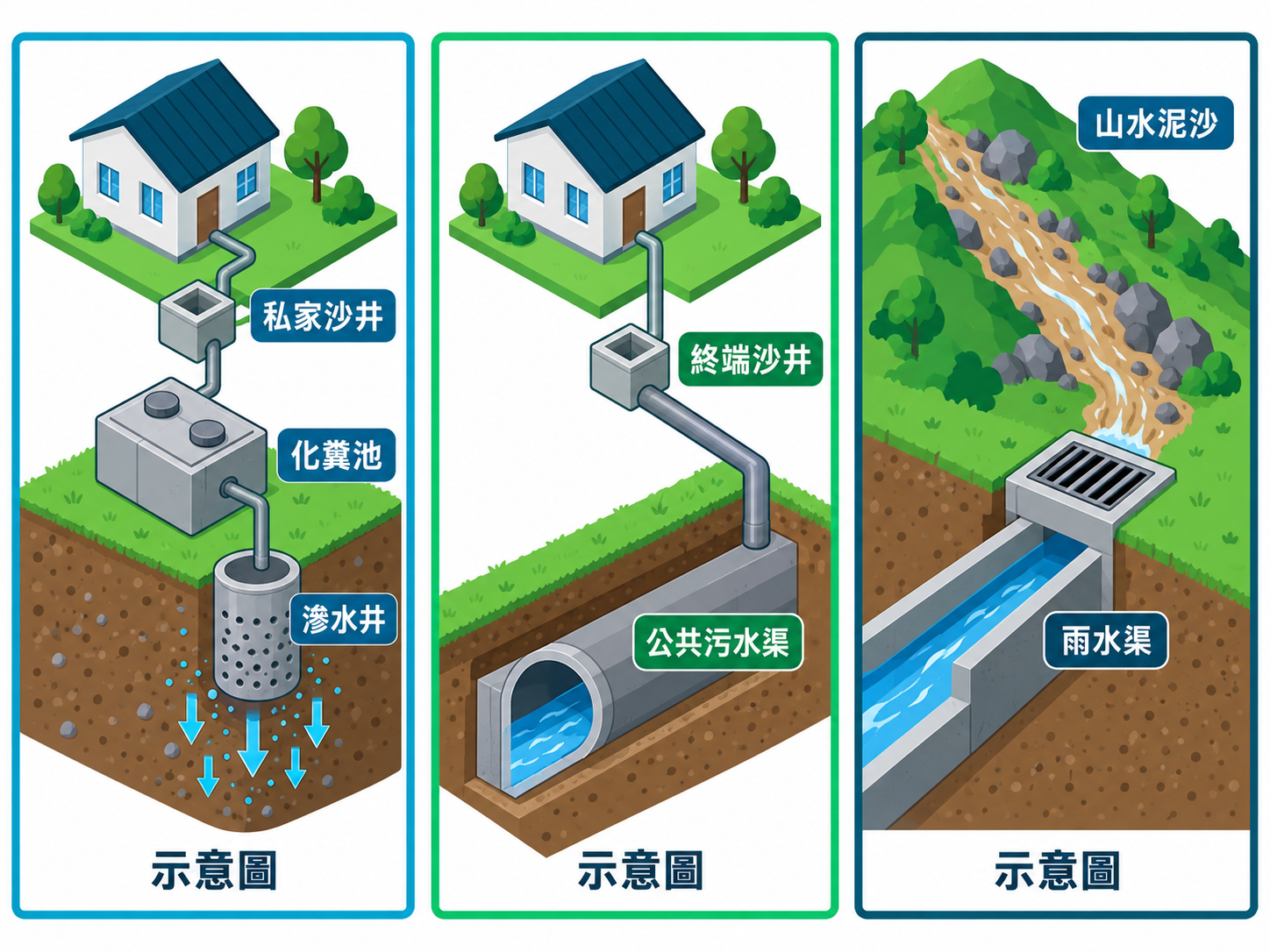
Drainage in the Hang Hau rural area works nothing like an estate in the new town.
Last reviewed ·
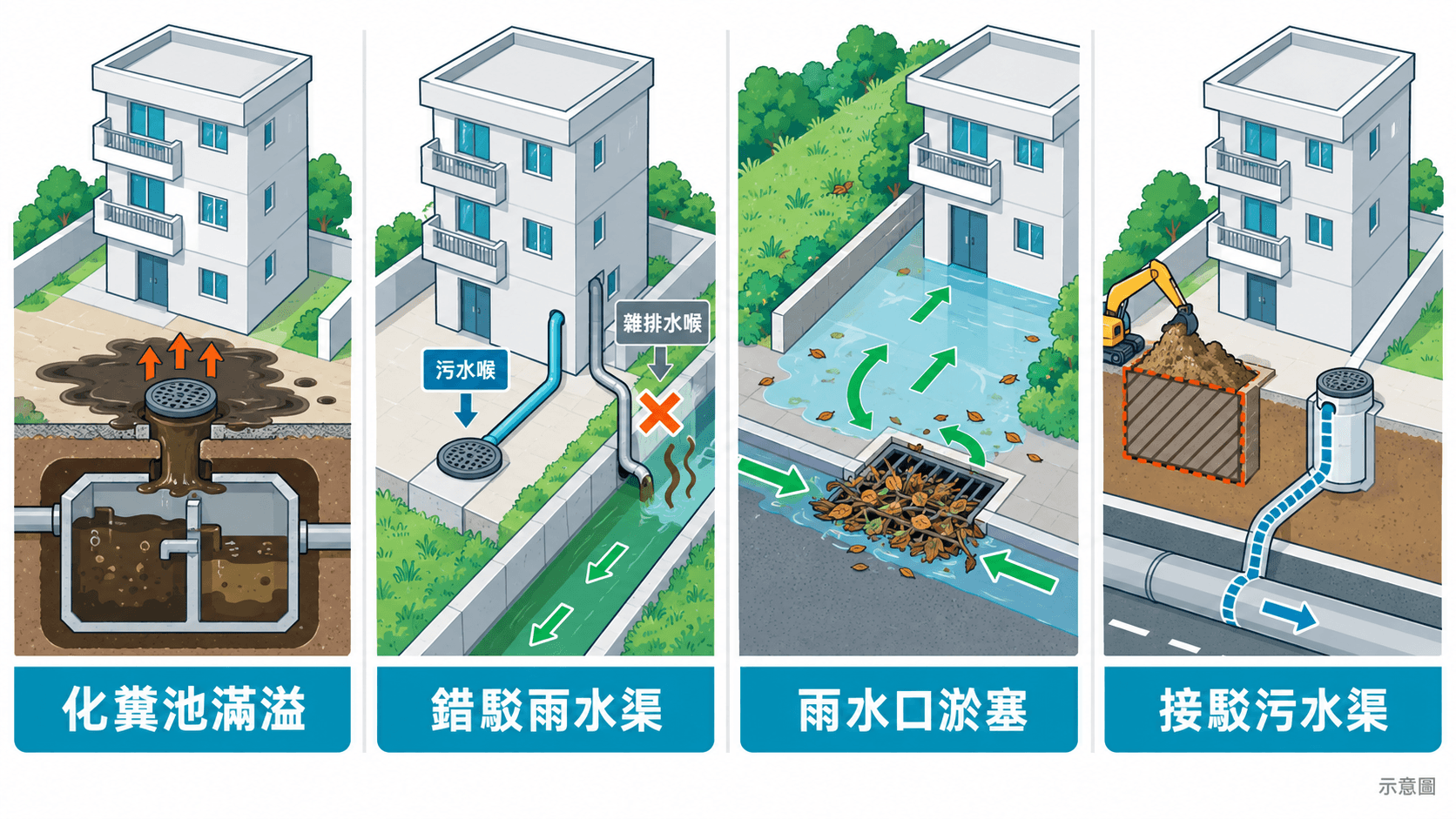
Choose the problem you are seeing to read the likely cause and next step.
At the Sai Kung District Council's Housing, Planning and Environment Committee on 15 November 2022, a member said that septic tanks in some villages had gone unmaintained for years and seeped sewage from time to time. At the District Facilities and Works Committee on 12 November 2024, members reported that septic-tank sewage was backing up in some villages and asked the Environmental Protection Department to weigh that when ordering the works. At the 2022 meeting the Drainage Services Department replied that, on a complaint or a referral, even though the tank and the terminal manhole are privately managed and maintained, it first deals with the overflow and disinfects the spot, then asks the relevant departments to refer the case to the owner. Inferring from the layout, a backing-up tank usually shows first at the lowest outlet — a ground-floor toilet, an outdoor floor drain or a garden manhole — so when the level rises abnormally, stop using water rather than flushing repeatedly to test it. Clearing up and disinfecting afterwards is the owner's own arrangement.
At the same meeting on 15 November 2022, a member said that waste pipework at some village houses was connected in a tangle that produced a great deal of odour. The Environmental Protection Department added that where it finds someone has connected a foul drain into a public stormwater drain it gathers evidence and prosecutes the offending household, and that if an overflowing septic tank causes sewage to escape, the Food and Environmental Hygiene Department also has legislation covering nuisance from septic-tank installations. After decades of extensions, alterations and floor-by-floor sales, and inferring from how these houses are built, shower, washing-machine or sink waste discharging into an open stormwater channel is a common legacy — unnoticed day to day, and found only after heavy rain or a neighbour's complaint. Putting it right is not a matter of rodding the pipe but of tracing where each line goes and returning the foul side to where it belongs.
At the Housing, Planning and Environment Committee on 19 July 2022, a member raised the pollution of the sea by sewage from coastal villages, naming Po Toi O, Sheung Sze Wan and Tai Wan Tau, asked departments to move faster on leaking septic tanks and on foul water mixed into stormwater drains, and said that on a recent visit to Sheung Sze Wan he had found the sewage had turned into a bank of silt. The chair also noted that houses along Clear Water Bay Road had leakage problems from ageing septic tanks. These are views recorded in council minutes rather than findings about any particular house, but the practical message to an owner is plain: on coastal slopes, tanks and soakaway pits drain slowly and salt air corrodes old covers and pipe brackets quickly, so the outdoor run and the tank are worth opening and checking on a schedule, not once the smell has reached the village lane.
The Sai Kung section of the Drainage Services Department's list of locations prone to blockage (file dated 26.8.26) includes Clear Water Bay Road near Pan Long Wan Village at lamp post VE5177. When the Director of Drainage Services attended the Sai Kung District Council on 6 March 2018, a member recalled that every wet season floodwater off Kowloon Peak caused serious flooding around Tseng Lan Shue, and said the problem had greatly improved after a U-shaped channel was built. At the District Facilities and Works Committee on 14 May 2024, the District Office explained that flooding around the Hang Hau Tin Hau Temple came mainly from large volumes of rain running off the hill behind, with some blocked channels sending it back over the temple and the road. Inferring from the terrain, gullies, catchpits and private manholes in a hillside village are the first things leaves, branches and washed-down silt will seal; when the water cannot get away it comes back in over the forecourt or at the lowest floor drain, and leaves a layer of silt behind. Street gullies and public channels can be reported to the Drainage Services Department, but the private catchpits and manholes around the house still need the owner to open and clear them regularly.
At the District Facilities and Works Committee on 12 November 2024, the Drainage Services Department said that once the sewerage works are complete the septic tank is no longer used and that, under the Water Pollution Control (Sewerage) Regulation, the tank must be filled in or demolished by the owner; on the cost of connection, householders may apply to the Urban Renewal Authority's assistance scheme for repairs to owner-occupied property or to the Buildings Department's Building Safety Loan Scheme. EPD's Guide to the Water Pollution Control Ordinance states that the department may serve notice on an owner requiring an appropriate terminal manhole and pipework to be built by a specified date so that all wastewater goes to the communal sewer. Inferring from what a changeover involves, the real work is on the house side: trace where the old pipes run, bring the sullage from showers, basins and sinks into the same system, repair cracked or silted lengths, and do not simply cap the old tank and leave it — an unflushed dead leg holds water, smells and breeds drain flies.
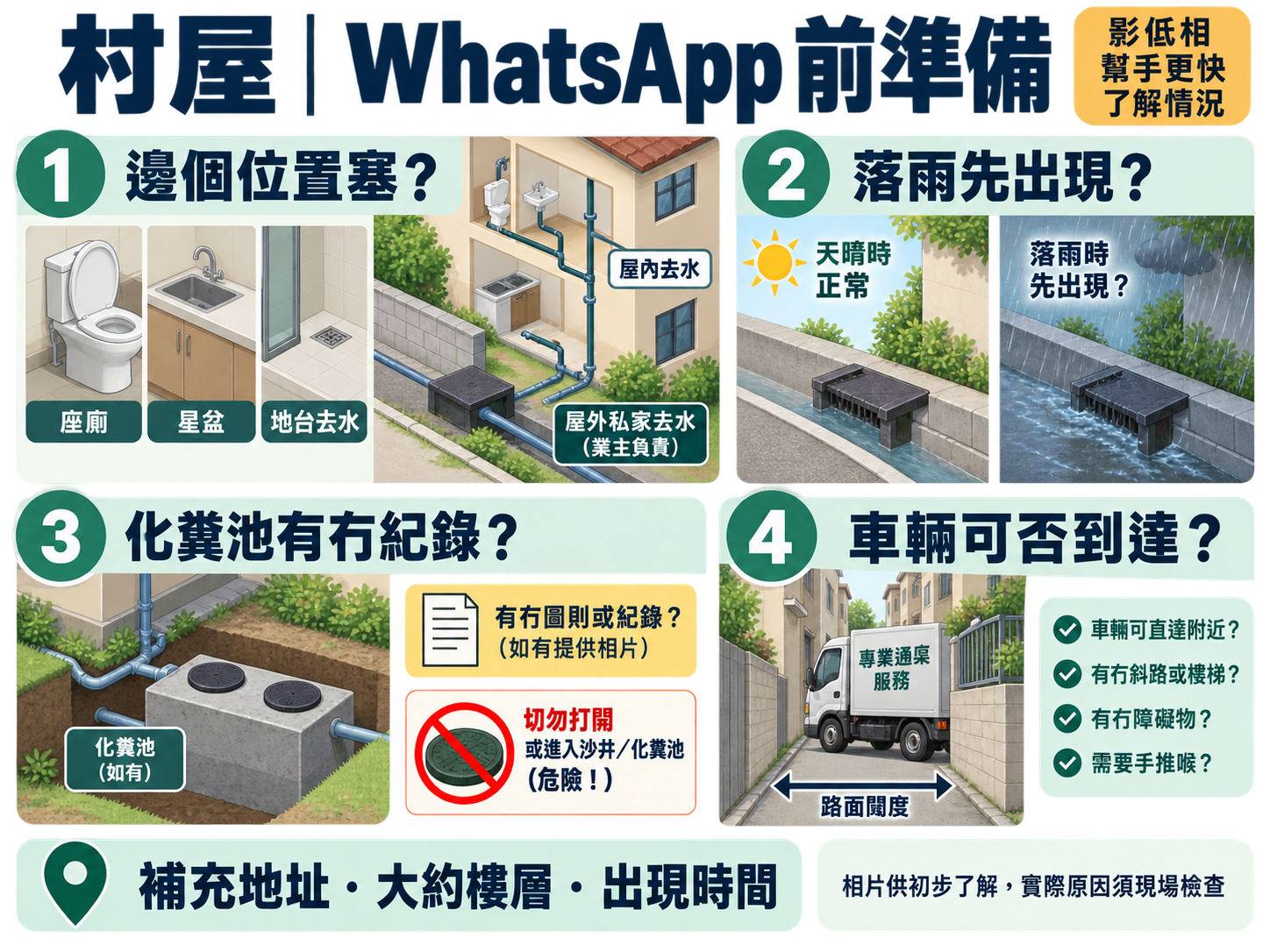
Photos or a short video on WhatsApp help us tell a single-fixture blockage from a shared-stack problem.
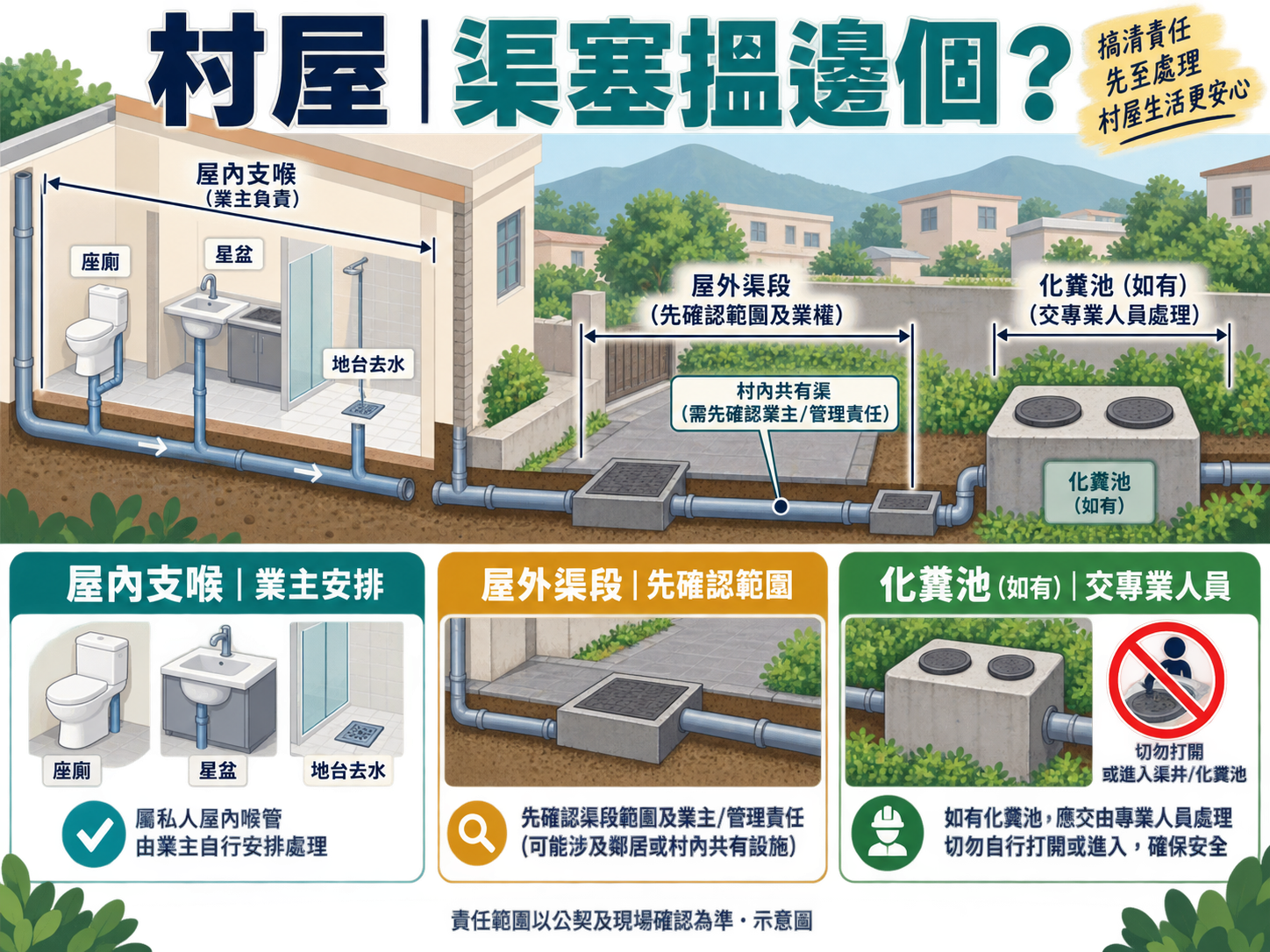
Drainage in the Hang Hau rural area works nothing like an estate in the new town. The three-storey village houses here have no management office and no shared soil stack: waste leaves the house through open or buried channels and private manholes into a septic tank, and the effluent soaks away through a soakaway pit. For villages along Clear Water Bay Road such as Pan Long Wan, Tai Hang Hau, Sheung Sze Wan and Tai Wan Tau, the Environmental Protection Department's connection statistics as at the end of December 2024 still do not list them among the houses connected to a public sewer. So when a toilet will not flush, an outdoor manhole is overflowing or the whole lot smells, the first move is not to pour drain cleaner but to work out whether the trouble sits in the house's own branch pipes, in the private drain outside, in the septic tank, or in the fact that the village has no public sewer yet.
The Hang Hau rural area reaches well beyond the new town. Wikipedia records that the Hang Hau Rural Committee was formally registered in 1957 and is made up of the eighteen villages of the Hang Hau area. Tseng Lan Shue lies along Clear Water Bay Road south-east of Kowloon Peak, and its Yau ancestral hall is dated to 1829; at the Sai Kung District Council's Housing, Planning and Environment Committee on 15 November 2022, a member said that Sum Long, Tan Shan, Pak Shek Wo and Pik Uk Au are all sub-villages of Tseng Lan Shue. Out on the Clear Water Bay peninsula there are Sheung Sze Wan, backing onto High Junk Peak and facing Port Shelter, and Tai Wan Tau, which together with Tai Au Mun is a recognised village under the New Territories Small House Policy. So a "Hang Hau village house" can mean any of many small settlements, and their drainage has to be taken village by village.
The plumbing here bears no resemblance to an estate. Inferring from the way these houses are built: each fixture drains through its own trap into the house's pipework, leaves the building in an open or buried channel, passes one or two private manholes, and enters a septic tank, whose effluent soaks away through a soakaway pit. There is no stack, no vent pipe and no shared building drain, so the estate symptom of flats above and below blocking together in one vertical line is rare here. What happens instead is that a length of drain outside, or the inlet of the tank, narrows, and several fixtures in the house slow down at once — while a three-storey house may be owned floor by floor with only one tank between them.
Public sewers are arriving in stages. At the Sai Kung District Council on 7 May 2019 the Drainage Services Department said that the works for Tseng Lan Shue and Po Toi O were included in project 273DS, phase three of the Port Shelter sewerage scheme (牛尾海污水收集整體計劃), and would begin in the fourth quarter of 2019 if funding was approved. At the committee meeting of 19 July 2022 a member said phase one was completed in 2017 and covered three Hang Hau villages. By the District Facilities and Works Committee of 12 November 2024, the Environmental Protection Department reported that phase two covers 31 villages with 11 complete and phase three 19 villages with 10 complete, the remaining 22 expected to take several years; at the same meeting, the future new phase members asked about covered "Pan Long Wan to Tai Wan Tau". The Drainage Services Department added that works in progress were due to finish in stages by the end of 2025, and that EPD would start writing to village house owners about connection roughly half a year after completion, around 2026. In short, many households here sit between still running on a septic tank and shortly receiving a connection notice.
Note: statements based on building age and type are general inferences, not findings for any particular flat.
A clear process from enquiry and assessment to an agreed scope of work
Tell us the drain problem and district and ask about available timing.
Confirm timing based on the district and schedule, then inspect the blockage or odour issue.
Explain the proposed approach, scope and price before agreed work begins.
Use suitable tools for the site conditions and agreed scope of work.
After the agreed work, test drainage and explain the observed result and any next steps.
PipeButler is an independent drain-service provider with no affiliation to the developer, owners' corporation, management company or Housing Department of the places above. Facts come from public sources checked on the dates shown; work on common drains or common parts follows the management office's and deed of mutual covenant's arrangements.
WhatsApp with the problem and district, and we will confirm available timing.