
Loading page…
Loading page…
Lo Wai & Chuen Lung · Village houses
Village founded 1669 · public sewers finished Oct 2025 · septic tanks giving way to the sewer
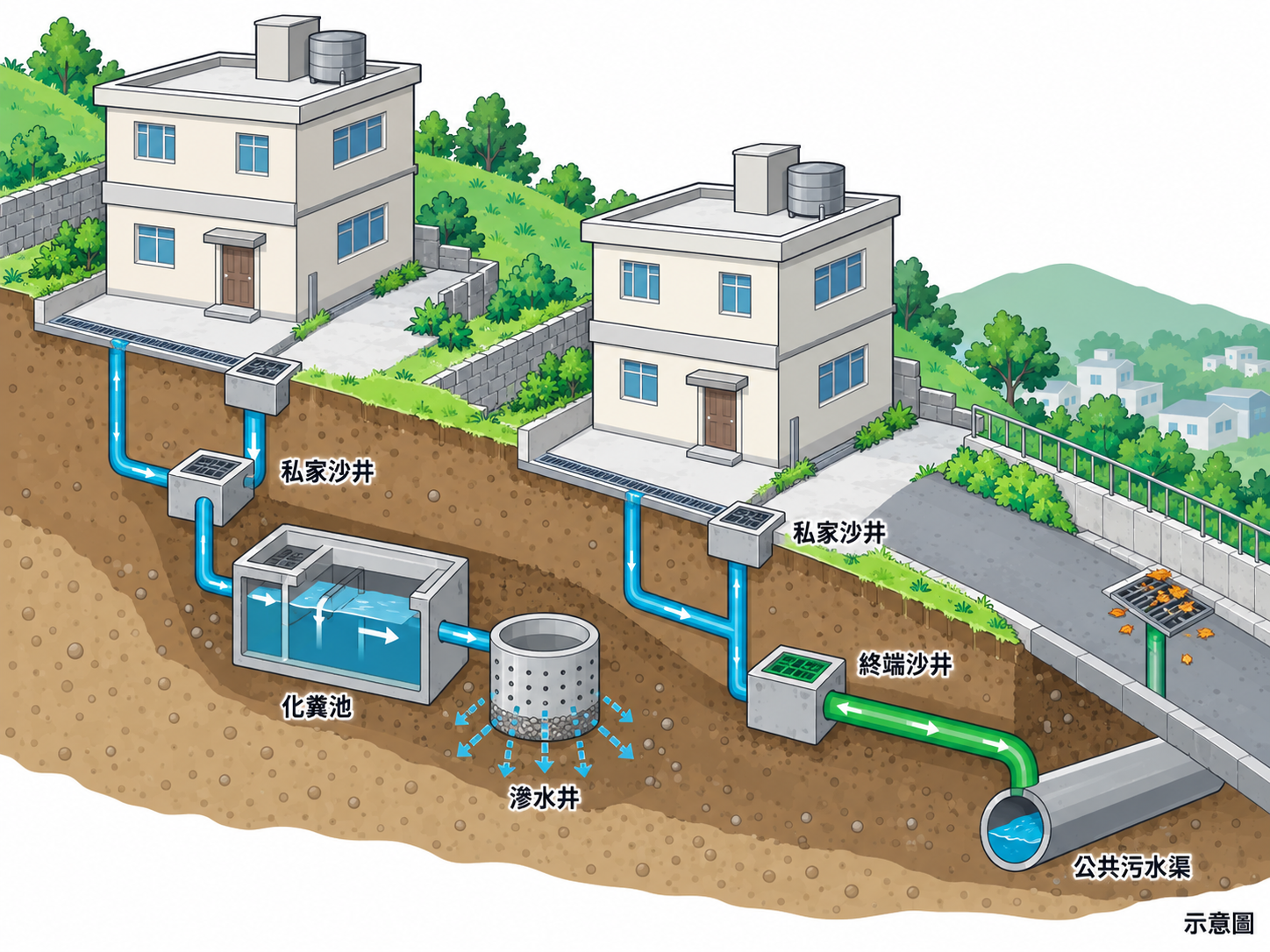
Lo Wai sits on the hillside in north-eastern Tsuen Wan and Chuen Lung on the slopes of Tai Mo Shan.
Last reviewed ·
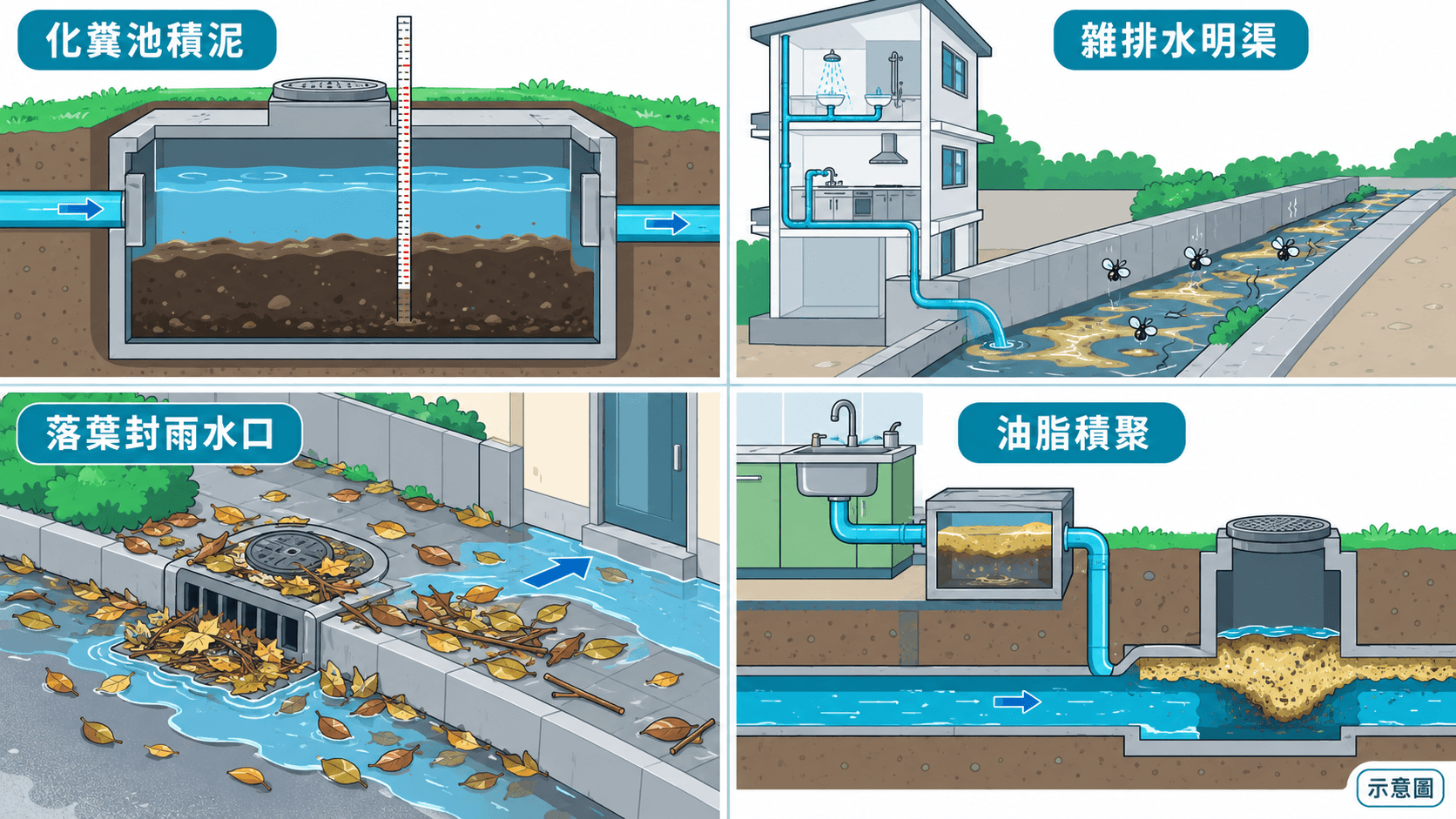
Choose the problem you are seeing to read the likely cause and next step.
Project 4358DS was completed on 31 October 2025, after which EPD follows up on the connections. Under EPD's procedure the government serves a notice on the owner setting out the position and specification of the terminal manhole, the date by which it and the pipework must be finished, the date by which all wastewater must be diverted into it, and the date by which disused pipes must be removed or sealed. Once the owner's work is done the government inspects it and links the terminal manhole to the public sewer. Premises subject to the Buildings Ordinance must engage an authorized person to prepare the plans for the terminal manhole and pipework and a registered contractor to build them; a New Territories exempted house holding a certificate of exemption for drainage works under the Buildings Ordinance (Application to the New Territories) Ordinance carries out the work in accordance with the notice. EPD also warns that failing to comply with a notice is an offence, with a maximum fine of HK$100,000 and a further HK$5,000 a day if it continues, and that the government may do the work itself and recover the cost from the owner.
A house not yet on the public sewer still relies on a septic tank and soakaway. EPD's guidance notes for village houses advise inspecting the tank and measuring the sludge depth at least once every six months, and desludging whenever the sludge is thicker than 30 cm (1 ft) or more than a quarter of the overall water depth. The notes also list three signs that call for an immediate inspection: the tank flooding or overflowing, the smell suddenly getting stronger, or the toilet not flushing well and the basin draining slowly. Houses in Lo Wai and Chuen Lung mostly stand on slopes and, by design inference, the soil around each soakaway absorbs water differently, so two houses in the same village can need emptying at very different intervals — measure your own rather than follow a neighbour. While the work is under way, the notes stress never leaving a manhole cover open and unattended, because a septic tank is a dangerous trap for children and older people.
EPD explains that for village houses built after 1984 the septic tank should have been designed to take both toilet waste and sullage — the water from showers, basins and kitchen sinks. In older village houses, however, most tanks were designed for toilet waste only, and some old houses had no tank at all, with sullage discharged through the surface channels outside into nearby streams. Lo Wai has both old tile-roofed brick houses and later three-storey village houses, which means two houses in the same village can send their sullage to completely different places. A channel that carries washing-up water and grease day after day builds up a greasy film and silt, runs slowly, breeds drain flies and smells. When you arrange the connection to the public sewer, deal with the sullage at the same time rather than connecting the toilet alone.
On DSD's list of locations prone to blockage, two of the six Tsuen Wan entries — Ma Sim Pai Road near Chun Sam Yuen in Lo Wai, and Sheung Kok Shan Road near Western Monastery — are in the Lo Wai area, and a third, Fu Yung Shan Road near Route Twisk, is on the main way up to Chuen Lung. By inference from the terrain, the gullies, channels and manholes of a hillside village are the first things sealed by leaves, branches and washed-down silt; in heavy rain the water cannot get away and comes back in across the ground outside or through the lowest floor drain, leaving a layer of silt once it recedes. Lo Wai is one of the Tsuen Wan Drainage Tunnel's intakes, but the tunnel only runs at Amber rainstorm warning or above and handles run-off intercepted on the hillside, so the private manholes and channels around your own house still need the owner to lift the covers and clear them regularly. Blocked street gullies and public channels can be reported to DSD.
The hillside around Lo Wai is dotted with temples and the Yuen Yuen Institute has a vegetarian refectory, while Chuen Lung is known for its self-service tea houses and mountain-spring beancurd pudding, with visitors concentrated at weekends. The Environmental Protection Department's grease-trap guidance for restaurants and food processors advises inspecting the trap at least every three days, cleaning it once greasy waste occupies the top 30 per cent of the liquid depth, and recording each maintenance in a log book. Premises like these discharge their water and grease in short bursts and, by design inference, if the trap is undersized or cleaned too rarely the grease slowly builds up in the run of drain outside, in the manholes and at the tank inlet, congeals as it cools and narrows the pipe — which can affect several neighbouring houses at once. The guidance is explicit that trap waste must never go into a toilet, a gully, a surface channel or a manhole: seal the container and dispose of it with the other kitchen refuse. Traps larger than 1,000 litres are hard to clean thoroughly by hand, and the guidance recommends an external maintenance contractor for those.
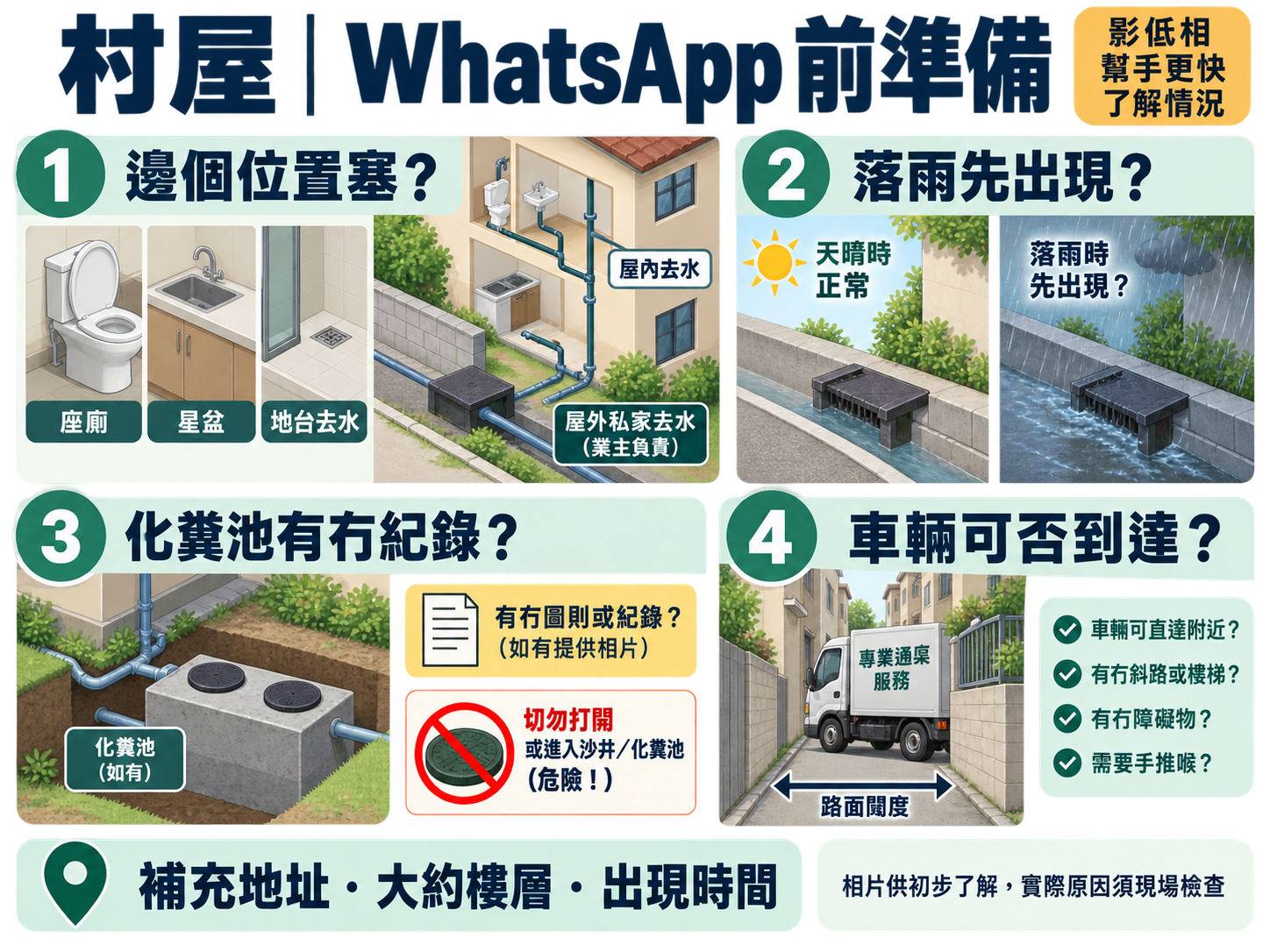
Photos or a short video on WhatsApp help us tell a single-fixture blockage from a shared-stack problem.
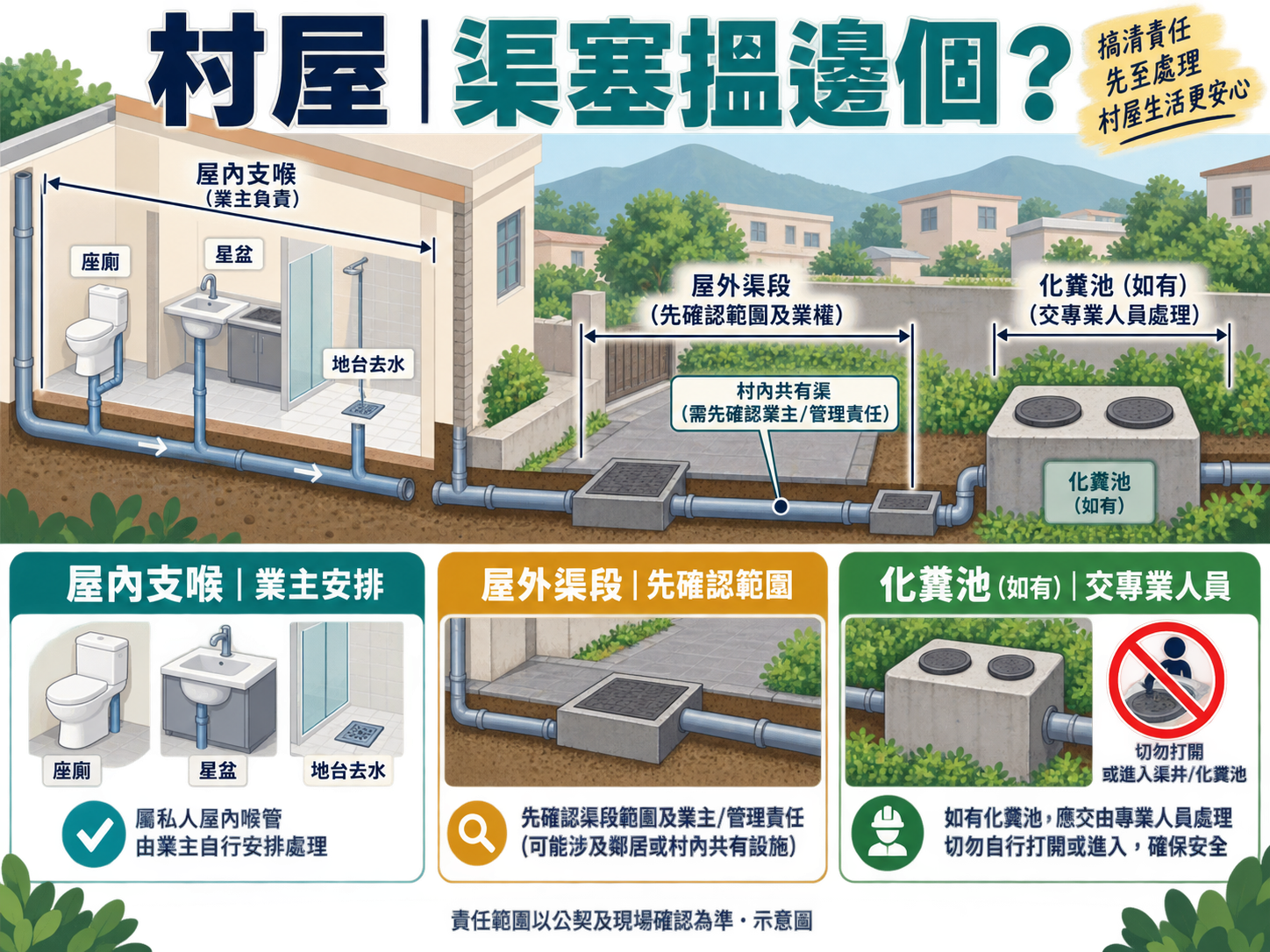
Lo Wai sits on the hillside in north-eastern Tsuen Wan and Chuen Lung on the slopes of Tai Mo Shan. Both are village-house settlements with no management office and no shared soil stack: everything from the outlets indoors, through the surface channels and manholes outside, down to the septic tank or terminal manhole, belongs to the owner. The Drainage Services Department completed Sewerage to Lo Wai, Chuen Lung and Kau Wa Keng Old Village on 31 October 2025, so the area is now in the transition from septic tanks to the public sewer. When a toilet will not flush, a manhole overflows, the channel outside smells or water stands after heavy rain, the first step is not drain cleaner but working out whether the fault lies in the branch pipe indoors, the private drains outside, the septic tank, or in a connection that has not been made yet.
Lo Wai Tsuen lies south of Lo Wai Road, backing onto the Shing Mun Reservoir plantation, and was built in 1669 by families of five surnames. Today the village still mixes old tile-roofed brick houses with later three-storey village houses, and has over 2,000 residents. Lo Wai itself is full of temples — Western Monastery, Yuen Yuen Institute, Tung Po Tor Monastery and the Lung Mo Temple are all nearby, and the Yuen Yuen Institute has its own vegetarian refectory. Chuen Lung sits on the slopes of Tai Mo Shan and is a Hakka village of the Tsang clan; because water is plentiful there, quality watercress has been grown since the 1960s, and the self-service tea houses and mountain-spring beancurd pudding draw people up the hill.
The biggest difference between a village house and a town flat is that there is no shared vertical stack. By design inference, the water path in a village house runs like this: each fitting indoors drains through its own trap into the house pipework, out to a surface or covered channel, through one or two private manholes, and then into the septic tank and soakaway; once the house is connected to the public sewer, the end point becomes the terminal manhole instead. So the estate pattern of "the flats above and below block together" is rare here. What happens instead is that one run of drain outside blocks and several outlets in the same house slow down at once.
On the sewage side, neither village had any public sewerage until recently. DSD's project 4358DS, Sewerage to Lo Wai, Chuen Lung and Kau Wa Keng Old Village, started on 30 August 2022 and was completed on 31 October 2025 at a cost of about HK$168.0 million, precisely to improve the water quality of nearby watercourses and the sanitary conditions of three unsewered villages. A finished public sewer, however, does not mean every house is connected: in EPD's village-house connection statistics as at the end of December 2024, the Tsuen Wan table lists only Pai Min Kok, several Sham Tseng villages, Ting Kau, Tsing Fai Tong New Village and Tsing Lung Tau — Lo Wai and Chuen Lung are not there. The same document states that most village-house owners complete their connection between two and five years after the public sewerage works finish.
On the stormwater side, both villages are on slopes. Lo Wai is one of the three intakes of the Tsuen Wan Drainage Tunnel, which opened on 28 March 2013, runs 5.1 km and discharges to the sea at Yau Kom Tau — but it only operates when the Amber rainstorm warning or above is in force, and it intercepts regional run-off on the hillside rather than dealing with the private drain in front of your house. Two of the six Tsuen Wan entries on DSD's list of locations prone to blockage are in the Lo Wai area, and a third is beside Route Twisk on the way up to Chuen Lung, which shows how often fallen leaves, branches and washed-down silt are behind blockages here.
Note: statements based on building age and type are general inferences, not findings for any particular flat.
A clear process from enquiry and assessment to an agreed scope of work
Tell us the drain problem and district and ask about available timing.
Confirm timing based on the district and schedule, then inspect the blockage or odour issue.
Explain the proposed approach, scope and price before agreed work begins.
Use suitable tools for the site conditions and agreed scope of work.
After the agreed work, test drainage and explain the observed result and any next steps.
PipeButler is an independent drain-service provider with no affiliation to the developer, owners' corporation, management company or Housing Department of the places above. Facts come from public sources checked on the dates shown; work on common drains or common parts follows the management office's and deed of mutual covenant's arrangements.
WhatsApp with the problem and district, and we will confirm available timing.