
Loading page…
Loading page…
Tsuen Wan West · Private estate
Occupied 2019 · 9 towers, 2,406 flats · new estate on a mall podium
Ocean Pride stands at 100 Tai Ho Road, Tsuen Wan, part of the Tsuen Wan West (TW5) Bayside Development.
Last reviewed ·
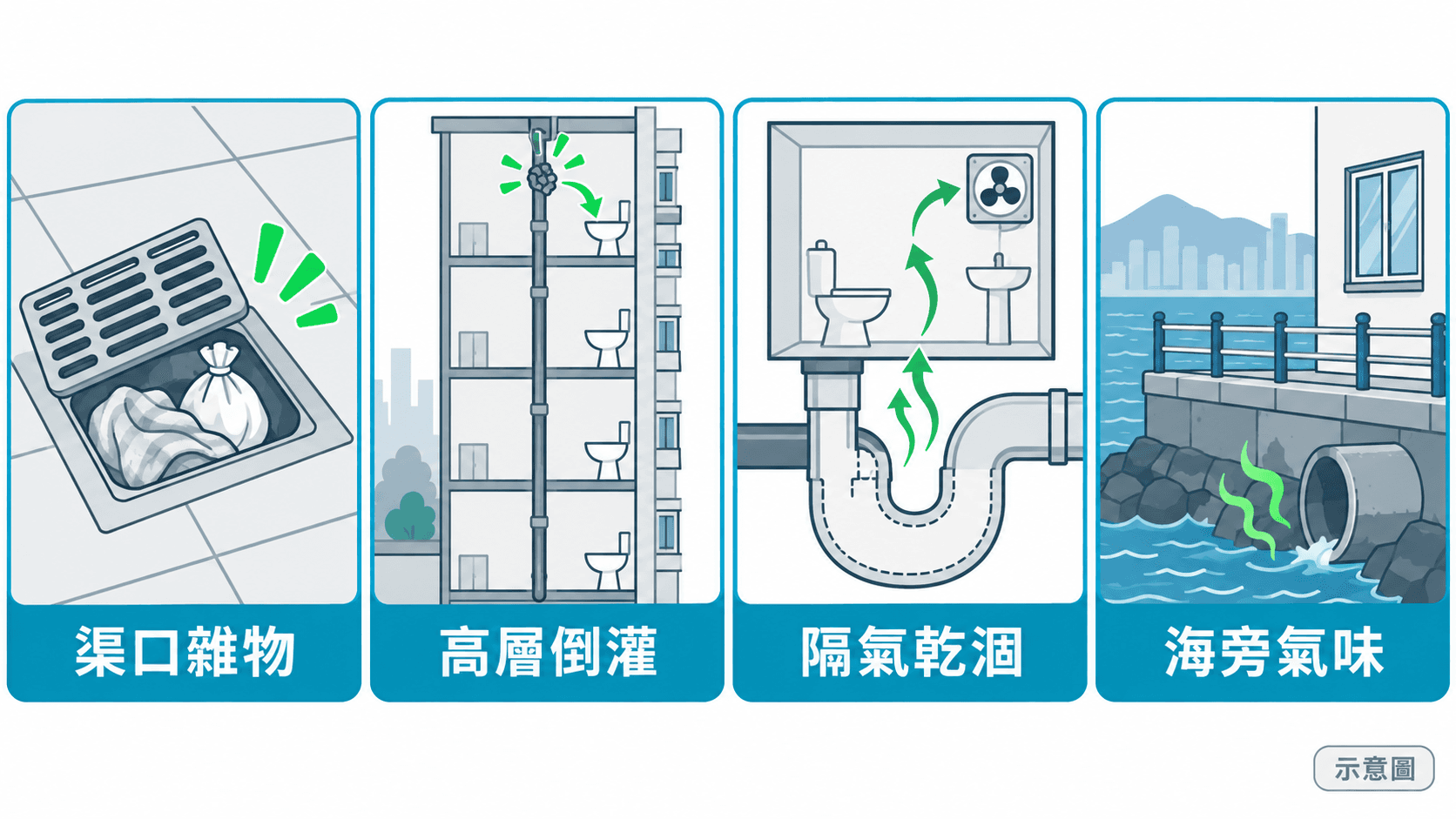
Choose the problem you are seeing to read the likely cause and next step.
HK01 reported on 26 May 2019 that MTR, replying to enquiries, said developer staff inspecting the affected Block 7 flat found a section of the common drain pipe serving it blocked by items including towels, plastic bags and sanitary products, and that the pipe was repaired immediately. That is one recorded, individual event and says nothing about other flats in the estate. The practical lesson for anyone in a newer building is real enough: during a fit-out or defect rectification, workers often plug drain outlets with cloth, plastic bags or tape to keep grit out, and every plug has to be confirmed removed before completion, with water run through each outlet as a test. The Buildings Department's guidance also notes that a serious blockage by material such as cement may mean exposing and replacing the affected length of pipe rather than simply rodding it.
Building inspector Lai Tat-ming told HK01 that backflow in a new building and on a high floor is very rare, explaining that backflow depends on pipe design and the build-up of rubbish, that narrow or winding pipes let debris collect, and that stacks bend as they approach the lower floors, which is why backflow usually happens in older buildings and on low floors. The general principle is this: sewage comes back out at the lowest fitment above the blockage, so the floor that suffers is set by where the blockage sits, not by how high the flat is. The published reports of the 2019 case do not say which section of pipe was blocked; they record only Lai's estimate that flats above and below might be in the same position. He also listed the most common warning signs — an outlet draining more slowly, or a toilet flushing away slowly. If the bowl refills sluggishly, or the bathtub and floor drain bubble at the same time, have it looked at rather than waiting, so the branch pipe and the stack can be told apart.
HK01 described the high-floor flats in Block 7 as having bathrooms with no window, like those in many new developments — a 「黑廁」. By design, such a bathroom depends entirely on its extract fan: with the door shut and the fan on, the room sits at slightly lower pressure, and if the floor drain or shower trap has an inadequate water seal, sewer air is drawn back into the room. The Buildings Department advises pouring about half a litre of water into each floor drain weekly. Because Ocean Pride was completed in 2019, well before APP-164's 31 August 2021 cut-off, the floor drains installed here are, as an inference from the building's age, conventional traps with no self-refilling arrangement, so they dry out most readily during long trips, between tenancies, or in a guest bathroom that is rarely used. If the smell survives the water, check whether the trap is damaged or has been replaced with a shallower one, and whether the branch pipe is leaking.
In the same report, Lai Tat-ming noted that many interiors are now designed without a marble threshold or a drain outlet at the kitchen or bathroom doorway, which makes the damage worse when wastewater escapes. HK01's description of the Block 7 high-floor flats records open-plan kitchens, and many owners also choose a level, sill-free bathroom floor when they renovate. It looks better, but if a toilet or floor drain backs up the water reaches the corridor and bedrooms quickly. This does not change the unblocking work itself; it changes the clean-up. After a backflow the job is not finished when the pipe runs clear — the floor needs thorough cleaning and disinfection, and timber flooring, cabinet plinths and skirting all need checking.
Not one residential floor at Ocean Pride sits near ground level — the lowest is the 6/F platform — and the balconies look straight out over Rambler Channel. The usual confusion here, then, is not a smelly manhole downstairs but an outdoor smell off the waterfront drifting in through an open balcony door or window and being taken for a drain smell indoors. The waterfront odour itself is a public drainage matter for the area: the Drainage Services Department's project 4450DS, to build dry-weather flow interceptors on Tsuen Wan's stormwater drains, states its main environmental benefit as improving the water pollution and odour of Victoria Harbour, and is currently in planning and design. Dry-weather flow interceptors exist to catch wastewater that has found its way into stormwater drains, which is exactly what misconnected pipes cause. To tell them apart, shut the balcony door and the windows and come back half a day later: if the smell has gone it came from outside, and if it is still there and strongest in the bathroom or under the sink it is a water seal or a branch pipe of your own. For what it is worth, the department's list of coastal low-lying or windy residential areas names only Sham Tseng San Tsuen in Tsuen Wan District, not the Tsuen Wan West waterfront.
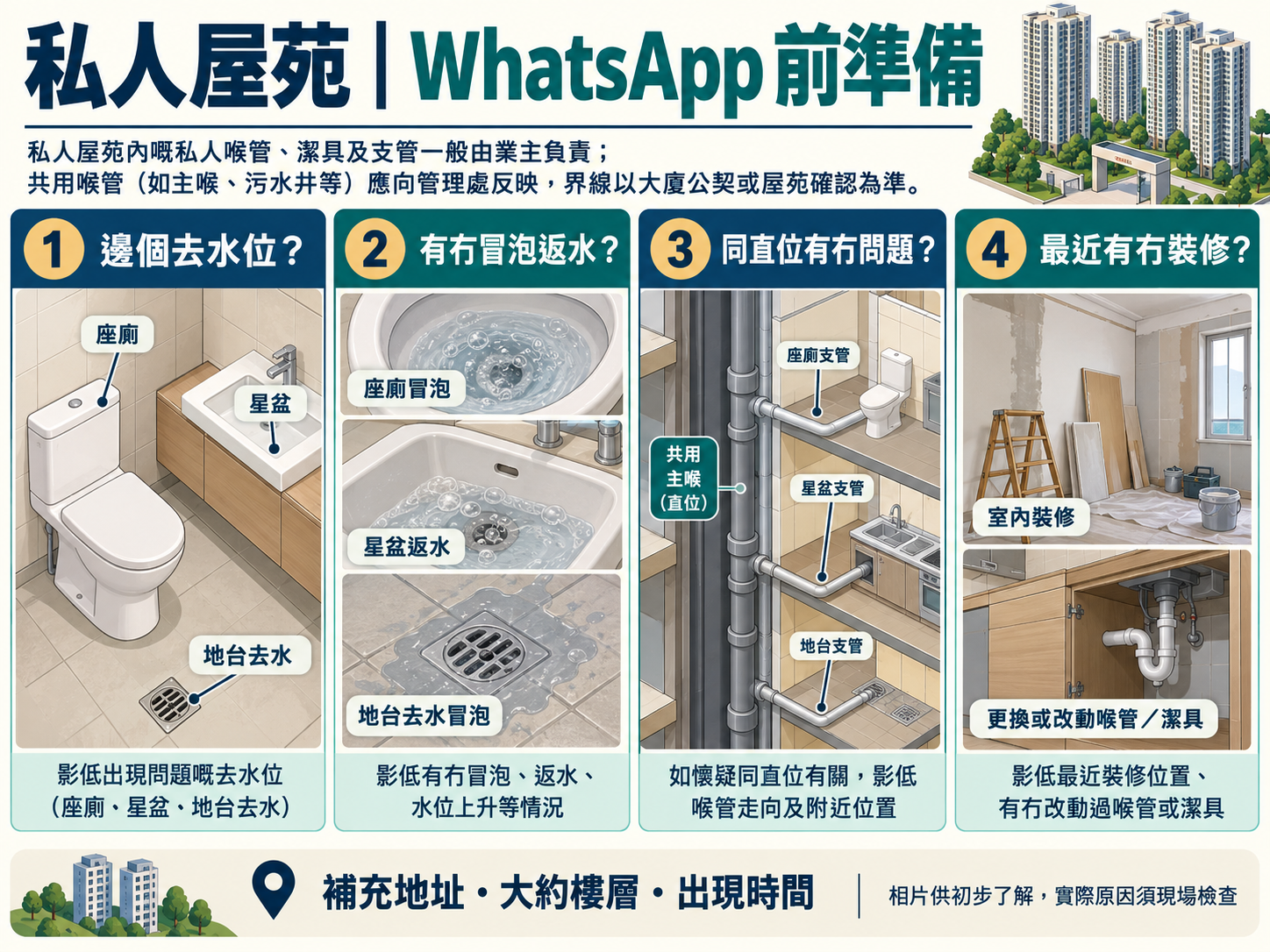
Photos or a short video on WhatsApp help us tell a single-fixture blockage from a shared-stack problem.
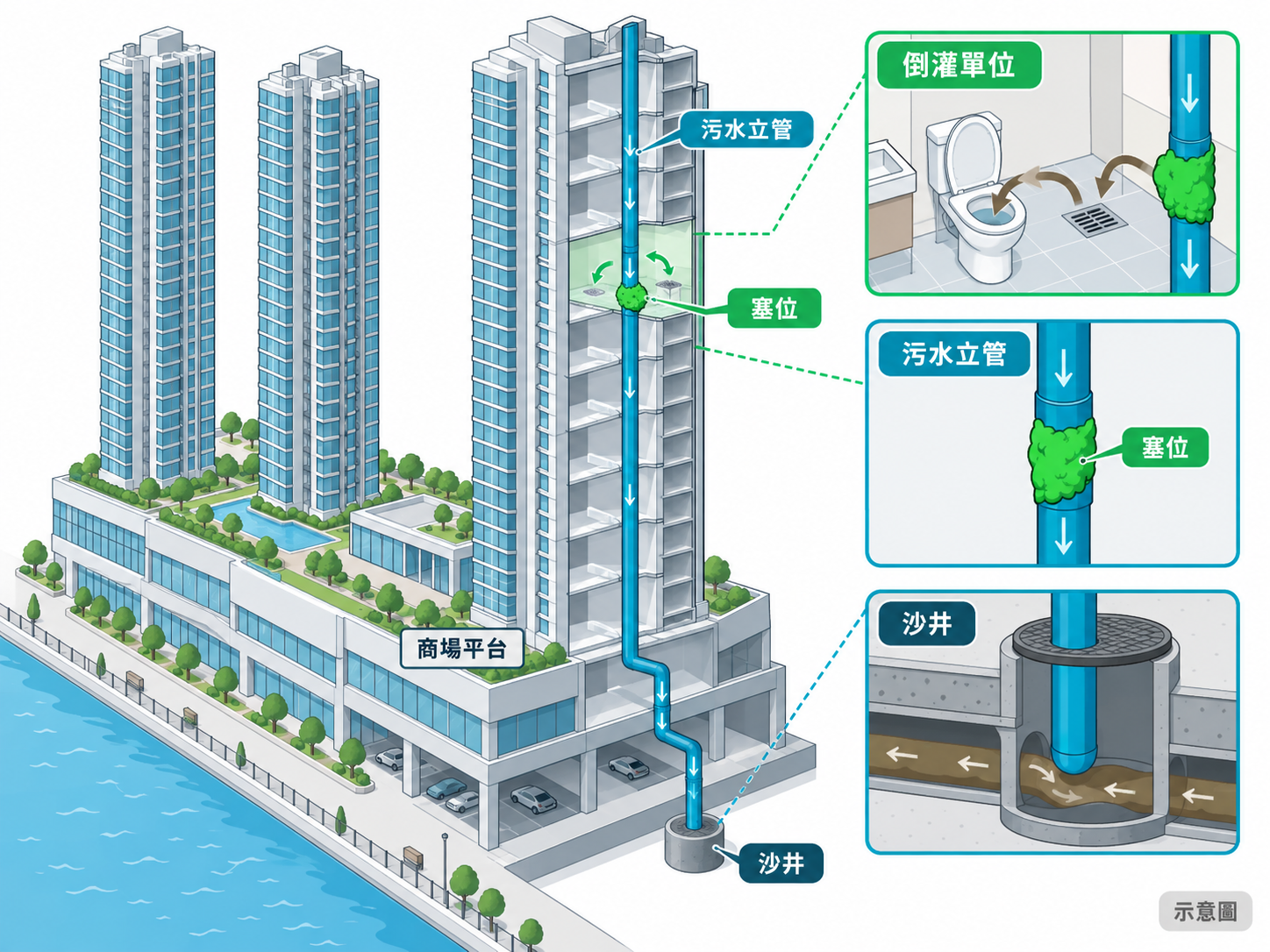
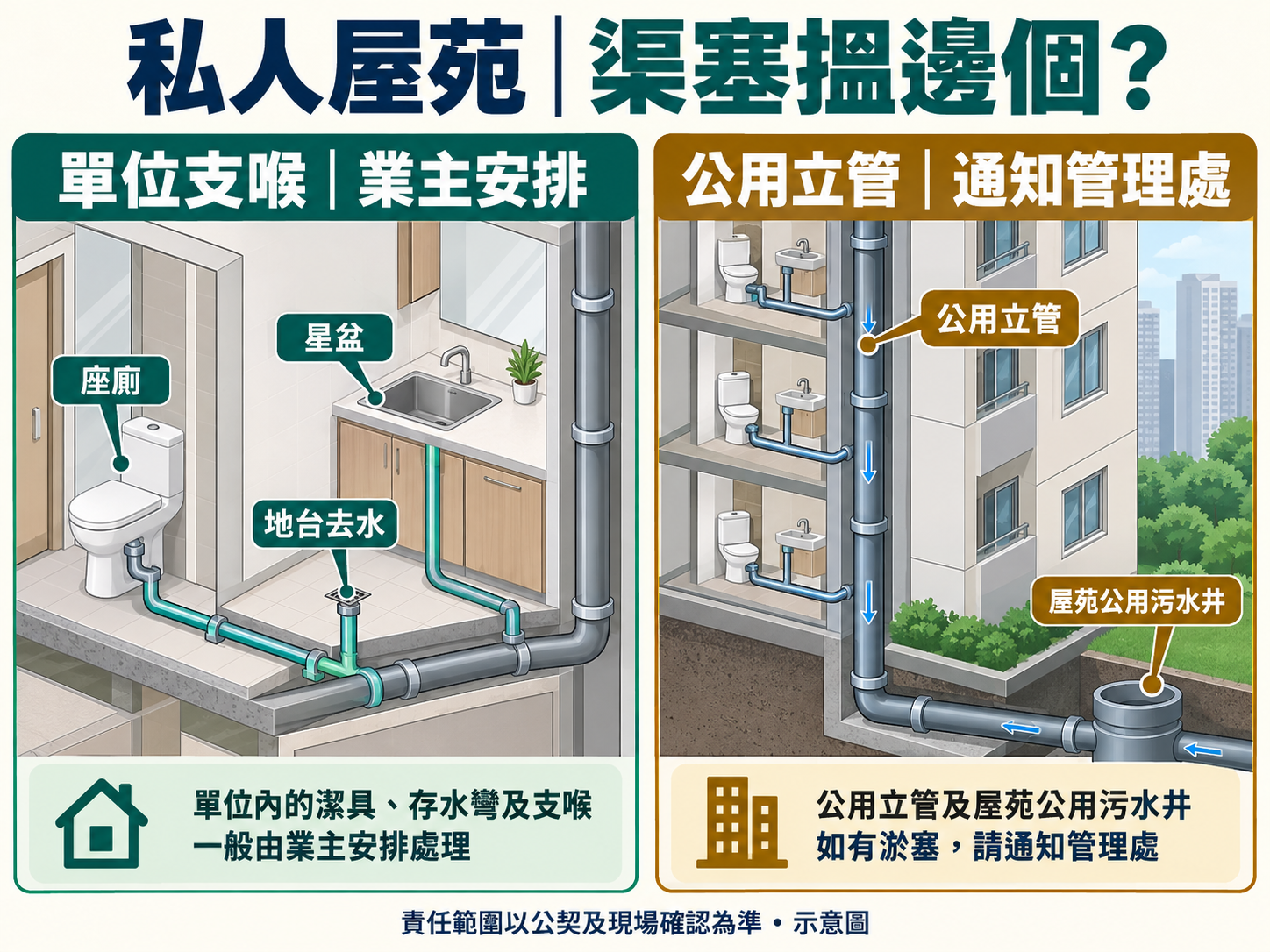
Ocean Pride stands at 100 Tai Ho Road, Tsuen Wan, part of the Tsuen Wan West (TW5) Bayside Development. Its nine residential towers sit on a shopping podium, the lowest residential floor is the 6/F platform, and its 2,406 flats were occupied in two phases in 2019. Drainage here behaves differently from an older estate: the pipes are new, but residential floors run from the 6/F platform up to between 50/F and 53/F on Wikipedia's lift schedules, and by design each soil stack has to pass through the podium structure before it reaches a manhole; as an inference from the estate's age, many flats will have been through an owner's fit-out and defect rectification since handover. When a toilet backs up, a flush drains slowly or a windowless bathroom smells, the first step is to work out whether the problem sits in the flat's branch pipe and trap or in the shared soil stack — that decides whether you book a call-out or tell the management office straight away.
Ocean Pride was developed by CK Asset with the MTR Corporation. Its nine towers sit on a platform beside Tsuen Wan West station: below the platform are a four-storey, 430,000 sq ft mall and a car park of about 1,800 spaces, while the clubhouse and residential lobbies are on the 6/F platform, reached by lift from the mall. Wikipedia, citing MTR's planning approved in 2011, records that the site could take nine residential towers of 50 to 51 storeys, and the lift schedules show residential floors running from 6/F up to between 50/F and 53/F. The drainage implication is straightforward: every soil stack has to travel from the top floors down through the podium structure before it reaches a manhole, and it cannot stay perfectly vertical the whole way.
By design, the longer a stack and the more changes of direction it has, the more readily debris settles at a bend or a narrowing. Buildings Department practice note APP-93 has long required that, except in buildings of three storeys or fewer, sanitary fitments on the floor level with the bottom of the soil stack must discharge through separate pipework straight to a manhole, so that a surcharged stack base does not back up into the lowest flats. At Ocean Pride the lowest residential floor is the 6/F platform, with the whole podium structure between it and the ground-level manholes. Separately, the Buildings Department's APP-164, first issued in April 2021, requires floor-drain traps to be refilled automatically by discharge from a basin, bath or shower; the practice note requires compliance from plans submitted for approval after 31 August 2021, and it applies equally to minor works begun after that same date — a new floor drain, a new offset in a stack, or a new pipe connection into a stack. As a general inference from the estate's age — it was occupied in 2019 — the floor drains installed here are conventional traps that evaporate dry if the outlet goes unused, so residents have to top them up.
The third distinctive feature is how the flats are used. They were handed over in 2019 with a basic fit-out and, as an inference from the estate's age, many will since have been through an owner's renovation, defect-rectification visits and re-letting. HK01 reported that the high-floor flats in Block 7 have open-plan kitchens and that their bathrooms, like those in many new developments, have no window — locally called a 「黑廁」. A windowless bathroom relies on its extract fan, so with the door closed and the fan running the room sits at slightly lower pressure and any weak water seal shows up as an immediate smell; an open-plan kitchen concentrates grease and food waste into a single branch pipe. None of this is a fault. It simply tells you where to look first.
Note: statements based on building age and type are general inferences, not findings for any particular flat.
A clear process from enquiry and assessment to an agreed scope of work
Tell us the drain problem and district and ask about available timing.
Confirm timing based on the district and schedule, then inspect the blockage or odour issue.
Explain the proposed approach, scope and price before agreed work begins.
Use suitable tools for the site conditions and agreed scope of work.
After the agreed work, test drainage and explain the observed result and any next steps.
PipeButler is an independent drain-service provider with no affiliation to the developer, owners' corporation, management company or Housing Department of the places above. Facts come from public sources checked on the dates shown; work on common drains or common parts follows the management office's and deed of mutual covenant's arrangements.
WhatsApp with the problem and district, and we will confirm available timing.