
Loading page…
Loading page…
Tai Wai · Private estate
Over the MTR depot · 12 towers of about 46–54 storeys · occupied in three phases from 2011
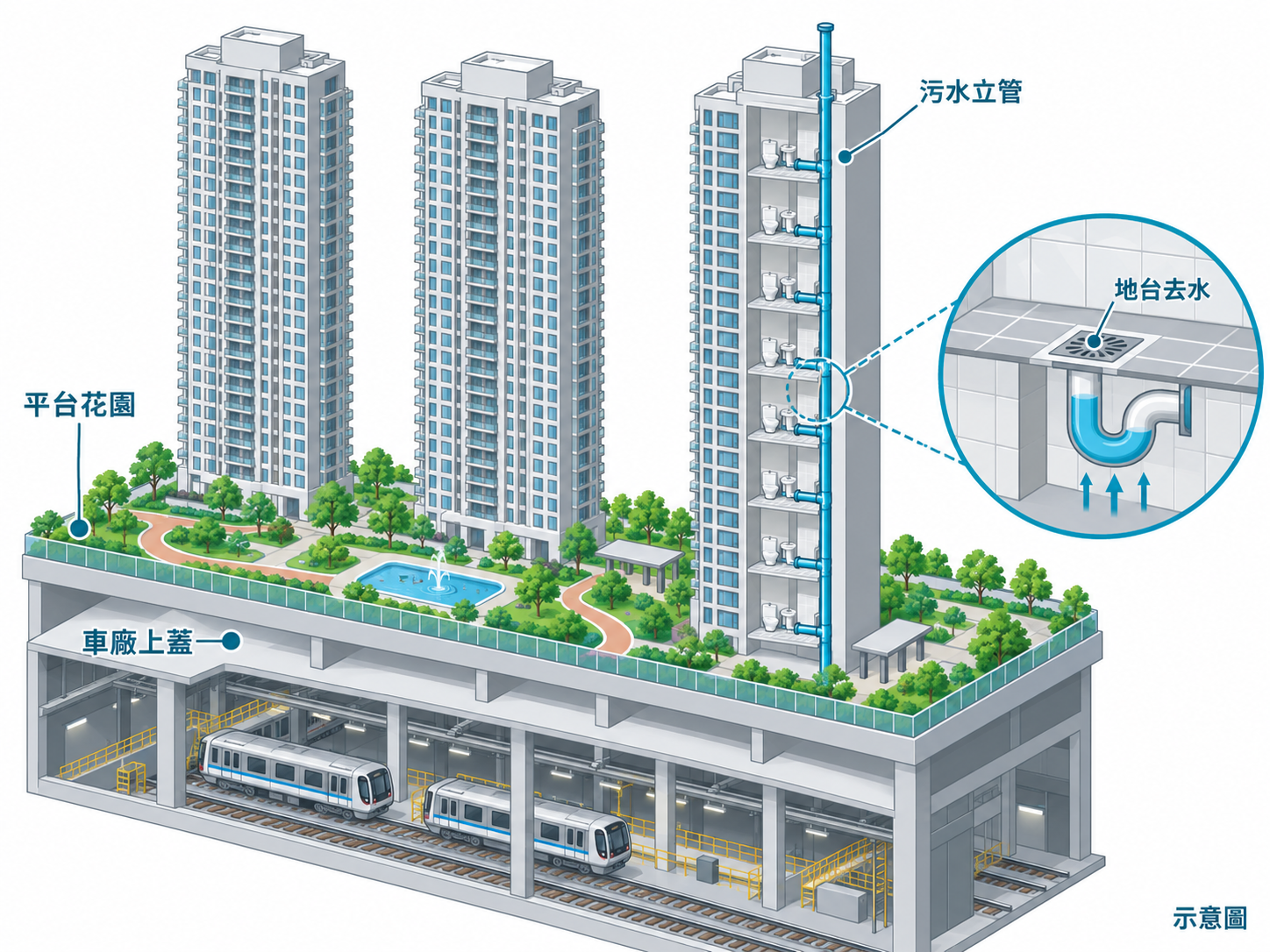
Festival City stands at 1 Mei Tin Road, Tai Wai, on top of the MTR Tai Wai depot: 12 towers of roughly 46 to 54 storeys, occupied in three phases from 2011.
Last reviewed ·
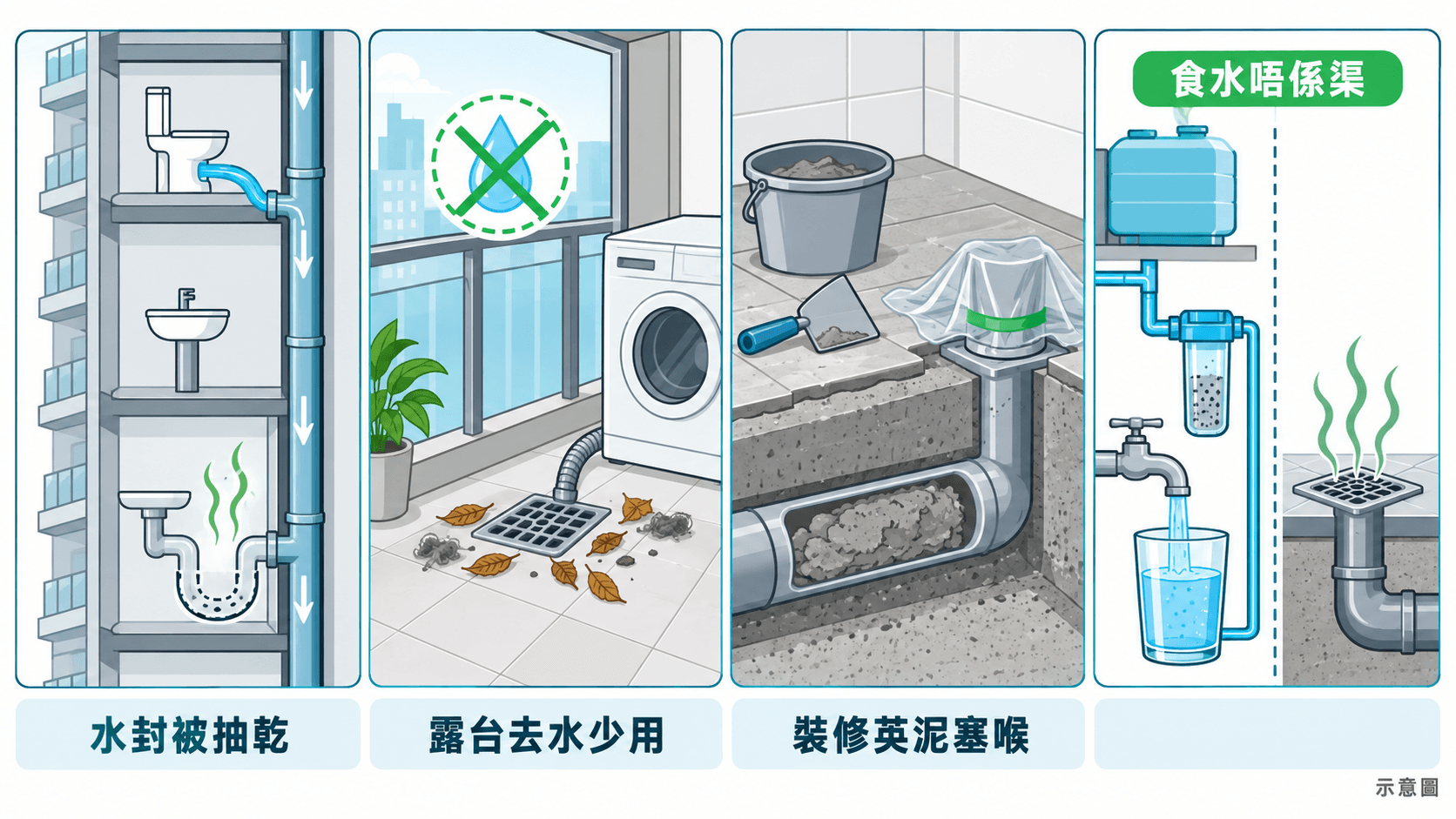
Choose the problem you are seeing to read the likely cause and next step.
The Buildings Department explains that when an upper flat discharges enough water, siphonage creates negative pressure in the branch pipes of flats below — enough to suck out the water seal in a trap. The anti-syphonage pipe has to stay unsealed and extend more than a metre above the roof for the pressure to balance. Festival City's towers run to roughly 46 to 54 storeys, so, inferring from the design, each stack serves more floors than in an ordinary estate and the pressure swings when several floors discharge at once are correspondingly sharper. If you hear a gurgle at the floor drain or basin, see the toilet water level dip and rise slightly, and then start smelling drains a day or two later, the water seal has most likely been pulled out or the venting is not keeping up — the pipe is not actually blocked. Clearing tools will not help; the trap type, seal depth and venting need checking.
The Buildings Department's practice note ADV-24 states that the water in a trap may dry up through evaporation unless it is replenished. The department's drainage-health pages add that once the seal is gone it no longer holds back sewer gas, and advise pouring about half a litre of clean water into each floor drain at least once a week — the same figure its pipe-maintenance leaflet gives. Flats here generally have a balcony and a utility platform, and three- and four-bedroom units usually have two or more bathrooms, so, inferring from the design, the balcony outlet, the utility-platform outlet and the guest bathroom's floor drain are the ones that see the least water — especially over a long holiday or between tenancies. The washing machine normally stands on the utility platform with its hose pushed straight into the outlet, so lint and detergent scum build up in the bend; once the outlet slows, water surges back out as soon as the machine drains.
The garden podium covers 430,000 sq ft with a jogging trail, water features and planters, and both schools sit on the same deck. Inferring from the design, once leaves, silt or planter soil cover the podium's rainwater inlets and planter drains, water stands on the podium during heavy rain — which is a separate system from the foul drainage inside your flat. The podium's rainwater inlets, planter drains and connections are not among the spots the government inspects routinely, so the clearing is arranged by the estate itself and how quickly leaves, silt and planter soil build up comes down to the management office's own cycle. If you see water standing on the podium, an inlet covered in debris, or a sewage smell coming from a spot on the deck, telling the management office is the quickest route; the toilet, floor drains and sink inside your flat are checked separately. As for the Shing Mun River, HK01 reported after the record black rainstorm of 7–8 September 2023 that the stretch of river bed off Mei Tin Estate and Mei Lam Estate was left "riddled with holes, covered in mud, stones and huge debris". The river and the stormwater system are a district-level matter and are not connected to the foul pipes in your flat; what a resident can actually do is check the outlets on their own balcony, the podium and the planters before and after heavy rain.
Flats occupied in 2011 and 2012 are now about 14 to 16 years old; inferring from that age, many are reaching their first substantial refit. The Buildings Department's guidelines on maintaining and repairing drainage systems and sanitary fitments separate two cases: an ordinary blockage can usually be cleared with a high-pressure jet or a rodding machine, but once material such as cement has set inside the pipe, that section generally has to be opened up and replaced. Inferring from the design of the period, the bathroom's horizontal pipes run in a sunken slab, and APP-93 warns that the void must not be backfilled with concrete or similar material; where that is unavoidable, enough access points must be provided to inspect the pipework and clear blockages, and owners should know the floor finish may need opening up for repairs. So sealing every outlet with plastic during the works, then running water into each one before handover to check the flow and for any smell, is the step that pays for itself many times over. Altering a trap, an anti-syphonage pipe or a drain position is minor works and must be carried out by a registered minor works contractor.
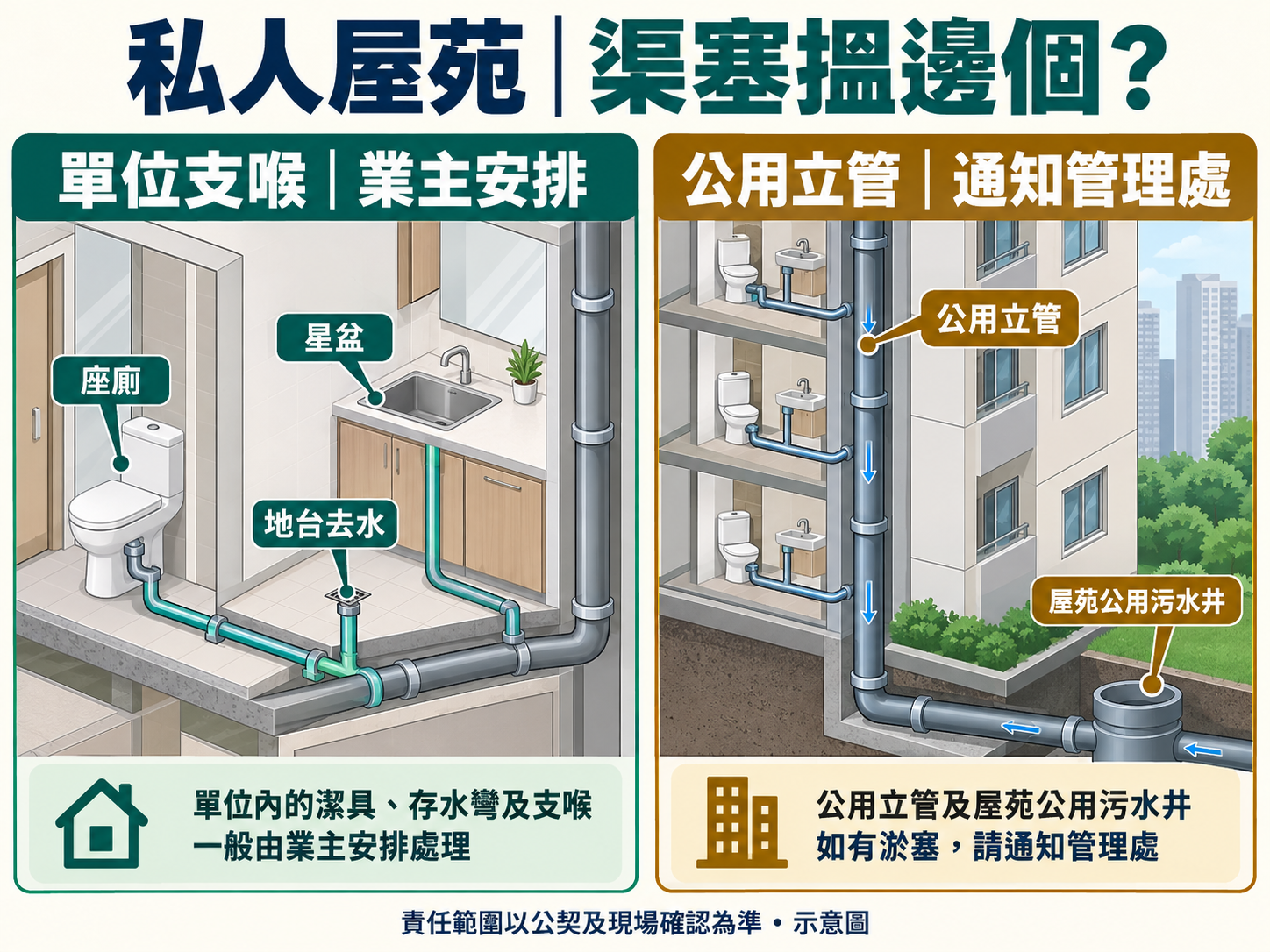
Wikipedia records that in late November 2016 residents found dark sediment in their tap water and that sediment also clogged the filters of Towngas water heaters. The MTR Corporation said at the time that it followed the restoration of supply after water-main works near Tai Wai stirred up deposits; about 400 households sought help from 1 December, the estate's customer service office arranged for contractors to clean each block's fresh-water tanks and strengthen the filtration on the supply system, and Towngas received about 1,000 requests, confirming after inspection that the heaters' filters had caught the sediment and that their function was unaffected. All of this belongs to the fresh-water supply system, not the drains. The Water Supplies Department states that the registered consumer is responsible for maintaining the internal plumbing that serves only their own building or flat and should employ a licensed plumber, while the estate's fresh-water tanks are cleaned by arrangement of the management office. So discoloured water, particles or a clogged heater filter is a job for a plumber and the management office; drain odour, slow draining and bubbling outlets are the drainage side.
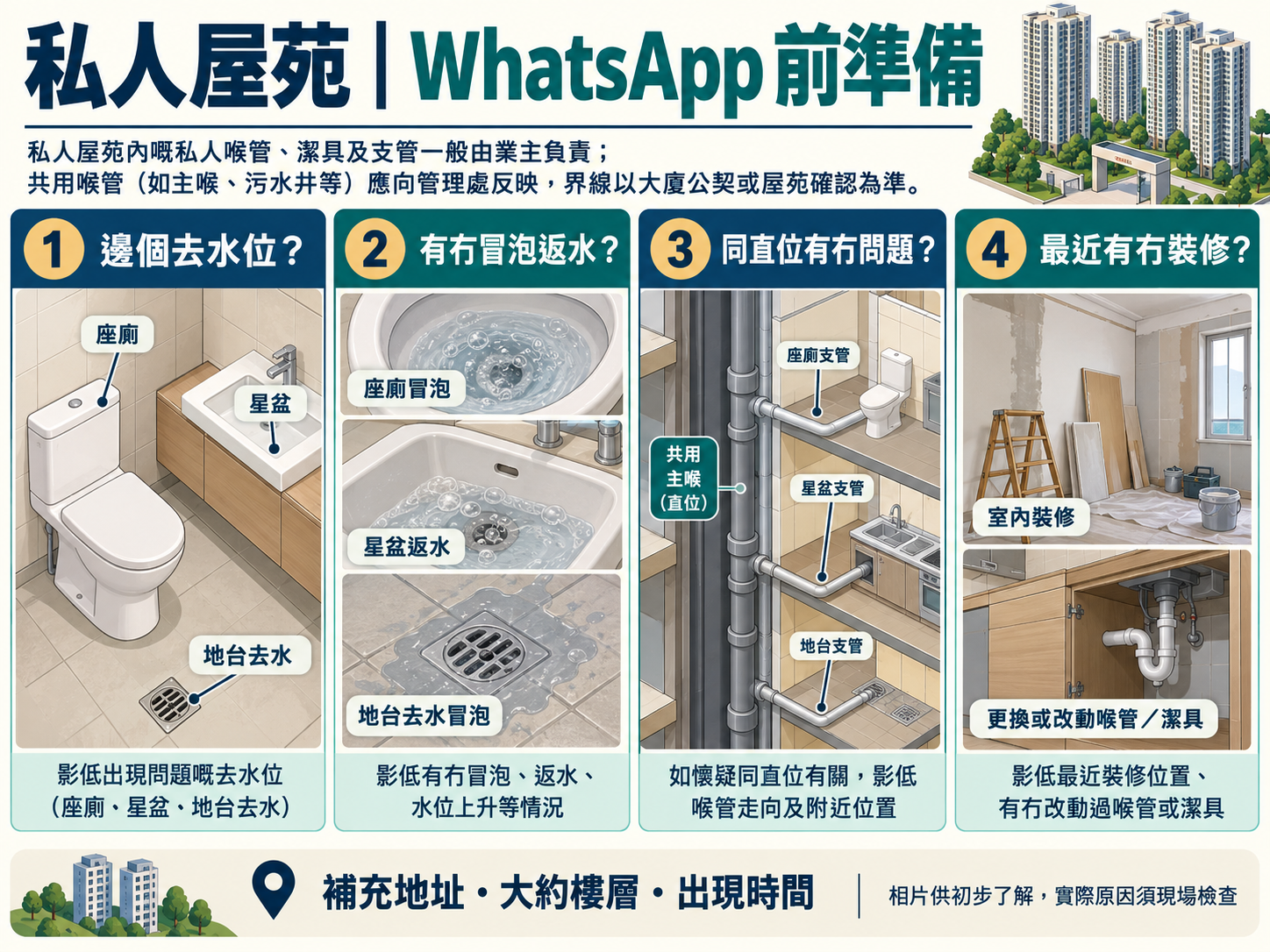
Photos or a short video on WhatsApp help us tell a single-fixture blockage from a shared-stack problem.
Festival City stands at 1 Mei Tin Road, Tai Wai, on top of the MTR Tai Wai depot: 12 towers of roughly 46 to 54 storeys, occupied in three phases from 2011. Drainage here behaves differently from an older neighbourhood block. The pipes themselves are still young, so the usual complaints come from pressure swings in very long stacks pulling water seals out, from rarely used outlets on balconies and utility platforms drying up, and from what the first round of major renovations leaves behind. One more thing worth stating plainly: the one publicly documented water incident here since occupation began in 2011, the 2016 sediment episode, was a fresh-water supply matter and had nothing to do with the drains. It is dealt with separately below.
The site was previously a public cycling park to the north and the Hong Kong School of Motoring to the south. Wikipedia records that KCRC invited expressions of interest in November 2005 and tendered the following year, with Cheung Kong winning the joint development, and that the development rights passed to the MTR Corporation after the rail merger; work started in July 2007. The English Wikipedia list of private estates in Sha Tin District dates completion to September 2010 for Phase I, October 2011 for Phase II and August 2012 for Phase III. The 12 towers rise roughly 46 to 54 storeys, about 170 to 180 metres, with 4,264 flats in total, all three- and four-bedroom units, occupied in phases from 2011. For drainage the number to remember is not the price per square foot but the height: the more floors a single soil stack serves, the sharper the pressure swings it puts on the branch pipes below when the upper floors discharge.
The flat design matters just as much. All three phases use a three-lift, four-flat layout in which four flats on a floor share one lift lobby, with standard flats of about 900 to 1,400 sq ft and top-floor duplexes of roughly 2,000 to 2,400 sq ft. Phase I material states that every flat has a balcony, and the case the Development Bureau cited at the time listed a 1,030 sq ft (gross) flat as including a 22 sq ft balcony and a 16 sq ft utility platform. Inferring from how large flats of this period were designed, one unit usually has two or more bathrooms, a kitchen sink, a washing-machine point, a balcony outlet and a utility-platform outlet — more than twice the number of drainage points of a small flat — and the outlet that sees the least water is the one that gives trouble first. Inferring again from the design of the period, the horizontal pipes serving bathrooms and kitchens are usually concealed in a sunken slab; the Buildings Department's practice note APP-93 expressly warns owners that the floor finish over a sunken slab may have to be opened up and reinstated for future pipe repairs.
The other distinctive thing here is that the whole community sits on a podium. The 12 towers and two Millennium-design schools were built together on a fifth-floor podium about 19 m above ground, with roughly 2,000 pupils and staff between the two schools; the garden podium covers 430,000 sq ft with a 1,200 m jogging trail and lake-style water features, and the Phase III base houses the Tai Wai social services building. By design, foul water and rainwater from the towers must travel down through the podium structure before joining the public sewers and drains under the road, so the podium's rainwater inlets, planter drains and connections fall within the estate's own day-to-day maintenance. The Drainage Services Department's published list of locations prone to blockage (file version 26.8.26, checked 19 September 2026) names 11 spots in Sha Tin District — the Tsang Tai Uk storage pond intake, the Sha Tin Tau Village channel, intakes and roadside points at villages such as Tin Liu and Ha Wo Che, and three points around Fo Tan — and none of them is on Mei Tin Road. In other words, this is not a stretch the government watches routinely, and the outlets on the podium and in the estate depend largely on the management office's own upkeep.
Note: statements based on building age and type are general inferences, not findings for any particular flat.
A clear process from enquiry and assessment to an agreed scope of work
Tell us the drain problem and district and ask about available timing.
Confirm timing based on the district and schedule, then inspect the blockage or odour issue.
Explain the proposed approach, scope and price before agreed work begins.
Use suitable tools for the site conditions and agreed scope of work.
After the agreed work, test drainage and explain the observed result and any next steps.
PipeButler is an independent drain-service provider with no affiliation to the developer, owners' corporation, management company or Housing Department of the places above. Facts come from public sources checked on the dates shown; work on common drains or common parts follows the management office's and deed of mutual covenant's arrangements.
WhatsApp with the problem and district, and we will confirm available timing.